

Bario was in a saucer plain with soft, blue-grey mountains ringing the rim. Water buffalos trudged along the dirt track past the control tower dragging battered sled-like affairs filled with large rock chips. There were no cars, jeeps, vans or trucks whatsoever but there were a few trail bikes parked outside the terminal.

The Bario Lodging House was a two minute walk from the airstrip. Hot black tea appeared and everyone there looked askance at his T-shirt and shorts and hoped that he had warmer clothes for the night. What did they know that he didn’t, he wondered?
Time to celebrate in Bario and off he went to find the local hotspots. The local shop sold ropes, machine bits, carved parangs, and warm Coca-Cola and that’s what he had. Back to the lodging house, and exhausted by the excesses of the previous night, he slept until dark.
Dinner time and he finally met his guide, Noah. He was short and stocky with a broad grin and legs the same size as the average person’s waist. He was not a Kelabit but came from a village lower down the Baram river, called Long Terawan. A few beers (it was getting distinctly chilly now and he had changed to jeans and socks) cooled in a bucket of river water while they discussed the trip. Everyone said that walking from Bario to Long Dano should take only six hours, but their legs were quite different to his, and he was skeptical of their idea of time and distance. People drifted in and out of the covered-in verandah and began to huddle round the flaring methylated spirits lamp in a desperate effort to maintain body heat. He got up and put on all his clothes and then stuck his stockinged feet inside his backpack.
Chris, wearing an African safari-style jacket with outsize pockets bulging with camera equipment, was in marketing and wanted to explore the area so that he could bring “top-end executives” out there. His preliminary market analysis indicated that people who had no knowledge about the area had no interest in it either. It sounded a bit like saying child birth was hereditary; if your parents didn’t have any children, then the chances are that you won’t have any either! Chris’ task then, back in London, would be to educate his clients with books and videos before they came out here.
Alan, a middle-aged tea planter from Selangor in Peninsula Malaysia, was lumbered down with his teenage son, a vcr and a tape recorder, not to mention his two still cameras (one for vistas, and one for snaps!). He said he was there to capture the spirit of the people before they vanished completely under the approaching industrial wave. Alan loved the walks because there was so much to see, and to prove his point, he showed him two porcupine quills, 3 woodpecker feathers and a dead beetle that he had collected. He said he didn’t drink but he finished off half a dozen beers, most of a bottle of whisky, explained that he wasn’t an argumentative chap and then related, for the next three hours how many quarrels he had had with famous people no-one had ever heard of. At the end of the evening, in exchange (for the whisky, or his patience?) Alan gave him a half empty tube of deep heat cream (“you’ll need that for your shoulders judging by the size of your pack,” he confided knowingly), a small camping cooker, a tube of insect repellent and a good few laughs.
A breakfast of cold baked beans, served daintily from the can, fried eggs, fresh pineapple and stale bread, the next morning, and it was nearly 9 before they finally left the guesthouse despite Noah having urged him to sleep the night before because of the proposed early start. Off he trudged across the airstrip, gaped at by a squad of soldiers drilling halfheartedly under the relaxed eye of their sergeant (the Indonesian border was only a few miles away). The track was wide and bumpy through the padi fields without any tree cover or shade. He strode jauntily along, his new backpack snug and comfortable on his shoulders, glancing at his watch as sweat dripped into his eyes, and my God, he’d only been walking for 20 minutes. Andrew, a swarthy young giant, joined then further on and Noah explained he carried all the food, in an uncomfortable looking backpack made of woven bamboo and rattan.
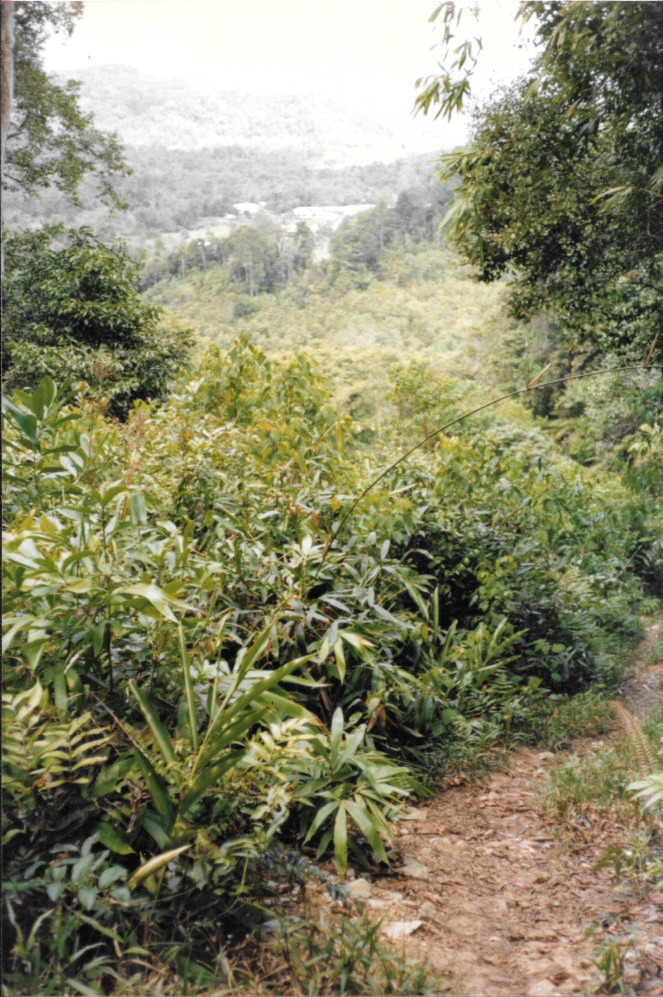
Into the jungle – and shade – finally and then the hills begin. From then on, a blistering, exhausting slog up hill and down dale, tripping and stumbling over tree roots and rocks. Noah cheerfully tells him that he’s lucky it is so dry as he teetered over notched logs and bamboo suspension bridges.
“Aha,” Noah said. “These are the bridges I told you about, they are made without any nails whatsoever”.

That’s just what he needed to know as he swayed and lurched perilously across, hoping the rotten looking bamboos would hold his weight. If only his bloody backpack wasn’t so heavy.
Another break and he stoped for a lengthy swig from the water bottle. Small bees buzzed and crawled all over him, greedily drinking the protein rich sweat that poured off his flabby, exhausted body. At the four hour mark they stopped for lunch. Stale chocolate wafers biscuits, compacted packets of cooked sticky, white rice wrapped up in leaves, a tin of chicken curry, a tin of pineapple chunks and a tin of sardines.
“How much further, Noah” he begged, but Noah just grinned enigmatically and strode on down the trail. He still felt ok, almost, but by late afternoon the strain was beginning to tell on the legs. Seven hours into the walk and he’s tired. Eight and three quarter hours later, they finally arrived at the Long Dano Long House, sidestepping clumsily through the outsize buffalo plops.

It was a sprawling cluster of, from the outside, crude wooden hovels. The main building looked quite new and was about 200 feet long, raised about 5 feet off the ground on stout wooden posts set in a concrete base. Surprisingly (for him, anyway), the building had glass louvred windows. Staggering up a roughly hewn log, he entered the main area which consisted of two parallel buildings connected by covered wooden bridges. One of the long buildings contained a fireplace for each family – about 20 families lived there – with a food storage area directly behind the fire. Above each cooking fire, on a rack, neat stacks of split logs are piled. The plank floor in front of the fire was covered in cheap linoleum, on which, as he went to sit down, was quickly covered with a finely woven reed mat. The other parallel building contained sleeping quarters and extra storage space.
Exhausted, he slumped down on the floor, propped up on his bag. People clustered around him curiously, bold, dirty hands reaching out to touch the hair on his arms. Noah busied himself around the fire, preparing tea. A smiling lady with filthy feet, grubby hands and incredibly distended earlobes which swung pendulously under her chin, offered him bananas and some other fruit that he had never seen before. It was called tarap, he learned, and was a tight cluster of white globules of sweet jelly around a hard stone, the whole lot covered in a thick, green rubbery skin.

People kept on coming up to introduce themselves and everyone had to shake hands with him. What with the deferential treatment, the present of fruit and all this hand shaking, he began to feel that he was special and that he really had accomplished something unique by making a six hour jungle walk spin out to almost nine hours!
The hot tea, tasting vaguely smokey from the wood fire, revived him and he began to sit up and take notice. The long house seemed quite prosperous although there were very few people around and he was told that all the children attended a local government school some distance away. They stayed in the school hostel there, coming home only at weekends.
Culture shocked and cold, he stayed where he had collapsed, and decided to dispense with washing for the moment. After the initial bout of curiosity and hand shaking, he was left pretty much alone, except for two little girls who couldn’t seem to decide to be frightened or fascinated by him. Rolling over on his side, he rummaged in his backpack and pulled out a few balloons he had brought along as presents. Soon he had a captive audience of about 15 people of assorted ages. Not content with just blowing up and then releasing the balloons, he had set himself up with a squawk band, teasing the most horrendous noises out of the balloons by stretching the necks of the balloons. Balloon blowing with just one breath competitions followed next until he began to feel dizzy and decided that that was it. Dry long house or not, he felt that it was time he had a little nip, so handing out the rest of the balloons, he retired to a corner and covertly swigged from one of the bottles of whiskey he had lugged all that way!
Dinner was a weird mix of tinned corned beef, raspberry jam, cream crackers, buckets of white rice, various dishes of totally unrecognisable vegetables, fruit and various bits and pieces that other families contributed to the communal feast. He had known in advance that the Kelabit people in this area were avid Evangelical Christians who had been converted after the war, and who now abhorred alcohol, tobacco and all good things of life which normal people like himself and the Ibans enjoyed, but he had been secretly hoping to find some old gaffer who had a secret store of their once fabled Tuak, or rice wine. No such luck, however, and exhausted, as much from the strains of withdrawal as from the day’s walking, he slept where he dined, as close to the fire as possible!
- With apologies to Eric Newby for copying part of his title – A Short Walk in the Hindu Kush (1958)

 Red Branch Chronicles