

Sitting around the following morning in the almost deserted longhouse but for the old women who remained by the fire while all the younger people were out at work in their fields, he decided to go out for a walk down by the river and he waded around, looking for fish. The river was broad with a flat, stony beach, and seemed crystal clear. It was also icy cold as he soon discovered. Shallow at the little beach, the river widened out upstream, and beyond a natural breakwater of slippy rocks, the river became suddenly deeper and much more turbulent. Farther upriver, a delicate suspension bridge of interlaced bamboos, hanging from ropes of twisted rattan, spanned the river.

He wandered off along the bank of the river towards the bridge. From close up, the bridge looked most unstable, as many of the support bamboos looked rotten and the rattan ropes were frayed and broken in some places. Commonsense told him that it must be okay, however, as the longhouse people obviously used it, but nevertheless, he decided to go across one foot at a time.

Halfway across, he stopped and gingerly turned around to take a photo only to see one of the kids from the longhouse wildly swinging on one of the supports, doing his best to make the bridge sway and buck violently underneath him. He gave such a bellow of fear and rage that not only did it stop the kid dead in his tracks but it also disturbed three large river birds from the undergrowth further upriver which flapped cumbersomely away from the bank and laboured up for height.
Safely across, he followed a winding path through some wet padi fields, hoping to see some snakes with which the fields were meant to be infested. No such luck, so he turned back and scampered across the bridge back to the longhouse.
He decided to leave Pa Da’ih at 2:00 and head back to Long Dano. Joseph and Andrew decided to go on ahead and meet him at the river where they hoped to spear catch some fish for their dinner that night.
No sooner had he started to walk, making excellent time to the river. There was no sign of Joseph or Andrew, but he decided to stop a while anyway. While Noah broke out his seemingly inexhaustible supply of stale chocolate wafers, he took off his shoes, socks and shirt and waded out to a flat rock in the middle of the river. Lying down on the rock, he gingerly stuck his steaming hot, sweaty head in the river and had his breath taken away by its swirling coldness.
Just outside of Long Dano, a skinny, miserable looking man wearing filthy, torn track suit bottoms, a faded T-shirt and flipflops that were several sizes too big for him, hailed him. His name was Mutang, and he was going off to pick some fruit, he said. Curious, he went off with Mutang to his fruit trees. These turned out to be a small clump of high, spindly trees absolutely laden with tarap fruit. Using a long bamboo pole, Mutang prodded at the fruits, looking for the ripest one, and then with a quick twist of his wrist, he brought half a dozen of the fruits, each about the size of a coconut without its husk, tumbling down about their heads.
They lay on the short, prickly grass, and gorged ourselves on the sticky fruit while Mutang told them the local news. The Minister of Development was expected in Bario on a flying visit (elections were coming up in Malaysia) and almost all the people from the surrounding longhouses had already left for Bario or were preparing to go in the following day. Mutang also wanted to go in so that he could sell one of his water buffalos. He had a herd of twelve, and he reckoned he could get about $1600 for a young heifer in Bario. It was just a question of driving the beast there. Remembering that it had taken him nine hours to complete the trip he was ready to sympathise with Mutang until he said that he could probably do it in six hours or so!
Thanking him for the fruit, he belched his way back to Long Dano and gratefully slid out of his pack as soon as he was inside the dark, smoky main hall. Joseph and Andrew suddenly appeared with an enormous fresh water fish which must have weighed at least three and a half kilos. Each kilo would fetch $40 down on the coast, they assured us, as this type of fish can only live in clear water. The scales were enormous, each one about the size of of an old fashioned American dollar, and the light flashed off them giving the fish an irridescent blue, green and purple colour.
Sprawled on the floor, sipping hot tea from a chipped cup, he felt as if he had come home again. It was a bizarre feeling, especially as only a short time ago he had felt that Long Dano was a “crude wooden hovel”. Familiarity, in this context, did not breed contempt, but pleasure at not having to walk any more.
Dinner, augumented by the fish, which they had fried as well as boiled in a watery sauce, was quite a feast, especially as Noah, lightening his load for the long walk tomorrow, opened up the last of the tins of beef curry in addition to two tins of stuffed spring rolls that he had kept hidden until then.
A rasping noise at the next hearth drew his attention and he wandered over to see what was happening. An old man, his pierced ear lobes down to his shoulders, a faded T-Shirt with the slogan “Levi’s Last Longer” covering his scrawny body, was meticulously sharpening his parang on a dry whetting stone. After every few rasp along the stone, he would stop and examine the lie of the blade carefully by the light of the flickering, home-made oil lamp on the mat beside him. The parang blade was two feet of bluey-black, slightly curved steel, topped by a worn bone handle carved into an abstract birdhead. The blade was connected to the handle by a two inch band of tightly and finely woven rattan string, the whole lot sealed at the base of the join by a blob of black tree resin. The sheath, lying on the mat was made up of two flat slabs of wood, tightly bound together by further strips of rattan. On the underside of the sheath, was a tacky looking plastic mini-sheath, attached to the original wooden one with loops of woven fishing line. This subsidiary sheath held a short round haft which ended in a three inch, slightly backward curving blade. The steel shone in the dim lamp light, burnished as it was by the steady, methodical strokes the old man was applying to it on the whetting stone. As it happened, he needed a good knife, not a trashy, touristy-style knife, adorned with beads and imitation tufts of hair, but a real, “working” knife. As soon as he held the knife in his hand, he knew that this was the knife he wanted. Calling Noah over to help, he entered into what turned out to be an hour of bargaining which turned out to be a good thing, as Noah later told him that if he had made a flat offer for the parang, the old man would have refused to sell it. By bargaining, however, he had shown that he had valued the knife for its own sake and this was what had convinced the old man to sell it to him, which he eventually did, without any apparent regret for thirty Malaysian dollars, a packet of cigarettes and 35 fish hooks of assorted sizes. To seal the bargain, and because he was so pleased, he threw in a ball point pen.
The whole business had attracted quite an audience and he produced his camera and began blasting away. He often found this type of close-up photography awkward and embarrassing, and wanted nothing to do with it but, to his surprise, the longhouse people delighted in it. Posed shots were the order of the day, and the more he was willing to take portraits, the more willing they became to be subjects.
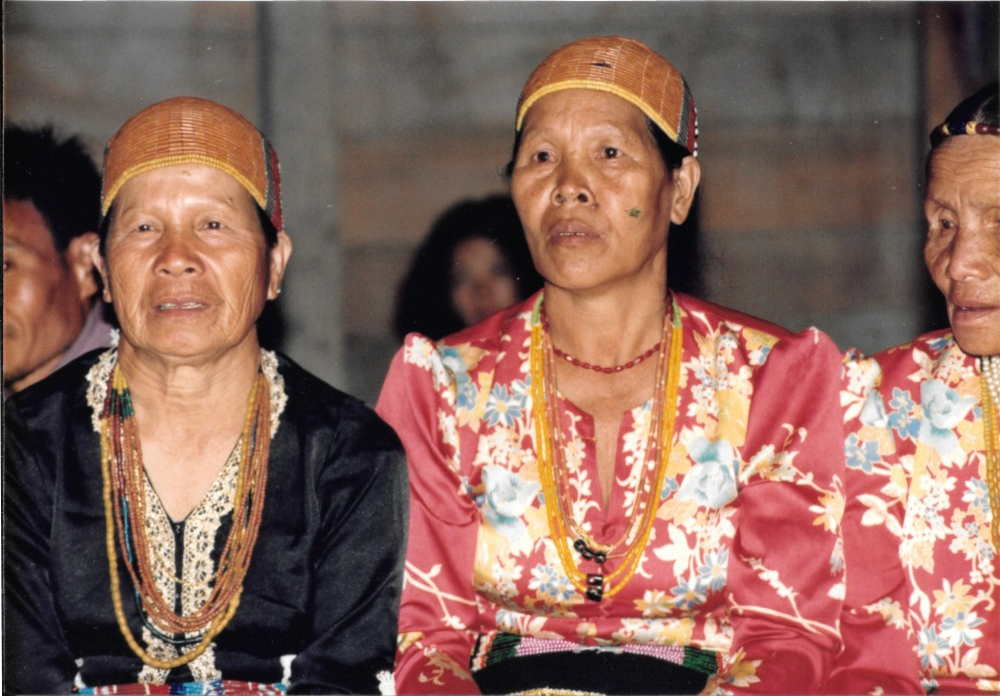
Old women rummaged like pack rats in dark nooks and caches and produced beautiful, ornate skull caps of finely woven beads which Noah told him were their family heirlooms. Some of the caps consisted of up to 10,000 small glass beads and weighed almost eight kilos! Only when he had exhausted his roll of film, and his face felt as if it were about to fall off his cheek bones from extended and extensive smiling, was he able to retire for the night.

By 7:30 the next morning, he was packed and ready for the trail. He said goodbye, smiled and shook hands with the remaining old people – everybody else had already made an early start for Bario and the forth-coming ministerial visit. Outside the long house, away from the warmth of the smokey fire, the air felt damp and cold while the whole valley was swathed in a thick mist. Striding along, feeling fresh and strong (he had only been walking for 5 minutes) he suddenly emerged out of a patch of mist and found myself face to face with an enormous, mud splattered water buffalo. He don’t know who was more amazed at the encounter, but one brief glance at the enormous spread of wickedly tapering horn curling back over the vast bulge of muscle across the shoulders and the cavernous, wet, flared nostrils was enough for him. One hoarse bellow escaped him before he did a complete turnabout and was charging back down the trail, while, judging by the heavy rumble of hooves, the buffalo (and his friends, it sounded like) was charging – thankfully – away in the other direction.
By 9:00 the mist had completely lifted, and what with the shade under the tree top canopy and the initial coolness of the morning, the day remained fresh and he made excellent time, feeling healthy, fit and strong and he tried working it out in terms of hours / miles walked, or was it the early nights, or the complete withdrawal from beer, or might it not be the heavy reliance on rice, or even the total lack of steroid filled meat. Whatever it was, anyway, had the most amazing effect on his normally taciturn communiques with Nature which had often been sullen, unrewarding and unco-operative in the past. For the past few days however, perhaps because of the position and strain imposed on the feeble citadel of the body by virtue of the squat toilet, which brought hitherto unknown muscles into play, he had felt the exact reverse of the depressed person who feels that the bottom has dropped out of his world.
When he stopped for lunch, Noah immediately produced another cellophane packet of his stale chocolate wafers, and he broke out more of his stock of muesli bars. Suddenly there was an eerie creaking noise a little bit away to their left. Noah and the other guides were on their feet in a split second and man-handled him off the trail and into the jungle on the right hand side. No sooner had they done so when, with an appalling crashing and tearing noise, a huge tree fell, bringing down with it an assortment of smaller trees, vines, and branches. Once the initial crashing noise was over a stillness fell on the forest and it was a while before the bugs and insects regained sufficient composure to pick up their tweeting, squeaking, croaking and rustling.
Noah and the others treated the whole event as just one of those things that happen in the jungle but he couldn’t for the life of him see why a tree of such size should topple like that when there was no storm or wind.
It was the hottest part of the day now and although he had made good time, they still had a long way to go before arriving back at Bario. To make matters worse, he was beginning to run low on water as he had swilled it down earlier on in the day. The jungle began to thin out shortly afterwards, and this compounded the problem as they lost the jungle canopy shade and were walking in the full blast of the sun through dull, uninteresting, baked countryside. He had his heart set on arriving back in Bario guest house and having a cold beer by 3:00pm but it was 2:55 before they broke out of the flat scrubland and looked across the padi fields at Bario itself.

Walking across the rough turf of the airstrip, Bario had a strangely deserted look. He somehow felt that there would be people to greet him and to marvel at the fact that he had survived the walk and returned to tell the tale. Instead, there was nothing and nobody. Even the little all-purpose grocery store at the edge of the airstrip was locked up and deserted. One or two loafers were lounging lazily on the verandah of the Guest house and they said that everyone had gone up the valley to the headman’s house to meet the visiting Minister of Development.
Noah slipped out of his pack and disappeared into a lean-to shanty attached to the guest house to make tea. He flopped wearily onto the hard chairs. Noah wandered out a few minutes later with a plate of ripe pineapple slices in one hand and a can of Heineken in the other. Following Noah back into the lean-to, he discovered that Joseph and Andrew had commandered a bucket of coldish river water in which half a dozen beers were cooling. Bliss at last, he thought, revising the feeling that the end of the walk was just going to be another anti-climax.
While they were on their fourth beer, he heard a familiar voice outside on the verandah and a moment later Chris, still wearing his African Safari jacket, wandered in. Bemoaning the fact that the zip-on long legs to his khaki shorts had just been washed and that he had nothing to wear to the Ministerial party, he filled them in on all the news. An Austrian – No, an Australian, Andrew claimed – had wandered off the trail, leaving his porter and girlfriend to raise the alarm, and had not been seen for the last two days. Noah, as befitting a guide, was annoyed and distressed at the story, saying that the porters had no right to leave their clients in the jungle. A lazy argument developed, with Joseph and Andrew saying that porters were not guides and had no responsibility to their charges other than to carry their bags around. More beer was called for – the water in the bucket had a peculiar, slimy feel to it by this stage – and the afternoon wore on with everyone saying that they must get along and see the minister. An event like this was quite a deal, as this was the first time that anyone of importance had ever visited Bario. Apparently, general elections were only a few months away in Malaysia, and this visit was the first shot on a long and often dirty campaign trail. He couldn’t have given a toss about it – and nor could anybody else, it seemed – but it appeared that there would be a night of feasting (a water buffalo had just been slaughtered for the occasion) and of ceremonial dancing performed by the headmen of all the neighbouring villages.
The beer, however exerted its inexorable effect and it was at least 8:00 pm before he set off. The night was clear and cold and after endless wrong turns, to the local Primary school, to the Secondary school, to the teachers’ quarters, they were finally overtaken by a white jeep which blared its way past them in a cloud of grey, granite dust. That had to be the Minister, Noah decided, because there were no cars in Bario and this jeep had to be the one that they had heard about being flown in especially by the Armed Forces.
By the time they arrived, it was well after 9:00pm, and the long house was crowded but nothing seemed to be happening. He refused to go in, so he could squat outside on the steps, smoke and take furtive sips from his last remaining ½ bottle of whiskey. A young soldier, his AK-16 casually under his arm came up and asked him for a light, and while he was giving it to him, a portly gentleman in a florid, batik shirt which he wore outside his trousers, came up and insisted that he wait in his house. He had no intention of doing so, but the fat man took him by the arm and led him directly into an empty barren room where half a dozen men sat around on the floor. They didn’t look local – they were too fat and were all wearing government style uniforms – suit bottoms, bush jackets made from some metallic looking cloth, nylon socks and impractical, city shoes and he felt immediately ill at ease with them. One of them, fatter than the rest, and wearing an open necked batik shirt, was writing importantly on a sheaf of papers, using the flat side of his combination lock attache case as a desk.
“Are you writing the Minister’s speech for him now?” he asked, to break the deadly silence, at the same time realising that he probably was the Minister himself. He wasn’t, as it turned out and mumbling excuses, he sprang up and made a bolt for the door away from the cloying atmosphere of stilted politeness and boredom that distinguished Malay living rooms from tribal ones.
- With apologies to Eric Newby for copying part of his title – A Short Walk in the Hindu Kush (1958)

 Red Branch Chronicles