A Short Walk in the Sarawak Highlands – Part Five

This long house was completely different to the one at Long Dano and Pa Da’lih. This was more of a town hall, a long low building raised a few feet off the ground on cement blocks.  Normally devoid of furniture, for tonight it had been decked out with a borrowed suite of furniture – a rattan couch and four matching arm chairs, a low, glass topped coffee table and two smaller side tables, the couch and chairs arranged in a line, the tables in front of them – while along the centre of the long hall lay a line of woven mats.  Against the bare wooden walls, the local and far-flung village people sat, quietly chatting amongst themselves or staring blankly into space, the whole scene illuminated by a row of hissing pressure lamps.  Everyone was in their best gear, many of the men wearing the scarecrow type straw hats that he had seen in Pa Da’lih, while the women sat in groups, demarcated by matching clothes and their identical, heavy, bead headresses.  He settled down on the bare boards up at one end of the hall and gawked at the people as frankly as they were gawking at him.  

Someone got up and strutted over to the assembled bank of microphones and then gave a surprisingly short speech and instantly there was an animated stir in the crowd.  A line of women appeared and laid down extra straw mats on the floor while other women doled out packages of rice wrapped in banana leaves.  Men appeared lugging heavy aluminium buckets which they passed over to the women.  “Ahh”, he thought, as they slopped out a grey-brown stew on to chipped enamal plates, “the fabled buffalo meat”.  Other women passed up and down between the two opposing lines on either side of the hall, dispensing tepid watery tea, into which he covertly added a generous slug of whisky for himself.

For a while, all political activity was suspended while the people – there must have been well over two hundred – threw themselves into the business of eating and drinking.  More by accident than by design, several other Europeans – Chris amongst them – had congregated at his end of the hall and were busy fending off generous offers of extra packets of sticky rice.  He declined all offers but leaned over and helped himself to a greasy gob of fat and sinew which he had mistakenly assumed to be meat.  He stuck to his tea after that and as soon as it was decently possible, he heaved himself to his feet and went out the back door for a cigarette.

Outside the hall, the likely lads, Noah amongst them, were hanging out, peering through the chinks in the plank wall and whispering furtive comments to each other on their prospects with certain girls inside, much spitting and extravagant pissing taking place in the shadows the whole time.
As soon as the food was picked up and the floor cleared of gristle and bone, all of which was tossed unceremoniously out the door he had just come in through, to the pack of scavenging, yellow curs that snapped and howled the whole night, the speeches began.  Surprisingly, they were kept to a minimum, possibly because several of the older people, their bellies bursting with meat and rice, were already snoozing in a sitting position. 

More surprisingly, the Minister himself, starting his speech in Malay, after a few minutes, changed into English and immediately lost 90% of his audience.  He had the uneasy feeling that his speech was aimed directly at the handful of Westerners at one end of the hall.  Stuffed with allusions to “leopard’s teeth in their ears”, the “hospitality of the longhouses” and the “unfailing charm of the indigenous people” he mercifully ended his speech in Malay so that the dancing could begin.

A remarkably willowy woman appeared, dressed in a long black and white dress with slits almost as far as her armpits, her hands enveloped in clusters of black and white hornbill feathers, and gracefully bobbed, twirled and bowed in exquisite slow motion to a taped music background. 

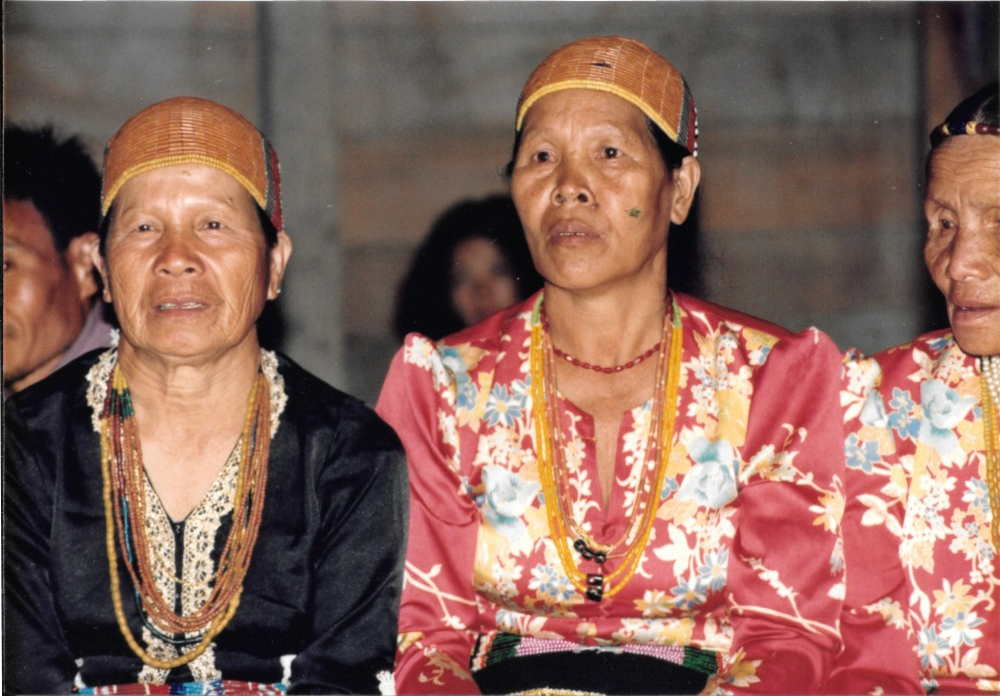
By far the best dance of the whole night, she was followed by a series of local attractions, most of which consisted of a long line of very elderly women who, dressed to the nines in gold embroidered sarongs, tightly bound bodices, and the bead skull caps, slowly stamped their way down one side of the hall in a long line, their outstretched hands resting on the shoulders of the woman in front of them, their lips barely moving as they shyly mumbled some indecipherable words.

It was well after 12:00 pm when he started the long walk back to the guest house.  It was very cold now and pitch black as the starlight was obscured by low, scudding clouds.  The first part of the journey was alright, as we trudged through the cool, silvery dust of the track, but made very poor time on the rough ministerial road of sharp granite chips.

Back at the guest house finally, outside on the verandah to finish off the very last two inches of whisky.  Noah appeared with a glass of foul smelling liquor and somehow the talk drifted into ghost stories, none of which he (Noah) claimed to believe.  He told him stories of the headless Bean Sí of Ireland who always appeared before a family member died and Noah countered that with stories of Gergasi Merah, a huge red headed giant with green eyes who devoured young children and his eyes bulged with polite disbelief when he pointed out that Irish people were often over six feet tall, had red hair and green eyes and would easily devour a bottle of whisky.  A long involved story began then, which he barely followed, about a camping trip Noah had gone on as a young man.  They had gone fishing and that night, six of the young men had sat around the campfire and had wished for their girlfriends, while the seventh member of the group, an older and more experienced man, had cautioned against such stupidity.  Lo and behold, later that night, seven women, in the form of their sweethearts / wives had appeared out of the jungle and would have seduced the group if the older man had not refused to acknowledge the woman claiming to be his wife.  Instantly, the women turned into hissing serpents and the stalwart group made a determined rush for the river and their boat.  On that note, feeling an abominable headache coming on, he quietly passed out.

The next morning the flight back to Miri was at 9:30.  Noah was up late and the best breakfast he could rustle up was hot black tea and a brilliant yellow sponge cake.  His bag significantly lighter than when he had arrived, he sat on the verandah in the early morning sunlight and fidgeted.  The airport “terminal” was only two minutes walk away and there seemed little or no point in going there until he actually saw the plane make its initial approach.  Noah approached and with a flourish, produced two cool tins of Heineken beer.  9:15, and the first one of the day and it was certainly more attractive than the tea and the mushy yellow cake that was the alternative.  10:00 and still no sign of the plane so there was very little he could do but have another beer and then later another one.  At about 10:45, an official looking chap – he was wearing a clean white shirt with epaulettes – showed up on a motor bike and demanded tickets.  The flight, he was informed, was indefinitely delayed because of unforeseen radio problems but could he please present himself at the terminal to be weighed.

Down to the Malaysian Airline Office Terminal, beer still in my hand, and an officious lady in a sarong and some kind of matching turban gave his tickets a close scrutiny as if he were to blame for the non-arrival of the only flight that day.  His  bag was weighed separately and then it was his turn on the scales, and because there was a crowd of local people gaping at him, he clowned around, as if he were too embarrassed to be weighed.  Anything for a laugh, especially with a few early morning beers sloshing around inside him.  The turbaned lady was not amused and scrawled 75 kilos on his form!  

Then the inside of the shed was heating up so he moved outside to the “Departure Lounge” which was merely a roof tacked onto to the main outside wall of the MAS office.  It was open on three sides, but to the left of us there were a few steps to a raised wooden platform. He almost choked on another beer when a roar of engines almost deafened him and an amphibious plane suddenly swept down out of an empty blue sky, buzzed the airstrip and then made another pass, landing at the very far end of it.  The man with the motorbike roared off in a cloud of dust and an elderly man with slit ear lobes told him that it was a special charter flight for the Minister.

The man on the motorbike came back, all smiles, and he asked him about his flight.  “Everything under control, don’t worrylah”, he was assured.

“Yes, I’m sure it is, but what seems to be the problem?” he asked reasonably.

The motorbike man dropped his voice confidentially and looked over his shoulder at the woman in the turban and then beckoned him closer, “It appears that they are having some sort of to-do with the altitude meter.  You can imagine the problem with these bloody mountains” and he gestured at the saucer rim of mountains around them.

“Oh,” he said, a bit dumbfounded.  “I thought there was a problem with the radio”.

“Yes, yes, maybe that too” the man replied and hurried off.

There was obviously nothing for it then but to have another beer, but he couldn’t help wishing for something a bit stronger.

He strolled over to the municipal notice board where a tubby little man in a rumpled shirt and a tie twisted askew under his ear was hammering up a hand written notice with the heel of his imitation Gucci shoe.  It was an invitation to all neighbouring longhouse and government departments to submit not more than four applicants for the next day’s blow pipe contest as part of Malaysia’s National Day celebrations.  He asked the little man what his job was and was apologetically told that he was a teacher at the local secondary school.  He glanced at his watch and saw that it was 11:50 so he asked the teacher why he wasn’t in school.  He grinned at him with discoloured teeth and admitted that he was the Deputy Principal, as if that explained everything.  He came from the coast but had been posted to Bario about two years ago.  He taught six periods of Geography a week and the rest of his time was taken up, he assured him, with administrative duties.  He told him that that must keep him fairly busy, and the Deputy Principal nodded seriously, and then excused himself on some errands.

Without any warning whatsoever, there was a throaty roar of engines and the DeHaviland Sea Otter appeared, circled the field and landed beside the untidy heap of the bags on the field, literally 10 feet away from him.  It was 1:35 pm, but everyone smiled and clapped when the plane turned off its engines.  He hung back to finish his warm beer and to take some pictures of the plane, but the motorbike man took him by the arm and told him to hurry up as the plane was late!  So he took his warm can of beer with him and nobody objected.

Take off was almost instantaneous, and there was no mention of either the radio or altitude meter problems and nor did the pilot allude in any way to the four hour delay.  Someone told him that the last time the flight didn’t show for two days because of bad weather, so he supposed a four hour delay was nothing.  The flight seemed much shorter this time and no sooner were they up than it seemed that they were beginning their descent again to Marudi.  We got off the plane for the ten minute stop – he was aching from his belly load of beer – and the first thing he noticed was the change in temperature.  Marudi was warm and humid.  He had almost forgotten what it was like.  Standing beside the pilot at the urinals, he asked him what had delayed the flight’s arrival, and the pilot burst out laughing as he undid his belt, opened the waist band of his trousers, fully unzipped his fly and dropped his pants as far as his knees, preparatory to taking a leak.  “Oh, it is always the same bloody problem in these mountains, you know.  The radio goes on the blink and then there is nothing we can do.  To make matters worse, our back up radio communications went out as well, so we really had to do something this time, I tell you”.

Not exactly one hundred percent reassured, he got back on the plane again for the last final hop to Miri down on the coast.  A small wiry little creature sat beside him on this leg of the trip, and bubbling with enthusiasm, asked him where he was going.  As the plane had only one last stop to make, he felt this question was redundant, but he needn’t have worried, as the little man had only used the question as a polite preliminary to telling him about himself.  He was a taxi driver from Limbang, who had come by way of Lawas to visit his family in Marudi but he was going back via Miri so that…Yawn!

The domestic Arrival Lounge at Miri was a small bustling affair and he was quite happy to let a taxi tout manhandle him and his grubby looking backpack through the crowd.

“Take me to the best hotel in town” he ordered, rather grandiloquently, but what the hell, he felt, why not have a bit of luxury.  No swimming pool (no hotel in Miri had one, it turned out, although one was being built, he was assured), but the room was carpeted, had a well stocked fridge, a tv, a bathroom and a relatively comfortable bed (superbly comfortable, he thought, in relation to the hard floors he had been sleeping on for the last couple of nights).

There was a plastic and glass junk fast-food place, Sugar-Buns, nearby, so he set off for a feast of hamburgers. Sitting there, surrounded by plastic, chrome, glass, styrofoam containers, junk food, and not a grain of rice or a single jungle edible fern in sight, it was hard to imagine the blow pipe competition taking place the next day, the long, twisty trails to Long Dano and the myriad trails leading on from there into the centre of Borneo and on over into Indonesia’s Kalimantan province.  

He supposed he was back to “normality”, now, but there was that little nagging doubt, but a couple of beers back at the hotel would soon get rid of that for him!  

  • With apologies to Eric Newby for copying part of his title – A Short Walk in the Hindu Kush (1958)

A Short Walk in the Sarawak Highlands – Part Four

Sitting around the following morning in the almost deserted longhouse but for the old women who remained by the fire while all the younger people were out at work in their fields, he decided to go out for a walk down by the river and he waded around, looking for fish.  The river was broad with a flat, stony beach, and seemed crystal clear.  It was also icy cold as he soon discovered.  Shallow at the little beach, the river widened out upstream, and beyond a natural breakwater of slippy rocks,  the river became suddenly deeper and much more turbulent.  Farther upriver, a delicate suspension bridge of interlaced bamboos, hanging from ropes of twisted rattan, spanned the river.  

He wandered off along the bank of the river towards the bridge.  From close up, the bridge looked most unstable, as many of the support bamboos looked rotten and the rattan ropes were frayed and broken in some places.  Commonsense told him that it must be okay, however, as the longhouse people obviously used it, but nevertheless, he decided to go across one foot at a time.  

Halfway across, he stopped and gingerly turned around to take a photo only to see one of the kids from the longhouse wildly swinging on one of the supports, doing his best to make the bridge sway and buck violently underneath him.  He gave such a bellow of fear and rage that not only did it stop the kid dead in his tracks but it also disturbed three large river birds from the undergrowth further upriver which flapped cumbersomely away from the bank and laboured up for height.  

Safely across, he followed a winding path through some wet padi fields, hoping to see some snakes with which the fields were meant to be infested.  No such luck, so he turned back and scampered across the bridge back to the longhouse.  

He decided to leave Pa Da’ih at 2:00 and head back to Long Dano.  Joseph and Andrew decided to go on ahead and meet him at the river where they hoped to spear catch some fish for their dinner that night.  

No sooner had he started to walk, making excellent time to the river.  There was no sign of Joseph or Andrew, but he decided to stop a while anyway.  While Noah broke out his seemingly inexhaustible supply of stale chocolate wafers, he took off his shoes, socks and shirt and waded out to a flat rock in the middle of the river.  Lying down on the rock, he gingerly stuck his steaming hot, sweaty head in the river and had his breath taken away by its swirling coldness. 

Just outside of Long Dano, a skinny, miserable looking man wearing filthy, torn track suit bottoms, a faded T-shirt and flipflops that were several sizes too big for him, hailed him.  His name was Mutang, and he was going off to pick some fruit, he said.  Curious, he went off with Mutang to his fruit trees.  These turned out to be a small clump of high, spindly trees absolutely laden with tarap fruit.  Using a long bamboo pole, Mutang prodded at the fruits, looking for the ripest one, and then with a quick twist of his wrist, he brought half a dozen of the fruits, each about the size of a coconut without its husk, tumbling down about their heads.

They lay on the short, prickly grass, and gorged ourselves on the sticky fruit while Mutang told them the local news.  The Minister of Development was expected in Bario on a flying visit (elections were coming up in Malaysia) and almost all the people from the surrounding longhouses had already left for Bario or were preparing to go in the following day.  Mutang also wanted to go in so that he could sell one of his water buffalos.  He had a herd of twelve, and he reckoned he could get about $1600 for a young heifer in Bario.  It was just a question of driving the beast there.  Remembering that it had taken him nine hours to complete the trip he was ready to sympathise with Mutang until he said that he could probably do it in six hours or so!

Thanking him for the fruit, he belched his way back to Long Dano and gratefully slid out of his pack as soon as he was inside the dark, smoky main hall.  Joseph and Andrew suddenly appeared with an enormous fresh water fish which must have weighed at least three and a half kilos.  Each kilo would fetch $40 down on the coast, they assured us, as this type of fish can only live in clear water.  The scales were enormous, each one about the size of of an old fashioned American dollar, and the light flashed off them giving the fish an irridescent blue, green and purple colour.

Sprawled on the floor, sipping hot tea from a chipped cup, he felt as if he had come home again.  It was a bizarre feeling, especially as only a short time ago he had felt that Long Dano was a “crude wooden hovel”.  Familiarity, in this context, did not breed contempt, but pleasure at not having to walk any more.

Dinner, augumented by the fish, which they had fried as well as boiled in a watery sauce, was quite a feast, especially as Noah, lightening his load for the long walk tomorrow, opened up the last of the tins of beef curry in addition to two tins of stuffed spring rolls that he had kept hidden until then. 

A rasping noise at the next hearth drew his attention and he wandered over to see what was happening.  An old man, his pierced ear lobes down to his shoulders, a faded T-Shirt with the slogan “Levi’s Last Longer” covering his scrawny body, was meticulously sharpening his parang on a dry whetting stone.  After every few rasp along the stone, he would stop and examine the lie of the blade carefully by the light of the flickering, home-made oil lamp on the mat beside him.  The parang blade was two feet of bluey-black, slightly curved steel, topped by a worn bone handle carved into an abstract birdhead.  The blade was connected to the handle by a two inch band of tightly and finely woven rattan string, the whole lot sealed at the base of the join by a blob of black tree resin.  The sheath, lying on the mat was made up of two flat slabs of wood, tightly bound together by further strips of rattan.  On the underside of the sheath, was a tacky looking plastic mini-sheath, attached to the original wooden one with loops of woven fishing line.  This subsidiary sheath held a short round haft which ended in a three inch, slightly backward curving blade.  The steel shone in the dim lamp light, burnished as it was by the steady, methodical strokes the old man was applying to it on the whetting stone.  As it happened, he needed a good knife, not a trashy, touristy-style knife, adorned with beads and imitation tufts of hair, but a real, “working” knife.  As soon as he held the knife in his hand, he knew that this was the knife he wanted.  Calling Noah over to help, he entered into what turned out to be an hour of bargaining which turned out to be a good thing, as Noah later told him that if he had made a flat offer for the parang, the old man would have refused to sell it.  By bargaining, however, he had shown that he had valued the knife for its own sake and this was what had convinced the old man to sell it to him, which he eventually did, without any apparent regret for thirty Malaysian dollars, a packet of cigarettes and 35 fish hooks of assorted sizes.  To seal the bargain, and because he was so pleased, he threw in a ball point pen.  

The whole business had attracted quite an audience and he produced his camera and began blasting away.  He often found this type of close-up photography awkward and embarrassing, and wanted nothing to do with it but, to his surprise, the longhouse people delighted in it.  Posed shots were the order of the day, and the more he was willing to take portraits, the more willing they became to be subjects. 

Old women rummaged like pack rats in dark nooks and caches and produced beautiful, ornate  skull caps of finely woven beads which Noah told him were their family heirlooms.  Some of the caps consisted of up to 10,000 small glass beads and weighed almost eight kilos!  Only when he had exhausted his roll of film, and his face felt as if it were about to fall off his cheek bones from extended and extensive smiling, was he able to retire for the night.

By 7:30 the next morning, he was packed and ready for the trail.  He said goodbye, smiled and shook hands with the remaining old people – everybody else had already made an early start for Bario and the forth-coming ministerial visit.  Outside the long house, away from the warmth of the smokey fire, the air felt damp and cold while the whole valley was swathed in a thick mist.  Striding along, feeling fresh and strong (he had only been walking for 5 minutes) he suddenly emerged out of a patch of mist and found myself face to face with an enormous, mud splattered water buffalo.  He don’t know who was more amazed at the encounter, but one brief glance at the enormous spread of wickedly tapering horn curling back over the vast bulge of muscle across the shoulders and the cavernous, wet, flared nostrils was enough for him.  One hoarse bellow escaped him before he did a complete turnabout and was charging back down the trail, while, judging by the heavy rumble of hooves, the buffalo (and his friends, it sounded like) was charging – thankfully – away in the other direction.

By 9:00 the mist had completely lifted, and what with the shade under the tree top canopy and the initial coolness of the morning, the day remained fresh and he made excellent time, feeling healthy, fit and strong and he tried working it out in terms of hours / miles walked, or was it the early nights, or the complete withdrawal from beer, or might it not be the heavy reliance on rice, or even the total lack of steroid filled meat.  Whatever it was, anyway, had the most amazing effect on his normally taciturn communiques with Nature which had often been sullen, unrewarding and unco-operative in the past.  For the past few days however, perhaps because of the position and strain imposed on the feeble citadel of the body by virtue of the squat toilet, which brought hitherto unknown muscles into play, he had felt the exact reverse of the depressed person who feels that the bottom has dropped out of his world.

When he stopped for lunch, Noah immediately produced another cellophane packet of his stale chocolate wafers, and he broke out more of his stock of muesli bars.  Suddenly there was an eerie creaking noise a little bit away to their left.  Noah and the other guides were on their feet in a split second and man-handled him off the trail and into the jungle on the right hand side.  No sooner had they done so when, with an appalling crashing and tearing noise, a huge tree fell, bringing down with it an assortment of smaller trees, vines, and branches.  Once the initial crashing noise was over a stillness fell on the forest and it was a while before the bugs and insects regained sufficient composure to pick up their tweeting, squeaking, croaking and rustling.  

Noah and the others treated the whole event as just one of those things that happen in the jungle but he couldn’t for the life of him see why a tree of such size should topple like that when there was no storm or wind.  

It was the hottest part of the day now and although he had made good time, they still had a long way to go before arriving back at Bario.  To make matters worse, he was beginning to run low on water as he had swilled it down earlier on in the day.  The jungle began to thin out shortly afterwards, and this compounded the problem as they lost the jungle canopy shade and were walking in the full blast of the sun through dull, uninteresting, baked countryside.  He had his heart set on arriving back in Bario guest house and having a cold beer by 3:00pm  but it was 2:55 before they broke out of the flat scrubland and looked across the padi fields at Bario itself.

Walking across the rough turf of the airstrip, Bario had a strangely deserted look.  He somehow felt that there would be people to greet him and to marvel at the fact that he had survived the walk and returned to tell the tale.  Instead, there was nothing and nobody.  Even the little all-purpose grocery store at the edge of the airstrip was locked up and deserted.  One or two loafers were lounging lazily on the verandah of the Guest house and they said that everyone had gone up the valley to the headman’s house to meet the visiting Minister of Development.  

Noah slipped out of his pack and disappeared into a lean-to shanty attached to the guest house to make tea.  He flopped wearily onto the hard chairs.  Noah wandered out a few minutes later with a plate of ripe pineapple slices in one hand and a can of Heineken in the other. Following Noah back into the lean-to, he discovered that Joseph and Andrew had commandered a bucket of coldish river water in which half a dozen beers were cooling.  Bliss at last, he thought, revising the feeling that the end of the walk was just going to be another anti-climax.

While they were on their fourth beer, he heard a familiar voice outside on the verandah and a moment later Chris, still wearing his African Safari jacket, wandered in.  Bemoaning the fact that the zip-on long legs to his khaki shorts had just been washed and that he had nothing to wear to the Ministerial party, he filled them in on all the news.  An Austrian – No, an Australian, Andrew claimed – had wandered off the trail, leaving his porter and girlfriend to raise the alarm, and had not been seen for the last two days.  Noah, as befitting a guide, was annoyed and distressed at the story, saying that the porters had no right to leave their clients in the jungle.  A lazy argument developed, with Joseph and Andrew saying that porters were not guides and had no responsibility to their charges other than to carry their bags around.  More beer was called for – the water in the bucket had a peculiar, slimy feel to it by this stage – and the afternoon wore on with everyone saying that they must get along and see the minister.  An event like this was quite a deal, as this was the first time that anyone of importance had ever visited Bario.  Apparently, general elections were only a few months away in Malaysia, and this visit was the first shot on a long and often dirty campaign trail.  He couldn’t have given a toss about it – and nor could anybody else, it seemed – but it appeared that there would be a night of feasting (a water buffalo had just been slaughtered for the occasion) and of ceremonial dancing performed by the headmen of all the neighbouring villages.

The beer, however exerted its inexorable effect and it was at least 8:00 pm before he set off. The night was clear and cold and after endless wrong turns, to the local Primary school, to the Secondary school, to the teachers’ quarters, they were finally overtaken by a white jeep which blared its way past them in a cloud of grey, granite dust.  That had to be the Minister, Noah decided, because there were no cars in Bario and this jeep had to be the one that they had heard about being flown in especially by the Armed Forces.

By the time they arrived, it was well after 9:00pm, and the long house was crowded but nothing seemed to be happening.  He refused to go in, so he could squat outside on the steps, smoke and take furtive sips from his last remaining ½ bottle of whiskey. A young soldier, his AK-16 casually under his arm came up and asked him for a light, and while he was giving it to him, a portly gentleman in a florid, batik shirt which he wore outside his trousers, came up and insisted that he wait in his house.  He had no intention of doing so, but the fat man took him by the arm and led him directly into an empty barren room where half a dozen men sat around on the floor.  They didn’t look local – they were too fat and were all wearing government style uniforms – suit bottoms, bush jackets made from some metallic looking cloth, nylon socks and impractical, city shoes and he felt immediately ill at ease with them.  One of them, fatter than the rest, and wearing an open necked batik shirt, was writing importantly on a sheaf of papers, using the flat side of his combination lock attache case as a desk.  

“Are you writing the Minister’s speech for him now?” he asked, to break the deadly silence, at the same time realising that he probably was the Minister himself.  He wasn’t, as it turned out and mumbling excuses, he sprang up and made a bolt for the door away from the cloying atmosphere of stilted politeness and boredom that distinguished Malay living rooms from tribal ones.

  • With apologies to Eric Newby for copying part of his title – A Short Walk in the Hindu Kush (1958)

A Short Walk in the Sarawak Highlands* – Part One

He awoke with a start, knowing he was already late, his breath still beery from the night before as he rinsed his mouth with warm water. He grabbed his backpack, ready and packed in anticipation of a late start. The whole idea of this jungle trek was to break out of this humdrum life he had been leading recently. What better place to do that than the Borneo hinterland? he reflected wryly. A hired car at Brunei Darussalam’s  Airport, an overnight stay in Bandar Sri Begawan overlooking the water village opposite the sultan’s massive palace, too many beers in the yacht club and then this drive south, the road hugging the coast, his head still pounding from the night before.

Better take it slowly, he cautioned himself, down the highway past Seria and on to Kuala Belait where he could return his car and catch the ferry over the Belait river.  He strolled on to the rusty, clapped-out looking ferry for the five minute crossing.  No sign of the guides who were meant to meet him at 8:00 am.  Mind you, it was nearly 10 at this point, but what the hell, they were paid for!  Maybe they’ll be on the other side of the river but there wasn’t much else there – no taxis, buses, or cars, only a bunch of smirking, lounging, idle louts in tight blue jeans and basketball Reboks.  Still no sign of the guide.  

A short walk down to the Brunei border and Immigration and it’s almost a breeze through except for the one question,

“What car you in?”

“Oh I didn’t take a car, I just got a lift.”What number your car?”

“I don’t have a car, actually, I just got…”

“OK, what number your car?”

“I’m sorry I don’t have a … oh never mind, KC 3201”.

“Oklah”

And on to the Malaysian Immigration and bingo, through.  Back into a taxi and a quick rush down the ten mile strip to the crossing  of Baram river on the other side of which he could get an express ferry up river to Marudi. The line of cars begin to move and they rolled onto the ferry, not much better looking than the previous one.  Before the taxi driver could slam on the handbrake, bottles of local perfume, oil, or is it rice wine, bundles of firewood and crude parangs were thrust in through the window for his approval. His headache slowly  dissipating, allowing him to shake his head in polite refusal, he began to feel that the trip was beginning to look up.   The ferry’s departure was so smooth that they were almost on the other side before he realised that they had left.  The boat nudged the bank and the taxi lurched off. Still no sign of the guide.  

Unlike the short-haul car ferry across the Baram, the riverine express boat was shaped like a narrow cigar with dirty polythene windows. Powered by massive diesel engines, entrance was through a narrow portal at the bow giving the ferry the sobriquet of ‘coffin boat’. It was due to leave at 11:30 for Marudi, so he went off looking for a phone to call the agency to inquire about the guides.  No phones in Baram, though, so he settled for a cup of coffee.  The cup arrived with a coffee bag!  No phones but coffee bags instead!  He washed the tepid stuff and decided a beer seemed like an excellent idea and enquired if they had cold ones.  Emphatic nods of the head from the fat Malay lady in the grubby sarong and dirty t-shirt.  Multiple shoutings backwards and forwards between the Malay stall and the neighbouring Chinese one and a glass filled with muddy-looking ice and a tin of warm Heineken beer appear.  Not good enough for him as he wanted them to go.  Off to the shop across the road and two beers are fished out of the ice-chest and it was  time to get on the boat.  

A punctual departure and the boat was three quarters empty.  The seats were built for midgets whose legs had been amputated.  He sat as far back as he could from the video screen – non-stop world wrestling –  and as far forward from the roar of the engines and the stink of hot diesel.  Two slatternly looking girls, one with a rather bruised and battered looking face, de-nitted each other’s hair and then proceeded to make each other up, with lots of coy looks and fluttering of wire-like false eyelashes in his direction.  He  smiled politely and gazed at the riverbank, piled with rotting logs, the banks stripped of vegetation, the river the colour of stale coffee with milk. Logging was big in this area, or was until there was nothing else to log.  So why don’t they do something with all this stuff stacked up on either side of the river, he wondered.  Maybe it’s seasoning or something.  He stretched out over two seats and used his sleeping bag as a pillow, slid off into an beer enhanced snooze until shaken awake at Marudi nearly three hours later.

He stumbled off the boat and looked around for the guides.  Maybe they would be waiting for him there!  Nobody stepped forward to greet him except grubby touts for cheap hotels.  A van for “The Grand Hotel” pulled up and something about the name rang a bell so he wandered over and asked if they knew anything about the Borneo Adventure Agency.

“You Mr. Mac?”

“Yep”

“Ah yes, wait a while.  You maybe take a coffee over there.  My hotel has a booking for you”.

That sounds fine so why bother to “wait a while” he thought.  Never mind, so over to the Chinese coffee shop, garish with large gold characters on a rich red plastic background.  Inside, wide bladed aeroplane propellor type fans lazily stirred the flies from the formica marbled tabletops.  Cups of coffee with a quarter inch of condensed milk sludge at the bottom of the cup and a generous portion slopped into the saucer appeared and then the van man reappeared with the van but now it’s his turn to “wait a while”, and he did.

Driving off to the hotel, the van man gestured at a row of shabby shop houses, half hidden behind raggy, blue canvas sun shades,

“Borneo Adventure office there”, 

and then, tyres squealing, he swung the van round the corner past the Foo Chow Association building and they were at the hotel. He signed the proffered registration card and was given a key.  Pleasant airy room, bathroom, TV, air con, cigarette scarred desk, view out of the dust coated louvred window of a barren, naked outcropping.  Probably a good place for the local roosters to perch and wake him the next morning.  No fear of oversleeping again!

Off to see the Agency finally.  Perhaps it was time to find his guide, collect his air tickets and discuss the itinerary, of which he was completely oblivious. A friend had taken the trip recently and had sworn about the beauty of the highlands, the hospitality of the traditional longhouses of the Kelabits, different in all ways to the coastal Ibans and Dyaks, so much so that he had offered to arrange the whole trip for him. All he knew was it involved several river ferries and then a flight up to Bario in the central highlands of Borneo close to the border with Kalimantan and from there he would walk to neighbouring longhouses in the area. At the time, the details hadn’t seemed important and he had imagined a streamlined process that would deliver him to Bario where all he had to do was accompany the guides and porters his friend had already arranged. 

Back past the Foo Chow Association building and The Las Vegas Pub, sidestepped the bicycles and crossed over to the row of dingy shop houses.  But there’s only an open fronted barber shop, a hair-dressing salon (same management?) a bicycle repair shop and a shop that smelled indescribable, but was thankfully  boarded up with rough hewn planks.  Off to the fancy Zola Hotel on the opposite corner to ask directions.  Two immaculately coiffed and painted smiling girls led him out onto the street and pointed back at the row of shop houses with the tatty blue awnings that he had just left.

Back again and peer carefully into all the shops and, sure enough, in the back of the barber shop, behind a withered looking creature lying full length on a chaise lounge having hair snipped from his nostrils, there was a hand drawn sign for Borneo Adventure on a sheet of Manilla card.  The door in the shadowy back wall is unlocked but there’s nobody at home.  He was about to leave a message when a girl and a child arrived.  The child solemnly switched on the aircon in the stifling windowless “office” and sat down behind the desk, all business like. Ignoring the child, he explained to the girl that he’d booked for the highland tour and he’d like to meet his guide and collect his tickets for tomorrow’s flight.

“Ahh, sorrylah, Richard not herelah.”

Who’s Richard?  That’s the first he had heard of him.  He thought his guide was called Noah.  Off again, led by the girl and child, down the main street, the child leading and kicking mangy mutts out of our way, past the Zola Hotel, and over to an obviously empty, spanking, new, white, two storey building.  

“Richard office there”, the girl announced flatly and then, tugging the child by the hand, walked away.  Might as well have a look at Richard’s office, even if he’s not there, he thought.  Up rough stairs, still coated in loose, concrete dust to a door with a printed stencil sign for Borneo Adventure.  This door was locked and there was no answer when he knocked.  He was about to walk back down the gritty stairs when the door was opened by a sleepy, tousled looking girl in a t-shirt and a sarong.  No, Richard wasn’t here, but she had his tickets and she could phone Richard in Miri, if he wanted.  He did want, and the line was surprisingly clear, and Richard seemed quietly confident.  They arranged to meet that night at the hotel at 7:00pm. It seems like an ideal time to have a cold one to celebrate the success of everything.  

A surly looking Chinese slapped down a large bottle of iced Carlsberg, and a Guinness stout glass with a daub of identifying red paint on its base, on a rickety wooden legged table with a genuine, chipped marble top.  Chinese opera boomed out of the in-house video and he settled down to the beer and to watch the world idle past in this sleepy little riverine port of Marudi.

Richard turned up promptly.  A small man of indeterminate race – Iban, Malay, Chinese, mixture of more that that?- in a rumbled open necked shirt and baggy blue jeans.  He had the tickets so they went across the street to a hole in the wall to have more beers and to discuss the trip.   8:30 pm and a rather foolish expectation of the “last hamburger he’ll have for a few days” and off they went to the posh looking Zola Hotel on the corner.  Posh it might look from the outside, but the menu still consisted of those old Chinese favourites of braised sea slug, sizzling liver, drunken chicken in a clay pot and ox hearts.  He settled for boring old sweet and sour pork ribs, kangkong belacan, sweet corn soup, sizzling deer meat and chili prawns.

After dinner, a stroll round the sights of Marudi – young men, with jeans rolled to the knees, were hosing the concrete dust off the brand new, all weather, main road, stalls and shops are fitfully illuminated by flaring pressure lamps, street hawkers offer flattened pieces of fried chicken and fish, nail clippers and bottles of home medicine. 

He saw a book shop and wondered if he should buy something to read.  The only English book they had was a Mills and Boon romance which he bought after protracted haggling over the mediocre price and then decided on the Las Vegas Pub.  Up a flight of dark stairs and into an even darker room with a bare concrete floor, scattered tables in the gloom and a small stage with a microphone at one end.  It’s a Karaoke bar, apparently.  A few people sit around and a hostess, the only woman in the place, brings him, unasked, a large bottle of Anchor beer, a bowl of nuts, a cologne-soaked paper napkin wrapped in plastic and a song menu.

“Excuse me, my name is Frankie, you like to join us.?”

A scrawny, earnest, bespectabled Chinese youth, wearing a white sleeveless singlet with the slogan “Let’s Make Waves” across his chest, asked.  He stood up and was introduced to his companion. 

“This is Andre, you know Andre the Giant?  He also work for the government with me in the Forestry Department.”

Hand shakes all around and smiles, and then Andre is called up to the stage to croon the song Carol, while an enormous video screen displays topless beauties lolling on a Southern California beach.  The words to the song appear on the bottom of the screen, changing colour as the song progresses.  Frankie is up next dedicating the song to him while more beer arrives, this time in a large glass jug.  Frankie then does a duet with Andre of “Hey Jude”.  It’s his turn then, and sweating with embarrassment, he croaked his way through a shaky version of “The House of the Rising Sun”.  Frankie and Andre cheer wildly and pound their glasses on the table in approval while others double up in laughter.  He came back to the table ridiculously pleased with himself and wondered what other song he dared make a mess of.  

More beer, and more songs – they were all enjoying themselves and Frankie could really sing while Andre specialised in the “Close the eyes and just belt the words out” method.  Later on, multiple exchanges of addresses took place amid promises to look each other up next time he’s in Marudi, and then Frankie and Andre lurched off into the night and he couldn’t help feeling that the holiday was off to a great start.

The next morning, breakfast in the open air market, spongy bread, burnt at the edges with “jem rasberri” and a bowl of noodle soup containing unidentifiable meaty tubes of some sort! Off to the airport then in a van and not only was his bag weighed but so was he too!  Stomach sucked in, just to make sure they didn’t refuse him.  The DeHavilland Sea Otter roars in and bumps to a stop fifteen feet away.  The door drops down and he picked up his bag and walked out to the plane, just as Frankie arrives to wish him “Bon Voyage and Have a good trip.”  He insists on buying a beer, nonchalantly claiming that the plane will wait.  

Inside the plane, the seats – all 19 of them – were collapsible and in a few minutes, along with a basket of live chickens, a few machine parts, lengths of plastic piping and some sheets of corrugated iron, already rusty from the humidity, he strapped in and prepared for take off to the fabled highlands.  No roads exist and the only way to Bario is by plane or a 10 day jungle trek.  The engines roared into life and through the open door of the cockpit, he saw the whole instrument panel quiver and shake.  Lights flashed on and the Indian pilot fiddled with some controls on the panel above his head, and they lurched down the airstrip.  He hoped they hadn’t miscalculated the weight as the plane lifted off and the mountains appeared around them.  The plane bucked violently and then reared up on its tail as it hit the updraft from the mountains. 

Across the tiny aisle from him, a leathery looking little man wearing a haircut that looks as if someone jammed a small rice bowl on his head and then trimmed off all the hair sticking out of it, his ears, pierced with a hole big enough to hold a fat cigar, pendulous and stretched down to his shoulders, calmly went to sleep.  Visibility was good, he was assured by the pilot, grinning back at him over his shoulder through the open cockpit door.  It better be, he thought, as he gaped open mouthed at the jungly mountains just below them as they laboured up for height. Dropping down quite steeply, he felt, the plane buzzed the hollow that had magically appeared in the heavily jungled mountainsides, before swooping in for a bumpy ride in what appeared to be a small paddock of some type.

Bario ‘airport’ was on a grassy strip about the size of a small football field.  In places the ground was reinforced with sheets of metal, and logs laid side by side, in one section, giving a corduroy effect to the field.  The place is definitely weird.  If he hadn’t just landed there, he would not have believed that this is an airport.  The terminal was an open lean-to, while the control tower had a peculiar lopsided look to it, and was made of plain chipboard.  

  • With apologies to Eric Newby for copying part of his title – A Short Walk in the Hindu Kush (1958)