I mentioned in a previous post that I am determined to shake off my sedentary lifestyle and start walking as preparation for the European peace Walk which I want to do next year. Anyway, I mentioned that I haven’t done much exercise recently but that one of my highlights was when I climbed Mount Kinabalu in Sabah State in Malaysia but that was almost 25 years ago. Anyway, here’s an account of the climb which I wrote shortly afterwards.
In July 1991, I was sitting on the wharf in Brunei Darussalam waiting for a boat to Labuan in Sabah. “Wait a while, check-in 12:30”, a small, middle-aged man, with an off-white pill-box hat perched jauntily on his head, told me. He was officially dressed in a blue and white striped T-shirt, city pants with a razor sharp crease, his squat brown feet in blue rubber flip-flops. I waited and looked around.
Young Brunei bucks, their long hair artfully coiffed, rings in their ears and on their fingers, lolled on slatted white benches, picking at their feet. Pointed perahus flashed between the wharf and the water village, their cowboy drivers, the lower half of their faces covered gangster style in a kerchief, standing cockily erect in the stern of the racing water taxis. A cadaverous little man, wearing what looked like an outsize jail-house set of fatigues, stalked around the waiting area, a lit cigarette smouldering in his hands clasped behind his back. His skeletal head jerked and bobbed on his skinny neck while bulbous, wrap-around, mirror sunglasses obscured his eyes. Two withered old women sat opposite me, clutching blue and pink plastic bags, bulging with sour smelling fruit and tins of soy-bean milk. Well-worn suede handbags were worn, bandolier style, over their shoulders. Thin gold bangles rattled on their bony wrists and rings with outsized, rough stones emphasized the frailty of their gnarled hands. A girl in a two toned mustard coloured skirt and shirt sat near me, her hair pulled back in a tight, painful-looking bun. Her face puckered into an angry frown, she glared at me.
At 12:25, a circuitous queue suddenly formed. I strolled around the benches and took my place at the end. The two old women contemptuously pushed their way past me and shuffled indifferently half way up the queue. Nobody seemed to mind or even pay the least attention.
Two Bruneian Immigration officials rapidly stamped the proffered passports, a look of querulous incomprehension on their set and serious faces. They took my passport and, for some reason, looked at the back cover before returning to the blank visa page that I had handed to them. Not once did they look at me, my photograph or the passport details.
The Duta Muhibah Dua express boat to the island of Labuan in the Malaysian state of Sabah was a long, enclosed, airplane-like fuselage with four seats on either side of a narrow aisle. I sat down on the edge of the aisle, hoping that I’d be able to stretch out over the four seats for a snooze once we got moving. Two bright-eyed girls in jeans and T-shirts walked past, smiling and giggling and then returned to ask if the seats beside me were taken. Smiling at me and apologising for disturbing me as I moved my backpack, they edged in past me row of seats behind us, and spreading their own bags on the seats.
“Are you writing in French?” one of the girls asked me, nudging her friend.
“Are you writing in French?” she repeated. “Never mind,” she added hastily, as I looked at her blankly, “I can’t read French”.
“Nor can I,” I said, “So I’m trying to write in English.”
Lim turned out to be 38 years old, A Seventh Day Adventist who had met her Chinese husband in Lincoln, Nebraska, of all places, where she was doing a degree in Fine Arts. Now she is a housewife with three children. When I told her I was also 38 with three children, but separated, she offered to give me marriage guidance counselling. I politely declined but accepted an orange and an introduction to her younger, single friend, Chen, instead.
We talked about children for a while and I told Lim that I was writing to my children. “Tell them Auntie Lim say a big `hello,'” she insisted.
“Tell them to study hard,” Auntie Chen, now wearing pink tinted spectacles, the better to watch the on-board video, chimed in. I told her she looked very pretty with glasses, and she collapsed into giggles, her hand covering her mouth. Lim leaned over and told me her children were aged seven, six and one.
A small Malay boy in the row of seats behind stood up and rested his head on the back of the seat between Lim and I and gazed at me implacably. I winked at him several times but got no response until he suddenly stuck his tongue out at me. This got him a quick slap on the back of his leg from his indignant mother and he was promptly pulled back to a sitting position.
Labuan Airport Canteen.
Sitting in a grubby little room with six rickety tables in what looks and sounds like a building site. Labuan Airport was obviously undergoing a bit of a facelift. That’s fine with me, I’m just pleased to be out of Brunei. There’s only one fan in the canteen and the sweat is trickling down my face. I’ve been in Labuan for less than an hour and so far I’ve bought a duty-free bottle of whisky on the docks, where I also changed my Bruneian money “under the table’, got a taxi, stopped off at a warren of rooms above The Relax Lounge to make a date for the following Sunday with Sharifah, a girl I met in June on my last trip to Labuan, gone to the airport, checked in, provisionally booked a return flight from Kota Kinabalu to Labuan for the Sunday and finished a cold beer. I’ve still got just under an hour before my flight leaves for Kota Kinabalu.
Kota Kinabalu State Park.
Beer is $4 a can here in the Kinabalu Balsam Restaurant so I’m drinking hot lemon tea. Another reason is that it’s also quite cold at about 5,000 feet above sea level even though I’m now wearing a jacket and long trousers. I arrived at Kota Kinabalu airport at 4:45 PM and went straight to the Tourist Office to enquire about getting to the National Park. The pretty little girls were aghast, “But it is so late already. No buses now”.
I pointed out, reasonably enough, I felt, that it was only 4:45, but this, to them, was irredeemably late. The only way to the Park – about two hours away – at this late hour was by chartering a private taxi for $120. I hemmed and hawed but there seemed to be no option, so that’s what I did.
There was a slight delay while the taxi driver rang his wife to tell her about the sucker he had met and how he’d be late home, and then we were off on the first leg of the 90 kilometre drive, crawling through the early evening traffic, and then away through the outskirts of Kota Kinabalu, flashing past scattered Malay kampongs where the road steadily climbs from sea level into the foothills of The Crocker Range and then along the tops of ridges, giving beautiful views of the rugged, jagged peaks of Mount Kinabalu. “Am I really going to climb that?” I kept asking myself, already beginning to feel the awe that the local Kadazan people attribute to the “Mother of all Mountains”.
We arrive in darkness at the Park HQ. It’s cold now and I’m shivering in my T-shirt and shorts. The rangers in the HQ are expecting me and hand over the keys to the hostel. In seconds I’ve burrowed into my backpack, and fished out long trousers and a quilted ski jacket I had borrowed. I’d be in trouble with just my tropical clothes here.
The Balsam restaurant was fairly quiet except for some Germans wearing weird assortments of outlandishly coloured clothes. They talked noisily to an Australian couple and clicked their fingers and shouted at the Malay waitress for more beer. I went back to my room in the Old Hostel – no-one else was staying there – where I was very grateful for the heavy blankets ( I took two extra ones off the other empty beds) and my bottle of whisky.
Up at 6:15 and change the dressing on my ankle. It looks OK, but it’s so crusty that it’s hard to see. Pull on the shoes and limp stiffly down the trail to the Kinabalu Balsam Restaurant for breakfast.
A plate of rice cooked in coconut milk, anchovies fried with garlic and peanuts, a hard boiled egg and some sliced cucumber, a dab of fiery chilli sauce on the side, two cups of tea and I feel ready for anything. It’s 7:25 am and time to look for my guide. Everything seems to be going very smoothly. The Park HQ has all my permits and climbing passes ready and they seem to be in full control. My guide is Darius, a 23 year-old Dusun who has worked in the park for about four years. As we go outside he tells me he sometimes climbs the Mountain three times a week. He’s forgotten how many times he’s climbed it altogether. “Many,” he smiles. He’s wearing a Mount Kinabalu International Climbathon T-shirt from 1990. It’s a 21 kilometre race up and down the mountain, starting at 6,000 feet and going up to the summit at 13,455!
We get a mini bus along a surfaced, winding road that leads to the Power Station at six thousand feet. The road stops here and it’s time to use the legs. I get out of the mini-van and stretch gingerly. The air is cool and sharp. A big sign warns people who suffer from diabetes, asthma, hepatitis, heart and circulation problems and a list of other ailments not to attempt the climb. Another sign proclaims the winners of the 1990 Climbathon. A Ghurkha soldier from Hong Kong went up and down in 2 hours, 50 minutes and odd seconds. I ask Darius how he did. He smiles and says not very well. It took him over four hours.
I wonder how long it will take me to get to the hostel at 10,500 feet, let alone up and back down.
Although the mountain towers above us, we go down about 100 steps to a booming waterfall. A pretty Malay girl in yellow is posing against the fall, her long hair glistening with spray while her boy friend crouches up to his thighs in water, taking photographs of her.
From then on, we go up. Crude steps, reinforced by rough hewn branches, are cut into the mountainside at irregular intervals. I feel fine, my legs are loosening up nicely and my backpack feels light and comfortable. Darius chats away beside me telling me about his family and his kampong. After a few minutes, I’m drenched in sweat and my heart is pounding with the climb. I have no breath to answer Darius so he stops talking to me and drops back slightly behind me, letting me set the pace. I look at my watch and we’ve only been climbing for ten minutes!
At 8:30 we come to the first of many rest stops. Rough picnic benches are grouped around a table with a protective roof of thatch. There is a group of chattering climbers there. We go on past them and continue to climb. I still feel good but we haven’t gone very far. At 9:00 I need to stop and take a swig from my water bottle. A stocky Swede in a conical, Merlin-like hat absolutely covered in badges and pins, trudges up and talks to me. He tells me the guides are very expensive and very bad. His English is heavily accented.
“Zey do nuv-fing for you. Venn I vas in Mulu Park in Sarawak ve had a boat trip through ze caves, ja? Ze river vas high, ze boat fell off-er and ze guide, he vas ze virst to svim to ze bank, ja?”
I find him boring. I nod at Darius and we start up the mountain again without a word. A sign says we have reached 7,500 feet, and a map of the trail up the mountain has a red arrow on it saying `YOU ARE HERE’. We seem to have climbed a disappointingly short distance. As we climb, the vegetation changes to mossy cloud forest. Although the air feels damp and cold, I’m sweating heavily and my T-shirt is clammy. Patches of green moss and ferns appear on the trail and hang from the gnarled, stunted trees.
The trail is so steep that it is not possible to see more that fifty feet or so ahead which is a blessing in a way. Each time I look up, I feel sure that the `top’ is just ahead of me because I can’t see any further and that the trail will level out. However, each crest proves to be equally illusory and the trail stretches on up higher and higher each time I struggle up to where I hope level ground should be.
The air is noticeably cooler now but the sun, unimpeded by the dwarf trees, is hot on the back of my neck and arms. My T-shirt is drenched and the waist band of my shorts is dark with sweat. Darius swings easily along, enjoying himself, obviously not bothered by the exertion of the climb.
At about 11:00 I meet three Canadians lounging on some rocks near a water tank. I stop for a break and they chat to me for a while. They have completed the climb and are on their way back down to the Park HQ.
One of them looks at my T-shirt. “Hope you got a good jacket in that bag of yours, fella,” he drawls. He’s tall and rangy, dressed in a long sleeved check, flannel shirt, blue jeans and heavy, professional hiking boots. I nod, too breathless to answer just yet.
“How about a poncho then?” I nod again, grinning inanely.
“You’ll need gloves for the ropes.” My breathing is almost back to normal now and I say I have gloves as well.
“Well, looks like we can’t sell you anything, then,” he laughs.
I ask about the climb.
“I tell you, the water in these here tanks tastes the best in the world,” the tall man answered, gesturing with his boot at the water tank opposite him, “But that climb from the Hostel is just one mean, sunnuva bitch!”
His girlfriend is lying stretched out full length on the ground, her bush hat over her eyes. She props herself up on her elbows and pushes her hat back and looks at me for the first time. “I made it to within about ten minutes of the summit and then I had to turn back. I could see Harry here, and Bill up there, but no power on earth could get me up the last rock climb”.
I asked her how she felt about that and she shrugged. “I guess I know my limits a bit better now.”
I topped up my water bottle at the tank and shared a Mars bar with Darius and then we shouldered our packs and began to climb again, leaving the Canadians still lying there.
We pass a sign that says in area between 7000 to 10,500 feet nine different types of pitcher plants can be found. I find one and Darius points out two other different types. The leaf tips of these plants form a cup which is both a trap for bugs and a stomach for the plant. Once an insect is lured into the cup by the liquid inside, the `lid’ closes and the insect is digested through the walls of the leaf. Darius tells me that is why the plant can live in the poor, thin soil at this altitude.
My legs are beginning to react now. If I stop for a break, they tremble uncontrollably, so I try to keep going, but very slowly. My calves are aching and I find it difficult to maintain an easy, swinging rhythm because the steps are so unevenly paced. Some are only 10 inches or so high while others are more than two feet and I can feel the pull and strain in my thighs as I haul myself up and on.
There is very little vegetation now, certainly nothing that can be described as trees. Dry looking grass and low bushes stick out of cracks in the flat slabs of granite that begin to appear now. We reach the first of the Mountain Huts at about 12:00 noon and Darius tells me it’s only another ten minutes to where we’ll be staying the night. We get there at 12 :15 and it’s just in time because I’m ready to collapse.
The hostel at Laban Rata is a wooden, two storey, crescent shaped building built by the pioneers of the Sarawak Army Rangers in 1985. I’ve never been so glad to arrive before in my life. I shrugged off my backpack and slid slowly down the wall to the floor, with my legs straight out in front of me. My thigh muscles are twitching and there is nothing I can do to stop them. I sit there for a long time, staring blankly at my legs. Darius goes off whistling gaily and brings me a cup of hot, sweet tea. I really need it and I begin to feel much better. I stand up and stretch gently and then go over to the bay windows. The view back down the valley from this vantage point of 10,500 feet is superb, while the summit, a sharply cresting rockface 3000 feet above and behind us is awesome. I stand there, frankly terrified, thinking I can’t climb that, I must be crazy. The lunar landscape of grey granite, fissured and cracked, ends in an massive silvery dome.
Darius comes over and gives me a nudge and takes me upstairs to my room. There are two tiers of double bunk beds, a radiator and a window in the room. I change into a dry T-shirt, long pants and put on a heavy woolen pullover and talk to Paul, a lawyer from Sydney who is in the opposite bunk. He and his brother started out at 7:30 that morning, but before they reached 7000 feet, his brother turned back. Paul is determined to make the climb and feels that it will be a`snap’. I remain doubtful.
I go downstairs to get something to eat and the place is jammed with chattering Koreans, packing up to leave. They all pose for numerous photographs before the bay window, laughing, giggling and jostling each other. There is a stupendous mound of gear stacked on the floor and I begin to wonder nervously what I am missing. It seems very quiet when they all troop out in an orderly fashion and begin their descent to the valley down below.
I put too much chilli sauce on my fried noodles and can’t eat them. I settle for more tea and go over and lie full length on the couch in front of the window. Even though the afternoon sun is shining in the window full on me I’m so cold that I stuff my hands into my armpits in an effort to keep warm. After a while I give up and go upstairs and crawl under the blankets on my bunk.
I wake up around 4:30 PM and the hostel is hopping. Paul comes in and tells me that a school party from Perth has just arrived. I go outside and there are teenage girls screaming in the showers down the hall as they wash their hair in cold water. Doors open and slam in flurries of meetings and assignments and kids charge wildly up and down the stairs. Downstairs in the restaurant area, there is a group in electric coloured tights doing aerobics. I go back upstairs and get my bottle of whisky and Paul and myself sit in a far corner and drink tea with whiskey on the side. We talk about legal rights and refugees in Hong Kong, the role of the Irish as the first scapegoats in Australia, and, inevitably, the climb the following morning.
By 7:30, we are the only ones left in the restaurant area, and then Paul gets up to go. I sit alone over a last whisky and then, standing up, go outside. The cold feels bright and clear, and although orange arc lamps marking the start of the summit trail obscure the stars, the bulk of rock towers up above me blacker than the dark sky. I look up at it and shiver with cold and apprehension. I must be mad, I think to myself again. Just as I turn to go in, Darius appears and tells me that he will bang on my door at 2:30 or so. “All things being well,” he says “we’ll leave at about 3:30.”
He’s gone before I can ask him what could go wrong.
I’m awake by 2:00 am, listening to the excited bustling of the Australian kids charging up and down the corridor outside my room. The place is booming like a drum. There’s no point staying on in bed. I swing my legs over the side of the bunk and sit up. Paul rears up in the darkness opposite me “Is it time?” he asks.
I put on a singlet, a T-shirt, a woolen pullover, a nylon ski jacket, long pants, socks, gloves and a hat, and I’m ready. My stomach is knotted with anxiety. I really don’t know if I’m up to this, but there’s only one way to find out. And yet, I really don’t know if I do want to find out.
Darius and I leave with Paul and his guide sharp at 3:30 am. Darius says it should take us about two hours. Paul is eager to get moving and strides off into the darkness, taking the lead. It’s icy cold, with a thin wind and I remember reading that 40% of body heat is lost through an uncovered head. I feel absurdly pleased that I remembered to bring a light cotton base-ball style cap with me.
Within five minutes, my heart is pounding, the blood is rushing in my ears and the back of my hair is slick with sweat. We pass a sign that says 11,000 feet and keep going.
By 4:15 am I’m in trouble. The trail just keeps going on up and up. I keep expecting it, naively, to level out and when it doesn’t I begin to get annoyed. At this height, the air is thin and I’m gasping for breath, my lungs hot and raspy. Doggedly, my head down, I begin to count my steps, saying to myself that I’ll stop at 38, part of my mind wondering if this bloody lump of rock will permanently stop me at 38! I force myself to trudge on up for fifty paces and then I have to stop. I daren’t sit down, I just slump against a rock. Darius pauses beside me, but doesn’t say anything. I like that. I wouldn’t have had the breath to answer him. I appreciate his non-judgemental attitude. There is no sound except the thin whistle of the wind and the monstrous pounding of blood in my ears. I peer up into the blackness and can see nothing except the wavering torch lights of other climbers and guides scattered over the trail. I have no idea where Paul is except that he must be somewhere ahead of me. I don’t care.
After a minute, I push myself off the rock and stagger on up. Just think of every step, count each pace, I tell myself. There’s no point in looking up or back – there’s still nothing to see. Every foot gained now is a struggle and I have to stop after every hundred paces or so. I suddenly realize that we’re walking on bare rock and that there are no trees or bushes or grass anywhere. At 4:30 or so, we reach the rockface proper, and thick, white, knotted ropes hang down. Even through the woolen gloves I can feel the harsh, coldness of the ropes. Thank God I have gloves. Labouriously, panting for breath, I begin to heave myself up. I actually begin to enjoy this part. I’m using my arms now as well as my legs and lungs and I get a vicarious pleasure out of making my arms take over some of the hard work. That’ll teach the lazy little sods, I think, and begin to giggle insanely. I must be getting light-headed.
Ahead, it seems to be getting brighter. I can see the top of the wall of rock outlined against the sky. I can’t believe I’m there, but at the same time, my body tells me it’s about time. Agonizing steps later, I reach it and see that I’ve arrived at the lip of a gently rising lunar-like plateau which sweeps up into a rounded dome at one end. Darius turns and points at the dome – “That’s the summit”. But I can’t go on. “I have to stop,” I gasp. My legs are rubber and my chest is heaving. We’ve just passed 12,000 feet. I won’t be able to make it, I can’t go on, my body screams at me. YOU CAN DO IT my brain bellows, macho-like.
The wind is a real problem now as it sweeps across the open plateau. It’s just one more thing to contend with. It whistles across the bare, grey rock and I can no longer feel my ears. My shirts are soaked with cold sweat and then Darius touches my shoulder and I look up. The summit rock looms up in front of us. The foot of the peak is about 300 metres away but it could be a lifetime away. Christ, I’m GOING to do it, I CAN make it. Slowly, slowly.
Darius strolls ahead casually, picking the way of least obstruction and greatest ease, I hope. I look down at my feet, and they are moving, step by step, all by themselves. It’s 5:20 am and I’m nearly there. I lean against a rock and cough and hawk up phlegm like a tubercular case. My chest feels tight and I’m panting for breath. I sit down on the cold rock and concentrate on my breathing. Fill the lungs, slowly let it out. Very slowly, fill them again. I sit there, trance like, and deliberately regulate my breathing. There’s a horrible rattling sound in my throat as if something is loose and I realize that my throat is parched. I’ve been lugging this bloody great big water bottle along with me the whole time but had forgotten it. I swirl water around my mouth and then spit it out. I gargle and spit and then gulp long draughts down. I no longer need my torch and I try to stick it in the pocket of my jacket. It seems to take a long time before my fingers can work the zipper. I pull myself up and Darius is waiting patiently for me. “Don’t worry, I’m OK. I can make it,” I say.
It’s another ten minutes before we reach the foot of the dome. It’s absolutely vertical and if it weren’t festooned with ropes I’d never make it up. Now that I’m not holding the torch, it’s easier with two hands on the rope but I still have to stop literally every thirty seconds or so. It’s much brighter now and I can see about fifteen people already at the summit waiting for the sun to rise. They are only thirty feet above me. I CAN do it, I tell myself and then I’m there. Darius grabs my arm, “Here, stand on this rock and you can go no higher”. A smiling Japanese moves aside and I stand on the rock. Darius slaps me on the back, practically knocking me off into the mile deep chasm on the other side of the dome, “You made it,” he says. The Japanese congratulates me.
The wind is bitterly cold up here. It’s 5:45 am and the sun isn’t up yet, although there is a bright orange line below us on the horizon, like the early dawn you can see from an airplane.
I sit on a rock with my feet dangling over the chasm on the north-east side of the dome. I’m so happy, I’m close to tears. After about five minutes, I stand up, lower my head and then straighten up, filling my lungs to the maximum. I throw my head back and give a bellow of triumph. The sound is lost in the immensity of mountain and height. Everyone laughs and cheers. A Malay from Sarawak, his face completely covered in a balaclava and scarf except for an eye-slit, shakes my hand and asks me my name. We are all grinning and congratulating each other. A Korean is posing with a Wooden Sign that says :
LOW’S PEAK
4101 m (13,455 ft)
CONGRATULATIONS
You are now standing on the highest point in S.E.Asia.
I grin maniacally at him and pull a bar of chocolate out of my pocket. It had melted and then frozen into a weird, disjointed shape. I break it in half and offer it to the Korean. Puasa, the Malay in the balaclava, gives me some of his Mars bar. The Japanese takes out a little digital thermometer and tells us it’s 5°C. The sun suddenly appears down at our feet and we all clap and cheer madly.
I feel absolutely fantastic, I feel superhuman. We all take photographs of each other and the sunrise. Paul tells me that there is a rat right behind me and I don’t even bother to look around. I’m too busy drinking in the scene around and below me. Darius asks if I want to leave. I shake my head. There’s no way I’m leaving yet. I only just got here. At 6:15 am, the Japanese announces that it is 10°C. I sit on, staring at the view over Borneo. Someone points to a smudge and claims it is the Philippines. I don’t know, it might be. To the west, I can see the South China Sea. The visibility is superb, but even as we watch, clouds start to edge in below us, filling the valley below.
It’s only when Darius and I begin the descent that I can appreciate, visually, how steep the ascent really was. My feet are jammed into the toes of my shoes and I have to lean back at an absurd angle to prevent myself from pitching face forward down the slope. Thank God we made the climb in darkness, I think. Seeing it in daylight would have completely broken my spirit. Now I feel on top of the world. We make the descent easily and I stop only once. My euphoria lasts and lasts – God, this is the best high I’ve ever experienced. The valley is spread out below us and through a hole in the clouds I see how beautiful it looks – a Shangri-La from a bird’s eye point of view.
We reach the hostel where I had stayed the night by 7:45 am. I strip off the ski jacket and my soaking pullover and T-shirt and sit there in my singlet. I feel so good. Two girls stumble in and I smile at them and say “Congratulations” to them.
“Thanks, …but we didn’t make it.”
“Well, you tried,” I say and they smile and limp away.
I hang my sweaty clothes out to dry in the bright sunshine and then go and change into dry shorts and a T-shirt and go for a cup of tea with Paul.
Paul had made it to the summit in one and three-quarter hours and then had sat there, freezing, waiting for the sun to come up. Like me, he was on a definite euphoric high, and we lounged there in the bright, early morning sunshine, pleased as punch with ourselves.
After he left at 9:00 am to begin the descent to the Park HQ, I sat on over another cup of tea and took stock. I began to feel that I deserved a bit of luxury and self-indulgence. After all, I had just climbed a mountain and it was my birthday. No point staying on top of a mountain then, I reasoned. Another cup of tea, and scribble a few lines in my notebook and then it was time to pack up.
Darius was squatting out on the verandah chatting to the other guides but as soon as I appeared he stood up, gestured inquiringly with his head towards the trail and, when I nodded, he picked up his bag and started to walk. I loved it. Other people would have had to say goodbyes, rushed off for a last trip to the loo, made last minute adjustments to their packs, or found some excuse to delay departure in some way for a minute or two. Not Darius. A nod was all he need and he was up on his hind legs, striding away.
Some people claim that going down a mountain is as bad as going up, that the strain on the legs is actually worse, especially on the ankle and knee joints. I don’t know what kind of legs I have, but with every downward step that I took I felt the strength flowing into me. I guess I am a sea person, and impressed as I am by mountains and heights, my true metier is sea-level. Another beauty of the descent – and there were many if I were to list them all – is that I had both the energy and the altitude to look around me and to appreciate the varying countryside we were moving down through. Below us, I could actually see the weather changing, clouds sweeping in and blocking off the view while we continued to make the descent. I asked Darius if he thought that it would rain and he shrugged indifferently. “It often looks that way in the cloud forest zone”, he said.
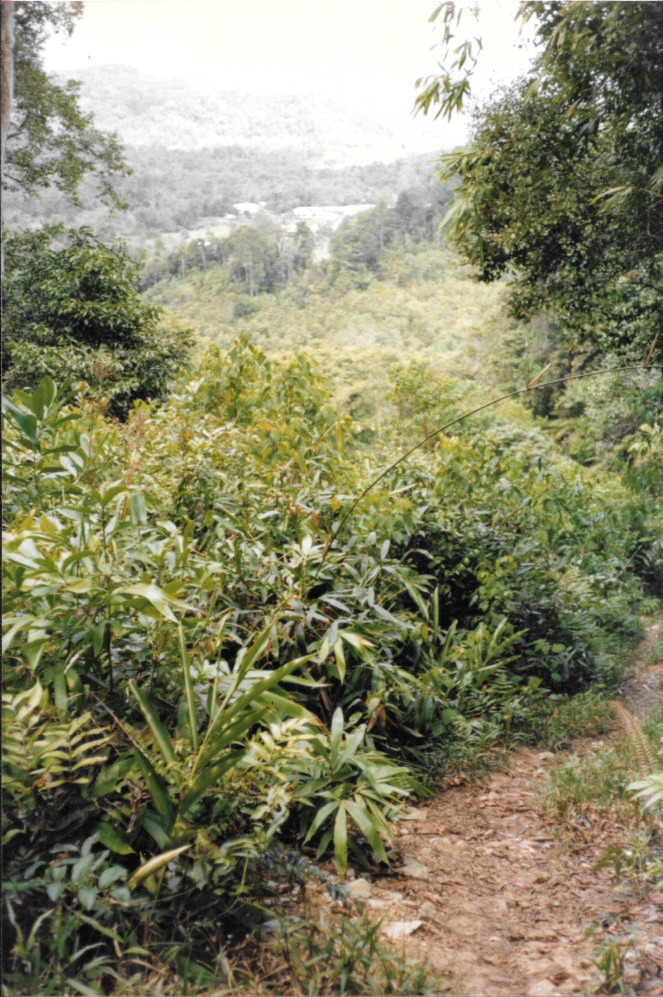
And then we were there, plunging into swirling wraiths of damp wetness. Visibility was suddenly gone and Darius moved ahead of me to take the lead. In this saturating mist, the landscape took on an eerie “Twilight Zone” appearance. Mosses of various types, sometimes as delicate as spider webs, draped the twisted, gnarled tress, hanging from their branches, looping down to the exposed roots. On the way up, I had barely noticed this weird, freakish forest, perhaps because there had been no enveloping mist; now I was fascinated, but glad to leave the damp clamminess and emerge in the sunshine below. We were now in true forest where trees were recognizable as being trees, and the lower we went, the higher the trees grew up around us until the sky was blocked out and isolated rays of sunshine dappling the forest floor became less and less frequent.
We were making excellent time and it was only when we stopped for our first break at noon that I realized that perhaps my knees were beginning to suffer from the constant pounding they were receiving as we hopped down the steps. Cautiously, I explored my legs, poking my thumb into my calves, along the shin-bone and into the meat of my thigh. Not too bad, I thought, but we weren’t down yet. And then suddenly we were down, and Oh God, there are those bloody steps to climb up. Never mind, I thought to myself, what’s a 100 steps or so after you’ve climbed a mountain? A lot, I was to find out. My legs, nicely conditioned to going down, bitterly resented this sudden turnabout, this violent reversing of gears, as it were. Back to counting the steps, take it easy, nice and slowly and then we arrive at the Power Station where we started out. We’re still 2½ miles (and 1,000 above) the Park HQ and Darius suggests we wait for a lift rather than walk. Sitting on the top step, idly chewing on a stalk of grass, I ask Darius when his next trip up the mountain will be. “Tomorrow morning at 7:30 am” he grins at me.
Superhuman and elated as I feel, I know that there is no power on earth that could drag me up that mountain again for a long time, if ever at all.
A mini-bus arrives and disgorges a bunch of picnickers and Darius scrounges a lift for the two of us back to the Park HQ.
“Where are you from, sir?” the mini-bus driver asks.
“Ireland”.
“Oh, have you seen Christy Brown’s film, `Down All The Days’. I thought it would be very sentimental, but in fact, I enjoyed it very much indeed. By the way, my name is Jody”.
Jody turned out to be a Filipino working here in Sabah whose sister had recently become engaged to a person I knew in Brunei. Back at the Park, Darius presented me with a fancy Kinabalu Certificate for climbing the mountain. We shook hands and that was that. Jody beeped the horn and asked if I wanted a lift back into town. I did, and by 1:00 PM we were flying around hair-pin bends and the air was getting noticeably warmer. I watched, appalled, as we slithered around bends and overtook a lumbering ox-cart on the inside, and it was as much a desire to block out the nightmare ride as creeping exhaustion that my head began to sag forward on my chest.
When Jody dropped me off in the centre of Kota Kinabalu, I was amazed to see that it was only 2:20 PM (the trip up in the taxi had taken over two hours).
Time for a birthday beer, I decide, and it tastes so good that I have a few more before I even considered going on to my hotel. I had booked a beachside hotel about 12 miles outside Kota Kinabalu on the recommendation of some friends whom I was planning to meet there.
All the taxis wanted an exorbitant sum to make the 12 mile run so, having been stung by taxis already on this trip, I decided to take one of Kota Kinabalu’s ubiquitous little private mini-buses that crisscross the state in competition with public transport. I check that the driver knows my hotel, agree on a price and climb past the other dozen or so people already crammed in, and we’re off. My eyes felt increasingly heavy and it was an effort to fight off the effects of tiredness and beer and the very welcome tropical warmth.
It was only when we stopped in a small village to disgorge sacks of rice that I began to suspect something was wrong. This didn’t look like quite the area for a beach-side resort hotel. I mentioned this to the driver and the look of shock and embarrassment on his face was comic. “Aiieeee, sorrylah. Forgot”.
It turned out that we were in a small town called Beaufort, which in a way, suited me fine as I would have had to come here to-morrow on my overland leg back home. The driver refused to accept any money from me and within five minutes I had checked into the only hotel in town above a bustling Chinese restaurant. Within ten minutes I was in bed.
Hunger woke me at 9:00 PM. Beaufort is a small town and a ten minute stroll was enough to show me that my choice was basically the restaurant under the hotel or nothing. The sweet and sour fish and fried vegetables were superb and the beer was cold and what more could I want for a birthday dinner?
Well, there was a nightclub around the corner and I lumbered (a bit stiff-legged now) over there. Small and dark, it had a three man band bashing away in the corner. I took a table diagonally opposite them (as far away as I could get) but one more beer and despite the noise, I began to slump and for once, prudence asserted itself, and I knew, with a surprising clarity, that the best possible birthday present I could give myself was a good night’s sleep, so that’s what I had.
Mount Kinabalu towers 4,101 metres (13,455 feet) above the tropical rainforest. It is the highest mountain between the Himalayas and the snow-capped peaks of New Guinea. Ever changing, it is a mountain of colourful blossoms and golden sunsets, but also of dark and violent storms. At times a ghostly mist shrouds the mountain and it is easy to believe the local Kadazan’s claim that it is the homeland of their spirit world.
The mountain stretches upward from lowland rainforest to montane forest, cloud forest and subalpine meadows, before finally reaching a crown of bare granite.
Kinabalu’s name is a mystery. The most popular view derives it from the Kadazan words Aki Nabalu meaning “the revered place of the dead”. The local Kadazans believe their spirits dwell on the mountain top. Among the bare rocks of the summit, grows a moss which early Kadazan guides said provided food for the spirits of their ancestors.
Another theory about the mountain’s name comes from the derivation of Kina meaning “China” and Balu meaning “widow”. A Kadazan legend tells the story of a Chinese prince ascending the mountain. He is seeking a huge pearl on the top which is guarded by a ferocious dragon. The prince succeeds in slaying the dragon and stealing the pearl. He then marries a Kadazan woman, but soon abandons her and returns to China. His wife, heartbroken, wanders to the mountain to mourn. There she is turned to stone.
As there is no record of local people climbing the mountain, the first honour goes to Sir Hugh Low, a government officer from Labuan who reached the summit plateau in 1851. He did not scale the highest peak believing, as he wrote, “the highest point is inaccessible to any but winged animals.” But in honour of his journey, this peak, along with a 1 mile deep gully, a pitcher plant, a rhododendron and a few other organisms, all bear his name.
The custom of leaving a signed and dated letter in a bottle at the top of the mountain gives us a history of the early climbers. In 1858, Sir Hugh Low made a second expedition to Kinabalu with his friend Spencer St. John. It was not until 1888 that the highest peak was scaled by John Whitehead and his intrepid Kadazan porters. In 1910, Lillian Gibbs became the first woman to scale Kinabalu’s lofty peaks. In the same year, Kinabalu’s first tourist made the ascent, describing his trip as “purely a vacational ramble.” Shortly after this, a bull terrier named Wigson gained fame as the first dog to climb the mountain, accompanied by the district officer from Kota Belud.
Kinabalu Park
Sabah Park Publication No. 7





 Red Branch Chronicles
You must be logged in to post a comment.