

I’d heard of terrines, of course, compressed dishes of fish or meat, usually served cold and an apparent staple of French cuisine but I don’t remember ever having one. Recently, however, I visited a new, for me, restaurant down on the river between the two traffic bridges. More of a place to sit and enjoy a drink I felt, while watching life on the river flow past, as the menu was a bit limited and portions were small – more tapas sized than a main meal. I ordered the pulled lamb with the potato terrine and while the lamb was tender and tasty, I was blown away by the slice of potato terrine – a rectangle the same size and thickness of my middle and index fingers together. I have never had anything like it before – it was gorgeous. Ever so slightly crisp on the edges, the slice of terrine with its layers of thinly sliced potato cooked in some type of creamy sauce was an absolute winner. So here is my third attempt at mastering this dish – my first try was adequate, my second one fell apart (I didn’t overlap the layers of potato sufficiently) – I’ve learned from my mistakes – and this, my third attempt, has made up for past errors but can still be improved upon the next time, while adding my own little twist.
 Here’s what I had –
a kilo of russet potatoes, washed but not peeled
250 ml cream
salt and pepper
butter
a fresh rosemary sprigs, leaves picked
3 large cloves of garlic, minced
100g Serrano ham
a rectangular oven dish or a loaf tin
grease-proof paper
tin foil
Preheat oven to 180ºC. Place cream, minced garlic, salt and pepper and the chopped rosemary leaves in a small bowl and stir.
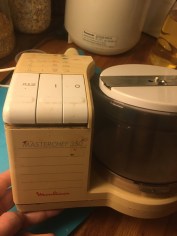
 Scrub the potatoes, and use a mandolin, if you have one, to slice the potatoes finely. Use a knife if you have to. I used an old late 1960’s Moulinex food processor, liberated from my mother’s kitchen back in the eighties, to cut almost a kilo of spuds into almost transparent slices and quickly dropped them into the cream mixture.
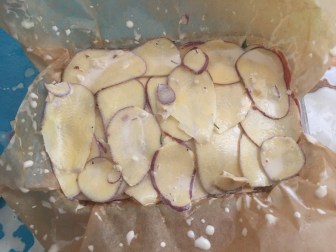
Very lightly butter your dish or loaf tin. I use a low rectangular glass dish. If you use a loaf tin, only fill it about halfway, unless you want loaf size slices of the terrine. Then line whatever you are using with grease-proof paper leaving considerable overhang on each side. You’ll eventually fold the paper sides over the top of the dish.
Build up the terrine in layers by taking slice after slice of potato and placing them into the dish. Spoon over the creamy stuff as you go but don’t drown it. Lay every slice down in the same shape and direction. Allow for overlaps and after every second or third layer, I put in two paper-thin slices of Serrano ham. A few tabs of butter here and there among the layers will later contribute to the firmness. Another few layers of potato and another two slices of the Serrano and so on until the dish is filled to the top. I used all but two of the kilo I started with and six slices of the ham.
Wrap the overhanging greaseproof over the top, then cover the top of the dish with foil. Bake for at least 90 minutes or longer. When you can easily poke a skewer, not through the tinfoil and greaseproof paper, but through the actual terrine itself, you know it is done to perfection.
Cover up again, remove from the oven and allow to cool for about 15 minutes.
Now, weigh down the dish, still wrapped in the greaseproof paper, until you can put the dish, weights and all, in the fridge for at least an hour – preferably over night! The more you wait and weigh it, the more solid it becomes! House bricks are ideal, if you have a few clean ones handy. Otherwise, use whatever you have, tins of beans, bags of rice, barbells, whatever.
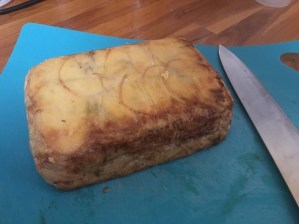 Remove from the fridge and bring to room temperature for around 15 minutes. Carefully remove from the dish, unwrapping the paper and unveil a solid block. Tidy it up the sides if necessary, revealing one perfect rectangle, layers exposed.
Heat a pan, and add in any fresh herb – thyme, marjoram whatever – and a crushed garlic clove to the pan for extra flavour. Then cut rectangular slices of terrine and slide them into the pan. 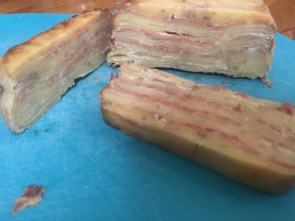 Cut side, flat side down? Up to you! Fry gently for about a minute a side as it can burn easily!
Place the finished slices on some kitchen paper to absorb any oil and sprinkle with cracked black pepper, a pinch of coarse sea salt. Super as breakfast with a poached or fried egg. Use it as an accompaniment to any meal, hot or cold. A dab of chutney or a smear of chilli jam, hmmm, a spoonful of sauerkraut?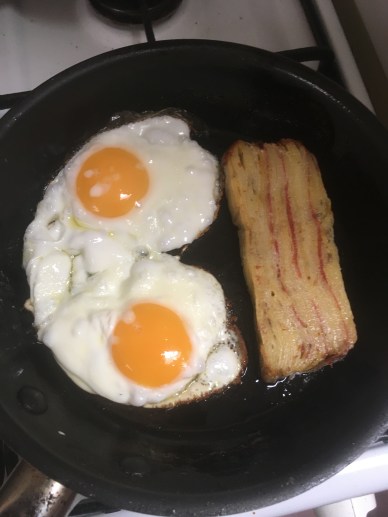

 extravaganza? – I must admit it is not something I often use or buy. On the rare occasions when I do, for a luxurious Irish Coffee or some special occasion, I would feel vaguely guilty. But I remember, as a child, we always used to have cream, along with butter and eggs and potatoes and buckets of milk and it was all considered healthy. However, you can, if you like, use milk instead but you will be missing out, I assure you, on the rich succulence that only cream can provide.
 So, to work! I threw the flour, the cubed butter and the egg yolk into my aged food processor and dribbled in four spoonfuls of cold water as the processor grunted and heaved its way through the dough. I bundled out not quite coarse ‘breadcrumbs’ onto a floury board and gave it a bit of a knead before forming it into a rough ball which I wrapped in cling film and put in the fridge to ‘set’ for thirty minutes or so.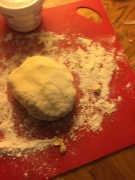
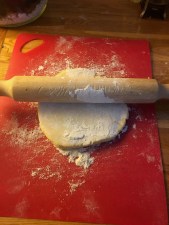 meaningfully into her hand as she waited for her sot of a husband to come home) I rolled the pastry out as thinly as I could before lifting the sheet up carefully and draping it over a round baking tin.
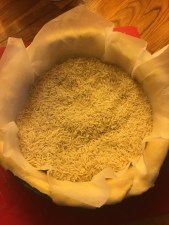 spread that evenly over the baking paper before putting the lot into a 180 degree C oven for about 10 minutes. After that, I removed the paper and rice – didn’t spill any, either! – and put the pastry tin back in the oven for another ten minutes.
 While that was baking, I chopped up two small shallots and tossed them into a pan with a spoonful of oil – I had no more butter, having used it all for the pastry. After the shallots softened a bit, I tossed in the cubed bacon and stirred it around for a while before leaving it for ten minutes or so.
 I pulled out the oven rack and gently lowered the nearly filled pie tin down before topping it up with the rest of the creamy egg sauce. That way, I didn’t slop any on the floor while banging the lot into the oven at 180 degrees C.
 Note to self: next time use one of those baking tins where you can push up from beneath the bottom.
 Red Branch Chronicles
You must be logged in to post a comment.