A Short Walk in the Sarawak Highlands – Part Two

Bario was in a saucer plain with soft, blue-grey mountains ringing the rim.  Water buffalos trudged along the dirt track past the control tower dragging battered sled-like affairs filled with large rock chips.  There were no cars, jeeps, vans or trucks whatsoever but there were a few trail bikes parked outside the terminal.

The Bario Lodging House was a two minute walk from the airstrip.  Hot black tea appeared and everyone there looked askance at his T-shirt and shorts and hoped that he had warmer clothes for the night.  What did they know that he didn’t, he wondered?

Time to celebrate in Bario and off he went to find the local hotspots.  The local shop sold ropes, machine bits, carved parangs, and warm Coca-Cola and that’s what he had.  Back to the lodging house, and exhausted by the excesses of the previous night, he slept until dark.

Dinner time and he finally met his guide, Noah.  He was short and stocky with a broad grin and legs the same size as the average person’s waist.  He was not a Kelabit but came from a village lower down the Baram river, called Long Terawan.  A few beers (it was getting distinctly chilly now and he had changed to jeans and socks) cooled in a bucket of river water while they discussed the trip.  Everyone said that walking from Bario to Long Dano should take only six hours, but their legs were quite different to his, and he was skeptical of their idea of time and distance.  People drifted in and out of the covered-in verandah and began to huddle round the flaring methylated spirits lamp in a desperate effort to maintain body heat.  He got up and put on all his clothes and then stuck his stockinged feet inside his backpack.

Chris, wearing an African safari-style jacket with outsize pockets bulging with camera equipment, was in marketing and wanted to explore the area so that he could bring “top-end executives” out there.  His preliminary market analysis indicated that people who had no knowledge about the area had no interest in it either. It sounded a bit like saying child birth was hereditary; if your parents didn’t have any children, then the chances are that you won’t have any either! Chris’ task then, back in London, would be to educate his clients with books and videos before they came out here.  

Alan, a middle-aged tea planter from Selangor in Peninsula Malaysia, was lumbered down with his teenage son, a vcr and a tape recorder, not to mention his two still cameras (one for vistas, and one for snaps!).  He said he was there to capture the spirit of the people before they vanished completely under the approaching industrial wave.  Alan loved the walks because there was so much to see, and to prove his point, he showed him two porcupine quills, 3 woodpecker feathers and a dead beetle that he had collected.  He said he didn’t drink but he finished off half a dozen beers, most of a bottle of whisky, explained that he wasn’t an argumentative chap and then related, for the next three hours how many quarrels he had had with famous people no-one had ever heard of.  At the end of the evening, in exchange (for the whisky, or his patience?) Alan gave him a half empty tube of deep heat cream (“you’ll need that for your shoulders judging by the size of your pack,” he confided knowingly), a small camping cooker, a tube of insect repellent and a good few laughs.

A breakfast of cold baked beans, served daintily from the can, fried eggs, fresh pineapple and stale bread, the next morning, and it was nearly 9 before they finally left the guesthouse despite Noah having urged him to sleep the night before because of the proposed early start.  Off he trudged across the airstrip, gaped at by a squad of soldiers drilling halfheartedly under the relaxed eye of their sergeant (the Indonesian border was only a few miles away).  The track was wide and bumpy through the padi fields without any tree cover or shade.  He strode jauntily along, his new backpack snug and comfortable on his shoulders, glancing at his watch as sweat dripped into his eyes, and my God, he’d only been walking for 20 minutes.  Andrew, a swarthy young giant, joined then further on and Noah explained he carried all the food, in an uncomfortable looking backpack made of woven bamboo and rattan.
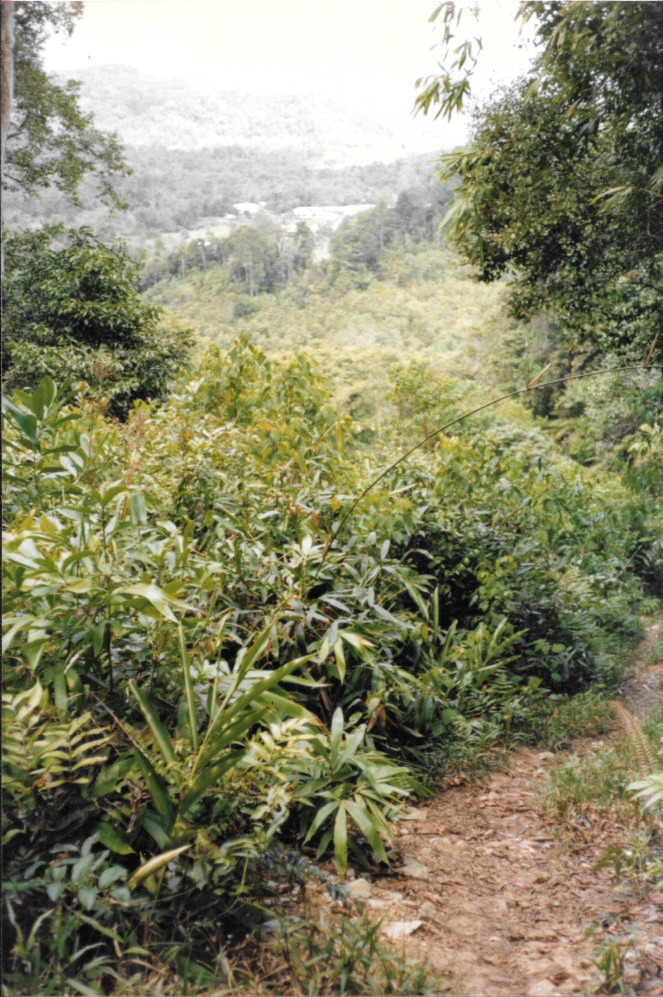
Into the jungle – and shade – finally and then the hills begin.  From then on, a blistering, exhausting slog up hill and down dale, tripping and stumbling over tree roots and rocks.  Noah cheerfully tells him that he’s lucky it is so dry as he teetered over notched logs and bamboo suspension bridges.

“Aha,” Noah said.  “These are the bridges I told you about, they are made without any nails whatsoever”.  

That’s just what he needed to know as he swayed and lurched perilously across, hoping the rotten looking bamboos would hold his weight.  If only his bloody backpack wasn’t so heavy.

Another break and he stoped for a lengthy swig from the water bottle.  Small bees buzzed and crawled all over him, greedily drinking the protein rich sweat that poured off his flabby, exhausted body.  At the four hour mark they stopped for lunch.  Stale chocolate wafers biscuits, compacted packets of cooked sticky, white rice wrapped up in leaves, a tin of chicken curry, a tin of pineapple chunks and a tin of sardines. 

“How much further, Noah” he begged, but Noah just grinned enigmatically and strode on down the trail.  He still felt ok, almost, but by late afternoon the strain was beginning to tell on the legs.  Seven hours into the walk and he’s tired. Eight and three quarter hours later, they finally arrived at the Long Dano Long House, sidestepping clumsily through the outsize buffalo plops. 

It was a sprawling cluster of, from the outside, crude wooden hovels.  The main building looked quite new and was about 200 feet long, raised about 5 feet off the ground on stout wooden posts set in a concrete base.  Surprisingly (for him, anyway), the building had glass louvred windows.  Staggering up a roughly hewn log, he entered the main area which consisted of two parallel buildings connected by covered wooden bridges.  One of the long buildings contained a fireplace for each family – about 20 families lived there – with a food storage area directly behind the fire.  Above each cooking fire, on a rack, neat stacks of split logs are piled.  The plank floor in front of the fire was covered in cheap linoleum, on which, as he went to sit down, was quickly covered with a finely woven reed mat.  The other parallel building contained sleeping quarters and extra storage space.

Exhausted, he slumped down on the floor, propped up on his bag.  People clustered around him curiously, bold, dirty hands reaching out to touch the hair on his arms.  Noah busied himself around the fire, preparing tea. A smiling lady with filthy feet, grubby hands and incredibly distended earlobes which swung pendulously under her chin, offered him bananas and some other fruit that he had never seen before.  It was called tarap, he learned, and was a tight cluster of white globules of sweet jelly around a hard stone, the whole lot covered in a thick, green rubbery skin. 

People kept on coming up to introduce themselves and everyone had to shake hands with him.  What with the deferential treatment, the present of fruit and all this hand shaking, he began to feel that he was special and that he really had accomplished something unique by making a six hour jungle walk spin out to almost nine hours!

The hot tea, tasting vaguely smokey from the wood fire, revived him and he began to sit up and take notice.  The long house seemed quite prosperous although there were very few people around and he was told that all the children attended a local government school some distance away. They stayed in the school hostel there, coming home only at weekends.  

Culture shocked and cold, he stayed where he had collapsed, and decided to dispense with washing for the moment.  After the initial bout of curiosity and hand shaking, he was left pretty much alone, except for two little girls who couldn’t seem to decide to be frightened or fascinated by him.  Rolling over on his side, he rummaged in his backpack and pulled out a few balloons he had brought along as presents.  Soon he had a captive audience of about 15 people of assorted ages.  Not content with just blowing up and then releasing the balloons, he had set himself up with a squawk band, teasing the most horrendous noises out of the balloons by stretching the necks of the balloons.  Balloon blowing with just one breath competitions followed next until he began to feel dizzy and decided that that was it.  Dry long house or not, he felt that it was time he had a little nip, so handing out the rest of the balloons, he retired to a corner and covertly swigged from one of the bottles of whiskey he had lugged all that way!

Dinner was a weird mix of tinned corned beef, raspberry jam, cream crackers, buckets of white rice, various dishes of totally unrecognisable vegetables, fruit and various bits and pieces that other families contributed to the communal feast.  He had known in advance that the Kelabit people in this area were avid Evangelical Christians who had been converted after the war, and who now abhorred alcohol, tobacco and all good things of life which normal people like himself and the Ibans enjoyed, but he had been secretly hoping to find some old gaffer who had a secret store of their once fabled Tuak, or rice wine.  No such luck, however, and exhausted, as much from the strains of withdrawal as from the day’s walking, he slept where he dined, as close to the fire as possible!

  • With apologies to Eric Newby for copying part of his title – A Short Walk in the Hindu Kush (1958)

A Short Walk in the Sarawak Highlands* – Part One

He awoke with a start, knowing he was already late, his breath still beery from the night before as he rinsed his mouth with warm water. He grabbed his backpack, ready and packed in anticipation of a late start. The whole idea of this jungle trek was to break out of this humdrum life he had been leading recently. What better place to do that than the Borneo hinterland? he reflected wryly. A hired car at Brunei Darussalam’s  Airport, an overnight stay in Bandar Sri Begawan overlooking the water village opposite the sultan’s massive palace, too many beers in the yacht club and then this drive south, the road hugging the coast, his head still pounding from the night before.

Better take it slowly, he cautioned himself, down the highway past Seria and on to Kuala Belait where he could return his car and catch the ferry over the Belait river.  He strolled on to the rusty, clapped-out looking ferry for the five minute crossing.  No sign of the guides who were meant to meet him at 8:00 am.  Mind you, it was nearly 10 at this point, but what the hell, they were paid for!  Maybe they’ll be on the other side of the river but there wasn’t much else there – no taxis, buses, or cars, only a bunch of smirking, lounging, idle louts in tight blue jeans and basketball Reboks.  Still no sign of the guide.  

A short walk down to the Brunei border and Immigration and it’s almost a breeze through except for the one question,

“What car you in?”

“Oh I didn’t take a car, I just got a lift.”What number your car?”

“I don’t have a car, actually, I just got…”

“OK, what number your car?”

“I’m sorry I don’t have a … oh never mind, KC 3201”.

“Oklah”

And on to the Malaysian Immigration and bingo, through.  Back into a taxi and a quick rush down the ten mile strip to the crossing  of Baram river on the other side of which he could get an express ferry up river to Marudi. The line of cars begin to move and they rolled onto the ferry, not much better looking than the previous one.  Before the taxi driver could slam on the handbrake, bottles of local perfume, oil, or is it rice wine, bundles of firewood and crude parangs were thrust in through the window for his approval. His headache slowly  dissipating, allowing him to shake his head in polite refusal, he began to feel that the trip was beginning to look up.   The ferry’s departure was so smooth that they were almost on the other side before he realised that they had left.  The boat nudged the bank and the taxi lurched off. Still no sign of the guide.  

Unlike the short-haul car ferry across the Baram, the riverine express boat was shaped like a narrow cigar with dirty polythene windows. Powered by massive diesel engines, entrance was through a narrow portal at the bow giving the ferry the sobriquet of ‘coffin boat’. It was due to leave at 11:30 for Marudi, so he went off looking for a phone to call the agency to inquire about the guides.  No phones in Baram, though, so he settled for a cup of coffee.  The cup arrived with a coffee bag!  No phones but coffee bags instead!  He washed the tepid stuff and decided a beer seemed like an excellent idea and enquired if they had cold ones.  Emphatic nods of the head from the fat Malay lady in the grubby sarong and dirty t-shirt.  Multiple shoutings backwards and forwards between the Malay stall and the neighbouring Chinese one and a glass filled with muddy-looking ice and a tin of warm Heineken beer appear.  Not good enough for him as he wanted them to go.  Off to the shop across the road and two beers are fished out of the ice-chest and it was  time to get on the boat.  

A punctual departure and the boat was three quarters empty.  The seats were built for midgets whose legs had been amputated.  He sat as far back as he could from the video screen – non-stop world wrestling –  and as far forward from the roar of the engines and the stink of hot diesel.  Two slatternly looking girls, one with a rather bruised and battered looking face, de-nitted each other’s hair and then proceeded to make each other up, with lots of coy looks and fluttering of wire-like false eyelashes in his direction.  He  smiled politely and gazed at the riverbank, piled with rotting logs, the banks stripped of vegetation, the river the colour of stale coffee with milk. Logging was big in this area, or was until there was nothing else to log.  So why don’t they do something with all this stuff stacked up on either side of the river, he wondered.  Maybe it’s seasoning or something.  He stretched out over two seats and used his sleeping bag as a pillow, slid off into an beer enhanced snooze until shaken awake at Marudi nearly three hours later.

He stumbled off the boat and looked around for the guides.  Maybe they would be waiting for him there!  Nobody stepped forward to greet him except grubby touts for cheap hotels.  A van for “The Grand Hotel” pulled up and something about the name rang a bell so he wandered over and asked if they knew anything about the Borneo Adventure Agency.

“You Mr. Mac?”

“Yep”

“Ah yes, wait a while.  You maybe take a coffee over there.  My hotel has a booking for you”.

That sounds fine so why bother to “wait a while” he thought.  Never mind, so over to the Chinese coffee shop, garish with large gold characters on a rich red plastic background.  Inside, wide bladed aeroplane propellor type fans lazily stirred the flies from the formica marbled tabletops.  Cups of coffee with a quarter inch of condensed milk sludge at the bottom of the cup and a generous portion slopped into the saucer appeared and then the van man reappeared with the van but now it’s his turn to “wait a while”, and he did.

Driving off to the hotel, the van man gestured at a row of shabby shop houses, half hidden behind raggy, blue canvas sun shades,

“Borneo Adventure office there”, 

and then, tyres squealing, he swung the van round the corner past the Foo Chow Association building and they were at the hotel. He signed the proffered registration card and was given a key.  Pleasant airy room, bathroom, TV, air con, cigarette scarred desk, view out of the dust coated louvred window of a barren, naked outcropping.  Probably a good place for the local roosters to perch and wake him the next morning.  No fear of oversleeping again!

Off to see the Agency finally.  Perhaps it was time to find his guide, collect his air tickets and discuss the itinerary, of which he was completely oblivious. A friend had taken the trip recently and had sworn about the beauty of the highlands, the hospitality of the traditional longhouses of the Kelabits, different in all ways to the coastal Ibans and Dyaks, so much so that he had offered to arrange the whole trip for him. All he knew was it involved several river ferries and then a flight up to Bario in the central highlands of Borneo close to the border with Kalimantan and from there he would walk to neighbouring longhouses in the area. At the time, the details hadn’t seemed important and he had imagined a streamlined process that would deliver him to Bario where all he had to do was accompany the guides and porters his friend had already arranged. 

Back past the Foo Chow Association building and The Las Vegas Pub, sidestepped the bicycles and crossed over to the row of dingy shop houses.  But there’s only an open fronted barber shop, a hair-dressing salon (same management?) a bicycle repair shop and a shop that smelled indescribable, but was thankfully  boarded up with rough hewn planks.  Off to the fancy Zola Hotel on the opposite corner to ask directions.  Two immaculately coiffed and painted smiling girls led him out onto the street and pointed back at the row of shop houses with the tatty blue awnings that he had just left.

Back again and peer carefully into all the shops and, sure enough, in the back of the barber shop, behind a withered looking creature lying full length on a chaise lounge having hair snipped from his nostrils, there was a hand drawn sign for Borneo Adventure on a sheet of Manilla card.  The door in the shadowy back wall is unlocked but there’s nobody at home.  He was about to leave a message when a girl and a child arrived.  The child solemnly switched on the aircon in the stifling windowless “office” and sat down behind the desk, all business like. Ignoring the child, he explained to the girl that he’d booked for the highland tour and he’d like to meet his guide and collect his tickets for tomorrow’s flight.

“Ahh, sorrylah, Richard not herelah.”

Who’s Richard?  That’s the first he had heard of him.  He thought his guide was called Noah.  Off again, led by the girl and child, down the main street, the child leading and kicking mangy mutts out of our way, past the Zola Hotel, and over to an obviously empty, spanking, new, white, two storey building.  

“Richard office there”, the girl announced flatly and then, tugging the child by the hand, walked away.  Might as well have a look at Richard’s office, even if he’s not there, he thought.  Up rough stairs, still coated in loose, concrete dust to a door with a printed stencil sign for Borneo Adventure.  This door was locked and there was no answer when he knocked.  He was about to walk back down the gritty stairs when the door was opened by a sleepy, tousled looking girl in a t-shirt and a sarong.  No, Richard wasn’t here, but she had his tickets and she could phone Richard in Miri, if he wanted.  He did want, and the line was surprisingly clear, and Richard seemed quietly confident.  They arranged to meet that night at the hotel at 7:00pm. It seems like an ideal time to have a cold one to celebrate the success of everything.  

A surly looking Chinese slapped down a large bottle of iced Carlsberg, and a Guinness stout glass with a daub of identifying red paint on its base, on a rickety wooden legged table with a genuine, chipped marble top.  Chinese opera boomed out of the in-house video and he settled down to the beer and to watch the world idle past in this sleepy little riverine port of Marudi.

Richard turned up promptly.  A small man of indeterminate race – Iban, Malay, Chinese, mixture of more that that?- in a rumbled open necked shirt and baggy blue jeans.  He had the tickets so they went across the street to a hole in the wall to have more beers and to discuss the trip.   8:30 pm and a rather foolish expectation of the “last hamburger he’ll have for a few days” and off they went to the posh looking Zola Hotel on the corner.  Posh it might look from the outside, but the menu still consisted of those old Chinese favourites of braised sea slug, sizzling liver, drunken chicken in a clay pot and ox hearts.  He settled for boring old sweet and sour pork ribs, kangkong belacan, sweet corn soup, sizzling deer meat and chili prawns.

After dinner, a stroll round the sights of Marudi – young men, with jeans rolled to the knees, were hosing the concrete dust off the brand new, all weather, main road, stalls and shops are fitfully illuminated by flaring pressure lamps, street hawkers offer flattened pieces of fried chicken and fish, nail clippers and bottles of home medicine. 

He saw a book shop and wondered if he should buy something to read.  The only English book they had was a Mills and Boon romance which he bought after protracted haggling over the mediocre price and then decided on the Las Vegas Pub.  Up a flight of dark stairs and into an even darker room with a bare concrete floor, scattered tables in the gloom and a small stage with a microphone at one end.  It’s a Karaoke bar, apparently.  A few people sit around and a hostess, the only woman in the place, brings him, unasked, a large bottle of Anchor beer, a bowl of nuts, a cologne-soaked paper napkin wrapped in plastic and a song menu.

“Excuse me, my name is Frankie, you like to join us.?”

A scrawny, earnest, bespectabled Chinese youth, wearing a white sleeveless singlet with the slogan “Let’s Make Waves” across his chest, asked.  He stood up and was introduced to his companion. 

“This is Andre, you know Andre the Giant?  He also work for the government with me in the Forestry Department.”

Hand shakes all around and smiles, and then Andre is called up to the stage to croon the song Carol, while an enormous video screen displays topless beauties lolling on a Southern California beach.  The words to the song appear on the bottom of the screen, changing colour as the song progresses.  Frankie is up next dedicating the song to him while more beer arrives, this time in a large glass jug.  Frankie then does a duet with Andre of “Hey Jude”.  It’s his turn then, and sweating with embarrassment, he croaked his way through a shaky version of “The House of the Rising Sun”.  Frankie and Andre cheer wildly and pound their glasses on the table in approval while others double up in laughter.  He came back to the table ridiculously pleased with himself and wondered what other song he dared make a mess of.  

More beer, and more songs – they were all enjoying themselves and Frankie could really sing while Andre specialised in the “Close the eyes and just belt the words out” method.  Later on, multiple exchanges of addresses took place amid promises to look each other up next time he’s in Marudi, and then Frankie and Andre lurched off into the night and he couldn’t help feeling that the holiday was off to a great start.

The next morning, breakfast in the open air market, spongy bread, burnt at the edges with “jem rasberri” and a bowl of noodle soup containing unidentifiable meaty tubes of some sort! Off to the airport then in a van and not only was his bag weighed but so was he too!  Stomach sucked in, just to make sure they didn’t refuse him.  The DeHavilland Sea Otter roars in and bumps to a stop fifteen feet away.  The door drops down and he picked up his bag and walked out to the plane, just as Frankie arrives to wish him “Bon Voyage and Have a good trip.”  He insists on buying a beer, nonchalantly claiming that the plane will wait.  

Inside the plane, the seats – all 19 of them – were collapsible and in a few minutes, along with a basket of live chickens, a few machine parts, lengths of plastic piping and some sheets of corrugated iron, already rusty from the humidity, he strapped in and prepared for take off to the fabled highlands.  No roads exist and the only way to Bario is by plane or a 10 day jungle trek.  The engines roared into life and through the open door of the cockpit, he saw the whole instrument panel quiver and shake.  Lights flashed on and the Indian pilot fiddled with some controls on the panel above his head, and they lurched down the airstrip.  He hoped they hadn’t miscalculated the weight as the plane lifted off and the mountains appeared around them.  The plane bucked violently and then reared up on its tail as it hit the updraft from the mountains. 

Across the tiny aisle from him, a leathery looking little man wearing a haircut that looks as if someone jammed a small rice bowl on his head and then trimmed off all the hair sticking out of it, his ears, pierced with a hole big enough to hold a fat cigar, pendulous and stretched down to his shoulders, calmly went to sleep.  Visibility was good, he was assured by the pilot, grinning back at him over his shoulder through the open cockpit door.  It better be, he thought, as he gaped open mouthed at the jungly mountains just below them as they laboured up for height. Dropping down quite steeply, he felt, the plane buzzed the hollow that had magically appeared in the heavily jungled mountainsides, before swooping in for a bumpy ride in what appeared to be a small paddock of some type.

Bario ‘airport’ was on a grassy strip about the size of a small football field.  In places the ground was reinforced with sheets of metal, and logs laid side by side, in one section, giving a corduroy effect to the field.  The place is definitely weird.  If he hadn’t just landed there, he would not have believed that this is an airport.  The terminal was an open lean-to, while the control tower had a peculiar lopsided look to it, and was made of plain chipboard.  

  • With apologies to Eric Newby for copying part of his title – A Short Walk in the Hindu Kush (1958)