

I love astronomical words like ‘gibbous’ referring to one of the moon’s phases, even though I don’t fully understand what it means in the same way that I haven’t really come to grips with solstices (longest & shortest days?) and equinoxes (equal nights and days?) but I do know that one of them – the summer solstice – is just around the corner.
Falling usually on December 21 or, in this case, on Saturday, 22 December 2018, the summer solstice is the longest day of sunlight we can expect for the next year.
Solstices are specific times on opposite sides (north and south) of the equator, which is the imaginary belt running snugly around the Earth’s belly and thus occur twice a year.
The winter solstice in the Northern Hemisphere (Europe etc.) is around December 21, the darkest day of the year, while around June 21, is the summer solstice.
It is the exact opposite here, of course, in the Southern Hemisphere (Down Under). During the December solstice, which is summer here, the Sun is directly over the Tropic of Capricorn (another imaginary band around the Earth’s knees, as it were) and has reached its southern-most position on the globe, when the North Pole is tilted furthest away from the Sun.
The Solstice is actually at a specific moment – when the Sun is exactly over the Tropic of Capricorn, (latitude 23° 30′ South), and occurs at 06:23 in Perth, West Australia, this year.
The summer and winter solstices were crucial points of reference for ancient civilizations, including the Celts. Only the druids who had angled their sacred sites so that they either faced, or stood, in a geometrical relationship to the rising sun of the solstice, could reveal the paths of heavenly bodies, showing the workings of the universe and the designs of the gods as the solstice is one of the two times of the year when the sun rises and sets in almost exactly the same place, several days in a row
The term solstice comes from the Latin word solstitium, meaning ‘the Sun stands still’, because on this day, the Sun reaches its southern-most position as seen from the Earth. The Sun seems to stand still at the Tropic of Capricorn and then reverses its direction. Some cultures referred to this period as the day the Sun turns around.
Ancient people are thought to have seen the sun rising and setting ever further to the north or south and to have assumed that, without a good deal of prayer, procession and bloody sacrifice, it would either get stuck in the same place – with disastrous consequences for agriculture – or, worse, continue in the same direction until it disappeared for ever. Absolute nonsense of course, given that these self same Neolithic peoples built enormous, astronomically aligned stone temples so that their priests, and spiritual leaders could guide their peoples through the obligatory festivals and celebrations of the astronomical events of the year.
Both Greece and Rome revered the sun with Hercules seen as a sun god. His twelve labours were equated with the twelve constellations of the zodiac through which the sun passes in the course of a year while Sol Invictus, the Unconquered Sun, was the official sun god of the later Empire of Rome.
Emperor Aurelian reintroduced the sun god and cult in 274 A.D. The Emperor Constantine the Great, with the Edict of Toleration, proclaimed at Milan, made Christianity legal throughout the Roman Empire in 313 A.D., but continued to have his coins inscribed with the words, “Sol Invicto Comiti”, which means Committed to the Invincible Sun. Accordingly, Constantine’s adoption of Christianity in the Roman Empire was more likely a matter of political strategy than religious conviction.
St. Patrick (the patron saint of Ireland) blended pre-Christian, pagan beliefs onto his brand of Roman Christianity introduced to Ireland c. 432A.D. by taking druidic beliefs in the sun god, Lugh and fashioning them into orthodox Christianity. The addition of a circle (the wheel – like the pocket-sized votive wheels still found in Celtic sanctuaries – was a symbol of the sun. The eight spokes are thought to represent the cardinal points and the rising and setting of the sun at the summer and winter solstices) onto the Christian cross became the commonly recognised Celtic Cross, bringing together elements of paganism and Christianity.
So too were dates chosen to offset pagan celebrations of Saturnalia and Natalis Invicti. In ancient Rome, the winter solstice festival Saturnalia began on December 17 and lasted for seven days. The festival was held to honour Saturn, the father of the gods and was characterized by the suspension of discipline and reversal of the usual order. The date of Christmas itself celebrating the birth of the “true light of the world” was aligned with the December solstice because from that point onwards the days began to have more daylight in the Northern Hemisphere. Mind you, what that has to do with anything is anyone’s guess.
Happy Solstice (winter or summer, wherever you are) and a very happy Christmas to all.

 I started off with a Pisco Sour – no sign of the egg white here – and then a bottle of Chilean Sauvignon Blanco Leon de Tarapaca, to accompany this huge plate of albacore covered in a salsa Santa Margarita, which appears to be small prawns and rings of squid in a white sauce, bread and a spicy dip of toms and onions and god knows what else.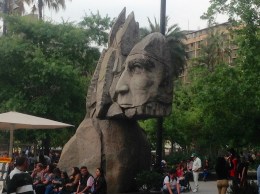
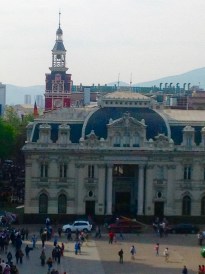 quiet drink in the only place open in Plaza de Armas. I ordered a pint of beer for a change and was absorbed reading in a cafe with maybe four or five other tables scattered around. I rather rudely ignored some mad punter who came up to my table and started jabbering away at me. I didn’t even look up until suddenly he grabbed my pint and started swilling it down. (Dan Hicks and His Hot Licks – “you’re drinking my beer and I’m gonna punch your teeth out”). I rather surprised myself by erupting, like an angry belch, up on the hind legs and grabbing him by the shirtfront, one arm raised to punch his lights out while roaring, in English of course, “I’ll f@#king kill you, you c**t”. Startled by my violent reaction, he twisted away while other punters at the outdoor cafe applauded and the waitress bustled over apologising and whisking my (nearly finished) pint off for a fresh one. No harm done, I suppose and a free pint, so I can’t complain. A promenade around the square later on, a surprising number of punters wrapped up in rugs, sleeping on the long park benches, despite police patrolling fairly regularly.
 One hour forty five minutes by bus from Santiago and arrived in Valparaiso shortly after12 noon. The first guest house was looking for 36,000 pesos a night so I moved a bit down market, private room with bathroom across the hall for 15,000. I’ll stay two nights and then look for something else – maybe at Viña del Mar, just down the road. Lovely to be beside the ocean again, although I am looking down at it as my hostel is up quite a steep hill but with no altitude, no problem.
 Drinking a 750 ml bottle of Altamirs Amber ale, lovely but a bit pricey at $15 Australian. Waiting for a “tun de mediterraneo” for lunch. “Que rico” (as they say here.) The place looks great, hundreds of hills and houses clustered around, all the colours of the rainbow. Pleasantly warm at the moment, t-shirt weather.
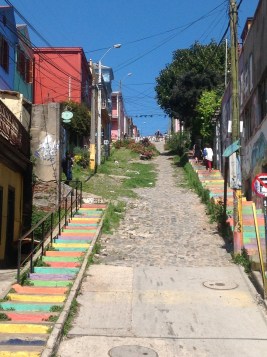 Valparaiso must be one of the most perpendicular cities I have ever been in. Hugging the coast, it clings to sheer hills that are accessed by elevators! Everywhere is a blaze of colour from the murals – think Banksy – on walls and hoarding and even the steps leading to my pensione. A stroll along the beach at Vina del Mar where the pelicans clusters at
 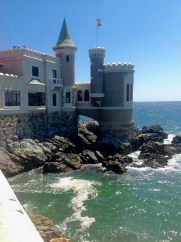 before returning to a tiny bar to watch the rugby between South Africa and New Zealand. Managed to swill down three pints in the company of a few South Africans.
 Red Branch Chronicles
You must be logged in to post a comment.