Wine and Amphorae

“Adds its own seasoning to food, cutting the richness of fat, making meat seem more tender and washing down pulses and unleavened bread without distending the belly” Hugh Johnson – The Story of Wine.

Southern Italy picked up the wine growing tradition from Greece where wine was often diluted with water or even seawater! In Homer, Odysseus got the one-eyed Cyclops pissed on strong Maronean red wine. Poor ol’ Cyclops was only used to weak Sicilian wine made from unpruned wild grapes. Scythian wine was so hard that Ovid claimed an axe was needed to cut it! Greek wine wisdom warned that one bowl was good for health, two for pleasure and love, three for sleep, four for violence, five for uproar, six for drunken revel, seven for black eyes, eight for peace officers involvement, nine for biliousness and the tenth for madness and the hurling of furniture.

Throughout the first century BCE the best quality wine was the white and sweet Opinium vintage. The most famous grapes were grown between Rome and Sorrento at the vineyard of Falernum where the wine came in three varieties – dry, sweet and light. A strong wine, Falernian’s colour varied from amber to brown when matured in the amphorae. Following on in terms of quality was Caecuban, followed by the wines of Alba, just south of Rome, while Trebellian came from Naples.

An amphora was a slender clay vase with two handles and a long neck. The base was either pointed or formed into a knob, but never flat. Sizes varied. Greek amphorae averaged about 40 litres, Roman amphorae = 26 litres or so. Potters made the amphorae in several sections, and then the wet sections were moulded together and the base pared down to a point or a knob, making it easier to lift and tip with the point acting as a third handle. Stamp of origin pressed into the wet clay of their handles. The mouth of the jar was sealed with cork or wax and resin. Ships could carry 2000 – 3000 amphorae at a time, the pointed ends buried in a bed of sand and the handles tied together to keep them steady on the trip from Pompeii up to Rome

Bordeaux was a perfect port for wine distribution to Britain and Ireland. A ‘negotiator Britannicuus” was identified on the wharf in the 1st century BC. Both Britain and Ireland had long had an active maritime trade based on the tin wealth of Cornwall, and the gold and copper found in Ireland, Bronze Age requirements for the growth in metallurgy.

Wine routes to Britain, varied widely. A long sea journey around Spain, overland to Bordeaux and then by sea, via the rivers – the Loire, the Seine and the Rhine and finally via the Moselle which was much more expensive than the sea route around Spain. Britons possibly bought the surplus from the Roman garrisons or, more likely, the amphorae were emptied of their southern contents and refilled with inferior, local German wines.

The Celts, as a race, seemed inordinately fond of drinking and, according to Diodorus Siculus, writing in the first century BCE, “they sate themselves with the unmixed wines imported by the merchants; their desire makes them drink greedily and when they become drunk, they fall into a stupour or into a maniacal disposition.” Poseidonius, writing sometime between 135 and 51 BCE claimed, “the drink of the wealthy classes is wine imported from Italy or from the region around Massalia…”

The city, modern day Marseilles, thrived by acting as a link between inland Gaul, hungry for Roman goods and wine (which Massalia was steadily exporting by 500 BCE) and Rome’s insatiable need for new products and slaves.

The great bronze vase of Vix, found in the tomb of a Burgundian princess at Vix who died in about 600 BC could hold 1200 litres or approximately 45 amphorae with the going price of an amphora equal to one (female) slave!

Of course, not all wine was drunk, often it was often used as an antiseptic for wounds although Druids disapproved of wine!


.
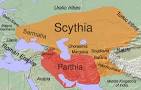


Scythia

Having mentioned in a previous post that the followers of Nemed were the third group of colonisers – according to The Book of Invasions, the semi-mythical origins of Ireland,  – who came from Scythia, followed, at a later date by the last of the so-called colonisers, the Milesians, once again from Scythia, I thought I had better establish who or what Scythia was.  Here goes:

Scythia was the name given by the ancient Greeks after about 800 BC to the homeland of the nomascythiadic tribes in the southeast part of Europe, eastward from the Carpathian Mountains to the Don River and in Central Asia, from the Danube River, an important route between Western Europe and the Black Sea, to the mountains of Turkistan.
They were a nomadic people who raised horses, cattle, and sheep. According to ancient Greek historians, Scythians travelled in tent-covered wagons and fought with short bows and arrows from horseback and spoke a form of Persian.

The most detailed western description is by Herodotus, The Father of Lies, or, more kindly, The Father of History, according to the blurb on my Penguin Classic, though it is uncertain if he ever went to Scythia.

Their empire stretched north of the Black Sea to parts of present-day Ukraine, Russia, and Moldova from the 7th century BC to the 4th century BC.

This region was seized by the Sarmatians in the 4th century BC and became known as Sarmatia. By the 3rd century the Danube formed the northern boundary of the Roman Empire in southeast Europe.


Epochs & The Book of Invasions

I have been going on about archeological and geological times frames, periods and epochs recently and I want to try and put this into some kind of framework with regard to Ireland and the first people to inhabit the island.

The tables below show the most recent information I can find with reference to the periods mentioned.

Paleolithic

pre 8800 BCE

Mesolithic

8800 – 4900 BCE

Neolithic

4900 – 2100 BCE

Nomadic hunting and gathering groups Transition between the Paleolithic and the Neolithic, the “Middle Stone Age”. Start and end dates vary by geographical region. begining with the Holocene warm period and ending with the start of the Neolithic era. Ireland initially colonised during this period, most probably from Scotland, the Isle of Man and Wales through existing land bridges.


c. 3800 – Farming widely adopted in Ireland over just a few centuries. Herding, polished stone axes, megalithic tombs and pottery almost identical to those found in Britain, suggesting a common origin or on-going contacts between the islands. Late Neolithic Grooved style pottery replaced by new Beaker tyle ceramics c. 2500 BCE


Bronze Age

2100 -500 BCE

Iron Age

1100 – 1 BCE

Roman Age

56 BCE – 420 CE

Britain Ireland

Ireland

The arrival of the irish language?

 
2100- 750 2100- 1500

The megaliths and the use of copper and tin, ushered in the early Irish Bronze Age

Early Iron Age

700- 400

Developed Iron Age

400 – 1 BCE


Initial contact with Roman World

Late Iron Age

AD 1 – 400

 
  1500 – 1200        
  1200 – 500    

Before I go any further I want to assert the fact that there is absolutely no evidence whatsoever that the earliest inhabitants of Ireland – during the Meseolithic and / or Neolithic Era – spoke Irish, Gaelic, or any form of a Celtic language until thousands of years after the first arrivals, no matter what the Lebor Gabála Érenn, The Book of the Taking of Ireland or, as it is more commonly known, The Book of Invasions, claims. This is a collection of poems and prose narratives that presents itself as a chronological “history” of Ireland and the Irish, the earliest of which was compiled by anonymous scribes during the 11th century and is regarded as part of the Mythological Cycle of Old irish documents followed by the Ulster Cycle, from which I drew the the inspiration for my novel, Raiding Cooley. Updated in the 12th century with Christian overtones, the aim of which was to provide Ireland and its kings with a genealogical lineage dating back to the earliest biblical times.

The difficulty here is trying to match the Mythological origins of Ireland with the hard archeological, genetic and linguistic evidence currently available.

The Lebor Gabála tells of Ireland being invaded six times by six groups of people:

The people of Cessair, the descendants of Noah, (direct evidence that biblical stories were incorporated into a sanitised version of the mythology), who first came to Ireland clung to the coast but later abandoned the country. Next were the people of Partholón, but he and his people died of a plague. Nemedians, supposedly from Scythia, were next but they left, having been continually harrassed by fierce sea robbers, the Formorians, from their base on Tory Island.

The Fir Bolg, (or Bag Men), descendants of the Nemedians returned, supposedly from Greece but more likely from Gaul and are credited with the erection of the great stone forts such as Dún Aengus on the Aran Islands as well as the division of the island into the five fifths – Ulaidh, Laighin, Connachta, Dá Mumhain and the central territory of Midhe. The fifth group were the Tuatha Dé Danann who were credited with magical powers and later came to represent Ireland’s pagan gods. Under their king, Nuada of the Silver Hand, they defeated the Fir Bolg and later destroyed the power of the Formorians who still infested the island.   To them, the great passage tombs at Newgrange are ascribed as well as the Stone of Destiny upon which the High Kings of Ireland were later crowned on the Hill of Tara.

The final group, the Milesians, represent the Irish people (the Gaels) and arrived sometime between 1700 – 1000 BCE after extensive travelling from (again) Scythia, Greece, Egypt (?) and Spain.

Archeologically, it seems certain then that different groups of people, some from the north of Atlantic Europe and some from the South, reached Ireland at different times since the start of the Meseolithic period.

So, who were these first people, and where did they come from? I will come back to this in  later blogs.

Partholon

Anthropocene – Waves and Epochs

Alvin Toffler, the fururist who died recently, posited the ideas that the world had lived through three “waves”, each one pushing the next wave further on. The first wave was that of the spread of Agriculture which replaced the hunter-gatherer societies of the Mesolithic periods. That, in its turn, was replaced by the mid seventeenth century Industrial Wave based on the mass production, distribution and consumption of goods as we became bedazzled with mass media, recreation, entertainment, and weapons of mass destruction. Combined with standardization, centralization, concentration, and synchronization, this second wave resulted in bureaucracy which was swamped by the Third Wave – the title of Toffler’s 1980 book which described the post-industrial society, beginning in the late 1950s.

For me, the amazing thing is the time spans involved with the first wave enduring for several thousands of years while the second wave only lasted a few centuries. How long will the third wave last? A few decades and then what? Will the fourth wave consist of …?

I’m not sure how these waves fit in with geological time but the notion that the world has entered a new geological age is currently being reviewed by scientists worldwide and the term Anthropocene is being proposed as the latest subdivision of geological time.

The search is now on for a “golden spike”, a marker that can designate the start of the Anthropocene Epoch, meaning the current phase of Earth history known as the Holocene has terminated. The best spike should reflect events on Earth around the 1950s – the start of Toffler’s Third Wave – and would probably be plutonium fallout from bomb tests in the 1950s, found in marine or lake sediments or ice layers This is seen as the beginning of what is often referred to as the “great acceleration”, when human impacts on our planet suddenly intensified and became global in extent.

Anybody care to suggest what the Fourth Wave might be?