

I suppose every country in the world has some sort of national dish – Ireland – Irish Stew; England – Roast Beef and Yorkshire Pud; Italy – Spag Bol; USA – Hamburger & Fries; Germany – Wurst mit Mayo; Turkey – Lentil Soup (though not quite sure if that is the national dish and in Georgia – the country, not the state in the US – all the restaurants in Tbilisi and wherever else I went, seemed to serve Lobio Nigvzit – a hearty bean stew in a small clay pot. (Apologies to anyone who feels I have misrepresented their national dishes above)
 Lobio is, at its most basic, just a thick stew of mashed beans with some or all or the following ingredients – fresh coriander, walnuts, garlic, onions,pomegranate molasses, fresh parsley or celery leaves, mint, chilli flakes, roasted whole coriander seeds, but it can be upgraded with bacon, beef, cheese etc. Here’s my take on the basic – feel free to add extras as you wish, but a word of caution, without any of the extras, it is still a deeply satisfying dish
Ingredients
1 mug of red kidney beans
1 cup walnut halves or pieces, finely ground
5 cloves garlic, minced
3 bay leaves
1 cup finely chopped coriander or flat-leaf parsley, dill, basil, celery greens
1 large, brown onion finely chopped
* 1/4 mug pomegranate molasses or red wine vinegar
1 tablespoon ground coriander, or to taste
1 teaspoon ground thyme
2 teaspoons kosher salt, or to taste
1 teaspoon smoked paprika or to taste
Method
Soak the beans, preferably overnight, in cold water but at least for several hours. I used one mug full of red kidney beans and covered them with buckets of water and they had pretty much doubled in size by the next day.
Drain the beans and cover with fresh water, add a few bay leaves and bring to a brisk boil before lowering the heat and letting the beans simmer while you chop onion and the fresh herbs finely.
When the beans are soft but still have distinct texture, add some salt and continue cooking until the beans are softer. Adding the salt too early can keep the beans from becoming tender.  Drain but keep back some of the liquid and use the back of a wooden spoon, or a potato masher, to mash the beans on the side of the pot. Remember to remove the bay leaves.
Pound the parsley, garlic,fresh and ground coriander, chilli, thyme and smoked paprika and whole mixed pepper corns in a mortar and pestle. I could find the pestle only and not the mortar so I used my mum’s old food processor, a Moulinex MasterChef 350, which I helped myself to when she was in hospital one time when I was back visiting. My sister assured me that our mum would not be using it again and that I would get better use out of it. And I do. It’s ancient but it still does the job!
Add the pounded or whizzed ingredients to the ground walnuts, also whizzed, and stir well with the pomegranate molasses before adding to the beans.
 Fry the chopped onion until golden and add to bean mix. Heat and thoroughly stir in reserved cooking liquid from the beans for desired consistency. Garnish with a few leftover parsley or corainder leaves, or whatever you have!
* pomegranates are a fairly new thing fro me and certainly the pomegranate molasses was a major new addition to my pantry. Tangy and sweet and sour, I bought it in a Middle Eastern style grocery but if you can’t find it, red wine vinegar can be used, I suppose. Incidentally, the pomegranate molasses is lovely mixed with sparkliing water for a really refreshing – and different – drink.
Variation: add chorizo, bacon or yoghurt

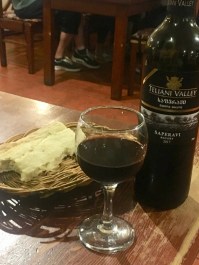 The Washington Post, National Geographic, The Daily Mail, the BBC, CNN, The New York Times and the ABC all ran fairly recent stories bruiting the news of radio-carbon dating of pot shards and bio-molecular and DNA archaeology of grape pips from the Stone Age accurately dating wine making to that period in Georgia.
 Just as no one can claim the invention of the wheel or the discoverer of fire, similarly, no one can claim to have invented wine. Nevertheless, legends lay easy claim to the latter. Noah, after he landed the ark on Mt. Ararat (on the borders of modern day Turkey and Armenia) disembarked the animals and planted a vineyard after which he got horribly drunk and made a disgrace of himself. All of which begs the question of where he originally came from because he must have brought the vine shoots or saplings with him in the ark! Then there is the much older Sumerian Epic of Gilgamesh which also details a deluge after which the eponymous hero sets out on a quest to discover wine and the immortality it can bestow. Another Persian legend describes how Jamshyd – a semi-mythical king – kept grapes to be eaten in jars. One of his handmaids, out of temper with the king and his court, attempted to top herself by drinking the juice from the foaming grapes in one jar, believing it to be poison. Instead she discovered the delights of alcoholic inebriation which she then passed on to the king who, according to the XVII Rubaiyát of Omar Khayyam (The Fitzgerald Translation 1859)


 Red Branch Chronicles
You must be logged in to post a comment.