Travel and Transport

Transport options were fairly limited in Iron Age Ireland. There were no paved roads although at its simplest, trackways of single planks laid end to end across boggy surfaces would have been used by single pedestrians. A more stable surface would consist of tightly packed bundles of hazel or birch twigs laid in thick layers across boggy and marshy land. More elaborate were “hurdle” trackways which consisted of woven panels of brushwood placed end to end, over which logs and crude planks were laid sideways.

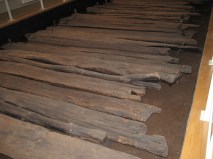
Excavation in a peat bog in 1994 uncovered the Corlea trackway, the largest trackway of its kind to be uncovered in Europe, extending as it did for more than a kilometre in a NW – SE direction before turning to a SW direction for a further kilometre.

Near the village of Keenagh in County Longford, Ireland, the trackway dates from approx. 148 BCE and consists of packed hazel, birch and oak planks placed lengthways. The upper surface of the

IMG_0373
Photo taken ar Corlea Visitor Centre by author.

trackway was up to four metres in width with planks laid side by side on top of parallel beams and must have been used for wheeled transport.

Hundreds of oak trees would have been felled, trimmed and then labouriously split by pounding in wooden wedges along the natural grain of the wood until the trunk split into two halves, each half being then further split into crude planks. Such a major construction project of the time would have involved hundreds of people and, unlike other bog trackways or “toghers” catering to the needs of local farmers moving animals and goods across country, may have been part of a larger communication

network.

IMG_0374

IMG_0376
Photo taken at Corlea visitor Centre by author

Overland journeys were made on foot or on horseback or in heavy 4-wheeled wagons, pulled by oxen.

Despite my inclusion of chariots in my novel, Raiding Cúailnge, no archeological evidence has been found to support the use of chariots inIron Age, Celtic ireland although chariot use was widespread among European Celts.

Light, fast two-wheeled chariots were often decorated with bronze and enamel fittings and were pulled by two horses yoked together and controlled by up to five terret rings through which the reins passed, setting the angle at which the charioteer could pull on the reins.

Chariots were usually open, front and back, with double hooped sides of woven wicker, joined to a flat, springy base of interwoven rawhide strips. The base, upon which the warrior would stand, was suspended within the frame of the body, thus providing a very rough form of suspension, similar to the stage coaches used so much later in the Wild West of the USA.

Wheels had twelve wooden spokes on a fixed axel. The outer part of the wheel was the rim and the wheel itself was fashioned either by using an ash sapling which was bent and shaped until it required the requisite shape or made with six felloes. A felloe was an arc cut from a board of timber with each one abutting its neighbour. Iron was forged into a hoop and put on the wheel while still hot and as it cooled, it contracted and tied all components of the wheel together.

Coracles, small circular boats, designed for rivers and lakes, were made of cow leather stretched over a latticed wooden frame and were powered and steered by a single oarsman standing erect leaving room for one or two people only. Larger, sea-going boats had removable oars and a mast for the sail.
 

Stuffed

I started off, way back now in March, swearing to get on top of all this cyber stuff – social media communication –  and I launched myself bravely into Facebook, Twitter, Google+, LinkedIn and WordPress as well as continuing to write and market my first book, Raiding Cúailnge, start research for my second book – tentatively titled “Three Spears” and actually live a normal life with all that entails – getting up in the morning, feeding the chickens, pottering around in the garden, going for a short cycle, endlessly devising the shortest and flattest routes between home and other points and all the other humdrum aspects of daily life.

And I’m stuffed.

I’ve just about managed to continue WordPress and my three blogs – Celtic Trivia, Book Stuff and Curves-  and start scribbling notes for Three Spears but I am afraid everything else has gone by the board. I just don’t seem to have the time to do them all and certainly I can’t remember the last time I bothered to look at Twitter or LinkedIn.

As for Facebook …

I remember a knowledgeable guru told me that I should narrow my focus and concentrate on just one aspect of social media.  “Make it yours” he told me sternly and he opined that I should focus on Facebook.

Well, of course I didn’t and I suppose it is too late now given that I seem to have poured my energy into WordPress. I think it is the fact that WordPress remains a bit similar to the hole in a tree down in the local park (which I cycle past). I post stuff here and I feel it is the same as if I stuff it into a hole in the tree and I have no idea if anyone ever reads it or bothers to look at it but for some obscure reason, I enjoy shoving a nugget into the bole of the tree and leaving it there for someone to discover – posthumously!

Whereas with Facebook, I feel constrained in some way I haven’t fully analysed as yet. I think it all comes down to that vague, unidentifiable fear I mentioned ages ago – hmm, on Facebook or on Word Press? I am sure it is just a question of tightening up a nut here and a screw there and making a few fine adjustments to the way I present my Facebook page but at the moment – although I haven’t checked for weeks – I feel inundated with Facebook things – are they posts, tweets, messages, mails? – with the whole world constantly updating their whatever it is and uploading new photos of themselves – I can tell because I get a constant barrage of beeps and whistles from my mobile phone telling me that I “can’t be a man ‘cos (I) don’t smoke the same cigarettes as (you)” – thank you Nanker Phelge.

Anyway, the point is that while I struggle to continue with the triad of blogs on WordPress as well as continuing to work on Three Spears, I just don’t seem to have the time to mess around on FaceBook, Twitter, LinkedIn or Google+ and I have yet to make a hash of Tumblr, Instagram and Gawd knows what else I can ignore!

Genres and Writing

cropped-bookcase.jpgI mentioned somewhere previously that I had started “work’ on my next novel. After all, you can’t really call yourself an author unless you have about half a dozen trilogies to your name so … anyway I began. Scribbling away in my new notepad as well as in MS Word – actually I like a notebook and pen. Oh don’t let me go down that path the endless discussion between writing with paper and pen as opposed to on a keyboard. People come to blows over things like that, I understand. Anyway, I will just say let me get on with my vapid scribblings on my hand-scuffed vellum, bleached ox-hide covered notebook. Anyway the point is that I was going through notes and points of views and characters and settings – and all the various possibilities of beginning a novel or a story (there are apparently something like 10,000,000,00, 000 moving possibilities within the first ten moves in a chess game. Actually, there are one hundred and sixty-nine million, five hundred and eighteen thousand, eight hundred and twenty-nine followed by twenty-one ciphers and no, I haven’t counted them myself. In fact I don’t even know how to play chess – Oh, Gawd, another learning curve?).

Anyway, I am discovering it is the same with a book beginning. I can start anywhere I like and in whatever genre suits my purpose. Reading the translations of the early Irish documents from the 8th century and is preserved in The Book of the Dun Cow (c. 1100) I found myself bursting out laughing at various points at the machinations of the characters and the tongue in cheek descriptions given by some unknown clerics back centuries ago. Maybe I’ll make a new genre, or at least add to the corpus of humour historical. I bow down to the past master – The Flashman creator, what a ripper. I love him, but I am not attempting to make my characters in any way the same as Harry Flashman but …

Anyway, the point is – a new genre – Historical Humour / Humorous Hisorica?

Do I have it in me to be a funny man?


Bards, Druids and Knowledge

cropped-img_0322_edited1.jpgIn a society which valued oral traditions over the written word, story-tellers or a seanachi and bards played a vital role in linking disparate groups and providing a common identity through shared stories and histories. A bard learned all the different types of poetry and memorized hundreds of songs, poems and legends. They also learned how to play instruments and to read and write although music and poetry was never written down. A bard was the first step taken towards becoming a druid which could take up to twenty years learning by heart the verses and stories. Such sacred knowledge was considered too important to be written down, hence the current lack of information as to the exact role that druids played.

Druid meant “Knowledge of the Oak” which, along with Mistletoe, was considered sacred. Special groves of oak trees provided sanctified, sacrificial area for rites central to the Celtic way of life. What those rites were is impossible to know, given that nothing was ever written down. I imagine druids performed sacrifices and rituals which might actually match the self same rituals we often undergo in our lifetimes – births, deaths, anniversaries, celebration of the seasons and so on. Whether they had a more sinister side as in human sacrifice, I suppose it is possible but certainly not the norm.

Mistletoe was believed to have magical powers and, when growing on an oak tree, must only be cut with a golden sickle.

Druids believed some days were luckier than others and would confer powerful totems of strength, fertility and power, as represented by wild boars, elks and wolves, on warriors.

What medical knowledge current within the Roman Empire would also have been known in Iron Age Ireland. Medical practices such as using maggots to eat wounded and diseased flesh would have been commonplace while boiling willow branches to make a bitter tisane containing some of the pain killing properties of modern day aspirin would be well known. Spider webs and certain types of mosses were packed into and over wounds and apparently acted in some sort of anti-biotic way while valuable and imported Cedar oil was used by the druids to preserve human heads.


Times and Seasons

cropped-img_0322_edited1.jpg

I should have posted this about a week ago as the time was germane to the topic but here goes now anyway.

The Iron Age Celts counted time in terms of nights rather than days and the passing of moons rather than months while the celebration of Féis, or festivals, at regular intervals marked the passing of the years.

The most commonly observed féis included:

Bealtaine (May 1) which was observed by lighting bonfires, the smoke of which had purifying powers and was used to kill pests on cattle. I think it might also have been an early harvest time but i couldn’t swear to it.

Next up was Lugnasa aka Lughnasadh and Lughnasa. (Aug. 1) which was the festival marking the beginning of the harvest season. Originally it was held on or about halfway between the summer solstice and autumn equinox. The festival itself is named after the god Lugh. It involved great gatherings that included druidic ceremonies, ritual athletic contests (most notably the Tailteann Games, Áenach Tailten which were held at Tailtin in County Meath), feasting, matchmaking and trading while community rites included an offering of the first of the grain crops, a feast of the new food and of bilberries, the sacrifice of a bull and a ritual dance-play. Much of this would have taken place on top of hills and mountains.

Samhain (Nov. 1) was the start of the Celtic year and was, again, a time for sacrifices and community gatherings. Rememberance of spirits of the dead was a prominent feature while the festival also marked the end of the harvest season and the beginning of winter or the “darker half” of the year, the time when cattle were brought back down from the summer pastures and when livestock were slaughtered for the winter. As at Bealtaine, special bonfires were lit. These were deemed to have protective and cleansing powers.

Finally, Imbolc (Feb. 1) marked the beginning of spring and fertility, renewal and purification and the yearly cycle continued its round.

Interestingly, in the fifth Century when St. Patrick brought Christianity to Ireland, rather than trying to stamp out these “pagan” festivals, the early church commandeered them – Samhain becoming All Souls Day and Easter taking over Bealtaine. St. Paddy himself used the sun symbol of the god Lugh superimposed on the Christian cross to make what is widely known now as the “celtic cross”.

A follow -up to “A Rod for my Own Back”

cropped-bookcase.jpgI think I mentioned some time before that I really needed to be goaded, cajoled and pushed into doing things because my natural indolence often pre-empts unilateral action on my part.

Anyway, even though I was slaving away on my book –Raiding Cúailnge – for years, I had neither a title not any real idea of getting it published. And then a friend of mine – we had been friends since we were seven years old when I broke my collar bone sliding in my school socks down his linoleum covered hallway – contacted me from Nantes, where he had been living for the last twenty years or so, to announce, out of the blue, that his book was being published. It was like a bucket of icy water thrown in my face. The cheek of him – to write – and publish a book before I had gotten around to doing one. Anyway, the immediate result was that it galvanised me into action and within a short space of time – well, probably two years, I had chosen a title and finished off my rambling novel based on old Irish manuscripts about Ireland’s legendary hereo, Cú Chulainn.

Anyway, Michael – although for some reason I always refer to him as Mick – asked me to write a review of it on Amazon and I scribbled something like “if your friends are loud and boozy, this is the book to give them if you like a mix of Pink Panther style crime and mystery” or something like that.

So, his book – initially a real paper and cover book but now also available as an E-Book – is called The Full Stop Artist by Michael O’Reilly Kennedy and is available on Amazon.

A different style to mine I’d have to admit – I’m more of the plodding historical kind while if you were a fly on the wall during one of the weird dinner parties with which The Full Stop Artist is punctuated, then you would end up as a drunken – and probably – squashed smear.

Iron Age Trade

cropped-img_0322_edited1.jpgIt is easy to assume that groups of people – tribes, clans and so on – were isolated in the Iron Age. In fact, the opposite was true – trade routes were well established connecting Ireland, Britain and continental Europe. Rome was the only game in town, spreading across North Africa, Mauretania, Cyrenaica, Arabia, Mesopotamia, Parthia, Scythia, Sarmatia, Germania, Gaul and Hispania. There was no Internet, not even a Telex or a news agency but there was the empire and its administrators, its quantity surveyors and its salesmen, purveying its values and influencing its colonies and satellites.

There was a common understanding – and appreciation – of the value of things. “Why do you, with all these grand possessions, still covet our poor huts?” was an apparent lament of the oul’ Brits when Caesar arrived in 55 BCE or something like that. I take that to mean that the Brits had some understanding of what the empire stood for and had prominent citizens and traders visiting huge cites which dwarfed their own, possibly, more humble dwellings. Big fish in small ponds suddenly made aware – but so far ignored – that there were bigger fish in larger ponds.

Anyway, inevitably, people traveled, spreading news, ideas and culture and bringing with them desirable trade items – spices, scents, slaves, ivory from North Africa used for armor (see the account of Ferdia’s armor in The Táin) while the far flung western isle had, at least, both wolf hounds and gold.

Extensive trade was long established with Gaulish Europe along settled sea routes while movement between the east coast of Ireland and what is now Scotland, Wales and England was common. Contact was probably less frequent with Greece, Scythia, Parthia, but shared knowledge – pottery, smelting – could never be unlearned while commodities like copper, tin, enamel, tortoiseshell, Tyrian purple dye from Murex glands, Falernian wine and slaves were common – but expensive – items.

Commodity or Currency?

cropped-p8170324.jpg
CURVES

This – for me- from where I am coming from, (mostly ignorance) – whole deal about bitcoins is pretty weird. What are they? According to at least two articles I read on BBC news they are either a commodity – like pork belly and coffee – or they are a token like the Italian “getone,” which you had to buy – usually in a bar with a good coffee machine – before you could use a public telephone. So, bitcoins – or getones – weren’t currency because they (the latter anyway) had no monetary value but they were worth the duration of a telephone call. This was well before Skype, I suppose.

Anyway, the point is, that these yokes, bitcoins, are something that can be traded and swapped, – like, I suppose, pork bellies and Euros. (By who and where, and what for?)

So, where do they come from? Who makes money from them? Why was it all a big secret? Why didn’t the Japanese guy – or did he? – say something like – I am not the inventor.

I remember reading something somewhere where it mentioned that if you ever wanted to be mega rich from absolutely nothing, then start your own religion. Ron L Hubbard did apparently – as well as write books – did he write Genesis or was that God?

So, bit coins are “mined” from something – obviously – but a 64-digit number is the answer to some increasingly complex cryptographically engrossing problem and then you need a bitcoin address. And a wallet in the cloud? Mother of god! It’s all getting a bit too fancy for me – a bit rich for my blood and I still have not done anything about the copyright issue for photos and that kind of stuff. Something to look forward to later, this month!

Can’t believe it is May already.