This is a standard Malaysian kampong style recipe and while it is called a curry or “gulai” no commercial curry powder is used. Instead the exquisite flavour comes from the dried spices and seeds, which are traditionally pounded in a stone mortar, mixed with the dried chillies, fresh ginger, garlic and lemon grass, or serai, and santan, or coconut milk, in Malay.
My experience with coconuts before living in S.E. Asia was limited to the hard, hairy nut we would buy once a year on Hallow’een when I was a child. Then, my father would use a corkscrew to punch through two of the three small depressions at the top of the nut so that he could drain out the juice before labouriously cracking open the shell with several increasingly hard blows of the hammer until, misjudging his blows, the shell would suddenly shatter and pieces of it would fly around the kitchen. The thin, insipid water drained from the shell was what I mistakenly then thought was coconut “milk”.
I remember goggling with amazement when my neighbour in the kampong, demonstrated the ease with which he unhusked a coconut and then sliced it open, evenly and cleanly, with one blow of his parang. The so-called milk was poured into a rusty basin for his goats to drink and then the real magic of the nut appeared.
Sitting astride what looked suspiciously like a stripped down bicycle frame with a heavy, rounded, metal grater knob emerging from where the handlebars had been, Mamu would rotate and rub each half of the shell over the grater, scraping out the firm white flesh inside the shell. Two cups of water were added and stirred around this mound of grated coconut in a large basin. The kneaded and squeezed mixture strained through a fine sieve resoled in 2 cups of a brilliant, white, thick, deliciously sweet milk, called the first squeezing or the cream. Two more cups of water and the mixture kneaded and squeezed one more time, resulted in a much thinner liquid called the milk. For most people, it will be much easier to just buy a can of coconut cream or milk from the local Asian supermarket.
Delicately flavoured lemon grass can be grown in most back yards or bought in Asian supermarkets either fresh, dried or bottled and adds a wonderful flavour to a host of Asian dishes. The stalk is quite fibrous, so remove the tough outer husk and then smash the inner stalk with the back of a cleaver to release the flavour before adding it to the mortar.
In most S.E. Asian cooking, the spices are pounded and ground daily so that the sudden thumping of pestles and mortars traditionally done, squatting on the floor, echoes throughout the afternoon in the village.
In Malaysia, I used tenggiri, a glorious, firm fleshed variety of deep sea Spanish Mackerel. Albacore is the name used in West Australia for this beautiful, white-fleshed fish. Grilled, fried, baked or curried, it requires serious over-cooking before it falls apart.
So honoured in S.E. Asian waters that it was the subject of a North Vietnamese Stamp, and may still be, for all I know. It is usually sold cut into thick, plate-sized steaks but any firm fleshed, white fish can be used.
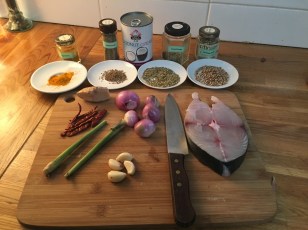
Ingredients
I kg Spanish mackerel cut into steaks
3 tsp. of coriander seeds
2 tsp. fennel seeds
8 small red shallots
5 cloves of garlic, peeled
I tsp. cumin seeds
1 tsp. turmeric powder
5 dried red chillies, soaked for 5 minutes in hot water and then deseeded
2 stalks of lemon grass
Thumb size knob of fresh ginger
2 cups of coconut cream
Salt, to taste
2 cups coconut milk
1 Tbsp. of oil
Fresh coriander (garnish)
Method.
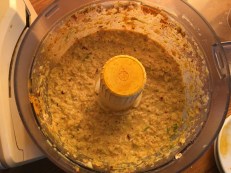
Pound the shallots, garlic, ginger, dried red chillies and lemon grass in a mortar, (or whiz in a food processor, if you prefer) Mix the dried spices – the coriander, cumin, fennel and turmeric – together and crush in a mortar or in a coffee grinder. If you have neither, crush on a cutting board with the back of a large spoon.
Heat oil in a large wok, add the pounded shallot mixture and the crushed coriander mix and fry briefly until fragrant – about 1 minute.
Add the 2 cups of thin coconut milk to make a paste and bring to a gentle simmer. Stir occasionally for about 10 minutes
Add the 2 cups of coconut cream and simmer for a further 10 minutes.
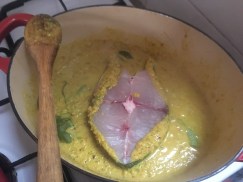
Finally add the fish and salt to taste and cook gently for a further 10 minutes or until the fish is done.
Serve with white rice and garnish the dish with a sprig of fresh coriander and some slivers of fresh red chilli.
I do not know what it is about islands but I am always drawn to them. If there isn’t an island handy, I make do with a beach. The first time in the Philippines, I had spent my time lolling on White Sands beach on Mindoro, an island south of Manila. So, this time, after one day of wandering along Roxas Boulevard in urban Manila, admiring the sludge called Manila Bay, sidestepping hordes of ragged children clamoring for dollars, I decided to head to the far north of Luzon and the Bay of a Thousand Islands.
Easier said than done, sometimes in the Philippines. The buses are old and bone-jarring, crowded to bursting point with peasants and country folk who always seemed to be traveling inordinate distances with out-sized sacks and bags of produce, the occasional trussed chicken and the odd pig squealing mournfully at my cramped feet on the floor, as if it knew it was being taken to the nearest market to have its throat slit. Even more worrying, for me, at the time, was the way my carry bag was roughly tossed on top of the bus’s dented and battered roof rack, along with the baskets of mangoes and gunny sacks of … I couldn’t tell you what not. Say goodbye bag, I thought to myself, convinced that that would be the last I would see of it as labourers, passengers, scavengers, children and assorted hop-off-my-thumbs swarmed over the bus, adjusting bundles and tightening bales before we lurched off into the night with a sickening jolt and an explosive backfire.
Every bus journey I have ever taken in an Asian city always seems to go through the dreariest, seediest, roughest parts of town. This trip was no exception. Endless industrial zones with grimy workshops advertising “Re-Vulcanising” which could have meant anything, as far as I was concerned, litter strewn, desolate streets, groups of ragged men standing around smouldering braziers, tattered children playing in petrol streaked pot-holes but then, almost with a gasp, we were out of the city and trundling north towards Baguio.
Eventually, after what seemed hours, the bus rumbled into San Fernando La Union just as dawn broke on the Gulf of Lingayan. Numbed by sitting bolt upright for the last 8 hours or so, I was too exhausted to even be surprised that my bag – intact – was still on top of the bus. Even more surprising was the charm of first place I came to which was a set of picturesque chalets nestled on the side of the bay.
“Balut, Balut” repeated cries later that afternoon woke me from the deep sleep I had fallen into almost immediately after my arrival. The sun was already beginning to sink over the Gulf, flooding the area with a peculiar rosy hue that only lower atmosphere pollution can achieve. Still stiff from the bus journey, I decided that the best thing to do would be to stroll along the beach and see what was what.
Hawkers and vendors were out in force selling fried bananas, crispy on the outside, succulent and gooey on the inside, fresh coconuts, the tops of which 5 year old children could whack off with what looked like WWII bayonets, sliced pineapples in plastic bags, and the ubiquitous mangoes which the hawkers would slice in half, rapidly criss-cross the flesh with a knife and then partially fold inside out so that the juicy flesh was pushed up and out in bite sized chunks. Smiling, dark-haired girls proffered skewers of cooked meat from small charcoal hibachis while lovers strolled hand-in-hand along the beach, enjoying the serenity of the sunset.
“Balut, balut, balut” the cry came again and a pretty girl in an embroidered peasant blouse and wraparound skirt, a woven basket over her arm, approached me. Nestled in the basket were a dozen eggs, slightly larger than chicken eggs, with a faint bluish tinge to them.
Annalisa was 23 years old and only sold the eggs for her grandmother, who lived down the coast in Vigan. During the day, she worked in a museum, commemorating the death of a “padre” executed by the Spanish in 1872. When I asked her why he had been executed, she smiled and admitted she didn’t know. “But you work in the museum,” I protested. A delicate shrug of rounded, tanned shoulders, a coquettish toss of the head, “Never mind-ah, lon’ time ago, you buy balut fro’ me. Balut bery goo’ for man, make you stron, bery goo fo’ you”.
Hard-boiled eggs always reminded me of childhood picnics in Dublin and I was hungry, come to that, and she was pretty, in an elfin way. Rummaging carefully under the clustered eggs in the basket, Annalisa produced a twist of newspaper containing a sprinkling of coarse sea salt and proffered it to me with an encouraging gesture.
Slightly stung by her assertion that I should need a few eggs to make me strong – after all, hadn’t I just completed the bus journey from hell, I reminded myself – I handed over a few pesos and walked along the shore with her at my side, attempting to juggle the eggs to impress her with my manliness.
“You eat now-ah, goo’ for you, make you stron.’” she insisted.
Throwing an egg high up in the air so that in spun in the diffused light of the setting sun, I caught it left handed and gave it a sharp crack on my forehead to break the shell, preparatory to peeling it away. Instead, a thin viscous liquid trickled down through my hair and slid down the side of my face. A scrawny gosling, all paper thin bones, pointy beak and bedraggled feathers gaped up at me from the shell!
Annalisa looked at me in utter amazement before doubling over with laughter as I stood there, aghast, eggs in each hand and the remains of a semi-boiled, fertilized duck egg smeared over my hair and face.
Luckily, the night was rapidly darkening and no one else was there to see me with egg all over my face. Annalisa was quick to proffer tissues, fearful of losing a potential customer, but unable to hide the giggles from breaking out again, as I made rather hasty and flimsy excuses and fled back to chalet to wash the gunk out of my hair and to wipe it from my mind with liberal doses of the local dark Mabuhay rum and calamansi limes.
What makes a book irresistibly good? What type of book garners remarks like “couldn’t put it down”, ” a real page turner” and so on?
Are they character driven, or is it the genre, the plot, the setting, the style, the twist or the originality? All of them, of course and much more as well.
But to find, not only all of the above in a strong, character-driven novel, but also a specific and vivid historical mystery in Tudor times, is a find indeed.
In the Shardlake series of novels by C. J. Sansom both mystery and a historical vividness blend seamlessly in the humanist form of a candid and honest barrister at Lincoln’s Inn during Tudor times. Unwillingly, he finds himself working for Thomas Cromwell, Henry VIII’s first minister, and other members of the court as the massive task of dissolving the monasteries’ grasp on power and land begins. An ardent reformer in his youth, Shardlakes begins to withdraw from the capriciousness and cruelty of the court but finds himself investigating, on Cromwell’s behalf, the murder of a high official at an isolated monastery in the depths of winter.
The six novels in the series (so far) span the reign of Tudor Henry VIII, from the winter of 1537 to the summer of 1546. Tudor England, where Henry has already broken with Rome and assumed the role of Head of Church as well as State, is a dangerous world of fanatical religious reformers, ambitious and jostling informers and unscrupulous and powerful performers and where to speak one’s true thoughts on religion and God could lead to charges of heresy and death by torture and burning.
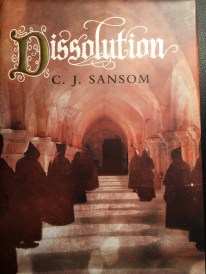
In Dissolution, the first in the series, Matthew Shardlake, single, a lawyer, a humanitarian and a hunchback, regarded with distrust and fear by most people because of his deformity, reviled but used by the nobility for his intelligence, diligence and ability, is sent to investigate the sacrilegious murder of one of Cromwell’s commissioners in a remote monastery in the midst of a freezing winter. Drawn into a world so completely realized, the actual setting is as palpable as the villians he encounters, Shardlake’s involuntary involvement with the politics of the law and church unravels murders and mayhem. Increasingly disillusioned, he must juggle personal and conflicting ideals, as reforms seep into the kingdom. Emotionally scarred by his brush with politics and greed, Shardlake is determined to withdraw to an ordered and quiet life at Lincoln’s Inn helping those who are most in need of his legal skills.
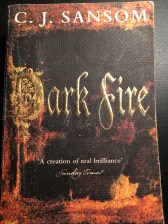
However, in Dark Fire, the second in the series and, again at Cromwell’s express command, Shardlake, with the help of his new assistant, Jack Barak, must discover the source of a lost secret weapon – Greek Fire – with which Cromwell hopes to regain the king’s favour while at the same time acquiring an apparently hopeless case defending a young girl accused of murdering her own cousin.
Fascinating in both the legal details of the time – “peine et dure” being a case in point – and the seething background of the London scene, Shardlake discovers that in the world of alchemy and greed, nothing is as it seems and avariciousness plays an equal part in the life’s of both the common and noble folk.
Hoping to avoid further contact with the court after Cromwell’s downfall, Shardlake is nevertheless involved on missions for Archbishop Crammer and in Sovereign, he travels with Henry’s court to York on the Great Progress, dealing with legal submissions to the king but also to oversee the welfare of a traitor due to be conveyed to the Tower of London for a torturous interrogation. A seemingly irrelevant murder in York involves the lawyer and his irreverent assistant in a cache of secret documents which undermine the sanctity of the Tudor throne and which brings Shardlake terrifyingly face to face with the torturers in the Tower.
Revelation, the fourth novel, delves into the twisted world of a serial killer – a concept so alien to the ordinary Tudor mind that it arouses fears of witchcraft and sorcery, all the more so when inextricably linked with the prophecies of the biblical Book of Revelations. Taking on the case of an accused heretic, confined within Bedlam insane asylum, Shardlake must navigate the treacherous waters of religious purges while investigating the murder of his best friend linked to the dark prophecies of Revelations.
Heartstone, the penultimate novel in the sextet, sees Shardlake set off for Portsmouth on a private mission for Catherine Parr in the summer of 1545 as Henry prepares the Mary Rose and The Great Harry for a imminent French invasion.
Strong, driven characters, grounded in a specific time or era, essential but often locations are cursorily sketched or taken for granted but not so, in these multi-layered mystery events set in Tudor times. Shardlake, with his modest and unassuming air, a strong moral integrity and a keen interest in using the law to help the downtrodden, is a true renaissance man who grows and develops through constant danger among the shifting thoughts and trends of Tudor politics, a vivid and immediate setting, dealing with bewildering and baffling murders, alien to the beliefs and understandings of the time.
Multiple plot lines weave seamlessly together as characters assume unexpected relationships which reverberate through the stark realities of the Tudor world where being different or out of favour risks cruelty or execution. Shardlake, determined, scrupulous but above all, human must investigate events as feared and misunderstood at the time as terrorist outrages are today.
I’m looking forward to getting my hand on the most recent in the series, Lamentations.
(I know, I know this isn’t really Celtic Iron Age Trivia / Technology like the other posts in this category have been but …. well, it was just St. Patrick’s Day (March 17) this day last week so here goes – sorry if I dispell any myths!).
Go into any Irish pub anywhere outside of Ireland itself and no doubt there will be a mural or picture of the saint himself, mitred, robed, smiling beatifically or looking suitably sombre and not a pint of Guinness in sight.
The reality was rather different as it turns out.
Patrick, whose birth name was Maewyn Succat (b.390 CE), was the son of Conchessa and Calpurnius, a tax collector appointed by the Roman administration in western Britain. Patrick’s family were local stock who had long accepted Roman rule and custom and would be considered well to do in that they themselves were slave-owners.
Constantine the Great had earlier exempted Christian clergy from city council duties and, as increasingly frequent raids on the coastal districts made collecting taxes difficult, Maewyn’s grandfather, Potitus, had taken full advantage of the exemption by entering into a relaxed form of Christianity.
Calpurnius, however, was obliged to resort to harsh methods to collect the amounts demanded by Rome as, if less than demanded was collected, the “exactor,’ as Calpurnius was known, had to make up the deficit from his own pocket.
Stillicho, a Roman legate, was insisting on the full tax levy and Calpurnius was under a lot of pressure to buy and sell slaves to redress the difference
In 406 CE, Irish raiders attacked their Roman style villa and enslaved the 16 year old Maewyn to herd and tend sheep in the rugged countryside around Slemish, Northeastern Ireland. By 410 CE, all Roman forces had withdrawn from Brittania, leaving the country exposed to continuing raiding by Goidels or Irish raiders.
The youth spent 6 years in thrall to Irish pagans, where he discovered both his “anam cara” – the friend of his soul with his God and an empathy for his captors as much cut off from the true religion as he felt himself to be. Guided by a voice only he could hear, he escaped captivity and, convinced of his divinely inspired mission, studied under Bishop Germanus in Auxerre and again in Rome, determined to bring salvation to the people controlled by their pagan druids.
In 431 Pope Celestine I, concerned more at the growth of Pelagianism in Britain than the rife paganism in Hibernia, sent his bishop to suppress the Pelagianheresy but Palladius died with no success in Scotland in 432.
Maewyn, meanwhile, had received the tonsure at Lérins Abbey and taken the name Patroculus, and jumped at the chance to return to the island of his slavery and pagan druidism. Celestine sensed that Patroculus was made of sterner stuff than his former envoy and as a womaniser, a fighter, a hard man of his times, well used to both the power of the word as well as the sword, he would be an invaluable bulwark against the bishops in Britain who stuck to their heretical ways. Patroculus certainly never claimed to be a saint but by his death in 461 he had founded a base for Christianity in the far-flung western isle that has never wavered since.
Happy Saint Patrick’s Day for next year if you missed it!
According to Julius Caesar and other writers and chroniclers from the first century BCE, such as Strabo, a Greek geographer, and Diodorus Siculus, an historian from Sicily, the ancient Celtic druids were more than just a semi-mystical priesthood.
Caesar certainly saw them not only as an organised inter-tribal brotherhood who acted as living repositories of their tribal histories and legends, negotiating, legislating, judging and officiating over all individual and community oaths and sacrifices but also as a rival authority to the extension of Roman power among the so-called barbarian tribes of the north.
Others regarded druids as poets and bards, seers, teachers, historians, astronomers, medical practioners and – later through the distorted lens of early Christians – as devious wizards and magicians who kept their people in thrall with simple sleight-of-hand tricks.
Probably all of the above is true, in some sense, in that they were, without doubt, the learned men of their people who had the recognised and unquestioned power to ‘excommunicate” individuals from community events. All commentators agree that they had a vast store of knowledge which they acquired orally and passed on to their followers over a 20 year training period.
No doubt they were poets and bards as the easiest way to memorise huge tracts of knowledge relating to tribal law and ownership was to make use of standard poetic functions such as alliteration, rhyme, onomatopoeia, simile and metaphor as a way of preserving and keeping alive tribal history and legends.
However, as no written records*1 exist of what the druids knew or learned, it is mere conjecture to say what they actually did.
Nevertheless, it is feasible to consider how the classical ancients described them and to put that knowledge into a suitable context.
It is likely that the druids became the sole provider of laws and customs among the widely varied nomadic and pastoralist Celtic people inhabiting Europe from the Early Iron Age, c.800 BCE. Being outdoors as a way of life, the druids would have become very receptive to the divine powers inherent in nature and would willingly have entered into a communion with them, having gradually assimilated facets from other existing codes of law and belief into their own oral bodies of knowledge. As nomadic people settled and adopted agriculture, more elaborate rituals and sacrifices were needed and the druids eventually became the predominant social and political bond uniting all Celtic people that Caesar feared so much and vowed to destroy.
What is known is that druids could be both male and female, with the men shaving their head across the forehead, leaving the hair long at the back, and that they were exempt from taxes and military service. Extraordinary attention was paid to the human head, which was seen as the location of the human spirit or soul. Heads, taken as a trophy in battle, implying control of an enemy’s spirit, were later preserved in cedar oil. Shrines often contained these mummified skulls or artistic representations of them.
With the rise of the hill forts and their ascendant chieftains, druids gravitated to the throne where they acted as trusted advisors. Regarding their role as seers and astronomers, they believed in a future or imagined worlds such as Tír na nÓg, Uí Breasail and Magh Mell.
Such powers they may have exercised would have depended upon their knowledge of the seasons and seasonal change, and their priveledged status, as intermediaries in the communion between men and gods, giving them the authority to initiate the planting and harvesting of crops and rites of thanks for success.
Seasonal change may have involved a close study of nature with such signs as frogs spawning deeper than usual or the trees showing the backside of their leaves and so on, being an imminent sign of changing weather patterns.
Similarly, like shamans world-wide, they perhaps used local plants to alter their worldly perception and also that of their people through the use of hallucinogenic mushrooms and plants such as foxglove or belladonna or perhaps, on a more one-to-one situation, hypnotism.
Oak groves were sacred to the druids as were certain rivers, and natural features of their landscape such as hilltops and valleys. Certainly, sacrifice of plants and animals took place while classical writers shuddered in scandalised horror at the idea of human sacrifice, ignoring their own brutal histories of slavery, torture and sacrifice in the public arenas.
Caesar seemed to feel Druidism originated in Britain, most especially in the modern day region of Anglesley Island off Wales, known then to the Romans as the Isle of Mona and that druidism spread to most of Europe but not as far south as Spain or Italy but it is more likely the other way round. As Caesar advanced into Gaul, gradually pushing back the barbarian tribes, the old knowledge retreated along with the population until further encroachment from Germanic tribes in the north meant that remaining Celts retreated to the islands of the Atlantic or clung to the northernmost fringes of Europe. Pushed again and finally hemmed in by the legions in Britain, the druids reputedly met their end facing off against advancing Roman legions who stormed the Isle of Anglesey in 60 CE, wiping out the last stronghold of Celtic druidism. That he knew of, anyway!
Inevitably druids continued, unhindered in their ways, in the far flung western isle of Ireland, relatively untouched by Roman rule, for a further 500 years until the arrival of Christianity on the shores, (not taking into account of the hundreds of Christian enslaved from raids on both the European mainland but also from the west coast of Britain, a trade that was to continue for many more centuries).
The Hindu Link
Recent Celtic scholarship*2 has shown that the origins of druidism share a common Indo-European heritage with the Brahmins of Vedic India. Strong parallels exist between ancient Celtic and Hindu society, with their common Indo-European roots in law and customs going back to the Early Bronze Age or even the Neolithic period.
As far back as 1786, Sir William Jones discovered close links between ancient Sanskrit – the language of the Vedas – and Greek, Latin, Celtic and Germanic languages. Linguistically, Italic and Celtic (the fore-fathers of Latin and Old Irish) and Indo-Iranian (Persian, or Avestan, and Sanskrit) were part of the much greater family of Indo-European languages sharing many common features and lexical cognates.
By the third millennium BCE, The Indo-Aryan cattle-rearing nomads roaming the Eurasian steppes west of the Urals dispersed west to Europe and, circa 1500 BCE, arrived in the north west plains of India from the mountain passes of Afghanistan where their beliefs merged with pre-existing ones to form the basis of Hinduism. Similar to the Celts of Western Europe, their culture was characterised by domesticated cattle and horses, chariots, spoked wheels and elaborate metalworkings.
Certainly, early Celtic society was based on a shared or common language – (Proto-Celtic), an authoritative priesthood (Druids), a strict social hierarchy (Chieftains / Kings – Nobles / Warriors – Priests / Druids – Farmers / Craft-workers – Slaves) with acknowledged descent from a single, known ancestor and where cattle represented both wealth and prestige. The Indus valley civilization at a comparable time was remarkably similar as society was based on the pillars of language (Sanskrit), an authoritative priesthood (the Brahmins) and a social hierarchy of chieftains supported by the Brahmin priestly caste overseeing a warrior nobility with ordinary people below them and subjugated people or slaves at the bottom).
The Celtic grouping of families into four generations – the Irish “derbfine” is similar to the Indian notion of “sapinda.” Ancient Irish marriage laws paralleled ancient Indian ones, so too did the laws of inheritance through the female line. The use of fasting – a hunger strike – to “dishonour” a transgressor is common to this day in both societies – think Gandhi, Bobby Sands and the many others who have pledged their life for a principle! The ancient oral Irish legal foundation, the laws of Fénechus, transcribed from the 7th century CE by Christian scribes and constantly annotated and added to, and later known as the Brehon Laws, share many similarities with the Vedic culture and laws of the North West Indus valley in modern day India.
According to The Book of Invasions, (see earlier post on Epochs and the Books of Invasions) a collection of poems and prose narratives that presents itself as a chronological “history” of Ireland and the Irish, the earliest of which was compiled by anonymous scribes during the 11th century, Amergin was a Milesian seer or druid who fought against the Tuatha De Danann and is chiefly remembered even today for his song where he subsumes the world into his own being with a philosophic outlook that parallels the declaration of the Lord Shri Krishna in the Hindu Bhagavad-Gita. *3
The Song of Amergin
I am the wind that blows across the sea;
I am the wave of the ocean;
I am the murmur of the billows;
I am the ox of the seven combats;
I am the vulture on the rock;
I am a beam of the sun;
I am the fairest of flowers;
I am a wild boar in valour;
I am a salmon in the pool;
I am a lake on the plain;
I am the skill of the craftsman;
I am a word of science;
I am the spear point that gives battle;
I am the God who creates in the head of man the fire of thought.
Who is it that enlightens the assembly upon the mountain, if not I?
Who tells the ages of the moon, if not I?
Who shows the place where the sun goes to rest, if not I?
Who is the God that fashions enchantments – The enchantment of battle and the wind of change?
Compare with Chapter 10, The Divine Manifestations, of the holy book of the Bhagavad Geeta *3
I am the electric Force in the powers of nature
I am the mind
and I am the intelligence in all that lives,
I am the Whirlwind among the winds
of the waters, I am the Ocean
I am the Thunderbolt of weapons
of cows I am the Cow of Plenty
I am the Eagle among birds
I am the passion in those who procreate
I am the eternal present,
I am the lion among beasts
I am the beginning, the middle and the end in creation
I am time inexhaustible
I am all devouring death
I am the origin of all that shall happen
Whatever is glorious, excellent, beautiful and mighty,
be assured that it comes from but a fragment of my splendour.
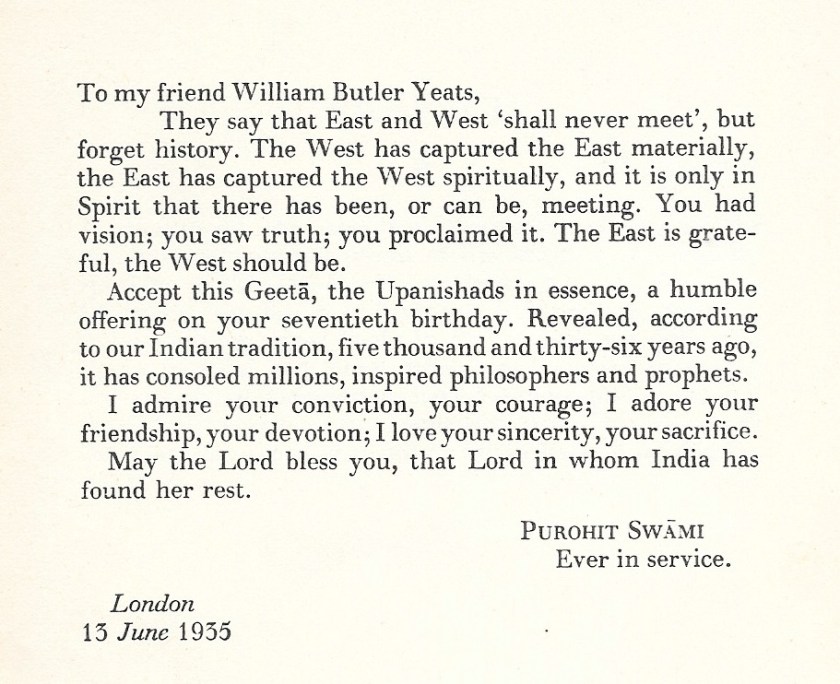
Whatever the case, it is beguiling to think of a single strand of humanity sowing the seeds of civilization from Bengal to Donegal as attested by this dedication from the 1935 edition of The Geeta to W.B. Yeats!
*1 The Coligny Calendar, dating from the first century CE has sixteen columns of months covering a period of five years and has been compared with Vedic cosmology. Major festival, according to Diodorus Siculus were held every five years and festival days were marked on the calendar.
Binchy, D. A. 1972. “Celtic Suretyship, a fossilized Indo-European Institution?” The Irish Jurist 7, 360–72.
Charles-Edwards, Th. 1980. “Nau Kynwedi Teithiauc.” In D. Jenkins and M.E. Owen (eds.), The Welsh Law of Women. Studies presented to Professor Daniel A. Binchy on his eightieth birthday, 3 June 1980. Cardiff: University of Wales Press, 23–39.
*3 The Geeta – the Gospel of the lord Shri Krishna
Put into English by Shri Purohit Swami 1935 Faber & Faber Ltd.
Panting for breath in the high altitude of La Paz in Bolivia, which seemed to verge on the chaotic with strikes, blockades, enormous protests and heavily armed troops and police everywhere, I made a break for it and descended a few thousand metres to Salta in northern Argentine which was pleasant and warm, even when I arrived at night after a fairly lengthy bus, train, and three more buses, the last of which was stopped by a military style roadblock just outside Jujuy. Everybody was ordered off the bus and while the locals were all searched and questioned, I was totally ignored, thank God.
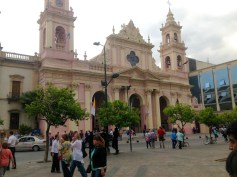
Salta, the first major city over the border from Bolivia, looks and feels pleasant and actually warm at night compared to semi freezing temperatures in the mountains further north so I had a refreshing ale (40 pesos) before I even bothered to look for a hotel!
A few days to rest up and enjoy the amenities – my hotel bathroom actually had a bidet and excellent free Internet connections. Despite Google Maps claiming the existence of an Irish pub, there was no sign of it – the location now an expensive jewellery shop which had been there for at least ten years. Never mind, plenty of other bars to enjoy a beer and a few empanadas around the Ninth of July plaza before gaping at the mummified bodies of three Inca children sacrificed centuries ago.
Four hours further south then and 190k through the most amazing canyons and rock formations to the small town called Cafayate, the second premier wine area of Argentine, after Mendoza.An incredible road winding through the most bizarre colourful mountains and canyons similar to what I imagine the Painted Desert in Nevada would be like. Cafayate is probably the smallest town I’ve been in so far. Brilliant little wineries scattered around, almost at sea level, well, just over 1500 metres, warm and sunny. I got off the bus, found a hotel, had a litre bottle of excellent cold beer and a deep bowl of soup with beans, meat, and God knows what else here thrown in. I will probably stay here two or three days and explore local wineries – specialising, apparently in an Argentinean white which is Argentine’s only native variety of grape, Torrontes, and I’ve Just booked myself in for a fantastic tastings of five of the same white grape specific to this region!
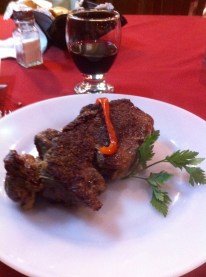
Dinner every night is a huge steak and a bottle of Malbec now. In heaven, food and wine wise. I am quite content to let Peru keep its speciality dish of guinea pig, as far as I’m concerned.
Cafayate is a fantastic little town, best place so far on the whole trip. Baking hot in the day, cool at night, loaded with fantastic bodegas of which I am taking full advantage. Every night seems to be a festival here – usually religious with processions adoring the rosary and the Virgin Mary, all of which was accompanied by noisy bands, people dancing in the streets and a never ending flow of wine. Great fun.
Much as I am enjoying Cafayate – another very pleasant lunch with two classes of wine, a Malbec flavoured ice cream and a bottle of Torrontes to enjoy in the afternoon in the garden of my hotel – I am aware that this is kind of a dead end. To continue on to Córdoba or Mendoza, I would have to go back to Salta – which I don’t want to do – or take another bus from here to Tucuman, which I have never heard of and (unreasonably) don’t like the sound of – and from there on to either Mendoza or Córdoba.
An 8 to 10 hour very comfortable bus trip (think business class on an airline) south to Tucaman – where Argentinian independence was declared from Spain but a bit disappointing. I arrived at sunset but every hotel seemed to be full. Eventually found a dump, well over priced but no choice so I checked in late and left the next morning at 5:30 for Córdoba, Argentine’s second largest city. Meant to be a hotbed of bars and nightlife – got in around 3:30 in the arvo and COULD not find a place to stay – must have tried at least 12 hotels and hostels and by 7:30 still hadn’t found a place to stay – beginning to get desperate, cold, drizzly, beginning to get dark when I eventually found a very rough place – Hostel Pomelo – a right dump. Probably among the worst places I have stayed in over the last 40 years. Absolutely desperate, but what choice did I have – there or a night sleeping upright in a cold bus terminal. Even then when I arrived, the host said he was full and tried to give my money back, which his ratty partner has just accepted. At this point it was about 8:00 pm and cold as buggery so I played dumb and just sat down on a ragged sofa and began to doze off. Eventually I was herded into a dorm with 6 rickety bunks and torn, stained mattresses – fresh sheets, the host proudly claimed. However, no choice so I dumped my bag, took the important stuff and headed out to the best restaurant I could find and had a magnificent steak, gorgeous malbec and then, in lieu of a brandy, ½ a bottle of champagne. Back to the hostel and across the street into one of the roughest bars that would outshine the toughest outback bars in Oz by a long shot where I sampled the local favourite, Fernet and coke and became involved in a semi scuffle over the price of a single cigarette while unfriendly girls snorted Coke in the grubby, (unisex, I think) toilet. Back to the hostel where everyone seemed to be smoking dope, and into the bunk bed and slept like a log.
Next day, Sunday, the city seemed deserted and I really had to change money. – none of my cards worked in the atm and street touts didn’t want to change euros, only US dollars. Beginning to get pissed off, especially as Ireland was playing France in rugby and I was unable to find a bar open in the afternoon. So off to the bus station once again, a grey and fairly miserable day, and bought a ticket on an overnight bus (180 degree reclining seats) and eventually found a bar and watched Ireland thrash France before leaving that evening from Córdoba.
Mendoza, the premium wine district of Argentine, should knock Cafayate into the shade with its wineries and wines. Arrived in a freezing cold dawn and drew up a short list of five hotels before taking a taxi to the first one – “completo” – and that was the story with all of them that I trekked around, getting increasingly pissed off. Some hotels said come back at 11 0’clock, others said come back at 12:30!
Eventually I found a rather smart (for me, that is) Hotel International on the corner of Calle Peru that let me in by 8 o clock for 800 pesos a night. Gorgeous soft, fluffy pillows, crisp sheets and duvets, boiling hot water – what a contrast to Hostel Pomelo!
Argentine could be expensive as there are less than ten peso to the US dollar. However, at one of the crossroads on the pedestrian areas of Calle Sacrimento which cuts through the huge Plaza Independencia, past the pink water fountain, near a few newspaper kiosks, seedy looking punters hang around whispering “cambio” as you stroll past. On this so-called “mercado azul” you can easily change one dollar for about 16 pesos which makes thing seem more reasonable.
Nevertheless, I moved to Hotel Zamora on Calle Peru, a nice outdoor tiled courtyard but the room was small and dark and the shower crappy. Next-door in the Melbourne Coffee Company, I was offered a job as a barista so that the incumbent could focus on wine tasting. No time for that nonsense, of course as I planned to move to Hotel Petit, a bigger, brighter room, just past Plaza Chile.
Loads of cafes line the beautiful tree-shaded streets with deep, cobblestone-lined irrigation ditches on either side. Presumably it gets hot in the summer and the trees provide a welcome shade. I don’t have gps and I never bother with maps, depending on my unerring sense of direction to guide me to the wrong side of the tracks as usual but with the huge Plaza Independencia – the art gallery is underground and the usual gaggle of street entertainers, dressed in motley and on stilts do the most amazing dances and contortions – and the other four main plazas on each corner, all with huge statutes of local heroes, even I found it easy to get around on foot.
Cold but not freezing with occasional splashes of sunshine filtering down through the trees onto a street cafe where I drink a large bottle of Andes beer and scribble in my notebook or just gape at my surrounding before returning to the hotel in the early evening. Just as well because no one in Mendoza would dream of going out to eat or to the bars until well after 10:30 pm. So, a snooze in the late afternoon and then fresh as a new coat of paint, I blunder out for a steak dinner later that night.
In Mendoza, the wine capital of Argentine, heavy-duty, meaty wine flows freely, cheaper than a bottle of beer. Excellent wine for less than 100 pesos so I indulged myself freely and enjoyed the last of the sunshine, wandering aimlessly around the city and the parks stopping here and there for coffee and ice cream!
The main attractions seem to be snow boarding, expensive wine tours, white water rafting and that sort of thing, so I focus on what I do best!
The steaks here are magnificent, better than the steak in Lardos in Hong Kong where I used to live, or the steaks in El Gaucho, an Argentinian restaurant, in Saigon. Here, in Mendoza, the best steaks have been in El Florencita on the corner of Peru and Sacriemento – an enormous slab of bloody beef, cooked over charcoal.
Despite gorgeous sunshine yesterday in Mendoza, which seemed to exacerbate the effect of a lovely bottle of Trapiche Malbec I was enjoying with my lunch of half a cow on a plate, there were hail stones as I was making my way to the bus station to buy a ticket to Santiago in Chile, a mere 149k as the crow flies. However, the road over the mountains winds back and forwards for more than 350k and the road is so steep in parts that the bus has to slow down to 10 or 15 kph. So the journey, in good weather, might take more than 8 hours.
Amazing, but not as amazing as when I arrived at the bus station and discovered all the buses were “completo” for the following day and it was only after I had tried half a dozen different bus companies that it was finally explained to me that all bus trips between the two countries have been suspended since last Sunday due to the mountain passes being blocked by bad weather – one company said because of “nieve”. Incredible! No one knows when the route over the Andes will reopen.
I still have plenty of time before I fly out of Santiago but I don’t know if my liver will last that long under the unremitting onslaughts of free flowing Malbec! Thank god for the “mercado azul” which makes a big difference to a budget traveller like myself. I’m looking forward to the coach trip over the Andes into Chile, the seats as good as airline business class and the views should be spectacular.
After a delay of several days I finally managed to get a bus over “La Routa de las Liberatores.” and had one cigarette, a small bottle of beer, 380g steak, 500ml bottle of plonk, an espresso, a brandy and a large ice cream in preparation for this second assault on the Andes, to Santiago, from where I eventually fly back to Perth.


 In most S.E. Asian cooking, the spices are pounded and ground daily so that the sudden thumping of pestles and mortars traditionally done, squatting on the floor, echoes throughout the afternoon in the village.
 ed, it requires serious over-cooking before it falls apart.
 , crush on a cutting board with the back of a large spoon.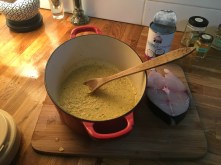


 In Dissolution, the first in the series, Matthew Shardlake, single, a lawyer, a humanitarian and a hunchback, regarded with distrust and fear by most people because of his deformity, reviled but used by the nobility for his intelligence, diligence and ability, is sent to investigate the sacrilegious murder of one of Cromwell’s commissioners in a remote monastery in the midst of a freezing winter. Drawn into a world so completely realized, the actual setting is as palpable as the villians he encounters, Shardlake’s involuntary involvement with the politics of the law and church unravels murders and mayhem. Increasingly disillusioned, he must juggle personal and conflicting ideals, as reforms seep into the kingdom. Emotionally scarred by his brush with politics and greed, Shardlake is determined to withdraw to an ordered and quiet life at Lincoln’s Inn helping those who are most in need of his legal skills.
 command, Shardlake, with the help of his new assistant, Jack Barak, must discover the source of a lost secret weapon – Greek Fire – with which Cromwell hopes to regain the king’s favour while at the same time acquiring an apparently hopeless case defending a young girl accused of murdering her own cousin.
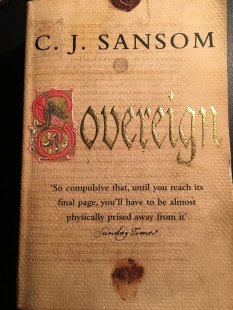 Hoping to avoid further contact with the court after Cromwell’s downfall, Shardlake is nevertheless involved on missions for Archbishop Crammer and in Sovereign, he travels with Henry’s court to York on the Great Progress, dealing with legal submissions to the king but also to oversee the welfare of a traitor due to be conveyed to the Tower of London for a torturous interrogation. A seemingly irrelevant murder in York involves the lawyer and his irreverent assistant in a cache of secret documents which undermine the sanctity of the Tudor throne and which brings Shardlake terrifyingly face to face with the torturers in the Tower.
 world of a serial killer – a concept so alien to the ordinary Tudor mind that it arouses fears of witchcraft and sorcery, all the more so when inextricably linked with the prophecies of the biblical Book of Revelations. Taking on the case of an accused heretic, confined within Bedlam insane asylum, Shardlake must navigate the treacherous waters of religious purges while investigating the murder of his best friend linked to the dark prophecies of Revelations.
 Heartstone, the penultimate novel in the sextet, sees Shardlake set off for Portsmouth on a private mission for Catherine Parr in the summer of 1545 as Henry prepares the Mary Rose and The Great Harry for a imminent French invasion.
 Salta, the first major city over the border from Bolivia, looks and feels pleasant and actually warm at night compared to semi freezing temperatures in the mountains further north so I had a refreshing ale (40 pesos) before I even bothered to look for a hotel!
 now an expensive jewellery shop which had been there for at least ten years. Never mind, plenty of other bars to enjoy a beer and a few empanadas around the Ninth of July plaza before gaping at the mummified bodies of three Inca children sacrificed centuries ago.
 similar to what I imagine the Painted Desert in Nevada would be like. Cafayate is probably the smallest town I’ve been in so far. Brilliant little wineries scattered around, almost at sea level, well, just over 1500 metres, warm and sunny. I got off the bus, found a hotel, had a litre bottle of excellent cold beer and a deep bowl of soup with beans, meat, and God knows what else here thrown in. I will probably stay here two or three days and explore local wineries – specialising,
  apparently in an Argentinean white which is Argentine’s only native variety of grape, Torrontes, and I’ve Just booked myself in for a fantastic tastings of five of the same white grape specific to this region!
 Every night seems to be a festival here – usually religious with processions adoring the rosary and the Virgin Mary, all of which was accompanied by noisy bands, people dancing in the streets and a never ending flow of wine. Great fun.
 ried to give my money back, which his ratty partner has just accepted. At this point it was about 8:00 pm and cold as buggery so I played dumb and just sat down on a ragged sofa and began to doze off. Eventually I was herded into a dorm with 6 rickety bunks and torn, stained mattresses – fresh sheets, the host proudly claimed. However, no choice so I dumped my bag, took the important stuff and headed out to the best restaurant I could find and had a magnificent steak, gorgeous malbec and then, in lieu of a brandy, ½ a bottle of champagne. Back to the hostel and across the street into one of the roughest bars that would outshine the toughest outback bars in Oz by a long shot where I sampled the local favourite, Fernet and coke and became involved in a semi scuffle over the price of a single cigarette while unfriendly girls snorted Coke in the grubby, (unisex, I think) toilet. Back to the hostel where everyone seemed to be smoking dope, and into the bunk bed and slept like a log.
 Loads of cafes line the beautiful tree-shaded streets with deep, cobblestone-lined irrigation ditches on either side. Presumably it gets hot in the summer and the trees provide a welcome shade. I don’t have gps and I never bother with maps, depending on my unerring sense of direction to guide me to the wrong side of the tracks as usual but with the huge Plaza Independencia – the art gallery is underground and the usual gaggle of street entertainers, dressed in motley and on stilts do the most amazing dances and contortions – and the other four main plazas on each corner, all with huge statutes of local heroes, even I found it easy to get around on foot.
 The main attractions seem to be snow boarding, expensive wine tours, white water rafting and that sort of thing, so I focus on what I do best!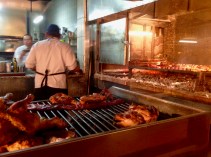
 myself. I’m looking forward to the coach trip over the Andes into Chile, the seats as good as airline business class and the views should be spectacular.
 Red Branch Chronicles
You must be logged in to post a comment.