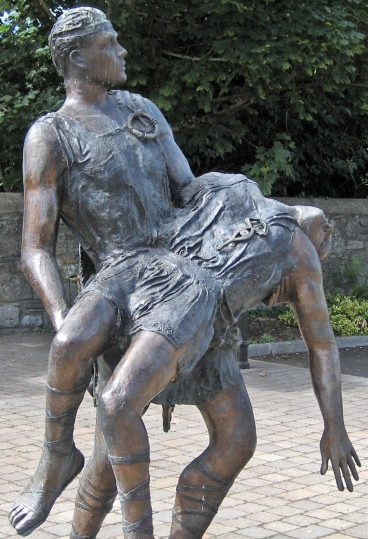
Saint Paddy

(I know, I know this isn’t really Celtic Iron Age Trivia / Technology like the other posts in this category have been but …. well, it was just St. Patrick’s Day (March 17) this day last week  so here goes – sorry if I dispell any myths!).

Go into any Irish pub anywhere outside of Ireland itself and no doubt there will be a mural or picture of the saint himself, mitred, robed, smiling beatifically or looking suitably sombre and not a pint of Guinness in sight.

The reality was rather different as it turns out.

Patrick, whose birth name was Maewyn Succat (b.390 CE), was the son of Conchessa and Calpurnius, a tax collector appointed by the Roman administration in western Britain. Patrick’s family were local stock who had long accepted Roman rule and custom and would be considered well to do in that they themselves were slave-owners.

Constantine the Great had earlier exempted Christian clergy from city council duties and, as increasingly frequent raids on the coastal districts made collecting taxes difficult, Maewyn’s grandfather, Potitus, had taken full advantage of the exemption by entering into a relaxed form of Christianity.

Calpurnius, however, was obliged to resort to harsh methods to collect the amounts demanded by Rome as, if less than demanded was collected, the “exactor,’ as Calpurnius was known, had to make up the deficit from his own pocket.

Stillicho, a Roman legate, was insisting on the full tax levy and Calpurnius was under a lot of pressure to buy and sell slaves to redress the difference

In 406 CE, Irish raiders attacked their Roman style villa and enslaved the 16 year old Maewyn to herd and tend sheep in the rugged countryside around Slemish, Northeastern Ireland. By 410 CE, all Roman forces had withdrawn from Brittania, leaving the country exposed to continuing raiding by Goidels or Irish raiders.

The youth spent 6 years in thrall to Irish pagans, where he discovered both his “anam cara” – the friend of his soul with his God and an empathy for his captors as much cut off from the true religion as he felt himself to be. Guided by a voice only he could hear, he escaped captivity and, convinced of his divinely inspired mission, studied under Bishop Germanus in Auxerre and again in Rome, determined to bring salvation to the people controlled by their pagan druids.

In 431 Pope Celestine I, concerned more at the growth of Pelagianism in Britain than the rife paganism in Hibernia, sent his bishop to suppress the Pelagian heresy but Palladius died with no success in Scotland in 432.

Maewyn, meanwhile, had received the tonsure at Lérins Abbey and taken the name Patroculus, and jumped at the chance to return to the island of his slavery and pagan druidism. Celestine sensed that Patroculus was made of sterner stuff than his former envoy and as a womaniser, a fighter, a hard man of his times, well used to both the power of the word as well as the sword, he would be an invaluable bulwark against the bishops in Britain who stuck to their heretical ways. Patroculus certainly never claimed to be a saint but by his death in 461 he had founded a base for Christianity in the far-flung western isle that has never wavered since.

Happy Saint Patrick’s Day for next year if you missed it!


Ancient Celtic Druids and the Bhagavad Gita

Bengal to Donegal

According to Julius Caesar and other writers and chroniclers from the first century BCE, such as Strabo, a Greek geographer, and Diodorus Siculus, an historian from Sicily, the ancient Celtic druids were more than just a semi-mystical priesthood.

Caesar certainly saw them not only as an organised inter-tribal brotherhood who acted as living repositories of their tribal histories and legends, negotiating, legislating, judging and officiating over all individual and community oaths and sacrifices but also as a rival authority to the extension of Roman power among the so-called barbarian tribes of the north.

Others regarded druids as poets and bards, seers, teachers, historians, astronomers, medical practioners and – later through the distorted lens of early Christians – as devious wizards and magicians who kept their people in thrall with simple sleight-of-hand tricks.

Probably all of the above is true, in some sense, in that they were, without doubt, the learned men of their people who had the recognised and unquestioned power to ‘excommunicate” individuals from community events. All commentators agree that they had a vast store of knowledge which they acquired orally and passed on to their followers over a 20 year training period.

No doubt they were poets and bards as the easiest way to memorise huge tracts of knowledge relating to tribal law and ownership was to make use of standard poetic functions such as alliteration, rhyme, onomatopoeia, simile and metaphor as a way of preserving and keeping alive tribal history and legends.

However, as no written records*1 exist of what the druids knew or learned, it is mere conjecture to say what they actually did.

Nevertheless, it is feasible to consider how the classical ancients described them and to put that knowledge into a suitable context.

It is likely that the druids became the sole provider of laws and customs among the widely varied nomadic and pastoralist Celtic people inhabiting Europe from the Early Iron Age, c.800 BCE. Being outdoors as a way of life, the druids would have become very receptive to the divine powers inherent in nature and would willingly have entered into a communion with them, having gradually assimilated facets from other existing codes of law and belief into their own oral bodies of knowledge. As nomadic people settled and adopted agriculture, more elaborate rituals and sacrifices were needed and the druids eventually became the predominant social and political bond uniting all Celtic people that Caesar feared so much and vowed to destroy.

What is known is that druids could be both male and female, with the men shaving their head across the forehead, leaving the hair long at the back, and that they were exempt from taxes and military service. Extraordinary attention was paid to the human head, which was seen as the location of the human spirit or soul. Heads, taken as a trophy in battle, implying control of an enemy’s spirit, were later preserved in cedar oil. Shrines often contained these mummified skulls or artistic representations of them.

With the rise of the hill forts and their ascendant chieftains, druids gravitated to the throne where they acted as trusted advisors. Regarding their role as seers and astronomers, they believed in a future or imagined worlds such as Tír na nÓg, Uí Breasail and Magh Mell.

Such powers they may have exercised would have depended upon their knowledge of the seasons and seasonal change, and their priveledged status, as intermediaries in the communion between men and gods, giving them the authority to initiate the planting and harvesting of crops and rites of thanks for success.

Seasonal change may have involved a close study of nature with such signs as frogs spawning deeper than usual or the trees showing the backside of their leaves and so on, being an imminent sign of changing weather patterns.

Similarly, like shamans world-wide, they perhaps used local plants to alter their worldly perception and also that of their people through the use of hallucinogenic mushrooms and plants such as foxglove or belladonna or perhaps, on a more one-to-one situation, hypnotism.

Oak groves were sacred to the druids as were certain rivers, and natural features of their landscape such as hilltops and valleys. Certainly, sacrifice of plants and animals took place while classical writers shuddered in scandalised horror at the idea of human sacrifice, ignoring their own brutal histories of slavery, torture and sacrifice in the public arenas.

Caesar seemed to feel Druidism originated in Britain, most especially in the modern day region of Anglesley Island off Wales, known then to the Romans as the Isle of Mona and that druidism spread to most of Europe but not as far south as Spain or Italy but it is more likely the other way round. As Caesar advanced into Gaul, gradually pushing back the barbarian tribes, the old knowledge retreated along with the population until further encroachment from Germanic tribes in the north meant that remaining Celts retreated to the islands of the Atlantic or clung to the northernmost fringes of Europe. Pushed again and finally hemmed in by the legions in Britain, the druids reputedly met their end facing off against advancing Roman legions who stormed the Isle of Anglesey in 60 CE, wiping out the last stronghold of Celtic druidism. That he knew of, anyway!

Inevitably druids continued, unhindered in their ways, in the far flung western isle of Ireland, relatively untouched by Roman rule, for a further 500 years until the arrival of Christianity on the shores, (not taking into account of the hundreds of Christian enslaved from raids on both the European mainland but also from the west coast of Britain, a trade that was to continue for many more centuries).

The Hindu Link

Recent Celtic scholarship*2 has shown that the origins of druidism share a common Indo-European heritage with the Brahmins of Vedic India. Strong parallels exist between ancient Celtic and Hindu society, with their common Indo-European roots in law and customs going back to the Early Bronze Age or even the Neolithic period.

As far back as 1786, Sir William Jones discovered close links between ancient Sanskrit – the language of the Vedas – and Greek, Latin, Celtic and Germanic languages. Linguistically, Italic and Celtic (the fore-fathers of Latin and Old Irish) and Indo-Iranian (Persian, or Avestan, and Sanskrit) were part of the much greater family of Indo-European languages sharing many common features and lexical cognates.

By the third millennium BCE, The Indo-Aryan cattle-rearing nomads roaming the Eurasian steppes west of the Urals dispersed west to Europe and, circa 1500 BCE, arrived in the north west plains of India from the mountain passes of Afghanistan where their beliefs merged with pre-existing ones to form the basis of Hinduism. Similar to the Celts of Western Europe, their culture was characterised by domesticated cattle and horses, chariots, spoked wheels and elaborate metalworkings.

Certainly, early Celtic society was based on a shared or common language – (Proto-Celtic), an authoritative priesthood (Druids), a strict social hierarchy (Chieftains / Kings – Nobles / Warriors – Priests / Druids – Farmers / Craft-workers – Slaves) with acknowledged descent from a single, known ancestor and where cattle represented both wealth and prestige. The Indus valley civilization at a comparable time was remarkably similar as society was based on the pillars of language (Sanskrit), an authoritative priesthood (the Brahmins) and a social hierarchy of chieftains supported by the Brahmin priestly caste overseeing a warrior nobility with ordinary people below them and subjugated people or slaves at the bottom).

The Celtic grouping of families into four generations – the Irish “derbfine” is similar to the Indian notion of “sapinda.” Ancient Irish marriage laws paralleled ancient Indian ones, so too did the laws of inheritance through the female line. The use of fasting – a hunger strike – to “dishonour” a transgressor is common to this day in both societies – think Gandhi, Bobby Sands and the many others who have pledged their life for a principle! The ancient oral Irish legal foundation, the laws of Fénechus, transcribed from the 7th century CE by Christian scribes and constantly annotated and added to, and later known as the Brehon Laws, share many similarities with the Vedic culture and laws of the North West Indus valley in modern day India.

According to The Book of Invasions, (see earlier post on Epochs and the Books of Invasions) a collection of poems and prose narratives that presents itself as a chronological “history” of Ireland and the Irish, the earliest of which was compiled by anonymous scribes during the 11th century, Amergin was a Milesian seer or druid who fought against the Tuatha De Danann and is chiefly remembered even today for his song where he subsumes the world into his own being with a philosophic outlook that parallels the declaration of the Lord Shri Krishna in the Hindu Bhagavad-Gita. *3

The Song of Amergin

I am the wind that blows across the sea;

I am the wave of the ocean;

I am the murmur of the billows;

I am the ox of the seven combats;

I am the vulture on the rock;

I am a beam of the sun;

I am the fairest of flowers;

I am a wild boar in valour;

I am a salmon in the pool;

I am a lake on the plain;

I am the skill of the craftsman;

I am a word of science;

I am the spear point that gives battle;

I am the God who creates in the head of man the fire of thought.

Who is it that enlightens the assembly upon the mountain, if not I?

Who tells the ages of the moon, if not I?

Who shows the place where the sun goes to rest, if not I?

Who is the God that fashions enchantments – The enchantment of battle and the wind of change?

Compare with Chapter 10, The Divine Manifestations, of the holy book of the Bhagavad Geeta *3

I am the electric Force in the powers of nature

I am the mind

and I am the intelligence in all that lives,

I am the Whirlwind among the winds

of the waters, I am the Ocean

I am the Thunderbolt of weapons

of cows I am the Cow of Plenty

I am the Eagle among birds

I am the passion in those who procreate

I am the eternal present,

I am the lion among beasts

I am the beginning, the middle and the end in creation

I am time inexhaustible

I am all devouring death

I am the origin of all that shall happen

Whatever is glorious, excellent, beautiful and mighty,

be assured that it comes from but a fragment of my splendour.

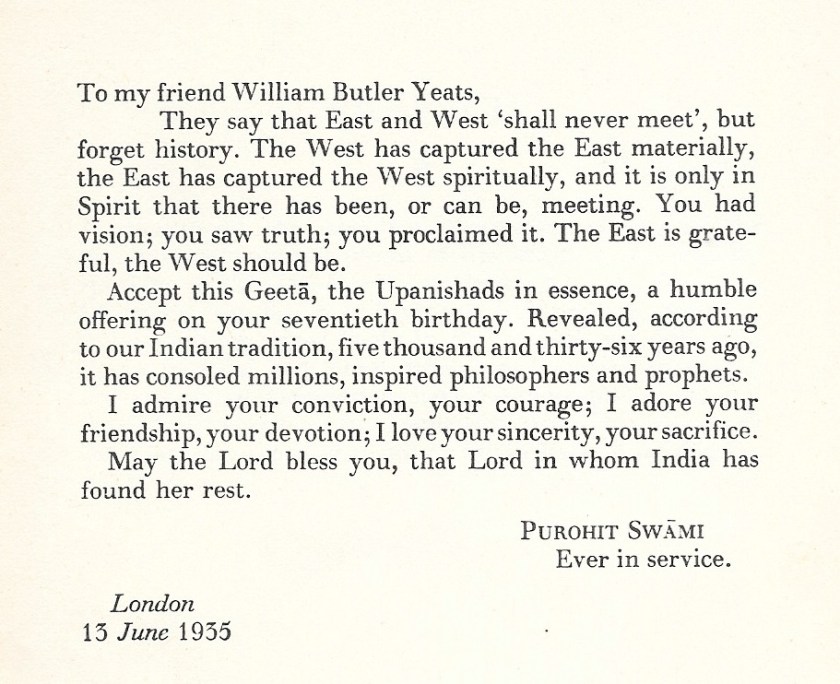
Whatever the case, it is beguiling to think of a single strand of humanity sowing the seeds of civilization from Bengal to Donegal as attested by this dedication from the 1935 edition of The Geeta to W.B. Yeats!

Geeta Dedication

*1               The Coligny Calendar, dating from the first century CE has sixteen columns of months covering a period of five years and has been compared with Vedic cosmology. Major festival, according to Diodorus Siculus were held every five years and festival days were marked on the calendar.

*2          Kelly, Fergus (1988). A Guide to Early Irish Law. Early Irish Law Series 3. Dublin: DIAS. ISBN 0901282952.

Binchy, D. A. 1972. “Celtic Suretyship, a fossilized Indo-European Institution?” The Irish Jurist 7, 360–72.

Charles-Edwards, Th. 1980. “Nau Kynwedi Teithiauc.” In D. Jenkins and M.E. Owen (eds.), The Welsh Law of Women. Studies presented to Professor Daniel A. Binchy on his eightieth birthday, 3 June 1980. Cardiff: University of Wales Press, 23–39.

*3               The Geeta – the Gospel of the lord Shri Krishna

Put into English by Shri Purohit Swami 1935 Faber & Faber Ltd.

Big Brother’s Younger Sister

The Circle

Some books claim to change your life but then when you pick one up, it seems banal, run-of the-mill but you glean that it is actually giving a real message. So it was with this book – The Circle by Dave Eggers.

Ithe-circle didn’t like it for a lot of reasons (but I did admire the logo) and I couldn’t empathise with the main character, tech worker Mae Holland -who seemed, from my point of view – exasperatingly stupid, naive, foolish or just plain insensitive – and she was (initially, anyway) on the side of the good guys.  Joining a lavish and ever expanding Tech company which provided all the bells and whistles that an aspiring Google or Facebook employee could dream of – free pizza, concerts, parties, saunas, down-time, the latest proto- gadgets, all of which “newbies” like Mae are expected to not only partake of but also to recommend and support. The all-pervasive company began to take over every aspect of Mae’s life, with her lack-lustre willing acceptance.

The “baddies” were just the same but manipulative, faux-caring and determined to dominate. Their use of language irritated me, a meta-language insistence on agreement, even as their ideology is absorbed with a generous helping of sugar as in the Sound of Music song. Statements, directives and implicit orders always ended with something like “do you see the benefits of that?” or “Does that sound interesting / appealing / better?” The never relenting stream of “…, don’t you think?“, the condescending “… sound good?” or the more insistent “…, don’t you agree?” wear the reader down, as they are intended to do.

Set in near or contemporary time, the Circle is a global network linking billions of people sharing and associating with others similar to them, rather like people do on Facebook. Much like Orwell’s Animal Farm, where such aphorisms as “All animals are equal” and “four legs good, two legs bad” take the place of meaning, phrases in The Circle like “secrets are lies,” “sharing is caring,” and “privacy is theft” illustrate the philosophy of the tech company. One of the innovations of the company is a lightweight, wearable camera allowing everyone to see what the wearer sees, a bit similar, perhaps, to police body cams which monitor the actions of both the police and the suspect. Once the ice is broken by a minor politician wishing to be “transparent” to his constituents, the rush is on for everyone to allow the world to see what they are seeing at all times.

Bit by bit, witless Mae gets sucked deeper and deeper into the folds of the Circle where every aspect of her life, and that of her parents and her friends, is constantly streamed to the world. In a justification for its ever encroaching inroads on privacy, the Circle administration claims that it never extorts citizens to provide their private data – everything was willingly provided by the eager masses clamouring to hand over every aspect of their lives, from what they had for breakfast to photographs and videos of their private and domestic lives.

And then, recently, on the BBC, there was an article on the incredible advances of facial recognition technology which is increasingly used by both governments and corporations to screen and vet everyone within their gambit.

High-definition cameras – measuring such things as the distance between the eyes, the length and width of the nose, along with other “nodal points” on our faces – combine with machine learning algorithms, utilising ever-enlarging databases of videos and photos, available to individuals, organisations and businesses, and to intelligence and law enforcement agencies, sort through this vast store of data to improve security and surveillance and to identity verification for business transactions.

Technological Tools such as FaceSearch, analyse more than 350 aspects of the human face, enabling suspects to be matched to a cloud-based database of more than 15 million “mugshots” while Faception, a middle-eastern “facial profiling” company claims it can determine your personality traits, with an 80% accuracy rate indicating whether you are on a government watch list for terrorism, extortion, paedophilia, or merely an “average Joe”

The Georgetown Law Center for Privacy and Technology claims more than 117 million US adults have their images logged in a facial recognition network of some kind – a trend civil liberties groups describe as “a real and immediate threat” to privacy while New York plans to install facial recognition tech on its bridges and tunnels to scan and identify people driving in and out.

In theory, you could track down a complete stranger you snapped on the bus or train and what price is privacy then?

I remember an Irish movie from the late 90’s – The General – in which Brendan Gleeson the-general
played the role of Martin Cahill, a prominent Irish criminal who gained a certain notoriety in the Dublin media, which referred to him by the sobriquet “The General”. During his relatively short lifetime – he was gunned down at the age of 45 – Cahill took particular care to hide his face from the media by spreading the fingers of one hand across his face. Perhaps that is what we should all do to preserve our increasingly elusive privacy.

The flip side of the coin, however is that while Big Brother and his little sister keep a constant watch on us all, the same applies to organisations and governments world-wide. Increasingly, individuals, armed with a camera concealed in a shirt button, or some other innocuous thing, can challenge the power of a brutal and despotic regime, by filming human rights abuses by soldiers, militia groups and corrupt officials. Just as cameras – think the multinova traffic speed cameras – can inhibit anti-social behaviour, the same goes for the governments as well as those governed. Let’s hope so, anyway.

Prologue

I haven’t done an audio recording of Raiding Cooley for a while – and it would feel a bit too strange to do a video recording of me reading, so I think I’ll give that a miss for now.

Anyway, trying to decide what to read – whether to begin at the beginning or just pick a point at random, like I’ve done before.

OK, the very, very, very beginning.

The Prologue outlines the reasons why the Triple Goddess of War cursed the warriors of the Ulaidh Kingdom in Celtic Ireland, thereby setting the scene for the future consequences of the curse, and, incidentally, the beginning of the story proper, about 450 years later. Imperial Rome is still occupied with subduing the Celts in Gaul and Teutonics in northern Rhineland in 57 BCE but Caesar is already planning the first invasion of Britain. Ireland, while sharing extensive linguistic, cultural and extensive trade links with both Britain and Europe, remains a land of mystery, remote from Roman rule.

Iron Age Hero Traits

Along with the rise of the hill forts circa 1000 BCE, and the emphasis on items both as weapons and ornamentation, the stratification of society, into chieftains or kings surrounded by nobles and warriors supported by priests or druids interceding for farmers, craft-workers and slaves, was firmly established. This hierarchy inevitably involved the notion of the hero or champion and was marked by a leader able to distribute gifts and largesse while, at the same time, host feasts and celebrations where warriors would vie with each other for the favour of their liege. Such restrained power necessitated the rise of the heroic warrior, the hero, to stand alone and unbeaten. No doubt the flowering of literature of the twelfth century French Romance and Mallory’s later Arthurian romances must all have stemmed from the Iron Age concept.

Not everyone would – or could – be a hero. While all young boys played fierce physical games with wooden sticks – a proto Hurley? – before weapons could be handled, a hero was always set apart. Never having recognised parents and a mysterious background, Arthur is fostered at an early age just as Oedipus is brought up in ignorance of his parents and Lancelot of Arthurian legend is raised by the shadowy Lady of the Lake while Cú Chulainn’s birth is similarly shrouded in mystery.

Not obvious parentage means the hero has no name and must acquire one through his own actions – Sétanta kills the forge hound and becomes Cú Chulainn, while later Celtic heroes, Finn and the Welsh, Gwion, gain their later names of brilliance and light. The significance of having no family means a concomitant feeling of standing alone – the hero can expect no aid in his quest for glory but at the same time no limits are placed on his ambitions for his name to live on, forever, on the lips of men.

Never accepted in his own country, the Iron Age hero must leave his comfort zone, undergoing training at the hands of learned druids or experienced warriors. Tests of physical prowess, – ability to jump or vault over a stick their own height, run barefoot through a forest without breaking a twig underfoot, defend against 9 men throwing spears, remove a thorn from his foot while running – must be passed, but the hero must also be erudite and knowledgeable about poetry. Strangers approaching the territory of a chieftain had to undergo single combat or compose a poem on the spot.

Cú Chulainn trained under the tutelage of the warrior woman, Scáthach, who presented the fearsome gae bolga to the hero, along with a warning of its consequent use. Beowulf sought out sea monsters before going on to defeating Grendel and its mother, Arthur trained under the venerable Sir Ector de Maris, all to achieve the fame they sought. Beowulf leaves for the court of Denmark; Tristan of Arthurian legend travels to Ireland from his native Cornwall.

Nowhere in the manuscripts is it ever suggested that Cú Chulainn is not from the kingdom of the Ulaidh (modern day Ulster in Northern Ireland) nevertheless, when all the fighting age men of the area are stricken with an ancient curse, Cú Chulainn alone is exempt. Like all his fellow outsiders, having no ties to hamper his actions, the hero inevitably becomes a force for disruption, change and catastrophe.

Heroes must claim their weapons forcibly or obtain them from supernatural forces – Lancelot receives his sword from the Lady of the lake, Beowulf discovers a sword in the lair beneath the lake, and Cú Chulainn smashes King Conor’s armoury before the king himself presented the nascent hero with his very own weapons while the youthful Arthur plucks the sword from the stone.cropped-img_0328_edited1.jpg

A tipping point occurs in all the lives of the heroes when the focus on honour and glory supersedes the needs or bonds of their society. Achilles rejects his mother’s help and chooses to die before the walls of Troy. Cú Chulainn hears the druid’s prophecy of bloody and glory but still chooses to seek the latter. This tipping point influences the remaining portion of the heroes’ life. Every further irrevocable action with the umbrella-like spear, the gae bolga, that Cú Chulainn accepts from the hands of Scáthach maintains or furthers the glorification of his name. Chulainn, in his killing fury, is just as prepared to slaughter his enemies as his compatriots once his battle fury descends upon him.

Mortal enemies of the heroes often involve demonic or supernatural forces as human weapons have little effect upon them, Achilles is dipped in the pool of immortality, Arthur is protected by the power of Excalibur and Cú Chulainn is unassailable when he is in his battle fury. The inevitable downfall of the hero is, therefore, always linked with the breaking of a vow or the forsaking of an oath. Arthur is killed at the hands of his illegitimate son, Cú Chulainn dies alone after breaking the taboos that ruled his life, Beowulf meets his demise by neglecting his role of kingship and acting as if he were still the hero.


Who are the Irish and Where did their Language come from? Part Three

Ireland was a different story – relatively untouched by Rome, society there did not change dramatically until the advent of Christianity 500 years later. Groups of Celtic speaking people continued to arrive and leave, bringing with them La Tène styles and influences.  Iron Age Celts thus survived in Ireland long after it had been wiped out elsewhere.

Linguists refer to the languages spoken in Britain and Ireland as Insular Celtic which can be further subdivided into Brittonic or P-Celtic and Goidelic or Q-Celtic, as in the table below.

Insular Celtic

Brittonic or P-Celtic

Goidelic or Q-Celtic,

Ancient British

Welsh Cornish Breton Irish Scots

Manx

Whether the ancient Celts can be identified with the Gauls that Caesar defeated, the Insular Celtic languages are closely related to one another and to the other Celtic languages of Europe, now sadly extinct. Although the earliest record of what is now known as Irish dates from the 5th century A.D. in the form of a simple inscription, there is no doubt that Irish is a branch of Celtic which is a branch of Indo-European and Irish cannot have arrived in Ireland before the spread of the Indo European languages.

Despite the similarities and inter-relationships between the Celtic languages, it is not possible to pinpoint the exact origin of Irish. Linguistically speaking, the more similar two languages are to each other, the less time they have spent apart and the languages of Ireland, Britain and Gaul are remarkably similar and related to Proto Celtic.

Obviously, languages like French, Spanish and Italian bear striking similarities, so much so that they can be viewed as cousins, with their parent language being Latin, as spoken during the Roman Empire.

Similarly, Irish can be seen as cousin to Welsh, Cornish and Breton on one hand and to Scots Gaelic and Manx on the other and the original parent language would have been Common Celtic.

A subset of the Proto- Indo European Family of Languages

Celtic Italic Germanic Slavonic Greek
Irish, Welsh, Cornish, Breton, Scots Gaelic & Manx Latin, French, Spanish, Italian etc. English, German, Scandinavian languages Russian

The shared vocabulary of all Indo European languages, including Celtic, indicates there could have been no separation of the Celtic group into divergent dialects before the development of farming soon after the end of the Stone Age as the ancestors of Indo European flood in from Eastern Europe and Western Asia in four main Language groups – Graeco-Latin along the Mediterranean, the Germanic around the Baltic, the Slavonic in the east and the Celtic in the centre and west. It is impossible to see “Irish” arriving during the Neolithic period as that would postulate a physical split between the earliest speakers of Irish, British and Gaulish back to 4000 BCE.

Equally, it is next to impossible to imagine a Celtic language entering Ireland much before 1000 BCE.   Although Ireland was in contact with Britain and Europe for nearly a thousands years prior to this, as seen through the distribution of ceramics, polished stone axes and megalithic tombs, and that link continued throughout the Bronze Age, with the exchange of weapons and ornaments, but again there is no direct evidence for Irish having been introduced as a “trade” language or as a “lingua franca”. Neither Irish nor any other Celtic language have the aspect of a pidgin or trade language nor are they simplified in any way while their respective grammars and vocabularies retain the full range of their Proto-Indo European ancestor.

By 300 BCE, archaeological evidence indicates the spread of La Tène culture and the arrival of small groups or bands but no sign of a major settlement of a foreign population. Nevertheless, the evidence of tribal names suggests that Celtic speakers, both Goidelic and Brittonic with the former gradually subsuming the latter, occupied large areas.

So, if the accounts in the Book of Invasions are discounted as to the origins of the Irish and their language and Irish was not a trade language introduced during the Bronze Age, what is left?

Although multiple opportunities for a language shift in Ireland have been postulated, the one most likely to have been the direct ancestor of Irish aligns itself with the rise of the hill forts from 1000 BCE as the sites assumed significant religious and ceremonial features. The spread of regional centres in areas of Ireland – Crúachan in the west, Eamhain Macha in the north, Dún Ailinne in the east, Cashel in the south and Tara in the middle – might also herald the arrival of a new language.

So, although Irish was not native to Ireland, there would have been Celtic predecessors brought in multiple times by small groups from similar areas of the Atlantic seaboard and Britain who introduced their language, not through warfare but more likely, through having a more productive economy or just by simply outnumbering the sparse native population and whose identity became subsumed under a continuing influx of Celtic people. Bi-lingualism is the first stage when two languages meet and the native Irelanders would have adopted Proto Irish if it had been in their interests to do so.

Languages represent social phenomena with no language being intrinsically superior or inferior to another. Instead, language is used to fulfil essential social contacts in areas such as religion, law, sport, trade, literature and so on. Linguists refer to these social contexts as “language domains”. The new or target language is often linked with specific domains and, in the case of a “proto Irish” arriving in Ireland, the new language must have either filled in an existing domain or else created a need for a new one so that the native inhabitants would have thought it worth their while to embrace the new language.

So, the most probably reason for the adaptation of a “proto-Irish” by native Irelanders was that the new language offered the people access to something they did not have before – perhaps it was a tighter form of social organisation,

based on stratification, feasting, gift giving or some type of social prestige – a warrior elite or a new religion. Traditionally, the spread of world religions often carried with it a new language, Islam and Arabic, for example or Christianity and Latin.

The spread of hill forts and the regional centres they controlled, along with the rise of iron weaponry, leading to a warrior elite such as the Red Branch (Craobh Ruadh), with society forming clearly delineated stratification lines between tribal chiefs, religious leaders or druids, the warrior elites and the trade and craft people all tended to attract the native Irelanders to a new social system and the language that came with it. The overall result might have caused the native “Irelanders” to identify with and behave like the early speakers of “proto Irish”.

So, on the basis of archaeological, linguistic and genetic evidence, it seems most likely that from 1000 BCE, “proto Irish” would have arrived with different Celtic groups, pushed to the fringes of Europe from the inhabited La Tène lands into Britain and then further west into Scotland, Wales and Ireland. Certainly by 100 AD, a Celtic language, the predecessor to the modern Irish language, was in place. Linguistically, Old Irish was a monolithic language, meaning that, if it had been in Ireland for millennia, it would have developed dialects, which it did not do until more recent times.

In conclusion, it seems that the language known today as Irish arrived in Ireland sometime between 1000 – 100 BCE with evidence for both Brittonic and Goidelic groups establishing central foci for existing communities and ultimately providing a means of dividing Ireland up into different social groups, tribes and clans. Nevertheless, it would be nonsense to think of the people then as an Irish nation, the first reference to which only occurred nearly 1800 years later!

Who are the Irish & Where did their Language come from? Part Two

Meanwhile, in Europe, Celts originated in central and east-central Europe during the Early Iron Age, about 850 BCE. Various groups or tribes assimilated during the Bronze Age and gradually developed a single culture around the discovery and use of Iron. Referred to as Hallstatt, from an area in Austria where major archaeological finds were discovered, this Celtic culture developed into a major trading centre with the Mediterranean and the Greek port of Massalia (modern day Marseilles).

By about 450 BCE, during the Late Iron Age in Europe, the Hallstatt culture was succeeded by a period known as La Tène after a site in modern day Switzerland. This was a major shift in culture and style focusing on decorative metalwork such as gold torcs and horse gear with iron being cheaper and more available than bronze. Despite later descriptions of the Celts being unruly and warlike, they were predominantly an agricultural and pastoral people and iron plough shares cleared the land more efficiently while iron swords, spears and shields gave them a tactical advantage as their need for farmland kept pace with their growing population and inevitably, groups reached Britain and Ireland.

Further south, Celtic tribes began their expansion over the Alps and into Italy (sacking Rome in 390 BCE) and down through the Balkans, eventually reaching Turkey where they were known as the Galatians (the object of many of St. Paul’s future letters!). The Romans called them Celtae or Galli and the Greeks referred to them as Galatae or Keltoi but it is not clear what they called themselves. The first written reference to them was in Greek c.500 BCE.

By c.600 BCE, during the early Irish Iron Age, the former trade links with Europe apparently collapsed, isolating Ireland from events in Europe. The former communal interdependence relied on Ireland being a source of copper, essential for Bronze Age metallurgy but with iron being relatively widespread in Europe, trade declined. After 600 BCE and before the start of La Tène in Ireland by about 300 BCE, nothing much is known yet it is during this time, from about 300 BCE – 400 AD that the Irish language most probably arrived in Ireland.

The shift from Bronze to Iron technology varied widely within Europe. The majority of metal finds in Ireland from this period were not, in fact iron, most being bronze which remained in widespread use throughout the Irish Iron Age. It was not until the 3rd century BCE, that La Tène items such as ornaments, weapons and tools appeared in Ireland and this Celtic influence may have been the greatest single cause of the creation of both the “Irish” people and their language. This was also the period when Ireland came into regular contact with the Roman world through Roman traders and “Irelanders” travelling to Britain and beyond.

Despite the archaeological evidence, once again there is no direct evidence of a substantial population movement from Europe to Ireland. In fact the opposite seems to have occurred, with the land becoming re-forested and agriculture declining, suggesting a sharp fall in population. Nevertheless, two streams of La Tène culture continued to enter Ireland, the first direct from Europe to the west of Ireland and the later input from Britain to the north.

From 300 – 200 BCE as Roman power extended in the south and east, the Celts were being pressed on the north by the Germanic tribes moving south. Rome continues to squeeze Celtic lands, and by 150 BCE their area of influence continued to decline until Caesar conquered Gaul a century later ending their hegemony and, more slowly but just as surely, the languages of the continental Celts. By 100 – 1BCE only Britain & Ireland retained a Celtic lifestyle.

Celtic Languages of Europe

Gaulish Galatian Lepontic Hispano Celtic Tartesian
P-Celtic P-Celtic P-Celtic Q-Celtic Q-Celtic

As a distinct entity, Celtic language and culture were wiped out in Europe. In Britain, Celtic tribes were driven north into Scotland and east into Wales by the numerous incursions, first by the Romans themselves and then later by the Angle and Saxon invasions.

Who are the Irish & Where did their Language come from?

In a few recent posts – Epochs & the Book of Invasions and Anthropocene – Waves and Epochs – way back in September or October I have been wittering on about past times and after months of dithering, I have decided to put it all together and explain who the irish are and where they came from! No smallorder, I admit. Here goes:

Part One

According to the 11th Century Book of Invasions, the Lebor Gabála Érenn or The Book of the Taking of Ireland, (see earlier blog entry), the Milesians, the last of the six groups of “invaders,” brought the Irish language and constituted what are now known as the Irish people (the Gaels) and arrived sometime between 1700 – 1000 BCE after extensive travelling from Scythia, Greece, Egypt and Spain. These Gaels / Gauls were Celts and preserved their culture in Ireland, untouched by the heavy hand of Rome, where Celtic traditions live on, unhampered until the advent of Christianity 1500 years later.

That’s what I learned in school, anyway and it remains good copy for tourist brochures, I suppose. So the question remains, where, then, did the people and the language come from and when?

Pre-Aryan people initially occupied Ireland, probably from circa 8000 BCE arriving via the then existing land bridges, connecting Ireland with the Isle of Man, Scotland and mainland Britain. Judging by the number of polished stone axes found throughout the island dating from this Mesolithic period c. 8800 – 4900 BCE, there was more than likely a common language among these early inhabitants. Whatever that language was, it most certainly was not Irish or anything remotely connected with it. These hunters and gatherers, the first “Irelanders” left little behind them that archaeologists could use other than a handful of small stone tools – microliths – and the recently discovered remains of two people dated from 7200 – 6500 BCE. However, both Britain and Ireland were abandoned when the glaciers expanded and northwest Europe became too cold so that populations retreated to southern France and northern Spain before moving north again as the climate warmed.

The start of the Neolithic Period, roughly 4900 – 2000 BCE, ushered in the rise of farming communities with the arrival, at different times, of different groups of people, some from the north and some from the southern Atlantic seaboard.

These indigenous, pre-Celtic people built massive stone structures sometime between 4900 – 2000 BCE. Most notable among them are New Grange or Brú na Bóinne, just north of modern day Dublin, indicative of a noticeable change in the material and spiritual culture which had gone before.

The Bronze Age, c 2000 – 500 BCE, brought, along with metallurgy, a new style of ceramics – Beaker ware – which quickly superimposed itself on the earlier Grooved ware pottery but there is no direct evidence that “Beaker people” moved from north-west Europe into Britain and then on to Ireland despite the abundant evidence for a Beaker presence in Ireland. Ideas travel, not just people. What is clear is that the Beaker people established, or maintained, a network of trade both within Ireland and between Ireland, Britain and Atlantic Europe, which, of necessity, would have involved communication and immigration in all directions.

The early Bronze Age (2000 – 1500) was also the Age of the Megaliths and examples can be found along the Atlantic seaboard where trade flourished. Ireland was a vital part of a chain of contacts extending into Europe by reason of it being a source of gold and copper, the latter abundant in Ross Island in southwest Ireland.

Between 1500 – 1200 BCE – the Middle Bronze Age – Ireland underwent extensive land clearance, along with improvements in transport with the establishment of track ways across bogs and the rise of the hill forts. Prior to this time, Irish circular dwellings had their entrance on the north side, but after 1500 BCE entrances moved to the south and the east, another possible indication of a change in customs brought about by new immigrants, but again not sufficient to warrant the introduction of an Irish language.

However by 1000 BCE, there are signs of a society splitting into tribal societies with regional centres such as Eamhain Macha and Crúachan. These hill forts usually consisted of a ditch surrounding the summit of a raised area, the up thrown soil forming an inner wall, enclosing easily defended internal areas. Some of the larger hill forts would have up to three defensive rings around the protected centre. These massive structures, the products of community labour and effort over an extended period, must have been for defence or as trade and exchange centres or ceremonial sites used for communal feasting, but whatever their purpose, they served to focus communities in the vicinity. Nearly 5000 Fulachta Fiadh, stone troughs used for a variety of purposes, including cooking, brewing and so on, are in close proximity to these centres, again indicative of a communal purpose outside of the individual home. By 800 BCE, the largest architectural structures of the entire Bronze Age had been completed.

Because hill forts required massive co-operation, society became characterised by the rise of the elites, including that of the warrior in search of fame and glory, marked by advanced weaponry and ornamentation. By the Late Bronze Age, c. 600 BCE, Ireland was changing again with substantial reforestation and a decline in agriculture with settlements reduced down to small family groups.

(To be continued)

Further reading: J.P. Mallory – The Origins of the Irish

Simon James – The Celts

Helen Litton – The Celts

Kenneth H Jackson – The Irish Language and the languages of the world


Memory of a Childhood Christmas in Ireland

Christmas has always remained in my memory, I suppose because it was such a magical and loving time. For weeks before Christmas, food preparation was in full swing. Mummy would set about making the gigantic Christmas cake and three dozen mince pies. Daddy would spend every spare moment in the Golf Club trying to win a turkey or a special Christmas hamper. Stockpiling of foods and drinks would begin. Large brown glass flagons of Bulmer’s Cidona would be stored on the floor in the pantry under the stairs, green bottles of 7-Up would be bought for the “chiselers” while mummy would always have to remind daddy to pick up a bottle of A Winter’s Tale Sherry for granny. My father would receive gifts of bottles of Jameson whiskey and Cork CDC gin and every year we would be given a box of strongly smelling coal tar soap from McCormack’s Coal Merchants near the old west pier. I never thought to ask why we received these gifts from people I had never seen; it was just the way it was.

The Christmas tree would be bought a few days after my older brother’s birthday on December 15. Usually, we would get it from Davis’ shop around the corner of Temple Hill but sometimes we bought it from the narrow little shop with the two high stone steps leading up to it down in Monkstown, near the roundabout. It was always my job to find the Christmas tree stand, a hollow iron tube with three supporting scroll-like legs. Then the bole of the tree would have to be whittled down, by my brother with the small hatchet, out in the back garden, to fit into the tube or, if the bole was too thin, it would be wedged into place with old magazines.

Christmas decorations would be taken down from the attic above the bathtub and my brother would be needed to climb up there. My father would test the two sets of Christmas lights, the wires still wrapped around a rolled up magazine from the previous year. Invariably some of the bulbs of the Disney decorated lights in their old-fashioned egg-cup-sized plastic shades would need replacing, as would a few of the elegantly shaped plain coloured lights.

Orders for the ham and the turkey and a peculiar, gritty, brown spiced beef would be placed with Farren’s down in Blackrock or sometimes further down the Main Street at Grehan’s the butcher, with its old worn wooden chopping blocks and the sawdust liberally sprinkled on the tiled floor. The Galtee rashers and Hafner’s sausages and black and white pudding, and the kidneys would, of course, be bought up in Rheinhart’s or Hicks in Dun Laoghaire. My mother never did all her shopping in any one shop or supermarket, but would distribute her trade among a dazzling variety of places in both Blackrock and Dun Laoghaire which always made going shopping with her an exhausting business. God help you, if she sent you out alone with two pound notes wrapped up in a shopping list and you bought everything in one of the new supermarkets coming on stream then at that time in Dublin!

Christmas Eve followed a routine. Twice the amount of potatoes – half for mash and the other half to be roasted with the turkey – had to be peeled and left standing overnight in a large pot of cold water out in the scullery. The fires had to be set, but not lit, in the drawing room and in the dining room. The mahogany table in the dining room had to be dusted with Johnson and Johnson wax polish before one of the “good” linen, lacy tablecloths was put on. Then the heavy, gilt-edged place mats would be placed around the table for the six of us while the heavy box of silverware cutlery had to be pulled out from under the sideboard and every piece polished along with the silver table candelabra and the silver sauceboats. Then, they all had to be washed in hot water and dried carefully to prevent watermarks forming. Usually my sisters would have to attend to all of that while my brother and I were in charge of the potatoes and last minute urgent messages up or down to the shops. Everything always had a sense of urgency about it which all added to the Christmas thrill.

Short quarrels would break out among my two sisters and brother -all older than me – waiting impatiently for their turn in the one bathroom, one or other of them impatiently opening the door of the kitchen cupboard and feeling the huge copper tank of the old hot-water immersion heater and complaining that the other was using all the hot water. I was always the last to get my bath as I wasn’t going anywhere on Christmas Eve.
Instead, mummy would give me one of daddy’s or my brother’s, rugby socks and I would pin it up on the wooden mantelpiece in the drawing room beside my sister’s stocking, the elder two siblings too old for that kind of thing. A small tray, with a home-made mince pie, a bottle of Guinness Stout and a small glass of whiskey on it, had to be prepared and left out for the imminent arrival of Santa later that evening

Then, sitting excitedly in the kitchen, watching Bonanza on TV while my mother made last minute, endless preparations and my father sat by himself at the card table playing intricate games of Patience and Solitaire while he waited for my mother to finish whatever she was doing so that they could play their nightly game of gin rummy.

I’d twitch aside the kitchen window curtain sometimes to spot Santa on his sleigh or, even more magical, to see the snow swirling down in the orange glow of the street lights along Monkstown Road.

Up early the next morning, vague memories of my brother sitting on the edge of the bed the previous night, smoking a forbidden cigarette before flicking the butt out the window into the rhododendrons below. My father would shake us awake in the cold darkness by 6:45a.m. but no complaining was allowed on Christmas morning. Waiting downstairs in the hall for my mother, who was invariably the last to come down the stairs, I would just have time to peek into the closed drawing room to ensure that Santa had actually come in the middle of the night, appreciated the thoughtful offerings and that my stocking was bulging.

Then the brisk walk, led by my father, down to the church in Blackrock for the 7:30 mass. Numbed by the cold and the eerie quietness of the hour, our breath hanging in the still air, the church was alive with whispers and murmurs, the altar ablaze with candles and flowers, the air thick with the smell of incense, the priests resplendent in their heavy, embroidered robes, solemnity on everyone’s face, Children, smaller than me, unable to restrain themselves, squirming in the hard wooden pews whispering “Is it over yet? is it nearly over yet?”. The long, tortuously slow, queue for communion, people edging in and out of their pews while we waited our turn and then finally the priest would intone “The Mass is over, Go in peace” to which the congregation would respectfully reply “Thanks be to God”!

It would take an age to shuffle out of the church, dipping the tips of our fingers into the freezing holy-water fount in the vestibule and then stepping out into the cold still dark air, greeting well-wishing neighbours and relatives before heading back home, up Temple Hill, the excitement mounting for the day ahead.

Hats and coats off and put upstairs in the bed rooms to leave room in the pantry for visitors coats and scarves, but still no time for present opening, and then mummy would disappear upstairs to do her hair while my father took charge of the scullery, a linen dish cloth tucked into the front of his trousers, his collarless shirt open at the neck. The large kettle would be put on for tea while I would finish setting the breakfast table in the kitchen. Halved chilled grapefruit, each segment carefully loosened with a serrated paring knife, sweetened with a dusting of castor sugar, a red cherry in the centre, would be placed in glass bowls and put at each place setting. Daddy would light the oven and start the massive fry of bacon and sausages, eggs, black and white pudding, mushrooms, kidney, sliced tomatoes, the lot kept warm in the hot oven, the day outside slowly brightening. Waiting for mummy, my father would impatiently jerk open the kitchen door and go out into the hall to shout up the stairs to his wife “Shall I take the mea?” This was a common spoonerism, along with “Shall I take the most” that we all understood but which only served to irritate my mother who never understood what he was saying but who never failed to respond. She’d open the bathroom door and demand to know what was he talking about.

Finally breakfast, and with a flourish, daddy would serve us all, mummy snapping “mats, mats, mats” for the plates, red hot to incautious fingers. Cups of hot tea, Yorkshire Relish liberally sprinkled on the fry, runny egg yolks mopped up with crisp fried bread. As soon as breakfast was over, everyone had a job to do. Someone had to do the washing up, someone else had to dry and put away everything, then the two fires in the drawing and dining rooms had to be lit, ice put in the plastic pineapple ice bucket on the trolley in the dining room along with the ginger ale (for the whiskey), tonic water and the Mi-Wadi orange squash (for the gin). Then glasses and tumblers needed to be laid out on the sideboard and the oven in the scullery turned on to preheat for the turkey. The ham had to be taken out of the water in which it had been steeping overnight and rinsed in cold, fresh water and then put on to cook gently, steaming up the windows in the scullery.

Daddy commandeered the bathroom to shave, affix his collar to his starched white shirt and Brylcreme his hair, while mummy closed herself up in her bedroom to, yet again, get ready. Last minute ironing of pleated skirts would be carried out by my eldest sister, while my brother and I would wrestle with starched new shirts. Someone would be pounding on the toilet door, mixing accusations of whoever was inside of reading to desperate pleading that they were “bursting” and all the time, the pressure and excitement continued to mount among the increasing bustle of our Christmas morning.

To release some of this pressure – and to keep me from under their feet – my sister and I were now allowed to open the Christmas stocking presents, but on no account to touch the brightly wrapped packages and parcels under the Christmas tree by the drawing room window. Cheap, wind-up toys, made in Hong Kong, and bought in Hector Grey’s, off Henry Street in Dublin, Dinky and Matchbox cars, plastic bracelets, hard sweets and Urney chocolate bars barely dented our fierce anticipation.

No presents could be opened until we were all assembled in the drawing room and the turkey had finally been put into the oven. A week or so before Christmas, Daddy had given me a few pounds to buy presents for my brother and sisters well as giving me a present – usually a heavy brass figurine – to give to mummy. Now, sitting on the couch in the drawing room, the heat from the fire, the twinkling of the Christmas tree lights, the chocolate already eaten on top of the huge breakfast, the imminence of present giving made me almost sick with excitement. Not only were there the presents from mummy and daddy, but also from my sisters and brother, granny, my Godmother, and from different aunts and uncles. In addition, there were also the communal presents of large tins of Quality Street sweets and flat tins of Butter Shortbread.

And then mummy would finally come down the stairs and daddy would insist on her having a small whiskey and ginger before anything else could be done. At last, reaching under the tree, he would lift up the first present and make a great show of squinting at the label on it before reading out loud the gift card sellotaped to it. The frantic tearing off the paper to reveal jig-saws, Mechano sets, Lego, storybooks, Christmas Annuals of The Beano and other popular comics, The Guinness Book of World Records, sets of cuff-links for my brother, Switzer’s vouchers for my sisters, torches with coloured plastic overlays, board games of Cluedo and Checkers, new shirts, fleece-lined pyjamas. The big moment, of course was when daddy gave his present to mummy. We all knew that the success of that particular gift would make or break our Christmas Day. There would be an involuntary silence while daddy would present a carefully wrapped package to her. Sometimes it would be a large flat package which, when opened, would reveal another smaller one inside that and so on until finally Mummy, with a great show of exasperation, would demand to know was she getting anything at all.

Looking back now, I can’t remember the hits and misses that must have occurred over the years. I do remember the elegant bracelet, each slender, oblong green stone encased in fine gold links and the looks of joy and happiness that passed among us all. And then, “Cripes, the turkey”, daddy would shout and rush off to the kitchen to baste the slowly roasting turkey with hot oil.

My sister gave daddy one of the first small, pocket electronic calculators I had ever seen and we amused ourselves by calling out involved sums to daddy which he would do in his head faster than our clumsy fingers could tap the numbers into the display. “Bloody thing!” he’d claim, proudly “Sure, can’t I do all of that stuff in my own noggin just as well?” Months later, I noticed that he always kept it in the breast pocket of his suit for ease of constant access!

By 12 noon, the first visitors arrived. We didn’t have a car, so we never went anywhere on Christmas Day. Instead, uncles and aunts, cousins and neighbours would drop in for Christmas drinks and to exchange presents, if they hadn’t already dropped them off in the days preceding Christmas. “How art thou?” mummy would archly greet the menfolk. Granny, in her high heeled, black, buttoned boots, diminutive in an armchair, clutching her glass of Winter’s Tale, a morose aunt in a coat with a fur-trimmed collar, sipping a small whiskey and ginger, a jocular uncle in a mustard coloured waistcoat, his hands tucked under the flap of his loud check jacket, warming his backside at the fire, a large gin and tonic on the mantelpiece beside him, a thickset uncle, reminding me a badger, a white streak in his thick head of hair, a twinkle in his eye belying the severity of his look, cuddly aunts, smelling of perfume and sherry, the sweet tang of pipe tobacco, the roars of cousins racing up and down the hallway and stairs, a tall uncle with a beaky nose coming out into the hallway to bellow “Shout quietly, or I’ll knock the block off the lot of you” before helping himself to another whiskey in the dining room.

Just as suddenly as they had all come, they were gone and the job of picking up the torn wrapping paper – mummy always wanted to save it while daddy would order me to throw “the bloody lot out, for cryin’ out loud”.

On the second basting of the turkey, daddy managed to splash his wrist with the hot oil and an enormous, painful blister immediately developed. I was amazed at his stoicism until I overheard my brother whisper to my sister that he was fluthered. The kitchen – the heart of the house – was unnaturally quiet and empty, the smell of the roasting turkey and the gently cooking ham and spiced beef flavouring the room. As suddenly as the bustle had begun, quiet descended with mummy and daddy going upstairs for a snooze, after giving strict instructions about putting on the potatoes and preparing the vegetables for a late dinner at 5:30 or so.

A second round of visitors would arrive then for my older brothers and sisters. The drawing room would fill with the smell of cigarette smoke, bottles of Smithwicks beer and Harp Lager would appear. I sat, half hidden, at the top of the stairs, peeping down at my sister kissing a tall, dark, saturnine boy in the hall under the mistletoe while I nibbled home made traditional mince pies.

The dining room table had to be checked, fresh mustard made in a tiny blue dish which sat inside its own silver pot. My brother would carefully open a bottle of red wine for my parents and make sure that there was enough white wine in the fridge. No shortages of anything could be tolerated on Christmas Day

Mummy and daddy would come downstairs, looking refreshed after their afternoon snooze and my father would carefully stoke up the fire in the drawing room so that there would be a good blaze there when we returned after dinner. Mummy would cautiously stir her home-made parsnip soup and adjust the season while daddy would have another small whiskey before dinner to take the edge off his appetitie (he used to claim) so that he could enjoy the dinner the more!

Then, when we were all ready and set, the lights would be dimmed, the candles lit and mummy and my sisters would start carrying in the food from the kitchen. Turkey on a huge oval platter decorated with sprigs of holly, crisp roast potatoes in a bowl of their own, creamy, fluffy mashed potatoes with a glaze of brown sugar in another, moist Brussel sprouts adding colour to the carrots cooked with honey and brown sugar, peas glistening with melted butter, the round Irish ham studded with cloves, spiced beef, pink and rare in the centre, crusty and brown around the edges, candlelight glinting off daddy’s precious Waterford crystal glasses, our plates loaded with everything we desired, and always plenty more to come. When we could eat no more and the dinner plates had been cleared away, the candles blown out, my brother and mummy disappeared back to the kitchen to reappear with the plum pudding on its special Christmas plate. My brother had carefully poured a small glass of brandy over the pudding and just as mummy carried it into the dining room, he would light it with a match so that the round hump of the pudding was wreathed in exquisite blue flames as the liquor burnt off. Of course we were all far too stuffed – had sufficient, mummy would attempt to get us to say – to even attempt a serving so the pudding, after being admired by all was carried back to the kitchen and stored for the following Easter! Instead, the fruit and sherry trifle would be carried in by my sister. A light sponge base, doused in sweet sherry and loaded with fruit suspended in jelly topped with fresh, whipped cream, we could always find room for a few spoonfuls. Daddy would make the coffee in the rarely used percolator and allow us all to have a tiny glass of liqueur – coffee-flavoured Tia Maria, honey infused firey Drambuie, or the sweet orangeness of Cointreau.

The tedious task of clearing the table and washing all the plates, bowls, dishes, cups, silverware and glasses was divided up amongst us all. Once again, everybody had a job to do, picking up and tidying because, as mummy used to say, ”You’d never know what dog, cat or divill might drop in on top of us.”

Back from the chill of the unheated kitchen and scullery and into the warmth of the drawing room where the flames were just beginning to lick through the coal slack daddy had heaped on the fire before dinner. A fresh tea-towel would be laid on the low coffee table and the Christmas game of poker would begin. Almost a rite of passage, it was not a game I was allowed to play as a child. Daddy took poker seriously and showed no mercy to mummy or anyone else as he bluffed, raised or bet. Woe betide anyone who mis-called their hand of cards. I remember, sitting on the arm of his armchair, when someone, in an attempt to theatrically raise the tension of a winning hand, called out their opener as two pair when fours were actually held. Daddy insisted on enforcing strict rules and a declared hand was entitled to that value only. Tears and apologies were brushed aside and no quarter was given in a cut and thrust game of family friendly poker. “Sure, if you can’t afford to lose the money, you shouldn’t be playing the game in the first place” was daddy’s hard maxim. Looking back now, I see it as an attempt to prepare us all for the harsh realities that we might well face outside the security of our own family. Hard lessons were learned by us all but, for us all, it was still a part of Christmas.

Exhausted by the excitement of the long day, sated with rich food, bloated with fizzy apple Cidona and Seven-Up, giddy from the strength of the liqueur, it was all I could do to keep my eyes open as the carriage clock on the drawing room mantelpiece ticked away the minutes remaining on Christmas day. Gathering up my books and games and toys, the Airfix models sets, the Mechano, Lego boxes, coloured-light torches, teddy bears, the new shirts still in their cardboard boxes, I often needed a strong extra arm to help me upstairs to bed. And then the pleasure of finding, last thing of all, that someone had remembered to put a hot-water bottle into my bed. Drifting off into warm sleep, my last thought would be that the next day would be just as good

The Gift of Rain

I’ve just – sadly – finished a novel and, you know, sometimes within the first page that what you are going to read will be exceptional. It might be the evocation of a familiar setting, a specific time or place, the sharp delineation of a character, the nostalgia of a mood or scene or the beauty of the imagery clarifying a picture or a dozen other details but you know you have found one of those rare novels that hooks you immediately. In my case it was the imagery in the following sentence “” I could almost hear the chimes themselves and see the dust motes in the ray of sunshine filtering through wooden shutters into darkened, silent rooms.

So it was with A Gift of Rain by Tan Twan Eng, a taut, gripping story and a deep look into the darker sides of loyalty, honour and family and what those bonds involve, when placed under intense and conflicting pressures.

51vjpzwval-_ac_us160_Set in Penang, a former British bastion akin to Singapore, Hong Kong and Rangoon, several years before and during the Japanese invasion of Malaya and told by the elderly Phillip Khoo-Hutton to distract a surprise guest from her physical pain. The scion of a rich British merchant and a powerful Chinese family, Philip never felt he fully belonged to either culture and as tries to explain his relationship with the figure that has dominated his life and deeply impacted too on the life of his visitor he finds he may seek absolution from his guest in exchange for the honesty of his relationship with his mentor.

Images and similes are used beautifully to capture a precise moment in time as in “The sea sighed each time a wave collapsed on the shore line like a long-distance runner at the finishing line….. the waves roll to the shore with the detachment of a monk unfurling a scroll.”

Faced with differing cultures and ideas, Philip is gradually made aware of the importance of ancestry and loyalty to family but it is with his mysterious mentor that Philip experiences a rare and fleeting moment of intense lucidity.

“He had betrayed my innocence but at the same time had replaced it with knowledge and strength and love”

But that had never been enough to quieten the internal conflict his betrayal of all sides, the Japanese and the inhabitants of Penang, his homeland, had caused. Stung by his father’s accusations, Philip convinces himself that he is acting from a higher principle in line with his new understanding of family and ancestry and his duty to protect them at all costs.

Nevertheless, his suffering and pain in this confessional remembering of the paths he followed, remain and he endures now in the vain hope that he will re-experience the joy he once felt in those tumultuous times.

A fantastic read.