With apologies to John Lennon, “Imagine all the people Living for today…” a life without books, mail, radio, TV, video, streaming, and no regular 9 to 5 job. Hard to conceive of, isn’t it? So, what did people do with their time during the Developed Iron Age (starting from about 400 – 1 BCE) in Celtic Ireland? How did they spend their free time?
The short answer is work. Everyone worked. There were no free lunches as it were. Both men and women worked in the fields, clearing the land, Men did the heavy plowing, made easier with new iron tools while the women weeded and sowed crops of wheat, barley, rye, peas and oats Planting was done by hand in early spring, in tune with the feast of Imbolc celebrating fertility and the beginning of spring while the beginning of the harvest season was in late summer or early autumn. The harvest festival Lughnasa was held on or about halfway between the summer solstice and autumn equinox and would signal the turn of the seasons.
The women combed the sheep, cleaning the wool, dying and sorting it before spinning it into thread on a spindle. The threads were then woven on an upright loom. Heavy stones kept the vertical threads – the warp – straight while the horizontal thread – the weft – was passed in between.
Crops had to be ground down in hand powered querns (mill stones) for flour or made into porridge and used for beer /ale. The earliest querns consisted of a hollowed out stone onto which the grain was placed. A second, smaller and rounder, stone was place on top and rubbed back and forth to grind the grain, labouriously and slowly. A later Celtic invention made use of two stones, one convex and the other concave which were fitted together. Grain was poured in through a hole in the top stone, to which a handle was added so that the top stone could be “stirred” around, grinding the grain underneath into a rough flour.
Milk was an important part of the diet and used extensively in porridge, to which honey and herbs were often added. Cooking was done, for the most part, over open fires either on a spit or in a bronze or iron cauldron. Nearly 5000 troughs, known as Fulachta Fíadh, have been discovered throughout Ireland and it is assumed that they were used as a communal type of kitchen as the stone troughs could hold water heated by hot stones in which food could be cooked. However they may well have served other purposes – brewing, tanning, rendering down fat and so on – but whatever purpose they had would seem to indicate a social purpose outside of the individual domestic home.
Sick animals needed to be cared for, while milking, collecting eggs, repairing thatch, fetching water and herbs were all daily and regular activities. Cattle were highly prized, being the main source of wealth but pigs, goats, cows, ducks and geese were all essential to survival and meagre comfort while eggs were an essential part of protein and goose fat was used to soften and waterproof leather and goose feathers were used for bedding and cushions. (In Raiding Cooley, one of the characters was so excited that he bounced up and down, bursting the goose feather cushion he was sitting on!)
Dogs were used much as today, as both companions and guards against neighbourhood raiding, and fierce wild animals – the boar revered for its ferocity, and wolves while the superb Irish wolfhound would accompany warriors into battle.
No time was wasted in reading and writing for several reasons but mostly because there was no written language and the Druids believed holy knowledge was too important to be written down although Greek and Latin were sometimes used.
Ogham, often referred to as The Tree Alphabet, was an ancient British and Irish alphabet, not a language, dating from about 300 C.E. consisting of twenty (later amended to 25) characters grouped into sets of 5 and was made up of strokes or notches diagonally across, or on either side of, a vertical line, this often being the edge of a standing stone. Possibly the script is much older and might have been based on a type of sign language used by the druids using five fingers. More than likely based on the Latin alphabet, but using straight lines rather than letters, the message is read from the bottom up. A letter for /p/ is conspicuously absent, since the phoneme was lost in Proto-Celtic, and the gap was not filled in Q-Celtic, and no sign was needed before loanwords from Latin containing /p/ appeared in Irish (e.g., Patrick).
The Ogham alphabet originally consisted of twenty distinct characters arranged in four series named after its first character “the B Group – BLFSN”, “the H Group HDTCQ,” the M Group MGNGZR”, and “the A Group – AOUEI”). Five additional letters were later introduced, the so-called forfeda but for convenience here I have reproduced the letters in Alphabetical order.
Used mostly for names of individuals, they might well have been used to mark burial spots or act as memorials or perhaps they property borders.
I grew up during the mid fifties, sixties and seventies in an Irish family of six people on the outskirts of Dublin where the weekly menu followed a regularity which didn’t dull. Meals – breakfast, lunch and tea – were simple, quick, filling and always eaten!
Breakfast was invariable – bread, butter and Chivers orange marmalade, Kelloggs Cornflakes and lashings of tea, strong enough so that the spoon could stand up in it, as my father used to say. No tea bags for him – the sweepings off the factory floor, he used to refer to them disparagingly – but rich, dark Lyon’s breakfast tea. Sunday broke the monotony because that was when my father would cook breakfast for my mother, my brother and two sisters. That in itself was another invariable ritual. Good Galtee back rashers, Hafner’s homemade pork sausages, two eggs fried in the sizzling bacon fat, sliced black and white puddings and half a fried tomato, each plate kept hot in the oven while the final touch was prepared – a thick “doorstep” a slice of high loaf, fried in the remaining fat in the pan and liberally sprinkled with Lea and Perrin’s Worceshestshire Sauce. Not too healthy a breakfast, perhaps but it was only once a week.
Lunch was the big meal of my day. I’d come home from school by 12:50 to always find my mother in her tiny, cramped scullery (she always referred to it as the “kitchenette”) cooking our midday meal which I would wolf down before rushing out the back door to catch the 1:40 bus back to school.
Monday lunch was another fry, supplemented with baked beans but without the fried bread. Looking back now, I suppose it was just to use up whatever my father hadn’t cooked for Sunday breakfast. Tuesday was par-boiled sausages rolled up in mashed potato with butter and milk, lightly dusted with flour and then baked in a hot oven and served with fresh green peas from the garden, seasons permitting. Wednesday was steak and kidney pie, with a sopping crust of baked pastry supported in the middle of the casserole dish with a curious little Pyrex glass dome, which I have never seen since.
Thursday was lightly boiled eggs, chopped up and stirred into creamy mashed potatoes, garnished with parsley and served with a thick slab of calves liver, fried onions with baked beans on the side. Friday was always the same because that was when Granny came for lunch and tea. Friday also meant fish and chips, but certainly not take-away ones. I’d peel the spuds on a Thursday night and leave them soaking in a large pot of cold water and then sometime on Friday morning, my mother would labouriously chip them by hand and cook them in hot lard, while at the same time the fish fillets would be dunked in home-made batter and then deep fried in the same chip lard, the whole lot served with the ubiquitous green peas from the garden.
Saturday was the only day my father was home for lunch and he’d insist on a real stew because, he claimed, he couldn’t get anything like that from the canteen in the maternity hospital where he worked. A real stew was one with a thick, dark gravy that could be sopped up with thick hunks of buttered home-made soda-bread. Sunday was different in that, because we had had a late breakfast before tramping off as a family to 11:30 mass in the local town, we had no lunch. Back home at about 1:00 PM, my mother would sit at the kitchen table, a Silk Cut cigarette in the corner of her mouth, smoke wisping up into her eyes as she read the Sunday paper, a cup of instant coffee at her elbow. We’d all join her at the kitchen table and share a packet of Cadbury’s Half-covered chocolate goldgrain biscuits. I remember there were thirteen in a pack and five of us so we were all guaranteed getting at least two biscuits each. My mother might forgo her third biscuit which always presented the awkward situation of having three biscuits left over to share among four children, of whom I was the youngest.
The “cut” was usually the solution, as it was for the impartial divvying up of most tasks in our household. A book would be produced and each person would take turns, holding the book spine away from them and opening a page at random. The first letter on the top left hand corner block of print, headings and titles not included, was the key. The three “cutters” getting a letter nearest to A would then get the extra biscuit while, obviously, the unfortunate getting the letter furthest from A would not. This system, introduced by my father, was used for deciding who would wash the dishes, peel the nightly potatoes for the following day and for all the other mundane tasks that made up my Irish childhood.
Our evening meal, or tea, was just that. Identical to breakfast, only this time we had red jam, home-made loganberry, or gooseberry jam from the garden, more homemade soda bread, or as a change, crusty “Vienna Roll” from the shop up the road. Rarely did we have shop cakes, my mother turning out hot, buttered scones, jazzed up sometimes with the addition of raisins or some candied fruit and on Fridays, because granny was there, we always had homemade apple pie with a few cloves sprinkled through the chunky slices of green cooking apples, the shortcut pastry glazed with coarse brown sugar. Granny would always bring a Bewley’s Barn Brack with her, a rich, dark fruity cake on which the currants on top had always been burnt, giving a bitter, acrid undertaste to the brack’s sweetness.
Occasionally, perhaps for some adult celebratory reason, which I never though to ask about, my father would come home with a cake box, again from Bewleys’ Oriental Cafe in Westmoreland Street in Dublin, with individual Mary cakes. The mere thought of these delicious, gooey, chocolaty cakes on a hard biscuity base, capped with a shell of green marzipan with a drizzled chocolate M on the top is enough to bring back urgent memories of having to wolf down at least two slices of boring bread and butter and jam (in comparison to the anticipated sweetness) and gulp down hot, sweet tea before being allowed to have one’s reward.
Later, my father’s horizons expanded and he developed a taste for liver pate which he would bring home in a transparent tube as thick as my forearm, and which he would spread a inch thick layer of on top of his quarter inch of butter. Similarly, jellied eels were introduced, oily herring rollmops, stinky blue cheese that my mother insisted that he keep in the tool shed out in the garden. Summer time might produce smoked mackerel or punnets of strawberries, always accompanied by thick cream, but in the main, tea was just that – bread and butter, jam and hot tea with milk and sugar.
Sunday tea of course was different. We always had it around 5:30 or so in the evening and it was the most sumptuous meal of the week. Roast chicken, stuffed with chopped apples, walnuts, raisins, and bread crumbs, roast potatoes, giblet gravy, firm Brussel sprouts and sliced carrots, or perhaps Roast shoulder of pork, my mother’s favourite, homemade apple sauce, roast potatoes again, long green french beans with blanched, slivered almonds, carrots cooked in honey, butter and brown sugar. There was always a dessert to follow – stewed rhubarb with custard, sweet gooseberry fool with cream, semolina with a spoonful of loganberry jam swirled through it or sweet rice pudding with nuts and raisins stirred thought it.
Looking back, I never missed – nor even knew enough to notice their absence -such things as pasta or rice or the commonplaces that now abound worldwide. I was 18 and in Italy before I tasted my first ever pizza in the Trastevere in Rome and 22 in New York before I had a cheeseburger. I never knew of the delights of capsicum – indeed had never seen one until that eventful summer of 1971 when I first went to Europe – nor the bite of chilli or the freshness of ginger, the essentialness of garlic, the texture of beans and pulses, the succulence of seafood, the satisfaction of rice and noodles, the richness of aubergines, the meatiness of field mushrooms, the complexities of sauces and spices and fresh herbs…. Oh I could go on forever in a glorification of all the foods I have tasted and savoured and look forward to so much.
Looking back now, I wonder if my father’s eclectic and sporadic palate led me in search of new tastes or if necessity – that great mother – set me on the culinary path I have enjoyed so much all my life. Whatever it was, the career I chose brought me into contact with people and cultures, their food and tastes that was more than a quantum leap from the simple fare that I had grown up with and been accustomed to.
“Adds its own seasoning to food, cutting the richness of fat, making meat seem more tender and washing down pulses and unleavened bread without distending the belly” Hugh Johnson – The Story of Wine.
Southern Italy picked up the wine growing tradition from Greece where wine was often diluted with water or even seawater! In Homer, Odysseus got the one-eyed Cyclops pissed on strong Maronean red wine. Poor ol’ Cyclops was only used to weak Sicilian wine made from unpruned wild grapes. Scythian wine was so hard that Ovid claimed an axe was needed to cut it! Greek wine wisdom warned that one bowl was good for health, two for pleasure and love, three for sleep, four for violence, five for uproar, six for drunken revel, seven for black eyes, eight for peace officers involvement, nine for biliousness and the tenth for madness and the hurling of furniture.
Throughout the first century BCE the best quality wine was the white and sweet Opinium vintage. The most famous grapes were grown between Rome and Sorrento at the vineyard of Falernum where the wine came in three varieties – dry, sweet and light. A strong wine, Falernian’s colour varied from amber to brown when matured in the amphorae. Following on in terms of quality was Caecuban, followed by the wines of Alba, just south of Rome, while Trebellian came from Naples.
An amphora was a slender clay vase with two handles and a long neck. The base was either pointed or formed into a knob, but never flat. Sizes varied. Greek amphorae averaged about 40 litres, Roman amphorae = 26 litres or so. Potters made the amphorae in several sections, and then the wet sections were moulded together and the base pared down to a point or a knob, making it easier to lift and tip with the point acting as a third handle. Stamp of origin pressed into the wet clay of their handles. The mouth of the jar was sealed with cork or wax and resin. Ships could carry 2000 – 3000 amphorae at a time, the pointed ends buried in a bed of sand and the handles tied together to keep them steady on the trip from Pompeii up to Rome
Bordeaux was a perfect port for wine distribution to Britain and Ireland. A ‘negotiator Britannicuus” was identified on the wharf in the 1st century BC. Both Britain and Ireland had long had an active maritime trade based on the tin wealth of Cornwall, and the gold and copper found in Ireland, Bronze Age requirements for the growth in metallurgy.
Wine routes to Britain, varied widely. A long sea journey around Spain, overland to Bordeaux and then by sea, via the rivers – the Loire, the Seine and the Rhine and finally via the Moselle which was much more expensive than the sea route around Spain. Britons possibly bought the surplus from the Roman garrisons or, more likely, the amphorae were emptied of their southern contents and refilled with inferior, local German wines.
The Celts, as a race, seemed inordinately fond of drinking and, according to Diodorus Siculus, writing in the first century BCE, “they sate themselves with the unmixed wines imported by the merchants; their desire makes them drink greedily and when they become drunk, they fall into a stupour or into a maniacal disposition.” Poseidonius, writing sometime between 135 and 51 BCE claimed, “the drink of the wealthy classes is wine imported from Italy or from the region around Massalia…”
The city, modern day Marseilles, thrived by acting as a link between inland Gaul, hungry for Roman goods and wine (which Massalia was steadily exporting by 500 BCE) and Rome’s insatiable need for new products and slaves.
The great bronze vase of Vix, found in the tomb of a Burgundian princess at Vix who died in about 600 BC could hold 1200 litres or approximately 45 amphorae with the going price of an amphora equal to one (female) slave!
Of course, not all wine was drunk, often it was often used as an antiseptic for wounds although Druids disapproved of wine!
Having mentioned in a previous post that the followers of Nemed were the third group of colonisers – according to The Book of Invasions, the semi-mythical origins of Ireland, – who came from Scythia, followed, at a later date by the last of the so-called colonisers, the Milesians, once again from Scythia, I thought I had better establish who or what Scythia was. Here goes:
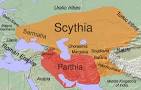
Scythia was the name given by the ancient Greeks after about 800 BC to the homeland of the nomadic tribes in the southeast part of Europe, eastward from the Carpathian Mountains to the Don River and in Central Asia, from the Danube River, an important route between Western Europe and the Black Sea, to the mountains of Turkistan.
They were a nomadic people who raised horses, cattle, and sheep. According to ancient Greek historians, Scythians travelled in tent-covered wagons and fought with short bows and arrows from horseback and spoke a form of Persian.
The most detailed western description is by Herodotus, The Father of Lies, or, more kindly, The Father of History, according to the blurb on my Penguin Classic, though it is uncertain if he ever went to Scythia.
Their empire stretched north of the Black Sea to parts of present-day Ukraine, Russia, and Moldova from the 7th century BC to the 4th century BC.
This region was seized by the Sarmatians in the 4th century BC and became known as Sarmatia. By the 3rd century the Danube formed the northern boundary of the Roman Empire in southeast Europe.
I have been going on about archeological and geological times frames, periods and epochs recently and I want to try and put this into some kind of framework with regard to Ireland and the first people to inhabit the island.
The tables below show the most recent information I can find with reference to the periods mentioned.
Paleolithic
pre 8800 BCE
Mesolithic
8800 – 4900 BCE
Neolithic
4900 – 2100 BCE
Nomadic hunting and gathering groups
Transition between the Paleolithic and the Neolithic, the “Middle Stone Age”. Start and end dates vary by geographical region. begining with the Holocene warm period and ending with the start of the Neolithic era. Ireland initially colonised during this period, most probably from Scotland, the Isle of Man and Wales through existing land bridges.
c. 3800 – Farming widely adopted in Ireland over just a few centuries. Herding, polished stone axes, megalithic tombs and pottery almost identical to those found in Britain, suggesting a common origin or on-going contacts between the islands. Late Neolithic Grooved style pottery replaced by new Beaker tyle ceramics c. 2500 BCE
Bronze Age
2100 -500 BCE
Iron Age
1100 – 1 BCE
Roman Age
56 BCE – 420 CE
Britain
Ireland
Ireland
The arrival of the irish language?
2100- 750
2100- 1500
The megaliths and the use of copper and tin, ushered in the early Irish Bronze Age
Early Iron Age
700- 400
Developed Iron Age
400 – 1 BCE
Initial contact with Roman World
Late Iron Age
AD 1 – 400
1500 – 1200
1200 – 500
Before I go any further I want to assert the fact that there is absolutely no evidence whatsoever that the earliest inhabitants of Ireland – during the Meseolithic and / or Neolithic Era – spoke Irish, Gaelic, or any form of a Celtic language until thousands of years after the first arrivals, no matter what the Lebor Gabála Érenn, The Book of the Taking of Ireland or, as it is more commonly known, The Book of Invasions, claims. This is a collection of poems and prose narratives that presents itself as a chronological “history” of Ireland and the Irish, the earliest of which was compiled by anonymous scribes during the 11th century and is regarded as part of the Mythological Cycle of Old irish documents followed by the Ulster Cycle, from which I drew the the inspiration for my novel, Raiding Cooley. Updated in the 12th century with Christian overtones, the aim of which was to provide Ireland and its kings with a genealogical lineage dating back to the earliest biblical times.
The difficulty here is trying to match the Mythological origins of Ireland with the hard archeological, genetic and linguistic evidence currently available.
The Lebor Gabála tells of Ireland being invaded six times by six groups of people:
The people of Cessair, the descendants of Noah, (direct evidence that biblical stories were incorporated into a sanitised version of the mythology), who first came to Ireland clung to the coast but later abandoned the country. Next were the people of Partholón, but he and his people died of a plague. Nemedians, supposedly from Scythia, were next but they left, having been continually harrassed by fierce sea robbers, the Formorians, from their base on Tory Island.
The Fir Bolg, (or Bag Men), descendants of the Nemedians returned, supposedly from Greece but more likely from Gaul and are credited with the erection of the great stone forts such as Dún Aengus on the Aran Islands as well as the division of the island into the five fifths – Ulaidh, Laighin, Connachta, Dá Mumhain and the central territory of Midhe. The fifth group were the Tuatha Dé Danann who were credited with magical powers and later came to represent Ireland’s pagan gods. Under their king, Nuada of the Silver Hand, they defeated the Fir Bolg and later destroyed the power of the Formorians who still infested the island. To them, the great passage tombs at Newgrange are ascribed as well as the Stone of Destiny upon which the High Kings of Ireland were later crowned on the Hill of Tara.
The final group, the Milesians, represent the Irish people (the Gaels) and arrived sometime between 1700 – 1000 BCE after extensive travelling from (again) Scythia, Greece, Egypt (?) and Spain.
Archeologically, it seems certain then that different groups of people, some from the north of Atlantic Europe and some from the South, reached Ireland at different times since the start of the Meseolithic period.
So, who were these first people, and where did they come from? I will come back to this in later blogs.
On several occasions in my novel, the renamed Raiding Cooley, I made several references to “Parthian Red” with reference to both Deirdre of the Sorrows and Emer, the unhappy spouse of Cú Chulainn. The Middle Irish text, Togail Bruidne Dá Derga (The Destruction of Da Derga’s Hostel)* includes a rather lengthy and colourful depiction of Étaín, in which Parthian Red also features, as in the following excerpt
As white as the snow of a single night her wrists; as tender and even and red as foxglove her clear, lovely cheeks. As black as a beetle’s back her brows; a shower of matched pearls her teeth. Hyacinth blue her eyes; Parthian red her lips. Straight, smooth, soft and white her shoulders; pure white and tapering her fingers; long her arms. As white as sea foam her side, slender, long, smooth, yielding, soft as wool. Warm and smooth, sleek and white her thighs; round and small, firm and white her knees. Short and white and straight her shins; fine and straight and lovely her heels.
So, where and what was Parthia?
Parthia, it turns out, was an ancient empire of Asia, in what is now Iran and Afghanistan.
The Parthians were of Scythian descent, and were excellent horsemen and archers. In battle, mounted Parthians often discharged their arrows back toward the enemy while pretending to flee; this is the origin of the phrase “a Parthian shot.”
About 250 BC the Parthians from eastern Iran founded an independent kingdom that, during the 1st century BC, grew from the military outpost of Al Hatra into an empire extending from the Euphrates River to the Indus River and from the Oxus (now Amu Darya) River to the Indian Ocean.
After the middle of the 1st century BC, Parthia was a rival of Rome, and several wars occurred between the two powers. Despite resisting Roman invasions, in AD 224 Ardashir I, king of Persia and founder of the Sassanid dynasty conquered Parthia. Ctesiphon, in modern Iraq, was the winter residence of the Parthian kings, the capital of the Parthian kingdom, and later the capital of the Sassanid dynasty of Persian kings, noted for the remains of a great vaulted hall of the Sassanid period.
The site was soon ruined and abandoned. Modern excavations, however, have uncovered many artifacts from Parthian times.
Plundered by the Arabs in 637, the city was abandoned when the Abbasid caliphs made their capital at nearby Baghdad.
The main Parthian cities – all long forgotten to everyone but specialists in that historical period – were Seleucia, Ctesiphon, and Hecatompylos.
So, you might well ask, what has all of tghe above to do with Celtic Trivia. I mentioned sometime ago, how interconnected Iron Age Ireland was with both Britain and Atlantic Europe through a variety of trade routes as ast my character, Breoga was a trader and merchant from northern Iberia, it seems more than likely, to me anyway, that he would have had contact, either through Roman outposts or through direct links with the Meditterranean area. Go ahead, prove me wrong!
I consider myself to be, at least, an average swearer; that is, I can curse and swear in several languages, besides English of course. Hitchhiking down to Rome in 1971 and totally bereft of Italian – I had earlier turned down a lift to “Firenze” because I wanted to go to Florence – a truck driver educated me, along with graphic hand gestures, all the more terrifying as we both slugged down miniature bottle of Campari as we barreled down the autostrada. To this day I am more fluent in Italian curses than in any other language other than English.
In Arabic I remember almost being arrested in the late 70’s when I muttered “kisimuk” under my breath at Damascus airport while, more recently, my Cantonese “pook guy” and “bart paw” had a student complain about me to the school principal.
So I was rather pleased when I discovered that a new study has found that those who have a healthy repertoire of curse words at their disposal are more likely to have a richer vocabulary than those who don’t.
“Taboo word fluency and knowledge of slurs and general pejoratives: deconstructing the poverty-of-vocabulary myth“, was published in the November issue of the peer-reviewed Language Sciences publication, debunking the “poverty-of-vocabulary” (POV) hypothesis that swearing is a sign of a deficient vocabulary and that profanity shows limited intelligence, a result of a lack of education, laziness or an inability to control oneself and we swear because we can’t find more intelligent words with which to express ourselves. As Stephen Fry once said, “The sort of twee person who thinks swearing is in any way a sign of a lack of education or a lack of verbal interest is just f*cking lunatic.”
Anyway, I have just finished reading a fascinating novel which took swearing to a new level for me. I have no idea if these are “real” words belonging to a subset of a dialectal form of English or whether the author simply made them up. Whatever, hats off to him. Here are a few samples:
Pussyhole (self explanatory, I’d imagine, needing no further gloss from me!)
R’ass (rat’s ass?)
fuckery ( as in an Amy Winehouse song)
bloodcloth ( tampon?, sanitary napkin?)
bombocloth or bombo r’asscloth (??)
rahtid (??)
batty (anus)
batty boy (arse bandit or bum boy)
stoosh (?)
duppy (a ghost)
And the book from which these little gems originate? Well, I thought I would leave it up to you to see if you can figure which recent novel (in the last two years, anyway) they came from. Answers, please, in the comments
One last thing, while it’s great that an ability to curse can be equated with intelligence, it is probably best to use that intelligence to know the social domains within which you can operate and let off steam without causing undue offense to your “audience”!
As you all probably know, I started this blog thingy way back in March of this year as a way to promote my novel, Raiding Cúailnge, set in Iron Age Celtic Ireland. Anyway, the book was published in April and a few people contacted me about the vocabulary and the difficulty of pronouncing some of the words, especially the title, Cúailnge, which is the Irish for the Cooley district in North East Ireland where part of the story takes place.
Anyway, I listened – thanks Shaybo and others – and I have decided to change the title of the book to Raiding Cooley so here goes – a sneak preview!
Of course, I made a few other small changes, correcting the inevitable typos that somehow managed to sneak in, as well as updating my contact details at the end of the book.
So, if you haven’t got a copy yet, you can do so now at Amazon, Kobo, Sony, Apple iBooks and all other good E-book retailers.
Oh, almost forgot, I have dusted off and updated my interview at Smashwords where you can also purchase a copy of my book along with thousands of others.
Smashwords boasts they have published 418,228 books, of which 65,818 are Free (mine isn’t any longer, though!)
Here’s where you can find the interview. Comments or suggestions? I’d love to hear from you. Thanks.
Having moaned a bit about culture shock I experienced when I fist moved to Vietnam (and me, an old Asian hand!) I thought I might attempt to redress the balance by posting this, which I wrote not long after the previous posting.
Approaching the end of my first four months here in Ho Chi Minh City, formerly Saigon, I have to say that the city, despite the myriad annoyances mentioned previously, is steadily growing upon me. The noise has almost faded into the distance, the money with its awesome coda of zeros rarely phases me now while the delights of the new and stylish restaurants set in uber cool settings complement the more traditional Vietnamese restaurants set so pleasantly along the riverside near where we live. Transport problems fade away with a 24-hour taxi rank at the end of our quiet street and some of the arcaneness of the language seems to be dissipating. Gainful employment still hovers on the periphery but, like the traffic laws here, remains just as a suggestion rather than something to be kow-towed to.
Saigon River
Tet has just ended and while I have been in Vietnam many times for Tet over the previous 15 years or so, this has been the first time I have been here for the warm-up to Tet, the actual period itself and the final run-down back to normalcy – or what passes for normalcy here in Saigon. Tet, or to give it its full name, Tết Nguyên Đán, is the start of the Lunar New Year and the herald of the Spring season and, like the Christian Easter, is a movable feast, usually falling around the end of January and before the middle of February.
Unlike many countries in the region, and indeed worldwide, Vietnam is particularly parsimonious with its gazetted, public holidays. Christmas Day for example, widely recognized in many countries, is totally ignored here with children attending school and people going to work as on any other normal day. Other public holidays amount to a stingy one-day off for special, usually historical, events in Vietnam’s fairly recent history. Labour Day (May 1), although it is called International Worker’s day here is, of course, de rigeur for every so-called communist country and then of course there is Liberation / Reunification day (April 30) when the North Vietnamese tanks crashed through the wrought iron gates of the Presidential Palace here in (then) Saigon and American Hueys lumbered from rooftops away to waiting ships in the Gulf and then there is National Day when Ho Chi Minh (the man, not the city) declared its rather premature independence from colonial forces (September 02 1945) but all these one day skimpy holidays pale into insignificance when compared to Tet.
Imagine, if you can, having your birthday, Christmas, Easter, Wedding Anniversary, Valentine’s Day, Buddha’s Birthday and St. Patrick’s day all rolled into one glorious holidays where everything, and I mean everything, closes down everywhere from a miserly minimum of one day to a glorious extravaganza of an eating and drinking and gambling fortnight. Add to that, of course, the annual roll-over of age in that at the beginning of Tet, every single person in the country becomes a year older, so in fact, it is your birthday so what is there not to celebrate?
However, with Tet being such an important holiday, it is essential to approach it with suitable reverence and intense preparation. Much like a western Christmas when shops start to gear up for the festive season as soon as Hallowe’en is over, so too do Tet preparations begin in earnest not only in shops and businesses but also in every home in the country. Shops fill up with gaudy decorations, usually some variation of the phrase Chuc Mung Nam Moi, ideally wrought in fine gold on a red velvet background – red and yellow being the principle lucky colours for an auspicious start to the New Year – but of course all variations on that theme, provided the colours are maintained, is acceptable.
Similar to the Chinese New Year when the largest world-wide migration of people take place, it is incumbent on Vietnamese to return to their home birthplace for Tet. Woe betide the Western tourist who tries to travel in Vietnam during this period as every form of transport will have been fully booked up and then overloaded. A 16 seat mini-bus will manage to accommodate up to 30 people along with luggage and bales of unidentifiable goods wrapped around and around with duct tape, baskets of live chickens and neatly trussed pigs. Part of the excitement in the build-up to Tet, of course is preparing to receive long absent family members and to scrupulously clean the home before Tet, as once the holiday begins, no cleaning may be done lest one inadvertently sweeps or throw away the good luck one is due on account of the preparations you and your family have made.
The Kitchen God – and every household has one – must be propiated with gifts and offering because it is he, and he alone, who will report back to the celestial Jade Emperor on the family’s efforts over the previous year and it is the Jade Emperor who will decide the future prosperity of each household. Of course as all shops and markets will be closed during Tet, it is of prime importance to stock up on all basic food items – rice, oil, noodles, preserved fruit and vegetables, as well as all the essential items, minced pork and mung bean tucked inside a solid wodge of sticky rice wrapped up in a thick layer of banana leaves and then boiled over an open wood fire in huge pots closely resembling oil drums, usually out in the street before the house for hours, often over night with family members taking the responsibility to sit up tending the fire and telling tales of Tets past – after all, what would Christmas or Thanksgiving be like without the turkey and the spiced ham and tales of Scrooge?
Once the home has been thoroughly cleaned, paying special attention to the kitchen, then it must be suitable decorated. Red and yellow flowers will predominate although orange marigolds may be included. Yellow forsythia branches must adorn the home while peach and cheery blossom trees are especially popular.
Private household altar
Kumquat trees laden with small fruit are also popular, symbolizing fecundity and abundance, something everyone aspires to in the New Year. Everyone makes that special effort to pay off all debts while new clothes and shoes are required for everyone, especially children. Everyone participates, much as they do here in driving in appallingly crowded situations by being mannerly and considerate to everyone else. Losing your temper in the bustling crowds in the teeming markets would be a very grave loss of face resulting in untold misfortune for the coming year, while at the same time, happily and willingly paying that bit extra for just about any service of goods will ensure that the Jade Emperor will look upon you with benignity, as well as helping all those others to afford the extravagance that the season demands.
The first day of Tet is probably the most important as the first visitor to the family home will set the luck for the coming year. Shortly after midnight on New Year’s Eve, – and usually by prior arrangement – an appropriate visitor – i.e. someone relatively prosperous, jolly and charming, bearing gifts of flowers, food and alcohol – should arrive and be boisterously welcomed, thus ensuring good luck to the host or hostess for the coming year. Be aware, not every visitor is welcome or suitable and expect the door to remain firmly shut if you are perceived to be from the wrong side of the tracks. I rather smartly slipped outside my own front door just before midnight, waited the appropriate time and then gave the beady-eyed one a near heart attack by banging and hammering on the front door. She opened it with great trepidation to find me beaming and lurching under the weight of a assorted potted plants in the appropriate colours, US dollar bills spilling out of every pocket, a bottle of wine gripped precariously under my oxter and my pockets stuffed with savoury snacks. Seeing as the apartment is in my wife’s name, I felt that I should be the first visitor to cross the threshold, ensuring an abundance of good luck for the New Year, although it was only her steadying hand that prevented me from shattering the bottle of Shiraz on the tiled floor as I attempted to unburden myself.
Having survived that hurdle, New Year’s Day is reserved for the nuclear family focused on the paternal side of the family. Children dressed in their new finery, bow to their parents and offer traditional greeting – Sống lâu trăm tuổi (Long life of 100 years) and formally receive a red packet – a small red envelope, decorated with traditional wishes, containing assorted bank notes (Vietnamese notes range from the very lowly 500 dong (approximately Euro 0..02 cents) to the rather lordly 500,000 (Euro 18.06 cents) while friends wish each other Tiền vô như nước (May money flow in like water).
The second day of Tet is then reserved for the maternal side of the family and for respected friends and acquaintances and it was then that we made our way to the beady-eyed one’s mother house to present our best wishes. Almost bankrupted by the excessive taxi fare for the 15 minute journey, we arrived bearing gifts of flowers, fruit, sticky rice packages and, of course, red packets. Not just for children, the custom appears to give them to everyone who is a) unmarried and b) younger than the giver. In my case, that seems to be just about everyone, including the grinning and obsequiously bobbing doormen / custodians / guards and gate-keepers at our apartment. And then, naturally, there were the Beady-eyed one’s nephews and nieces, shyly bowing to me as I sat in state on a hard wooden settle, wishing me the Buddha knows what in their whispered Vietnamese as I handed out bulging red packets. I had no idea how much money was in them as the beady-eyed one had merely presented me with a bundle of ready stuffed red packets and instructed me to hand them out. Judging from the gasps of astonishment and incredulous glances my way, not to mention the never ending line of unctuous supplicants bowing before me, it was enough to pay for a handsome university education overseas along with a Masserati for daily transport.
Shortly after Tet, Prime Minister Nguyen Tan Dung hailed ministries, branches and localities for their efforts to ensure a happy and safe Lunar New Year festival for people of all strata, although at the same time asking them to pay more attention to traffic issue, and reprimanded several localities where firecrackers were still set off during the festival despite the ban. On a more positive note, he urged everyone to take drastic measure to remove difficulties facing businesses, control inflation, solve bad debts, keep the prices of essential goods stable, and speed up agricultural production. In implementing the instruction of the President and the Prime Minister, New Year gifts worth a total of nearly 394 billion Vietnamese dong had been handed over to nearly 1.9 million people who have rendered services to the nation, while 24,000 tonnes of rice were sent to 15 provinces to help needy people. Besides, local authorities nationwide granted presents worth more than 807 billion Vietnamese dong to families, which are beneficiaries of social welfare.
However, in a number of localities, traffic jams still happened. In many tourist sites and spring festivals, visitors still ignored regulations on hygiene and safety. During the 9-day holiday, 681 criminal cases occurred nationwide, 314 people died and 387 other injured in 373 traffic accidents.
From Local English Language newspapers at the time.
I mentioned ages ago that one of the reasons for this blog thingy was cyber-space shock that I thought I was experiencing – not that I put it that elegantly, of course – which was a major driving factor for me to get involved with this blog thingy. Recently, that got me thinking about culture shock and where and how I had first encountered it. I think the first time I ever really experienced it was when I arrived in New York in 1977 and expected it to be similar to the worlds I had left behind in Europe. I remember reading somewhere (Alvin Toffler – Future Shock?) that Culture Shock can be amieleroated after about nine months and that used to hearten me, much like beating Google Maps time estimate for walking from A to B does for me now.
Anyway, jump forward to about 2013. I had, at that stage, lived and worked in different parts of S. E. Asia for more than twenty years, but, despite having visited and travelled in Vietnam several times over the few years, I had never actually lived there until I got serious and signed a lease on an apartment in Ho Chi Minh City (Saigon).
Saigon was a different world. Everything was strange and either ludicrous or just plain crazy. Traffic, for instance, was no doubt governed by laws, but what those were remained unfathomable to me. One-way streets, traffic lights and pedestrian crossings appeared to be mere suggestions without any serious compliance expected. Crossing any street was as fraught with as much excitement and danger as playing a computer game like Call of Duty (Black Ops) as “attackers” (motorbikes) can come at you from any direction and at any time without any warning whatsoever, but unlike computer games, you only have one life here, while lumbering buses and trucks made no allowance for either motorbikes or pedestrians. Pavements and sidewalks were fair game for motorbikes and the rule appeared to be that if you can stop your bike sideways on the pavement or in the middle of your living room, or even the road, why then, it was perfectly parked!
Recently the Saigonese police initiated one of their regular crackdowns but this certainly did not involve stopping bikes rushing through red lights or going the wrong way up a one-way street or driving on the pavement; instead, it seemed to be more of a crackdown on pedestrians in that if a pedestrian was involved in an accident, it must have been the pedestrian’s fault!. Similarly when driving at night, why run the risk of running your battery down when you can simply turn off your headlights at night and drive just as well in the dark.
Notwithstanding all that, the Beady-eyed one decided that we had better get into the spirit of things and rent our own personal motorbike and for reasons best know to others it was decided to rent a motorbike on the far side of the city to where we actually live. I made the rather tentative suggestion that we rent a scooter with automatic transmission – having spent at least a total time of less than one minute “practicing” on a Honda Airblade in Cambodia. This would, I felt, obviate the need to change cumbersome gears with the feet while attempting to maintain eyes forward, sideways and backwards and at the same time weave with the fluidity of a dust mote in a beam of sunlight, through the woof and weft of roundabout traffic. This suggestion was quickly rebuffed as it is a well-known motorbikes with automatic transmission are too powerful and have a tendency to “run away” with you if you twist the handlebar throttle too much! Instead we settled on a Honda 110cc with manual gears because then “you can start it up in 2nd gear and it won’t run away on you”. All well and good and the one-eyed tout renting the bikes appeared to have no qualms about renting a bike to a pair such as us who blatantly had no knowledge of where to even put the ignition key or whether to use the left or the right foot for the necessary gear changes. A one-minute tutorial in (unexplained to me) Vietnamese and a 5 minute practice ride in, through and around the flower beds in a nearby public park sufficed and the keys were quickly handed over for another million dong or so.
The immediate problem that presented us was two-fold; neither the Beady-eyed one or myself felt sufficiently confident to give the other a back pillion ride and, even if we were, neither of us had the slightest of idea how to circumnavigate the city to get to our far-flung district. Bit of an impasse, until a malleable plastic 50,000 dong note was slipped to the assistant of the one-eyed man and he drove the Beady-eyed one home, using the bike as a XÊ HỐM ̣motrobike “taxi” or litterally “hug machine” as the passenger is often obliged to hug the driver to avoid being jolted off the back as the rider careens over kerbs, potholes and the occasional bricks casually tossed onto the road. I then spent the rest of the afternoon hunting for a bus which would go within reasonable distance of where we actually live. By the time I got back home, of course it was too dark to warrant venturing out onto the tangle of streets surrounding us so all we had to do was pay the gate-keeper where we live another small fortune in well used plastic bank notes to allow us to park the bike under his supercillious nose.
The next morning, after the apparent ritual of handing over another bunch of crumpled plastic bank notes to the new gatekeeper which allowed him to retrieve our bike from wherever his colleague had hidden it the previous night – we took it in turns – “remember to start the bike in 2nd gear” – to cruise cautiously up and down our local street, rented helmets with greasey, sweat-stained linings slipping down over our eyes, our arms extended stiffly on the handlbars, eyes flickering nervously down to our feet and then belatedly up to scan the street for the unwary chickens which patrol it haphazzardly, tentatively trying out the horn (an absolute must for any aspiring driver here) and the indicators and stalling the bike in our attempts to bring it to a graceful stop actually in front of the street cafe rather than on top of one of its small tables.
Suffice it to say, a week later, the bike remains safely parked in the basement bowels of our building while our helmets moulder in a cupboard, while, since our arrival at this address, the local taxi mafia have set up a permanent taxi-rank outside our front door.
Enough said about traffic and bikes, I feel, although there was some talk that we might return the bike and exchange it for an automatic one as, apparently, they are easier to drive! Hmm, said I, non-commitedly
Noise is a constant factor with everyone, motorbikes, buses trucks and an increasing number of private cars having carte blanche to blast their klaxon-like horns constantly, mingling with the incessant noise of daily life on the streets – people crouch on tiny stools over rickety tin tables, sucking down noodle soup at all hours of the days or night while small “cafes” simply appropriate the space before a closed shop or office and set up their stools and tables there. Along with eating on the street, there are all the concomitant activities that go with it – obviously, cooking over an open charcoal fire on the pavement is perfectly normal, as are washing the dishes in a tub of greasy lather while it is perfectly
OLYMPUS DIGITAL CAMERA
acceptable to sprawl on the pillion seat of a motorbike with your bare feet propped on the handlebars while a foot massage or pedicure is administered. Why stop there, of course? The street is a perfect place for a barber to attach a chipped mirror to the railing and set up a barber’s chair, and while you are at it, you might as well bathe the naked children on the main street as well. Need a toilet, well there is a perfectly good tree that you can hug and pee away to your heart’s delight. Feel like a nap? Just stretch out on any semi level piece of ground and snooze away.
OLYMPUS DIGITAL CAMERA
Shopping is another new experience. Supermarkets are few and far between and the ones that do cater to western tastes – i.e. selling such delicacies as Kiwi shoe polish, Cornflakes, baked beans in tomato sauce, long-life UHT milk imported from New Zealand and Australia, pasta and P.G. tips tea bags – are few and far between as well as being outrageously expensive. Instead, Vietnamese life centers around the market – usually a maze of narrow alleyways where fruit, veg, fish, meat and live poultry are haggled over down to the last cent. Don’t feel the need to have an actual stall? Fine, just spread a torn sheet of plastic on the muddy ground and pile your veg there. Want a nice pig’s tongue or a bucket of toads, or a basin of slippery eels? No problem, just scoop them up into the ubiquitous plastic shopping bag and slaughter away in the convenience of your own home.
OLYMPUS DIGITAL CAMERA
Nothing pressing to do today? Well then, sprawl in a plastic garden chair and drink syrupy black coffee with ice, or, for a real taste buster, load up the glass – cups are rarely used – with sweetened, condensed milk, top up with Irel like coffee and then dilute the dregs with the complimentary glass of iced jasmine tea, flicking your cigarette butts (Craven A – pronounced CARavan A) at pedestrians’ feet as they stumble past on the cracked and uneven pavements between the parked and zooming motorbikes, while fending off the legion of crippled and maimed selling lottery tickets, sunglasses, feather dusters, zippo lighters and manicure kits from a sandwich board contraption they sling over their deformed shoulders.
However, it IS and experience and I am coping quite well, I think. For a start, I have enrolled in a Vietnamese language school and while I signed up for an elementary class with other would-be aspirants, so far I am the only student and have the undivided attention of a pretty, charming, superbly fluent and patient 24 year old teacher. I signed up for 35 hours at the monstrous price of 4,000, 000 dong (yep, 4 million!) and have already completed 12 hours, most of which has been spent grappling with the tonal aspect of the language as well as learning to write using the correct tonal signals along with the assorted diacritics that the Vietnamese alphabet of 29 letters uses. A “D” not surprisingly, is not, of course, pronounced “Duh” but instead sounds a bit like a “Yuh” while letters such as Ă, Â, Ê, Ô, Đ, Ư and Ơ still retain that aura of mystique. Add the tones then on top of those letters and it becomes even more baffling as in Ầ or Ẩ or Ẫ while a simple and important word like “wine” becomes unreconisable in RƯƠỤ – notice the all important dot under the final U!
However, having said all that, I have to admit to a rather modest surprise at how fast and well I am actually learning. My class is from 10:00 – 11:30 (but then again it might just be from 10:30 – 12:00 noon) three mornings a week so after the lesson I wander around and get lost and finally, in a sweating, red-faced, sodden mess, I attempt to squeeze my bum into a plastic chair clearly made for kindergarten kids and slurp coffee – (Cà phê) while mumbling such phrases as I believe I have mastered only to later discover that I have just told the waitress that “her mother is a beautiful grave”!.
Then the wearisome search for a bus home begins. Saigon is a maze of one way streets and while this is blithely ignored by motorbikes and small utility trucks powered by oily, smoke-belching ancient motorbike-like engines, buses here do tend to follow the standard traffic direction. So, getting off the bus and carefully noting the stop – all bus stops are conveniently identified with XÊ BỨYT stencilled in faded letters on the road itself – it is all to no avail as the street apparently is a one-way street and the return bus would not just simply chug along on a parallel street but perhaps take a more tortuous route several blocks away. My several attempts at asking directions in my newly fluent Vietnamese had one gentleman hawk a gob of spit at my feet while a rather prim lady blushed and pulled her paisley-patterned surgical-type mask firmly over her face and stalked off without a word.
On the subject of surgical masks! Apparently, it is not just the Beady-eyed one’s fastidiousness and it certainly it is not just the beach that can make a lady’s skin dark. It is, rather, the mundane situation of being anywhere outdoors between dawn and dusk. Here in Saigon, of course is the added problem of “the dust” which necessitates every sinlge female between the ages of 11teen and 90 wearing a plain or haute-couture designed face mask, much like the style favoured by bank-robbing cowboys. Those particularly concerned with the “whiteness” of their features will additionally opt for the more comprehensive cover of a gorget or wimple. Along with the face mask, covering everything from below the eyes, a floppy hat is also de rigeur. Add to that, elbow length evening style gloves, similar to those worn by Audrey Hepburn in Breakfast at Tiffany’s and, finally, as a finishing touch, wear fish-belly grey knee length stockings with a convenient cleft between the big and first toe, all the more suitable for slipping your foot into the ineveitable thongs / flip-flops that many ladies here seem to favour.
And then it is the numbers (or lack of them sometimes) that put the heart sideways in me – I still can’t get used to dealing in millions for relatively simple purchases. The first time I ever came to Vietnam, back in 1996, you needed a plastic shopping bag to carry the cruddy paper bank notes around. Now, a semblance of sense exists and the notes are all the new shiny plastic bank notes, originating, I think, from Australia. The largest note is a 500,000 dong note, followed by a 200,000 and then a 100,000, and then down the scale at 50,000, 20,000, 10,000, and the rather lowly paper notes of 5,000 2,000, 1,000 and finally the rather pitiful 500 dong note (approx. $0.02 Australian or Euro cents !)
Despite the above, I really came to enjoy it less than four monts later.


 but using straight lines rather than letters, the message is read from the bottom up. A letter for /p/ is conspicuously absent, since the phoneme was lost in Proto-Celtic, and the gap was not filled in Q-Celtic, and no sign was needed before loanwords from Latin containing /p/ appeared in Irish (e.g., Patrick).

 dic tribes in the southeast part of Europe, eastward from the Carpathian Mountains to the Don River and in Central Asia, from the Danube River, an important route between Western Europe and the Black Sea, to the mountains of Turkistan.

 cabulary and the difficulty of pronouncing some of the words, especially the title, Cúailnge, which is the Irish for the Cooley district in North East Ireland where part of the story takes place.

 time without any warning whatsoever, but unlike computer games, you only have one life here, while lumbering buses and trucks made no allowance for either motorbikes or pedestrians. Pavements and sidewalks were fair game for motorbikes and the rule appeared to be that if you can stop your bike sideways on the pavement or in the middle of your living room, or even the road, why then, it was perfectly parked!


 Red Branch Chronicles
You must be logged in to post a comment.