One of the original ideas for this blog thingy was for me to encounter new curves in media and technology and … ok, ok, I am the first to admit I have been a bit of a slow learner in those areas. But at least when I posted something on Red Branch Chronicles it also appeared, as if by magic, on my FaceBook thing which I never actually look at. No idea how that happens – it is something that automatically occurs when I post on my WordPress account. Now, for some reason, FaceBook no longer accepts direct input from WordPress unless I convert my FaceBook ‘Profile’ – didn’t even know I had one – to a Facebook ‘Page’.
Im not 100% sure what the difference is, but perhaps a page is more business-like than a (more?) informal profile? Who knows? Not sure I care actually, but I feel as if technology – and FaceBook in particular – have thrown up another obstacle in my snail like approach to media literacy.
Anyway, having followed explicit on-screen instructions (from FaceBook) on how to convert my Profile to a Page, this post should now magically spring up on Facebook to the shock and awe of … myself, anyway.
One of the reasons I went to the Caucasus – and Georgia in particular – was because of the claims wine was ‘invented’ there in 6000 BCE, or 8000 years ago, give or take a few centuries. The Washington Post, National Geographic, The Daily Mail, the BBC, CNN, The New York Times and the ABC all ran fairly recent stories bruiting the news of radio-carbon dating of pot shards and bio-molecular and DNA archaeology of grape pips from the Stone Age accurately dating wine making to that period in Georgia.
Alvin Toffler in his seminal book The Third Wave claimed that humanity advanced in sudden ‘waves’ or periods of intense adaptation and progress. The third wave was the technological and communications one which swept the world within the last century. The second was the Industrial Revolution but the first – and probably the most important wave – was the adaption of farming and the domestication of animals by our Neolithic Stone Age ancestors. Without this first wave, Toffler claimed, nothing else could have been achieved, which brings me back to wine.
To my mind, there is no question that wine was ever invented. Just as no one can claim the invention of the wheel or the discoverer of fire, similarly, no one can claim to have invented wine. Nevertheless, legends lay easy claim to the latter. Noah, after he landed the ark on Mt. Ararat (on the borders of modern day Turkey and Armenia) disembarked the animals and planted a vineyard after which he got horribly drunk and made a disgrace of himself. All of which begs the question of where he originally came from because he must have brought the vine shoots or saplings with him in the ark! Then there is the much older Sumerian Epic of Gilgamesh which also details a deluge after which the eponymous hero sets out on a quest to discover wine and the immortality it can bestow. Another Persian legend describes how Jamshyd – a semi-mythical king – kept grapes to be eaten in jars. One of his handmaids, out of temper with the king and his court, attempted to top herself by drinking the juice from the foaming grapes in one jar, believing it to be poison. Instead she discovered the delights of alcoholic inebriation which she then passed on to the king who, according to the XVII Rubaiyát of Omar Khayyam (The Fitzgerald Translation 1859)
‘They say the Lion and the Lizard keep
the courts where Jamshyd gloried and drank deep
It must have been a joyous discovery when the first Neolithic farmers found that the grapes, hoarded for leaner times, had fermented and changed magically into a drink other than the contaminated and disease ridden water that they had been dependent upon all their lives.
Three factors independently appeared, more or less at the same time, that all combined to give us the wine that we know today. Firstly the widespread presence of vitis vinifera, the wild Eurasian grape vine in the valleys between the greater and lesser Caucasus mountains, secondly the cultivation of barley and wheat which allowed food reserves to be stored, and thirdly the invention of pottery for making and storing wine.
But back to Georgia where the most astonishing thing is that wine is still made in the same way that our prehistoric ancestors made it.
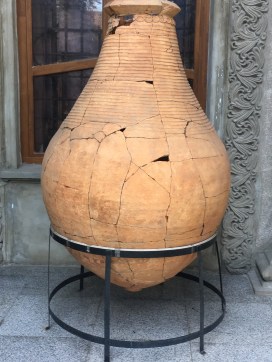
First the grapes are crushed – sometimes in large, hollowed out logs – before the juice, the skins, the grape pips and even the stalks are poured into qvevri, large earthenware jars, (several hundred to thousands of litres in size) often lined with beeswax, which are then buried in the ground. The juice ferments using wild yeast while the ground maintains a steady geothermal temperature and the conical shape of the qvevri allows the wine to circulate and clarify naturally.
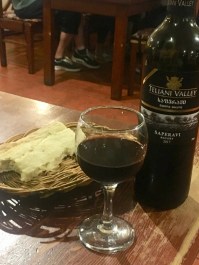
A glass of ‘white’ qvevri wine compared to ‘normal’ white wine
These qvevri wines – also known as ‘natural’ or ‘raw’ or unfiltered wines – have a distinct orange or amber coloured hue due to the skin contact during fermentation and taste quite different to European wines which are fermented without the pulp. Nevertheless, qvevri wines can differ in style with both sweet, semi sweet and dry wine all being made from the Saparavi grape.
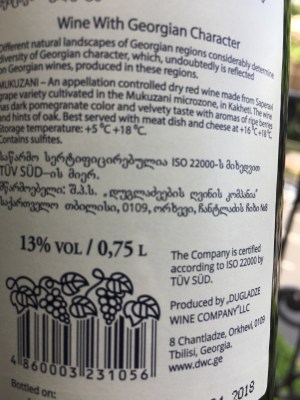
Wine is such an integral part of Georgian life that wine is made by just about every family as grape vines are ubiquitous throughout the country. Roughly 500 of the world’s 2000 grape varieties hail from Georgia although less than 20 varieties are used in wine making.
Kakheti, in the eastern part of the country is probably the most famous wine producing area in the country and that is where I went to sample the Saparavi dry red and the white Tsinandali in the town of Sighnaghi.
Under the Soviet rule, the Russian taste was for strong, sweet wine with extra sugar added which led to a decline in quality but since Georgia’s independence in 1991, wine makers have upped their game and while still producing wine in the traditional qvevri fashion, now also produce high quality wines in the western style.
When I was in school, I used to enjoy Geography and was proud of my childish ability to name European capital cities. Then the world seemed more compact, comprising of Western Europe, The USSR, Asia, Africa, The Americas and Antarctica. Then, of course from the ethnocentric European point of view, there was the Near East (Egypt and Suez), the Middle East (Syria, Turkey) and the Far East (China, Japan) and, intriguingly, Asia Minor or was it Eurasia? And then there was something called the Balkans, famously described by Bismarck, I think, as the ‘sick man of Europe’ and the Caucasus, which, in my mind, was a sort of no-go area. Nevertheless, none of those areas was ever clarified in my mind.
Confusingly too, in American crime news and novels, there were always references to “Caucasian males, armed and dangerous, if encountered, do not approach”. Who or what they were I was never quite sure but I suspected that I might be one of them – no, not the armed and dangerous bit, of course.
Anyway, as I learned recently, the currently outmoded system of classifying our species depended on a 19th century German physiologist and anthropologist, Blumenbach. He classified human kind in traditional terms of Caucasian / Caucasoid, Mongoloid, Australoid and Negroid, but it was the use of the term Caucasian that fascinated me.
The Caucasus Mountains in modern day Georgia, and specifically the southern slopes,
Ancient Wine amphora or Qveri from Batumi in Georgia
were apparently the home of, not only the autochthones – the original members of mankind – and the site at which Noah’s (of the Ark fame) son, Japheth – the traditional Biblical ancestor of the Europeans – established his tribes before migrating into Europe proper but also the birthplace of wine more than 8,000 years ago!With a history like that, what was there not to like about exploring this hitherto unknown – to me – part of the world.
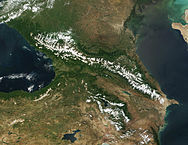
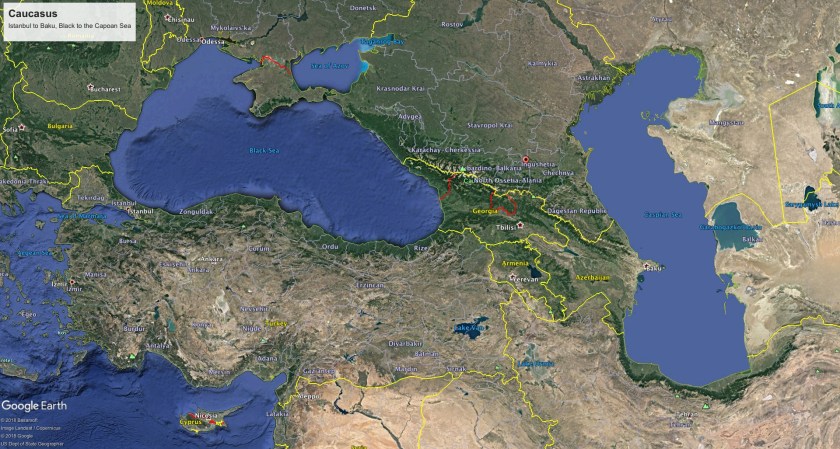
Factually, the Caucasus is the area of land, composed mostly of Georgia, Armenia and Azerbaijan (along with lesser, recognised and / or unofficial Republics of Ossetia (north & South), Abkhazia, Adjara, Ardsakh, bounded in the north by the Greater Caucasian Mountains and about 100 kilometres south by the lesser Caucasian Mountains.
Satelite view of the Greater and Lesser Caucasus Mountains
Nevertheless, without bothering particularly to look at maps, I arbitrarily decided for myself that my Caucasus (trip) would start in Istanbul where the Bosporus drained from the Black Sea and would encompass everything as far as Baku in Azerbaijan on the Caspian Sea. It seemed simple – Black to the Caspian Sea with the Caucasus somewhere in between – and the wine bit sounded good, to me at least.
Istanbul to Baku, The Black to the Caspian Sea.
I remember, years ago, I dozed through a class called Comparative Analysis of an Uncommonly Taught Language, Turkish and English. The only definitive thing I took away from that class was that Turkish is an ‘agglutinative’ language. I could still remember a smattering of Arabic phrases from my time in the Gulf so language shouldn’t be a problem! All I had to do now was get to Istanbul and start discovering 8000-year-old wines!
I think that I have a good to excellent vocabulary; I read a lot, I write a bit, I had a good education and I tend not to need a dictionary – I don’t believe that I actually have a paper dictionary here in the house. When, on the rare occasions, I do come across an unfamiliar word – one that I might be hard pressed to give an accurate dictionary-style definition – it doesn’t matter because I can understand the general meaning from the context. For the vast majority of books and articles that I read, I would say I have a total understanding of every word used in my own native language.
So, imagine my chagrin when I recently reread a novel I had read some 25 years ago (hint: referred to recently on this blog) and was dismayed to come across a plethora of words, some of which, luckily, stirred a vague memory in my word-hoard. Nevertheless many of them forced me to stop, and go to my online Oxford Dictionary of English and check to see if my understanding tallied with the author’s use and, embarrassingly, to actually look up new words that appeared almost on every page – it was like reading in a foreign language.
I remember – I think – reading somewhere that Anthony Burgess (The Malaysian Trilogy; A Clockwork Orange; Earthly Powers, etc.) kept a dictionary on the shelf in his toilet and tore out a page each day after having committed it to memory!
I am not going to go that far, of course and, besides, I don’t have a paper dictionary, remember?
Wasn’t it Humpty Dumpty who said (rather crossly, as far as I can remember) that words mean what you want them to mean, so here is a sample of words that I came across – hats off to anyone who can understand these, lifted, as they are, from context – but all from the same novel published in 1989 – shortlisted for the Booker Prize too!
abulia
glair
kern
^ jorum *
^ villious
^ ataraxy
echolalia
spruik
kickshaw
flitch *
cully
bumper *
epicene
finical
losel
mephitic
In all honesty, I can’t remember what half of them mean now – and I only finished reading the novel yesterday, too. Luckily my online OED keeps track of recently looked up words so there you have it. Nevertheless, it’s humbling to think that the English language is so vast and complex that there will always be new words to come across and not just the recently added ones as in “Milkshake Duck” which was recently acclaimed as the Word of the Year here in Australia. Go figure it out yourself.
* Words I have a memory my father used to use but I still had to check to ensure the author’s use tallied with my understanding of my father’s usage all those years ago.
^ Words which the inbuilt dictionary on my iMac does not recognise.
I don’t know why, but ever since I returned from Europe in August 2017, I seem to have hit a dry patch with regard to my writing and this blog thingy. I have been able to write neither bucolic accounts of my European Peace Walk, nor do research for my Red Branch Chronicles.
That’s not to say that I’ve been lazy – far from it. I seem to have been busy all day and everyday, just doing things that need doing and that won’t get done by themselves. There is always something “new” that has to be done in everyday, general living which has completely blotted out my creative world or perhaps, then again, I have voluntarily chosen to neglect it.
Despite the scribbled contents of a grubby, wine-stained notebook that I dragged along on the EPW and my eclectic, albeit desultory, readings in the Celtic area and era, over the last few months, nothing has sparked my interests. In truth, it may well be the other way around. I have this vague reluctance to commit myself to write about Celtic Iron Age,
Travel,
Food,
Books
and those sorts of things on my blog so I have done absolutely nothing. Saying that nothing resonated with what I felt able to write allowed me to stagnate. I’ve barely sat down in front of the computer, let alone attempted to write something about my forays into Christmas cooking so, as Ian Dury intones, I have most certainly not been “a pencil squeezer”!
However, today was different. My kitchen clock, permanently stopped at 8:42, since before I went to Europe and the September calendar on the back of the door, were all physical manifestations, I was told, of my sloth, stagnation and inactivity. Half-heartedly defending myself from those (acknowledged) charges, I pointed out the clock is always right twice a day and who needs a paper calendar anyway, when we are all tooled up with smart wearable gadgets? Nevertheless, I put up a new calendar on the back of the kitchen door and threw the recalcitrant clock into the bin (no more K-Mart clocks for me, thank you very much), resolving to buy a proper clock as soon as possible.
Seems such an easy feng shui fix, doesn’t it – buy a new clock and put up a 2018 calendar? I’m sure there is more to it than that but let’s see. I suppose the proof will be in the pudding. How much will I have written by the end of this month (January), season (Summer) or year (2018)? Well, there’s a nice attempt at temporising if ever I saw one! I started out writing about a nosedive but I may be able to convert that downward plunge into a Bigglesian loop de loop. https://en.wikipedia.org/wiki/Biggles
I watched a Christopher Nolan* movie recently on the long flight home – holy-moly, who understands or follows any of his plots on first viewing as they weave in and out, forward and back in undefined flash-forwards and backs? – and one of the main characters ejected from a doomed space station in a streamlined, white pod that zoomed through the atmosphere before plunging into the ocean.
I didn’t actually plunge but tentatively tried “a float’ in a space-aged pod to recover from my walk in Europe. Sleek and gently oval in shape, the pod is loaded with 500Kg of Epsom salts and the water gently heated to body temperature, allowing you to float and relax while the magnesium salts permeate the skin and relax tired muscles.
Remarkable therapeutic benefits, relieving stress, pain, fatigue, arthritis and fibromyalgia, are just some of the benefits claimed for the float and I was keen to try. Who wouldn’t? Described by some as otherworldly, a pure, blissful experience accompanied by deep feelings of lightens and grace.
Anyway, I turned up for this new adventure and there it was – the pod from the Nolan movie that had crashed into the ocean, only this one was sleeker and more inviting, a smooth, eggshell shape, yawning temptingly before me, soft internal pastel lights changing automatically.
I stepped into knee deep, warm water, pulled the (escape) hatch down, and lay back on the subtly shifting water as it adjusted so perfectly that I was barely aware of floating.
With the hatch down, it was stygian black – I couldn’t actually say ‘inside’, because I had no sense of the space around me, where right or left were, and which way was up or down – and alone, I floated or drifted in complete silence and darkness not knowing if my eyes were open or closed. There was no current, no movement until I thrashed around trying to centre myself, as if that were important.
I suddenly realised that everything I was experiencing then came from within me. There was no distraction, no outside stimuli to lead my wandering mind, nothing to look at, and nothing to hear or see. Deprived of most of the usual senses, I hung there passively, doing nothing.
Things are so black that I could imagine seeing vivid, other worldly scenes but all I saw was nothing. It reminded me of a comic scene where one character says, appreciatively, ‘ah, the sound of silence’ and the other character responds, ‘what? I don’t hear anything.’
I giggled then and listened to the sound of my heart and the blood pulsing in my body and then it was all over and I stepped out into the “chill-out” room with a cup of herbal tea. Did I feel lighter, more vibrant, was I boosted, were my dopamine and endorphin levels brimming over?
Not knowing what my endorphin or dopamine levels were before, it was difficult to say if they were raised after the float but I certainly felt pleased with myself for no apparent reason, and there might even have been a bounce to my step and my hair definitely felt fluffy!
* Christopher Nolan directed Inception, Momento, Batman Begins, Interstellar, The Dark Knight, The Prestige, Dunkirk, among others
I was in an outdoor cafe recently when I met a bloke who told me how he had suddenly woken up blind! It was terrifying, as you can imagine. He had had a stroke and a blood clot had formed in the occipital cortex of his brain, slowly starving his vision centres of blood and oxygen.
I have nothing to compare with that but in a recent eye test I was told that I had cataracts in both eyes with one being far worse than the other and that henceforth, driving would be at my own risk. Ah hah, I thought, that was why I was seeing double when I looked at the moon.
Eye surgery, as pioneered by the Australian Dr. Fred Hollows is a fairly simple procedure where, after cataract extraction, an inter-ocular lens (IOL) is implanted, usually resulting in a massive improvement in sight for more than 99% of patients.
I had my right eye done several months ago and the effect was immediate. Within a day or two, I was up and running, as it were, with no side effects. The second operation on my worst eye was a different matter. Itchy, red, uncomfortable and incredibly blurred vision, so much so that, for more than three weeks, I was unable to drive and any bright light was intolerable.
This was all normal, the surgeon informed me, after a major operation and he cautioned me against “using the eye too much”! Twenty-two days later, my vision is still quite blurry in the recently operated upon eye and I can expect another three weeks or so before the eye fully heals. Amazing!
Even more amazing is the surgery. The inter-ocular lens is manufactured in both Nepal and Eritrea for approximately $8 in factories set up by the Fred Hollows Foundation and the cataract extraction and IOL implant can be performed for $25. Not so in Australia, as I discovered, where the mark-up is, roughly, $2500 per eye. The fee is made up in three parts – the surgeon’s fee, the anaesthetist’s fee and finally the rental of the surgical theatre. Thank God for public health, which is what I used for both eyes and thank God for the Fred Hollows Foundation for all the afflicted punters in those less developed countries where the Foundation works.
I suppose the above is an excuse for the total neglect of my blog after I uploaded the 100th post quite some time ago. Anyway, YIPPEE, I can see again and it is only going to get better. Thank you to my doctor and all the people who have put up with my semi-incapacity. All I have to do now is get new ears and possibly a bigger brain!
* I once was lost but now I’m found.
Was blind but now I see.
I was talking to someone recently who regretted that, more than 40 years ago; they had never gone on to tertiary education. I couldn’t quite work out if it was because the fees were too high or because they had not made some type of academic grade at the time deemed necessary for university entrance.
I have to admit to having coasted through my first year at University so much so that my second year was spent repeating the year to get a marginally higher grade allowing me to progress to a slightly higher level in my overall degree.
Even then I felt that knowledge and ability didn’t always merit a badge of recognition, a public certificate, for example in swimming or social media or marketing or historical periods or anything for that matter. Knowledge could just be for enjoyment and pleasure.
I got my first computer in 1985 without having the slightest notion about what a computer was or what it could do for me but it soon became apparent that (some) academic qualifications were unnecessary with regards, anyway, to computing. Some people just took off and seemed to have an innate understanding of how computers and their coding languages worked long before both PC’s and Macs introduced their graphical interfaces. A blinking C:>Dir/w on a blank, black screen seemed scary while it became apparent that in the kingdom of the blind, the one-eyed man was king.
So, whether you want to learn through watching videos, or through assigned readings and discussions with others world wide studying the same courses or whether you just wish to broaden your knowledge of, for example, Art History or brush up your high school Spanish or delve into quantum mechanics, there is a free course available for you. Rediscover deep interests in things from many years ago and invest time in them now but without the burden of either payment or financial stress by using one of the incredible MOOCs now so easily available.
And therein lies the problem which I call the Chinese Menu syndrome – there is so much on offer that to wade through the various offerings can be daunting in itself. To find something you might be interested in just try MOOC, or to narrow down your search slightly, try any of the following,
One of the extraordinary things I’ve discovered is that after i signed up for a free course in an area that particularly interested me, but which wasn’t due to start for another month or so, I got an email “recommending” some other courses which were starting soon and which I might like!
I paged down contemptuously (how dare they think they know what I like, sort of thing) and was gratified to find that the first half dozen courses they offered had no interest whatsoever for me until something caught my eye – Trinity College Dublin.
When I went to university in Dublin in 1971, Trinity was pretty much the preserve of the old Protestant Ascendancy. Catholics were not excluded from the university but the Archbishop of Dublin, at the time, would demand written reason why Trinity and not the Catholic university was suitable for the recognised course of study.
Anyway, it caught my eye and I signed on to Trinity for a short two week course in such and such an area – something I knew nothing about and had never seriously considered before – and I thought I would just ghost through. Instead, maybe because of the video lectures or the reading content or provoking questions, I became interested enough to follow the first week of material.
Initially tempted to reply to other participants comments with a curt “well done” or “I agree” type of comments, I found myself engaging with people I had never seen or heard from before. I think that is really the first time I have ever done that. Not anyway since I first got a modem and heard non-global sounding squawks and squeals from cyberspace and logged on to obscure chartrooms where abuse and requests were hurled.
MOOCs, TEDs are all amazing and I wish you well in your explorations.
I recently received the European Peace Walk (EPW) guidebook for 2017. I know I mentioned ages ago that I was going to do this Walk – a 500+K walking trail through six European countries – Hungary, Austria, Croatia, Slovenia, Slovakia and Italy – over three weeks. It seems a bit daunting, given the current state of my overall fitness. Some days involve 30K hike between sleepovers and the most I’ve done so far is about 16k or so. Anyway, I don’t begin until mid summer – July 04, – so I still have a few months to get up to speed.
I’m really looking forward to this – it is going to be both an adventure and a bit of a learning curve – grappling with languages I don’t know – I only have a smattering of German and Italian, spoken, respectively, at the start and end of the journey, and no idea of the cultures, history, topography, everything.
Croatia, Slovenia and Slovakia didn’t exist as separate entities when I was in school and when the Balkans began its tragic breakup after the death of Marshall Tito, I was no longer living in Europe and the events passed me by, for the most part. Since its debut in 2014, commemorating the 100th anniversary of the First World War, the EPW now passes through Slavic, Teutonic & Romantic cultures, a route only made possible by the geo-political collapse of the region’s former Democratic, Communist and Socialist political allegiances. As recently as 1989, the EPW would not have been feasible, as Europe was still divided into the above contrasting ideologies and its borders and peoples were firmly closed. Now, it is possible to have breakfast in Hungary, lunch in Slovenia and sleep that night in Croatia! So an exciting learning curve there, getting to grips with the tangled histories of the region – I think Bismarck once referred to the Balkans as “the sick man of Europe” – and that, along with the dourness I associated with the former Iron Curtain countries may have contributed to my former lack of interest in the area. But now? Rolling countryside, originally populated by Celts before they (were?) moved on in their endless migrations and then there is the wine and food of the different regions. Can’t wait!
It’s kind of exciting to know that I will have to be totally alone, solely responsible for my own safety and enjoyment in exciting and new environments. I think the whole journey will be a mixture of ‘down-time” and reflection – perhaps not as spiritually reflective as on the Camino, – as well as a physical challenge (in between wines, beers and exciting food) as well as meeting and communicating with locals along the way as well as the 9 other walkers who begin on the same day I do. I suppose both the EPW and the Camino bring people together to share common experiences as well as to learn about each other’s differences and I think this might well embody the ‘Peace’ aspect of the EPW.
Anyway, I have already started planning and preparing,and that’s half the fun, isn’t it?. I bought a new 30 litre capacity backpack, a good pair of walking shoes – not boots – shirts and jackets and pants made of modern textiles which “wick” the sweat away from the skin while at the same time keeping me warm in cold weather and cool in hot. We’ll see. I want to travel really light, total weight, including my bag, should be no more than 10Kg. I’ll have to start carrying the bag when I walk soon. So, that is my current curve – start walking more in this Perth summer heat and build up to at least 20 – 25 k a day so that when July rolls around I will be in some type of fit condition to actually enjoy the walk and the surroundings. Wish me luck!
“Christmas is coming and the geese are getting fat,
Please put a penny in the old man’s hat”
is a rhyme from this time of year that I remember from my childhood and as I start laying in stocks of booze and food for the festive period I thought I might well update my blog with a new section devoted to … you guessed it, Food.
I haven’t done much on Curves recently, too busy with other rubbish, I suppose (more about that later), but I think I will overhaul the site and give it a new look as well as.
So, Food … hmm, recipes, I suppose. Now I can limit myself to traditional Irish recipes, given that the site is Red Branch Chronicles and was originally set up to promote my novel set in iron-Age Ireland, Raiding Cooley or … I can cast the net a but further afield and do world-wide recipes from places I’ve lived in and travelled to. Hmm, tugs at hair absent-mindedly, I’ll have to have a think about that.
Anyway, while I think of it – Happy Christmas everyone!
I will attempt to justify my lack of new Curves by telling you that I have been struggling with a wealth of data recently in an attempt to untangle where and when Irish people and their language came from, looking at the old annals as well as modern linguistic, genetic and archeological research. Drowning in data at the moment but will hopefully make sense of something before Christmas.
The other thing is that I have finally decided to start on a new novel. Spent the last two days scribbling away in a notebook and got quite excited about the whole project. Something completely different to what has gone before, but that is all I can say at this moment.


 The Washington Post, National Geographic, The Daily Mail, the BBC, CNN, The New York Times and the ABC all ran fairly recent stories bruiting the news of radio-carbon dating of pot shards and bio-molecular and DNA archaeology of grape pips from the Stone Age accurately dating wine making to that period in Georgia.
 Just as no one can claim the invention of the wheel or the discoverer of fire, similarly, no one can claim to have invented wine. Nevertheless, legends lay easy claim to the latter. Noah, after he landed the ark on Mt. Ararat (on the borders of modern day Turkey and Armenia) disembarked the animals and planted a vineyard after which he got horribly drunk and made a disgrace of himself. All of which begs the question of where he originally came from because he must have brought the vine shoots or saplings with him in the ark! Then there is the much older Sumerian Epic of Gilgamesh which also details a deluge after which the eponymous hero sets out on a quest to discover wine and the immortality it can bestow. Another Persian legend describes how Jamshyd – a semi-mythical king – kept grapes to be eaten in jars. One of his handmaids, out of temper with the king and his court, attempted to top herself by drinking the juice from the foaming grapes in one jar, believing it to be poison. Instead she discovered the delights of alcoholic inebriation which she then passed on to the king who, according to the XVII Rubaiyát of Omar Khayyam (The Fitzgerald Translation 1859)



 many of them forced me to stop, and go to my online Oxford Dictionary of English and check to see if my understanding tallied with the author’s use and, embarrassingly, to actually look up new words that appeared almost on every page – it was like reading in a foreign language.
 kept a dictionary on the shelf in his toilet and tore out a page each day after having committed it to memory!


 I didn’t actually plunge but tentatively tried “a float’ in a space-aged pod to recover from my walk in Europe. Sleek and gently oval in shape, the pod is loaded with 500Kg of Epsom salts and the water gently heated to body temperature, allowing you to float and relax while the magnesium salts permeate the skin and relax tired muscles.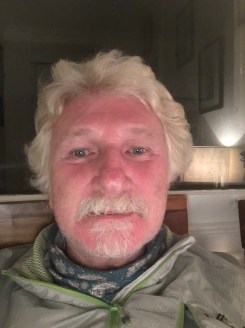

 I recently received the European Peace Walk (EPW) guidebook for 2017. I know I mentioned ages ago that I was going to do this Walk – a 500+K walking trail through six European countries – Hungary, Austria, Croatia, Slovenia, Slovakia and Italy – over three weeks. It seems a bit daunting, given the current state of my overall fitness. Some days involve 30K hike between sleepovers and the most I’ve done so far is about 16k or so. Anyway, I don’t begin until mid summer – July 04, – so I still have a few months to get up to speed.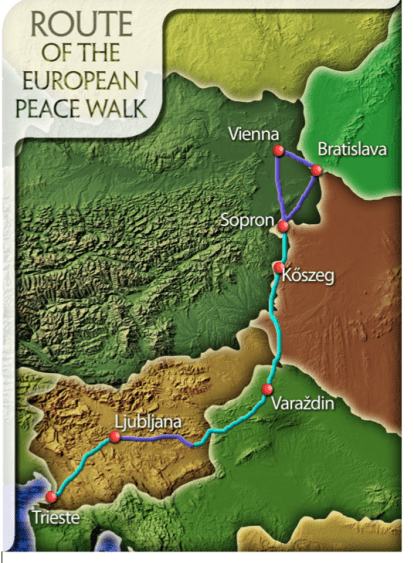
 Red Branch Chronicles
You must be logged in to post a comment.