A Short Walk in the Sarawak Highlands – Part Five

This long house was completely different to the one at Long Dano and Pa Da’lih. This was more of a town hall, a long low building raised a few feet off the ground on cement blocks.  Normally devoid of furniture, for tonight it had been decked out with a borrowed suite of furniture – a rattan couch and four matching arm chairs, a low, glass topped coffee table and two smaller side tables, the couch and chairs arranged in a line, the tables in front of them – while along the centre of the long hall lay a line of woven mats.  Against the bare wooden walls, the local and far-flung village people sat, quietly chatting amongst themselves or staring blankly into space, the whole scene illuminated by a row of hissing pressure lamps.  Everyone was in their best gear, many of the men wearing the scarecrow type straw hats that he had seen in Pa Da’lih, while the women sat in groups, demarcated by matching clothes and their identical, heavy, bead headresses.  He settled down on the bare boards up at one end of the hall and gawked at the people as frankly as they were gawking at him.  

Someone got up and strutted over to the assembled bank of microphones and then gave a surprisingly short speech and instantly there was an animated stir in the crowd.  A line of women appeared and laid down extra straw mats on the floor while other women doled out packages of rice wrapped in banana leaves.  Men appeared lugging heavy aluminium buckets which they passed over to the women.  “Ahh”, he thought, as they slopped out a grey-brown stew on to chipped enamal plates, “the fabled buffalo meat”.  Other women passed up and down between the two opposing lines on either side of the hall, dispensing tepid watery tea, into which he covertly added a generous slug of whisky for himself.

For a while, all political activity was suspended while the people – there must have been well over two hundred – threw themselves into the business of eating and drinking.  More by accident than by design, several other Europeans – Chris amongst them – had congregated at his end of the hall and were busy fending off generous offers of extra packets of sticky rice.  He declined all offers but leaned over and helped himself to a greasy gob of fat and sinew which he had mistakenly assumed to be meat.  He stuck to his tea after that and as soon as it was decently possible, he heaved himself to his feet and went out the back door for a cigarette.

Outside the hall, the likely lads, Noah amongst them, were hanging out, peering through the chinks in the plank wall and whispering furtive comments to each other on their prospects with certain girls inside, much spitting and extravagant pissing taking place in the shadows the whole time.
As soon as the food was picked up and the floor cleared of gristle and bone, all of which was tossed unceremoniously out the door he had just come in through, to the pack of scavenging, yellow curs that snapped and howled the whole night, the speeches began.  Surprisingly, they were kept to a minimum, possibly because several of the older people, their bellies bursting with meat and rice, were already snoozing in a sitting position. 

More surprisingly, the Minister himself, starting his speech in Malay, after a few minutes, changed into English and immediately lost 90% of his audience.  He had the uneasy feeling that his speech was aimed directly at the handful of Westerners at one end of the hall.  Stuffed with allusions to “leopard’s teeth in their ears”, the “hospitality of the longhouses” and the “unfailing charm of the indigenous people” he mercifully ended his speech in Malay so that the dancing could begin.

A remarkably willowy woman appeared, dressed in a long black and white dress with slits almost as far as her armpits, her hands enveloped in clusters of black and white hornbill feathers, and gracefully bobbed, twirled and bowed in exquisite slow motion to a taped music background. 

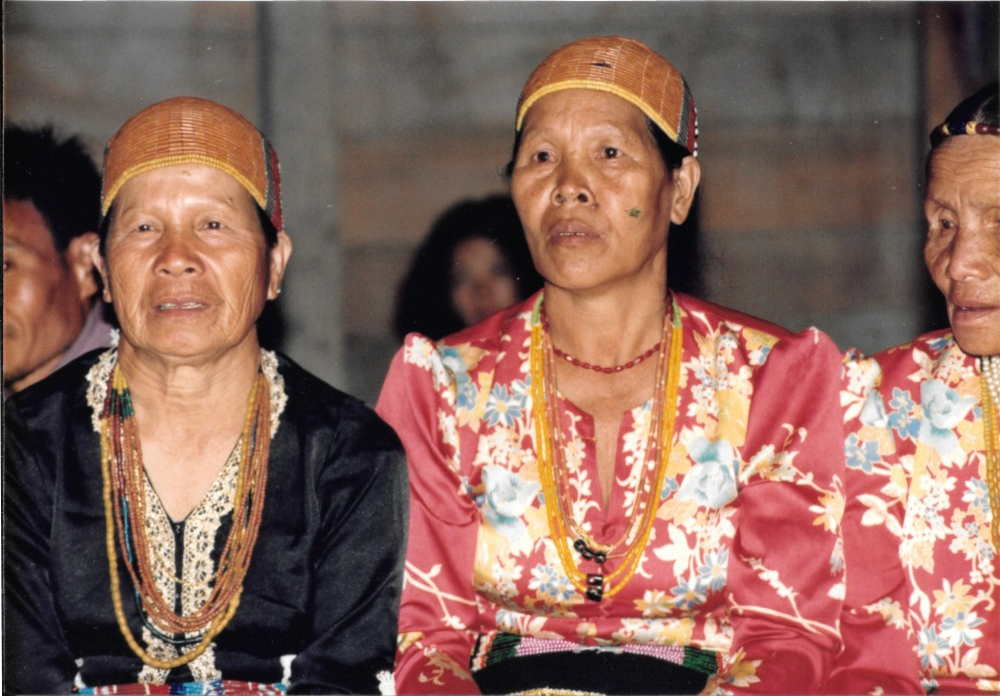
By far the best dance of the whole night, she was followed by a series of local attractions, most of which consisted of a long line of very elderly women who, dressed to the nines in gold embroidered sarongs, tightly bound bodices, and the bead skull caps, slowly stamped their way down one side of the hall in a long line, their outstretched hands resting on the shoulders of the woman in front of them, their lips barely moving as they shyly mumbled some indecipherable words.

It was well after 12:00 pm when he started the long walk back to the guest house.  It was very cold now and pitch black as the starlight was obscured by low, scudding clouds.  The first part of the journey was alright, as we trudged through the cool, silvery dust of the track, but made very poor time on the rough ministerial road of sharp granite chips.

Back at the guest house finally, outside on the verandah to finish off the very last two inches of whisky.  Noah appeared with a glass of foul smelling liquor and somehow the talk drifted into ghost stories, none of which he (Noah) claimed to believe.  He told him stories of the headless Bean Sí of Ireland who always appeared before a family member died and Noah countered that with stories of Gergasi Merah, a huge red headed giant with green eyes who devoured young children and his eyes bulged with polite disbelief when he pointed out that Irish people were often over six feet tall, had red hair and green eyes and would easily devour a bottle of whisky.  A long involved story began then, which he barely followed, about a camping trip Noah had gone on as a young man.  They had gone fishing and that night, six of the young men had sat around the campfire and had wished for their girlfriends, while the seventh member of the group, an older and more experienced man, had cautioned against such stupidity.  Lo and behold, later that night, seven women, in the form of their sweethearts / wives had appeared out of the jungle and would have seduced the group if the older man had not refused to acknowledge the woman claiming to be his wife.  Instantly, the women turned into hissing serpents and the stalwart group made a determined rush for the river and their boat.  On that note, feeling an abominable headache coming on, he quietly passed out.

The next morning the flight back to Miri was at 9:30.  Noah was up late and the best breakfast he could rustle up was hot black tea and a brilliant yellow sponge cake.  His bag significantly lighter than when he had arrived, he sat on the verandah in the early morning sunlight and fidgeted.  The airport “terminal” was only two minutes walk away and there seemed little or no point in going there until he actually saw the plane make its initial approach.  Noah approached and with a flourish, produced two cool tins of Heineken beer.  9:15, and the first one of the day and it was certainly more attractive than the tea and the mushy yellow cake that was the alternative.  10:00 and still no sign of the plane so there was very little he could do but have another beer and then later another one.  At about 10:45, an official looking chap – he was wearing a clean white shirt with epaulettes – showed up on a motor bike and demanded tickets.  The flight, he was informed, was indefinitely delayed because of unforeseen radio problems but could he please present himself at the terminal to be weighed.

Down to the Malaysian Airline Office Terminal, beer still in my hand, and an officious lady in a sarong and some kind of matching turban gave his tickets a close scrutiny as if he were to blame for the non-arrival of the only flight that day.  His  bag was weighed separately and then it was his turn on the scales, and because there was a crowd of local people gaping at him, he clowned around, as if he were too embarrassed to be weighed.  Anything for a laugh, especially with a few early morning beers sloshing around inside him.  The turbaned lady was not amused and scrawled 75 kilos on his form!  

Then the inside of the shed was heating up so he moved outside to the “Departure Lounge” which was merely a roof tacked onto to the main outside wall of the MAS office.  It was open on three sides, but to the left of us there were a few steps to a raised wooden platform. He almost choked on another beer when a roar of engines almost deafened him and an amphibious plane suddenly swept down out of an empty blue sky, buzzed the airstrip and then made another pass, landing at the very far end of it.  The man with the motorbike roared off in a cloud of dust and an elderly man with slit ear lobes told him that it was a special charter flight for the Minister.

The man on the motorbike came back, all smiles, and he asked him about his flight.  “Everything under control, don’t worrylah”, he was assured.

“Yes, I’m sure it is, but what seems to be the problem?” he asked reasonably.

The motorbike man dropped his voice confidentially and looked over his shoulder at the woman in the turban and then beckoned him closer, “It appears that they are having some sort of to-do with the altitude meter.  You can imagine the problem with these bloody mountains” and he gestured at the saucer rim of mountains around them.

“Oh,” he said, a bit dumbfounded.  “I thought there was a problem with the radio”.

“Yes, yes, maybe that too” the man replied and hurried off.

There was obviously nothing for it then but to have another beer, but he couldn’t help wishing for something a bit stronger.

He strolled over to the municipal notice board where a tubby little man in a rumpled shirt and a tie twisted askew under his ear was hammering up a hand written notice with the heel of his imitation Gucci shoe.  It was an invitation to all neighbouring longhouse and government departments to submit not more than four applicants for the next day’s blow pipe contest as part of Malaysia’s National Day celebrations.  He asked the little man what his job was and was apologetically told that he was a teacher at the local secondary school.  He glanced at his watch and saw that it was 11:50 so he asked the teacher why he wasn’t in school.  He grinned at him with discoloured teeth and admitted that he was the Deputy Principal, as if that explained everything.  He came from the coast but had been posted to Bario about two years ago.  He taught six periods of Geography a week and the rest of his time was taken up, he assured him, with administrative duties.  He told him that that must keep him fairly busy, and the Deputy Principal nodded seriously, and then excused himself on some errands.

Without any warning whatsoever, there was a throaty roar of engines and the DeHaviland Sea Otter appeared, circled the field and landed beside the untidy heap of the bags on the field, literally 10 feet away from him.  It was 1:35 pm, but everyone smiled and clapped when the plane turned off its engines.  He hung back to finish his warm beer and to take some pictures of the plane, but the motorbike man took him by the arm and told him to hurry up as the plane was late!  So he took his warm can of beer with him and nobody objected.

Take off was almost instantaneous, and there was no mention of either the radio or altitude meter problems and nor did the pilot allude in any way to the four hour delay.  Someone told him that the last time the flight didn’t show for two days because of bad weather, so he supposed a four hour delay was nothing.  The flight seemed much shorter this time and no sooner were they up than it seemed that they were beginning their descent again to Marudi.  We got off the plane for the ten minute stop – he was aching from his belly load of beer – and the first thing he noticed was the change in temperature.  Marudi was warm and humid.  He had almost forgotten what it was like.  Standing beside the pilot at the urinals, he asked him what had delayed the flight’s arrival, and the pilot burst out laughing as he undid his belt, opened the waist band of his trousers, fully unzipped his fly and dropped his pants as far as his knees, preparatory to taking a leak.  “Oh, it is always the same bloody problem in these mountains, you know.  The radio goes on the blink and then there is nothing we can do.  To make matters worse, our back up radio communications went out as well, so we really had to do something this time, I tell you”.

Not exactly one hundred percent reassured, he got back on the plane again for the last final hop to Miri down on the coast.  A small wiry little creature sat beside him on this leg of the trip, and bubbling with enthusiasm, asked him where he was going.  As the plane had only one last stop to make, he felt this question was redundant, but he needn’t have worried, as the little man had only used the question as a polite preliminary to telling him about himself.  He was a taxi driver from Limbang, who had come by way of Lawas to visit his family in Marudi but he was going back via Miri so that…Yawn!

The domestic Arrival Lounge at Miri was a small bustling affair and he was quite happy to let a taxi tout manhandle him and his grubby looking backpack through the crowd.

“Take me to the best hotel in town” he ordered, rather grandiloquently, but what the hell, he felt, why not have a bit of luxury.  No swimming pool (no hotel in Miri had one, it turned out, although one was being built, he was assured), but the room was carpeted, had a well stocked fridge, a tv, a bathroom and a relatively comfortable bed (superbly comfortable, he thought, in relation to the hard floors he had been sleeping on for the last couple of nights).

There was a plastic and glass junk fast-food place, Sugar-Buns, nearby, so he set off for a feast of hamburgers. Sitting there, surrounded by plastic, chrome, glass, styrofoam containers, junk food, and not a grain of rice or a single jungle edible fern in sight, it was hard to imagine the blow pipe competition taking place the next day, the long, twisty trails to Long Dano and the myriad trails leading on from there into the centre of Borneo and on over into Indonesia’s Kalimantan province.  

He supposed he was back to “normality”, now, but there was that little nagging doubt, but a couple of beers back at the hotel would soon get rid of that for him!  

  • With apologies to Eric Newby for copying part of his title – A Short Walk in the Hindu Kush (1958)

A Short Walk in the Sarawak Highlands – Part Four

Sitting around the following morning in the almost deserted longhouse but for the old women who remained by the fire while all the younger people were out at work in their fields, he decided to go out for a walk down by the river and he waded around, looking for fish.  The river was broad with a flat, stony beach, and seemed crystal clear.  It was also icy cold as he soon discovered.  Shallow at the little beach, the river widened out upstream, and beyond a natural breakwater of slippy rocks,  the river became suddenly deeper and much more turbulent.  Farther upriver, a delicate suspension bridge of interlaced bamboos, hanging from ropes of twisted rattan, spanned the river.  

He wandered off along the bank of the river towards the bridge.  From close up, the bridge looked most unstable, as many of the support bamboos looked rotten and the rattan ropes were frayed and broken in some places.  Commonsense told him that it must be okay, however, as the longhouse people obviously used it, but nevertheless, he decided to go across one foot at a time.  

Halfway across, he stopped and gingerly turned around to take a photo only to see one of the kids from the longhouse wildly swinging on one of the supports, doing his best to make the bridge sway and buck violently underneath him.  He gave such a bellow of fear and rage that not only did it stop the kid dead in his tracks but it also disturbed three large river birds from the undergrowth further upriver which flapped cumbersomely away from the bank and laboured up for height.  

Safely across, he followed a winding path through some wet padi fields, hoping to see some snakes with which the fields were meant to be infested.  No such luck, so he turned back and scampered across the bridge back to the longhouse.  

He decided to leave Pa Da’ih at 2:00 and head back to Long Dano.  Joseph and Andrew decided to go on ahead and meet him at the river where they hoped to spear catch some fish for their dinner that night.  

No sooner had he started to walk, making excellent time to the river.  There was no sign of Joseph or Andrew, but he decided to stop a while anyway.  While Noah broke out his seemingly inexhaustible supply of stale chocolate wafers, he took off his shoes, socks and shirt and waded out to a flat rock in the middle of the river.  Lying down on the rock, he gingerly stuck his steaming hot, sweaty head in the river and had his breath taken away by its swirling coldness. 

Just outside of Long Dano, a skinny, miserable looking man wearing filthy, torn track suit bottoms, a faded T-shirt and flipflops that were several sizes too big for him, hailed him.  His name was Mutang, and he was going off to pick some fruit, he said.  Curious, he went off with Mutang to his fruit trees.  These turned out to be a small clump of high, spindly trees absolutely laden with tarap fruit.  Using a long bamboo pole, Mutang prodded at the fruits, looking for the ripest one, and then with a quick twist of his wrist, he brought half a dozen of the fruits, each about the size of a coconut without its husk, tumbling down about their heads.

They lay on the short, prickly grass, and gorged ourselves on the sticky fruit while Mutang told them the local news.  The Minister of Development was expected in Bario on a flying visit (elections were coming up in Malaysia) and almost all the people from the surrounding longhouses had already left for Bario or were preparing to go in the following day.  Mutang also wanted to go in so that he could sell one of his water buffalos.  He had a herd of twelve, and he reckoned he could get about $1600 for a young heifer in Bario.  It was just a question of driving the beast there.  Remembering that it had taken him nine hours to complete the trip he was ready to sympathise with Mutang until he said that he could probably do it in six hours or so!

Thanking him for the fruit, he belched his way back to Long Dano and gratefully slid out of his pack as soon as he was inside the dark, smoky main hall.  Joseph and Andrew suddenly appeared with an enormous fresh water fish which must have weighed at least three and a half kilos.  Each kilo would fetch $40 down on the coast, they assured us, as this type of fish can only live in clear water.  The scales were enormous, each one about the size of of an old fashioned American dollar, and the light flashed off them giving the fish an irridescent blue, green and purple colour.

Sprawled on the floor, sipping hot tea from a chipped cup, he felt as if he had come home again.  It was a bizarre feeling, especially as only a short time ago he had felt that Long Dano was a “crude wooden hovel”.  Familiarity, in this context, did not breed contempt, but pleasure at not having to walk any more.

Dinner, augumented by the fish, which they had fried as well as boiled in a watery sauce, was quite a feast, especially as Noah, lightening his load for the long walk tomorrow, opened up the last of the tins of beef curry in addition to two tins of stuffed spring rolls that he had kept hidden until then. 

A rasping noise at the next hearth drew his attention and he wandered over to see what was happening.  An old man, his pierced ear lobes down to his shoulders, a faded T-Shirt with the slogan “Levi’s Last Longer” covering his scrawny body, was meticulously sharpening his parang on a dry whetting stone.  After every few rasp along the stone, he would stop and examine the lie of the blade carefully by the light of the flickering, home-made oil lamp on the mat beside him.  The parang blade was two feet of bluey-black, slightly curved steel, topped by a worn bone handle carved into an abstract birdhead.  The blade was connected to the handle by a two inch band of tightly and finely woven rattan string, the whole lot sealed at the base of the join by a blob of black tree resin.  The sheath, lying on the mat was made up of two flat slabs of wood, tightly bound together by further strips of rattan.  On the underside of the sheath, was a tacky looking plastic mini-sheath, attached to the original wooden one with loops of woven fishing line.  This subsidiary sheath held a short round haft which ended in a three inch, slightly backward curving blade.  The steel shone in the dim lamp light, burnished as it was by the steady, methodical strokes the old man was applying to it on the whetting stone.  As it happened, he needed a good knife, not a trashy, touristy-style knife, adorned with beads and imitation tufts of hair, but a real, “working” knife.  As soon as he held the knife in his hand, he knew that this was the knife he wanted.  Calling Noah over to help, he entered into what turned out to be an hour of bargaining which turned out to be a good thing, as Noah later told him that if he had made a flat offer for the parang, the old man would have refused to sell it.  By bargaining, however, he had shown that he had valued the knife for its own sake and this was what had convinced the old man to sell it to him, which he eventually did, without any apparent regret for thirty Malaysian dollars, a packet of cigarettes and 35 fish hooks of assorted sizes.  To seal the bargain, and because he was so pleased, he threw in a ball point pen.  

The whole business had attracted quite an audience and he produced his camera and began blasting away.  He often found this type of close-up photography awkward and embarrassing, and wanted nothing to do with it but, to his surprise, the longhouse people delighted in it.  Posed shots were the order of the day, and the more he was willing to take portraits, the more willing they became to be subjects. 

Old women rummaged like pack rats in dark nooks and caches and produced beautiful, ornate  skull caps of finely woven beads which Noah told him were their family heirlooms.  Some of the caps consisted of up to 10,000 small glass beads and weighed almost eight kilos!  Only when he had exhausted his roll of film, and his face felt as if it were about to fall off his cheek bones from extended and extensive smiling, was he able to retire for the night.

By 7:30 the next morning, he was packed and ready for the trail.  He said goodbye, smiled and shook hands with the remaining old people – everybody else had already made an early start for Bario and the forth-coming ministerial visit.  Outside the long house, away from the warmth of the smokey fire, the air felt damp and cold while the whole valley was swathed in a thick mist.  Striding along, feeling fresh and strong (he had only been walking for 5 minutes) he suddenly emerged out of a patch of mist and found myself face to face with an enormous, mud splattered water buffalo.  He don’t know who was more amazed at the encounter, but one brief glance at the enormous spread of wickedly tapering horn curling back over the vast bulge of muscle across the shoulders and the cavernous, wet, flared nostrils was enough for him.  One hoarse bellow escaped him before he did a complete turnabout and was charging back down the trail, while, judging by the heavy rumble of hooves, the buffalo (and his friends, it sounded like) was charging – thankfully – away in the other direction.

By 9:00 the mist had completely lifted, and what with the shade under the tree top canopy and the initial coolness of the morning, the day remained fresh and he made excellent time, feeling healthy, fit and strong and he tried working it out in terms of hours / miles walked, or was it the early nights, or the complete withdrawal from beer, or might it not be the heavy reliance on rice, or even the total lack of steroid filled meat.  Whatever it was, anyway, had the most amazing effect on his normally taciturn communiques with Nature which had often been sullen, unrewarding and unco-operative in the past.  For the past few days however, perhaps because of the position and strain imposed on the feeble citadel of the body by virtue of the squat toilet, which brought hitherto unknown muscles into play, he had felt the exact reverse of the depressed person who feels that the bottom has dropped out of his world.

When he stopped for lunch, Noah immediately produced another cellophane packet of his stale chocolate wafers, and he broke out more of his stock of muesli bars.  Suddenly there was an eerie creaking noise a little bit away to their left.  Noah and the other guides were on their feet in a split second and man-handled him off the trail and into the jungle on the right hand side.  No sooner had they done so when, with an appalling crashing and tearing noise, a huge tree fell, bringing down with it an assortment of smaller trees, vines, and branches.  Once the initial crashing noise was over a stillness fell on the forest and it was a while before the bugs and insects regained sufficient composure to pick up their tweeting, squeaking, croaking and rustling.  

Noah and the others treated the whole event as just one of those things that happen in the jungle but he couldn’t for the life of him see why a tree of such size should topple like that when there was no storm or wind.  

It was the hottest part of the day now and although he had made good time, they still had a long way to go before arriving back at Bario.  To make matters worse, he was beginning to run low on water as he had swilled it down earlier on in the day.  The jungle began to thin out shortly afterwards, and this compounded the problem as they lost the jungle canopy shade and were walking in the full blast of the sun through dull, uninteresting, baked countryside.  He had his heart set on arriving back in Bario guest house and having a cold beer by 3:00pm  but it was 2:55 before they broke out of the flat scrubland and looked across the padi fields at Bario itself.

Walking across the rough turf of the airstrip, Bario had a strangely deserted look.  He somehow felt that there would be people to greet him and to marvel at the fact that he had survived the walk and returned to tell the tale.  Instead, there was nothing and nobody.  Even the little all-purpose grocery store at the edge of the airstrip was locked up and deserted.  One or two loafers were lounging lazily on the verandah of the Guest house and they said that everyone had gone up the valley to the headman’s house to meet the visiting Minister of Development.  

Noah slipped out of his pack and disappeared into a lean-to shanty attached to the guest house to make tea.  He flopped wearily onto the hard chairs.  Noah wandered out a few minutes later with a plate of ripe pineapple slices in one hand and a can of Heineken in the other. Following Noah back into the lean-to, he discovered that Joseph and Andrew had commandered a bucket of coldish river water in which half a dozen beers were cooling.  Bliss at last, he thought, revising the feeling that the end of the walk was just going to be another anti-climax.

While they were on their fourth beer, he heard a familiar voice outside on the verandah and a moment later Chris, still wearing his African Safari jacket, wandered in.  Bemoaning the fact that the zip-on long legs to his khaki shorts had just been washed and that he had nothing to wear to the Ministerial party, he filled them in on all the news.  An Austrian – No, an Australian, Andrew claimed – had wandered off the trail, leaving his porter and girlfriend to raise the alarm, and had not been seen for the last two days.  Noah, as befitting a guide, was annoyed and distressed at the story, saying that the porters had no right to leave their clients in the jungle.  A lazy argument developed, with Joseph and Andrew saying that porters were not guides and had no responsibility to their charges other than to carry their bags around.  More beer was called for – the water in the bucket had a peculiar, slimy feel to it by this stage – and the afternoon wore on with everyone saying that they must get along and see the minister.  An event like this was quite a deal, as this was the first time that anyone of importance had ever visited Bario.  Apparently, general elections were only a few months away in Malaysia, and this visit was the first shot on a long and often dirty campaign trail.  He couldn’t have given a toss about it – and nor could anybody else, it seemed – but it appeared that there would be a night of feasting (a water buffalo had just been slaughtered for the occasion) and of ceremonial dancing performed by the headmen of all the neighbouring villages.

The beer, however exerted its inexorable effect and it was at least 8:00 pm before he set off. The night was clear and cold and after endless wrong turns, to the local Primary school, to the Secondary school, to the teachers’ quarters, they were finally overtaken by a white jeep which blared its way past them in a cloud of grey, granite dust.  That had to be the Minister, Noah decided, because there were no cars in Bario and this jeep had to be the one that they had heard about being flown in especially by the Armed Forces.

By the time they arrived, it was well after 9:00pm, and the long house was crowded but nothing seemed to be happening.  He refused to go in, so he could squat outside on the steps, smoke and take furtive sips from his last remaining ½ bottle of whiskey. A young soldier, his AK-16 casually under his arm came up and asked him for a light, and while he was giving it to him, a portly gentleman in a florid, batik shirt which he wore outside his trousers, came up and insisted that he wait in his house.  He had no intention of doing so, but the fat man took him by the arm and led him directly into an empty barren room where half a dozen men sat around on the floor.  They didn’t look local – they were too fat and were all wearing government style uniforms – suit bottoms, bush jackets made from some metallic looking cloth, nylon socks and impractical, city shoes and he felt immediately ill at ease with them.  One of them, fatter than the rest, and wearing an open necked batik shirt, was writing importantly on a sheaf of papers, using the flat side of his combination lock attache case as a desk.  

“Are you writing the Minister’s speech for him now?” he asked, to break the deadly silence, at the same time realising that he probably was the Minister himself.  He wasn’t, as it turned out and mumbling excuses, he sprang up and made a bolt for the door away from the cloying atmosphere of stilted politeness and boredom that distinguished Malay living rooms from tribal ones.

  • With apologies to Eric Newby for copying part of his title – A Short Walk in the Hindu Kush (1958)

A Short Walk in the Sarawak Highlands – Part Three

He was feeling feverish and sluggish the next morning, but saw no point in staying over, hoping that a steady ration of Panadol and a brisk walk would break the fever.  Breakfast consisted of smaller portions of last night’s leftover and more tepid tea, and then he hefted his pack, only marginally lighter, and hobbled stiff-legged, down the notched log and started off on the next leg of the journey, on to the neighbouring Long House of Pa Dal’ih.  This, Noah assured him, was an easy walk of three hours, as he strode ahead, swinging a trussed up, but very much alive, chicken by its legs.  All his joints aching from the sleep on the hard floor and the previous day’s marathon, he set off slowly.  

The path through the rolling flatlands surrounding Long Dano was far more scenic than yesterdays, winding between whispering groves of feathery bamboos, down towards and then parallel to the river.  This was the upper reaches of the Baram which he had travelled on by express boat to Marudi but it was impossible to recognise it as being the same river.  Here the water was crystal and babbley as opposed to Marudi’s sullen brown muddy swirl.

Stopping to tie his shoe lace and to have a few furtive drags from a cigarette, he had to hurry down the windy, rootey trail to catch up with the guides.  Stepping up over a log, his leg suddenly froze in mid-air as, slithering over the same log and into the undergrowth beside him was his first snake.  It was a brilliant emerald green and was about as thick as his big toe, with a wicked diamond shaped head, the snake began a leisurely climb up a nearby tree to be instantly lost in its leaves.  So perfectly did it blend in, that it was only when it moved that he could see it.

On again down the trail and they had already been walking for over two hours when Noah suddenly made a sharp right and crashed through the undergrowth and slithered down a steep bank to the riverside. The beach was flat and rocky for the most part with some impressively large boulders in the river itself.  Noah claimed that when the river was full the boulders were completely submerged and busied himself with lighting a fire, while the chicken, realising the game was up, squawked helplessly nearby.

Leaving his sweaty t-shirt on a rock to dry, he stepped gingerly into the river.  The water was cold enough to take his breath away so after the most cursory of dips, he  went over to huddle by Noah’s fire.  He was as pale and goose-bumpley as the wretched chicken, already slaughtered and defeathered.  Noah, meanwhile, chopped down some stout, green bamboos and cutting them into sections above their joints he rammed a mixture of chicken bits, rice, salt, pepper and MSG into the tube and sealed the open end with a banana leaf, and then placed the tube end-up in the fire.

“Lunch”, he grinned.

Determined to lessen the weight he was carrying, he rummaged in his pack, and came up with an unopened bottle of Remy Martin.  Picking the sunniest spot, he leaned back against a rock, waited for his bamboo chicken, sipped brandy from the measure cap and watched the swarms of little bees cluster thickly as grapes on his shoes and socks.  They did land on the other guides’ clothes as well, but for some reason his footwear took the brunt of their assault.

The chicken turned out tough and rubbery and not particularly appetizing so he shared a tin of mackerel fillets in tomato sauce with Noah and succeeded in adding a few fairly gory looking stains to the front of his shirt.

Off up the trail after lunch, and this time it was strictly up hill.  The brandy gave him an initial lightness of step but he knew that it would be temporary and he galloped on with all possible speed, red-faced, hot and puffing, making a final lunge for the top of the ridge which he could see silhouetted against the afternoon sky through a break in the jungle canopy.

From the cool of the river forty minutes before, he was now reduced to a filthy, sweaty, stumbling oaf, gasping for breath while the bees maintained a constant halo around his heads and necks, guzzling the rich alcohol sweat that liberally poured from him.

Time to bring out the heavy guns, he thought and he washed down two Paracetemol tablets with a cupful of brandy and water, topped the lot off with a high energy glucose capsule, and a cigarette, and only then  was he at last able to sit back and look down the other side of the ridge at Pa Da’lih for the first time.

Unlike Long Dano, which he had just left, Pada’lih squatted right on the banks of a river, and was made up of a collection of straggling shacks, huts and the main long house which ran along the left side of a large field, the opposite side of which is taken up by the village school!

For some reason, Noah led him around the back of the longhouse and it looked depressingly slummy and hovel-like.  The earth was bare, scraped clean by the innumerable scrawny looking chickens wandering irresolutely about.  A small moat, about a foot wide, filled with a rich looking green-black slime, surrounded the longhouse, which was raised on stilts.  Mangy pariah-like dogs sniffed at this rather unappetising channel and growled at him.  The longhouse itself looked both crude and flimsy as if one good blast of wind could send the whole thing flying.  His heart sank a little bit as he realised that he had paid good money for this trip and here he was, traipsing up and down bloody hills all day and sleeping in the equivalent of some high rise tenement lying on its side!

Too late to do anything about it now, so following Noah, he climbed up the notched log and pushed open the door made of scraps of wood planking, and patched sheets of cheap plywood.  He began to feel embarrassed by his obvious wealth in terms of his being there in the first place, as well as his expensive backpack and sneakers, but he was too tired, and a little pissed (off), to care.

Once inside the longhouse, he slipped out of his pack and subsided to the floor, against the wall.  Almost immediately, a smiling lady wearing, oddly he felt, glasses, a brown v-neck pullover with the sleeves rolled to her elbow, and her hair in a bun, brought him hot tea and he struggled up into a sitting position to look around.

The longhouse – about 200 feet long – was completely bare of furniture except for a plain wooden table to his left, upon which stood a bucket, several bottles and a large tin of Nestle Milo.  In front of most of the fireplaces were little stools, each one about six inches off the ground, on which the ladies squatted while tending the fire.  Unlike Long Dano again, this longhouse had no fancy louvred windows.  Instead shafts of sunlight filtered in through raised flaps in the attap roof.  Countless years of cooking fires had smoked and varnished the ceiling rafters and centre beam to a rich reddy-black mahogany colour.  Various elderly people hobbled over to him, all of them wishing to shake hands with him. 

Sinah Bend, the woman in the glasses, produced a quick snack of fruit (bananas, tarap, and a little round brown thing, quite sour and full of stones) and then got on with the business of preparing dinner for her unexpected guests.  He went over to help her and ended up squatting on one of the little stools, plucking leaves off a bunch of twigs while another old lady, also wearing glasses, clucked and nodded approval.  An old man wearing a sarong around his skinny waist, his bare feet horny and spatulate came over to shake hands with him.  This was Balam Tapan, the headman of the longhouse.  Mild mannered looking, despite his mutilated ears with two small oval shaped holes in the top section, and the bottom lobes looking as if a dog had mistaken them for a nice pair of bedroom slippers, he squatted down on the floor beside him and talked to him with the casualness of a long life acquaintance.

“What news with you?”

“Do you have a name?”

“Where have you come from today?”

“Was all well there?”

“Who are the people travelling with you?”

“Where will you stay tomorrow?

Luckily his Malay was well able to deal with conversation at this level as most of the questions, the answers also, were formulaic.  Only after all these formalities, like going through immigration, he thought, were over  was he able to speak directly to him.  He immediately asked him why he didn’t have his ears pierced like so many of the other older men.  Apparently, he had, when he was a much younger man.  The Christian Evangelical missionaries who had overrun the Bario Highlands after WW II had quickly set about discouraging the ear piercing habit and had managed to – and here he began to lose the thread – either persuade Balam Tapan to cut off the pendulous lobes or else sew them up.  Either way, he felt that it was none of the missionaries bloody business.

He fished out a few fishhooks from his pack and they were received with subdued appreciation until the old woman with the glasses, over by the fire, who turned out to be Sinah Bent’s mother, pronounced that the little hooks would be just ideal for catching birds in the fields!  After that, everybody wanted some hooks.

He decided to go for a walk to ease the aches in his legs and walked the length of the house being stopped at every fireplace to shake hands with people.  Outside on the field, he could see a cluster of kids near the school playing g some complicated game with a bat and al ball. Unable to resist an audience, he had to have a go at the bat, and after a couple of wild swings which spun him round violently, practically corkscrewing him into the ground, he managed to slam the ball right through one of the school’s open glass windows!  Enough was enough, and as it looked like rain, ominous black thunderclouds stretching up from behind a distant line of smudged mountains, he walked back to the longhouse, sidestepping a wary looking buffalo or two.

Dinner that night was quite a feast with Sinah Bent displaying an extraordinary culinary talent.  The rather unappetising leaves that he had been stripping had been transformed into a most delicious spinach type dish.  In addition to the vegetables, Sinah Bent, displaying a profound knowledge of the tastes of Europeans, had actually produced a small plate of potato chips.  Noah had contributed several tins of corned beef and curried beef rendang, and the only thing the meal lacked, he felt, was a couple of buckets of local rice wine.

After dinner most of the people wandered off to attend an evening church service, which he found to be yet another example of culture shock.  To be in the Borneo hinterland, so far away from everywhere and have people traipsing off to what amounted to evening mass, was just weird.

Sitting around in the shadows of a smokey, brass oil lamp, he asked Balam Tapan if the longhouse had any music or dancing, or had they and similar culture traditions been axed by the missionaries.  Sinah Bend, hearing his question, slipped away and came back with a small, double deck, Sharp tape recorder and some cassettes.  He had had the ancient, breast shaped, brass gongs, the two stringed sape guitar-like instrument in mind, but beggars couldn’t be choosers.  

“How many people can still dance”? he innocently enquired, feeling around in the dark for his brandy bottle.  Since their Evangelical conversion, he was well aware that the Kelabits no longer took heads, smoked, drank alcohol or indulged in the base habits of corrupt yesterdays, substituting attendance at church several times a day instead.  But he had also been told – and had every reason to believe – that old habits die hard and that among the older people, the odd sip of liquor wouldn’t go amiss.

Producing the bottle of Remy, he apologised for the fact that it wasn’t full and he carefully set it down, beside an opened packet of Benson and Hedges on the straw mat in the middle of the circle of people.  Sinah Bent started the cassette player and an old woman stood up, and gracefully began to gyrate her lower body while her arms and hands fluttered in a different direction.  The only light was from the dying embers of the fire and the tiny flickering flame from the single oil lamp.  The music was simple but no less beautiful for that, while the old lady became transformed – in his eyes – into a shapely pagan goddess dancing for the first white visitor to their previously unvisited longhouse.  Looking around at the rapt faces of the old people, and the bored, contemptuous faces of the few younger people who had joined them, attracted, no doubt, by the music, the cigarettes and the novelty of the visit, he noticed that the brandy must be evaporating as the level in the bottle had dropped quite sharply since he had placed it there.

Almost without warning, the old woman was bowing to him while another old woman hobbled to her feet to, again, become transformed by the magic of the music and the dance.  Reaching for the brandy, he discovered that there was barely an inch left in the bottle – some left for Mr. Manners, no doubt? – so he rummaged in his bag and brought out his last bottle of fine old Scotch.  Balam Tapan, with a ridiculous looking old straw hat, the front brim unfinished and unwoven, the straws sticking out like a crude visor, a rattan pack on his back, got up and did a humorous dance of a honeybear looking for honey and finding trouble.  The audience howled with appreciation as he continually scratched his arse, smelt his fingers, padded around the floor and finally discovered the bee hive half way up the main ridge pole.  Clambering up this he was suddenly attacked by bees and with clumsy swipes of his paws he dropped to the ground, and rolled around, pawing dementedly at himself.  Then, as the music changed it’s tempo, so too did he change his mime, becoming the stealthy hunter, the wicked looking parang clutched in his hand.  With a thump of his horny old calloused heel on the bare planks of the floor, Balam announced the presence of a mighty warrior and then, with a howl, he leapt towards his enemy.  Spinning into the air, the long blade of the parang gleaming in the lamp light, arms outstretched, he strutted and swaggered around the floor, accepting the admiring, coy looks of the girls as he displayed his victim’s head.

His clapping faltered and his enthusiasm waned when the old man  approached him, helped him to his feet and placed the straw hat on his head.  Assisted by the internal liquid fuel and his own super ego, he pranced wildly on the floor and succeeded in losing the hat in seconds which rolled perilously close to the fire before one of the kids retrieved it.  Finishing off with a leap in the air, half a spin and a Cossack style knee manouevre, he sat down, panting and sweating, and gulped at his whisky.

  • With apologies to Eric Newby for copying part of his title – A Short Walk in the Hindu Kush (1958)

A Short Walk in the Sarawak Highlands – Part Two

Bario was in a saucer plain with soft, blue-grey mountains ringing the rim.  Water buffalos trudged along the dirt track past the control tower dragging battered sled-like affairs filled with large rock chips.  There were no cars, jeeps, vans or trucks whatsoever but there were a few trail bikes parked outside the terminal.

The Bario Lodging House was a two minute walk from the airstrip.  Hot black tea appeared and everyone there looked askance at his T-shirt and shorts and hoped that he had warmer clothes for the night.  What did they know that he didn’t, he wondered?

Time to celebrate in Bario and off he went to find the local hotspots.  The local shop sold ropes, machine bits, carved parangs, and warm Coca-Cola and that’s what he had.  Back to the lodging house, and exhausted by the excesses of the previous night, he slept until dark.

Dinner time and he finally met his guide, Noah.  He was short and stocky with a broad grin and legs the same size as the average person’s waist.  He was not a Kelabit but came from a village lower down the Baram river, called Long Terawan.  A few beers (it was getting distinctly chilly now and he had changed to jeans and socks) cooled in a bucket of river water while they discussed the trip.  Everyone said that walking from Bario to Long Dano should take only six hours, but their legs were quite different to his, and he was skeptical of their idea of time and distance.  People drifted in and out of the covered-in verandah and began to huddle round the flaring methylated spirits lamp in a desperate effort to maintain body heat.  He got up and put on all his clothes and then stuck his stockinged feet inside his backpack.

Chris, wearing an African safari-style jacket with outsize pockets bulging with camera equipment, was in marketing and wanted to explore the area so that he could bring “top-end executives” out there.  His preliminary market analysis indicated that people who had no knowledge about the area had no interest in it either. It sounded a bit like saying child birth was hereditary; if your parents didn’t have any children, then the chances are that you won’t have any either! Chris’ task then, back in London, would be to educate his clients with books and videos before they came out here.  

Alan, a middle-aged tea planter from Selangor in Peninsula Malaysia, was lumbered down with his teenage son, a vcr and a tape recorder, not to mention his two still cameras (one for vistas, and one for snaps!).  He said he was there to capture the spirit of the people before they vanished completely under the approaching industrial wave.  Alan loved the walks because there was so much to see, and to prove his point, he showed him two porcupine quills, 3 woodpecker feathers and a dead beetle that he had collected.  He said he didn’t drink but he finished off half a dozen beers, most of a bottle of whisky, explained that he wasn’t an argumentative chap and then related, for the next three hours how many quarrels he had had with famous people no-one had ever heard of.  At the end of the evening, in exchange (for the whisky, or his patience?) Alan gave him a half empty tube of deep heat cream (“you’ll need that for your shoulders judging by the size of your pack,” he confided knowingly), a small camping cooker, a tube of insect repellent and a good few laughs.

A breakfast of cold baked beans, served daintily from the can, fried eggs, fresh pineapple and stale bread, the next morning, and it was nearly 9 before they finally left the guesthouse despite Noah having urged him to sleep the night before because of the proposed early start.  Off he trudged across the airstrip, gaped at by a squad of soldiers drilling halfheartedly under the relaxed eye of their sergeant (the Indonesian border was only a few miles away).  The track was wide and bumpy through the padi fields without any tree cover or shade.  He strode jauntily along, his new backpack snug and comfortable on his shoulders, glancing at his watch as sweat dripped into his eyes, and my God, he’d only been walking for 20 minutes.  Andrew, a swarthy young giant, joined then further on and Noah explained he carried all the food, in an uncomfortable looking backpack made of woven bamboo and rattan.

Into the jungle – and shade – finally and then the hills begin.  From then on, a blistering, exhausting slog up hill and down dale, tripping and stumbling over tree roots and rocks.  Noah cheerfully tells him that he’s lucky it is so dry as he teetered over notched logs and bamboo suspension bridges.

“Aha,” Noah said.  “These are the bridges I told you about, they are made without any nails whatsoever”.  

That’s just what he needed to know as he swayed and lurched perilously across, hoping the rotten looking bamboos would hold his weight.  If only his bloody backpack wasn’t so heavy.

Another break and he stoped for a lengthy swig from the water bottle.  Small bees buzzed and crawled all over him, greedily drinking the protein rich sweat that poured off his flabby, exhausted body.  At the four hour mark they stopped for lunch.  Stale chocolate wafers biscuits, compacted packets of cooked sticky, white rice wrapped up in leaves, a tin of chicken curry, a tin of pineapple chunks and a tin of sardines. 

“How much further, Noah” he begged, but Noah just grinned enigmatically and strode on down the trail.  He still felt ok, almost, but by late afternoon the strain was beginning to tell on the legs.  Seven hours into the walk and he’s tired. Eight and three quarter hours later, they finally arrived at the Long Dano Long House, sidestepping clumsily through the outsize buffalo plops. 

It was a sprawling cluster of, from the outside, crude wooden hovels.  The main building looked quite new and was about 200 feet long, raised about 5 feet off the ground on stout wooden posts set in a concrete base.  Surprisingly (for him, anyway), the building had glass louvred windows.  Staggering up a roughly hewn log, he entered the main area which consisted of two parallel buildings connected by covered wooden bridges.  One of the long buildings contained a fireplace for each family – about 20 families lived there – with a food storage area directly behind the fire.  Above each cooking fire, on a rack, neat stacks of split logs are piled.  The plank floor in front of the fire was covered in cheap linoleum, on which, as he went to sit down, was quickly covered with a finely woven reed mat.  The other parallel building contained sleeping quarters and extra storage space.

Exhausted, he slumped down on the floor, propped up on his bag.  People clustered around him curiously, bold, dirty hands reaching out to touch the hair on his arms.  Noah busied himself around the fire, preparing tea. A smiling lady with filthy feet, grubby hands and incredibly distended earlobes which swung pendulously under her chin, offered him bananas and some other fruit that he had never seen before.  It was called tarap, he learned, and was a tight cluster of white globules of sweet jelly around a hard stone, the whole lot covered in a thick, green rubbery skin. 

People kept on coming up to introduce themselves and everyone had to shake hands with him.  What with the deferential treatment, the present of fruit and all this hand shaking, he began to feel that he was special and that he really had accomplished something unique by making a six hour jungle walk spin out to almost nine hours!

The hot tea, tasting vaguely smokey from the wood fire, revived him and he began to sit up and take notice.  The long house seemed quite prosperous although there were very few people around and he was told that all the children attended a local government school some distance away. They stayed in the school hostel there, coming home only at weekends.  

Culture shocked and cold, he stayed where he had collapsed, and decided to dispense with washing for the moment.  After the initial bout of curiosity and hand shaking, he was left pretty much alone, except for two little girls who couldn’t seem to decide to be frightened or fascinated by him.  Rolling over on his side, he rummaged in his backpack and pulled out a few balloons he had brought along as presents.  Soon he had a captive audience of about 15 people of assorted ages.  Not content with just blowing up and then releasing the balloons, he had set himself up with a squawk band, teasing the most horrendous noises out of the balloons by stretching the necks of the balloons.  Balloon blowing with just one breath competitions followed next until he began to feel dizzy and decided that that was it.  Dry long house or not, he felt that it was time he had a little nip, so handing out the rest of the balloons, he retired to a corner and covertly swigged from one of the bottles of whiskey he had lugged all that way!

Dinner was a weird mix of tinned corned beef, raspberry jam, cream crackers, buckets of white rice, various dishes of totally unrecognisable vegetables, fruit and various bits and pieces that other families contributed to the communal feast.  He had known in advance that the Kelabit people in this area were avid Evangelical Christians who had been converted after the war, and who now abhorred alcohol, tobacco and all good things of life which normal people like himself and the Ibans enjoyed, but he had been secretly hoping to find some old gaffer who had a secret store of their once fabled Tuak, or rice wine.  No such luck, however, and exhausted, as much from the strains of withdrawal as from the day’s walking, he slept where he dined, as close to the fire as possible!

  • With apologies to Eric Newby for copying part of his title – A Short Walk in the Hindu Kush (1958)

A Short Walk in the Sarawak Highlands* – Part One

He awoke with a start, knowing he was already late, his breath still beery from the night before as he rinsed his mouth with warm water. He grabbed his backpack, ready and packed in anticipation of a late start. The whole idea of this jungle trek was to break out of this humdrum life he had been leading recently. What better place to do that than the Borneo hinterland? he reflected wryly. A hired car at Brunei Darussalam’s  Airport, an overnight stay in Bandar Sri Begawan overlooking the water village opposite the sultan’s massive palace, too many beers in the yacht club and then this drive south, the road hugging the coast, his head still pounding from the night before.

Better take it slowly, he cautioned himself, down the highway past Seria and on to Kuala Belait where he could return his car and catch the ferry over the Belait river.  He strolled on to the rusty, clapped-out looking ferry for the five minute crossing.  No sign of the guides who were meant to meet him at 8:00 am.  Mind you, it was nearly 10 at this point, but what the hell, they were paid for!  Maybe they’ll be on the other side of the river but there wasn’t much else there – no taxis, buses, or cars, only a bunch of smirking, lounging, idle louts in tight blue jeans and basketball Reboks.  Still no sign of the guide.  

A short walk down to the Brunei border and Immigration and it’s almost a breeze through except for the one question,

“What car you in?”

“Oh I didn’t take a car, I just got a lift.”What number your car?”

“I don’t have a car, actually, I just got…”

“OK, what number your car?”

“I’m sorry I don’t have a … oh never mind, KC 3201”.

“Oklah”

And on to the Malaysian Immigration and bingo, through.  Back into a taxi and a quick rush down the ten mile strip to the crossing  of Baram river on the other side of which he could get an express ferry up river to Marudi. The line of cars begin to move and they rolled onto the ferry, not much better looking than the previous one.  Before the taxi driver could slam on the handbrake, bottles of local perfume, oil, or is it rice wine, bundles of firewood and crude parangs were thrust in through the window for his approval. His headache slowly  dissipating, allowing him to shake his head in polite refusal, he began to feel that the trip was beginning to look up.   The ferry’s departure was so smooth that they were almost on the other side before he realised that they had left.  The boat nudged the bank and the taxi lurched off. Still no sign of the guide.  

Unlike the short-haul car ferry across the Baram, the riverine express boat was shaped like a narrow cigar with dirty polythene windows. Powered by massive diesel engines, entrance was through a narrow portal at the bow giving the ferry the sobriquet of ‘coffin boat’. It was due to leave at 11:30 for Marudi, so he went off looking for a phone to call the agency to inquire about the guides.  No phones in Baram, though, so he settled for a cup of coffee.  The cup arrived with a coffee bag!  No phones but coffee bags instead!  He washed the tepid stuff and decided a beer seemed like an excellent idea and enquired if they had cold ones.  Emphatic nods of the head from the fat Malay lady in the grubby sarong and dirty t-shirt.  Multiple shoutings backwards and forwards between the Malay stall and the neighbouring Chinese one and a glass filled with muddy-looking ice and a tin of warm Heineken beer appear.  Not good enough for him as he wanted them to go.  Off to the shop across the road and two beers are fished out of the ice-chest and it was  time to get on the boat.  

A punctual departure and the boat was three quarters empty.  The seats were built for midgets whose legs had been amputated.  He sat as far back as he could from the video screen – non-stop world wrestling –  and as far forward from the roar of the engines and the stink of hot diesel.  Two slatternly looking girls, one with a rather bruised and battered looking face, de-nitted each other’s hair and then proceeded to make each other up, with lots of coy looks and fluttering of wire-like false eyelashes in his direction.  He  smiled politely and gazed at the riverbank, piled with rotting logs, the banks stripped of vegetation, the river the colour of stale coffee with milk. Logging was big in this area, or was until there was nothing else to log.  So why don’t they do something with all this stuff stacked up on either side of the river, he wondered.  Maybe it’s seasoning or something.  He stretched out over two seats and used his sleeping bag as a pillow, slid off into an beer enhanced snooze until shaken awake at Marudi nearly three hours later.

He stumbled off the boat and looked around for the guides.  Maybe they would be waiting for him there!  Nobody stepped forward to greet him except grubby touts for cheap hotels.  A van for “The Grand Hotel” pulled up and something about the name rang a bell so he wandered over and asked if they knew anything about the Borneo Adventure Agency.

“You Mr. Mac?”

“Yep”

“Ah yes, wait a while.  You maybe take a coffee over there.  My hotel has a booking for you”.

That sounds fine so why bother to “wait a while” he thought.  Never mind, so over to the Chinese coffee shop, garish with large gold characters on a rich red plastic background.  Inside, wide bladed aeroplane propellor type fans lazily stirred the flies from the formica marbled tabletops.  Cups of coffee with a quarter inch of condensed milk sludge at the bottom of the cup and a generous portion slopped into the saucer appeared and then the van man reappeared with the van but now it’s his turn to “wait a while”, and he did.

Driving off to the hotel, the van man gestured at a row of shabby shop houses, half hidden behind raggy, blue canvas sun shades,

“Borneo Adventure office there”, 

and then, tyres squealing, he swung the van round the corner past the Foo Chow Association building and they were at the hotel. He signed the proffered registration card and was given a key.  Pleasant airy room, bathroom, TV, air con, cigarette scarred desk, view out of the dust coated louvred window of a barren, naked outcropping.  Probably a good place for the local roosters to perch and wake him the next morning.  No fear of oversleeping again!

Off to see the Agency finally.  Perhaps it was time to find his guide, collect his air tickets and discuss the itinerary, of which he was completely oblivious. A friend had taken the trip recently and had sworn about the beauty of the highlands, the hospitality of the traditional longhouses of the Kelabits, different in all ways to the coastal Ibans and Dyaks, so much so that he had offered to arrange the whole trip for him. All he knew was it involved several river ferries and then a flight up to Bario in the central highlands of Borneo close to the border with Kalimantan and from there he would walk to neighbouring longhouses in the area. At the time, the details hadn’t seemed important and he had imagined a streamlined process that would deliver him to Bario where all he had to do was accompany the guides and porters his friend had already arranged. 

Back past the Foo Chow Association building and The Las Vegas Pub, sidestepped the bicycles and crossed over to the row of dingy shop houses.  But there’s only an open fronted barber shop, a hair-dressing salon (same management?) a bicycle repair shop and a shop that smelled indescribable, but was thankfully  boarded up with rough hewn planks.  Off to the fancy Zola Hotel on the opposite corner to ask directions.  Two immaculately coiffed and painted smiling girls led him out onto the street and pointed back at the row of shop houses with the tatty blue awnings that he had just left.

Back again and peer carefully into all the shops and, sure enough, in the back of the barber shop, behind a withered looking creature lying full length on a chaise lounge having hair snipped from his nostrils, there was a hand drawn sign for Borneo Adventure on a sheet of Manilla card.  The door in the shadowy back wall is unlocked but there’s nobody at home.  He was about to leave a message when a girl and a child arrived.  The child solemnly switched on the aircon in the stifling windowless “office” and sat down behind the desk, all business like. Ignoring the child, he explained to the girl that he’d booked for the highland tour and he’d like to meet his guide and collect his tickets for tomorrow’s flight.

“Ahh, sorrylah, Richard not herelah.”

Who’s Richard?  That’s the first he had heard of him.  He thought his guide was called Noah.  Off again, led by the girl and child, down the main street, the child leading and kicking mangy mutts out of our way, past the Zola Hotel, and over to an obviously empty, spanking, new, white, two storey building.  

“Richard office there”, the girl announced flatly and then, tugging the child by the hand, walked away.  Might as well have a look at Richard’s office, even if he’s not there, he thought.  Up rough stairs, still coated in loose, concrete dust to a door with a printed stencil sign for Borneo Adventure.  This door was locked and there was no answer when he knocked.  He was about to walk back down the gritty stairs when the door was opened by a sleepy, tousled looking girl in a t-shirt and a sarong.  No, Richard wasn’t here, but she had his tickets and she could phone Richard in Miri, if he wanted.  He did want, and the line was surprisingly clear, and Richard seemed quietly confident.  They arranged to meet that night at the hotel at 7:00pm. It seems like an ideal time to have a cold one to celebrate the success of everything.  

A surly looking Chinese slapped down a large bottle of iced Carlsberg, and a Guinness stout glass with a daub of identifying red paint on its base, on a rickety wooden legged table with a genuine, chipped marble top.  Chinese opera boomed out of the in-house video and he settled down to the beer and to watch the world idle past in this sleepy little riverine port of Marudi.

Richard turned up promptly.  A small man of indeterminate race – Iban, Malay, Chinese, mixture of more that that?- in a rumbled open necked shirt and baggy blue jeans.  He had the tickets so they went across the street to a hole in the wall to have more beers and to discuss the trip.   8:30 pm and a rather foolish expectation of the “last hamburger he’ll have for a few days” and off they went to the posh looking Zola Hotel on the corner.  Posh it might look from the outside, but the menu still consisted of those old Chinese favourites of braised sea slug, sizzling liver, drunken chicken in a clay pot and ox hearts.  He settled for boring old sweet and sour pork ribs, kangkong belacan, sweet corn soup, sizzling deer meat and chili prawns.

After dinner, a stroll round the sights of Marudi – young men, with jeans rolled to the knees, were hosing the concrete dust off the brand new, all weather, main road, stalls and shops are fitfully illuminated by flaring pressure lamps, street hawkers offer flattened pieces of fried chicken and fish, nail clippers and bottles of home medicine. 

He saw a book shop and wondered if he should buy something to read.  The only English book they had was a Mills and Boon romance which he bought after protracted haggling over the mediocre price and then decided on the Las Vegas Pub.  Up a flight of dark stairs and into an even darker room with a bare concrete floor, scattered tables in the gloom and a small stage with a microphone at one end.  It’s a Karaoke bar, apparently.  A few people sit around and a hostess, the only woman in the place, brings him, unasked, a large bottle of Anchor beer, a bowl of nuts, a cologne-soaked paper napkin wrapped in plastic and a song menu.

“Excuse me, my name is Frankie, you like to join us.?”

A scrawny, earnest, bespectabled Chinese youth, wearing a white sleeveless singlet with the slogan “Let’s Make Waves” across his chest, asked.  He stood up and was introduced to his companion. 

“This is Andre, you know Andre the Giant?  He also work for the government with me in the Forestry Department.”

Hand shakes all around and smiles, and then Andre is called up to the stage to croon the song Carol, while an enormous video screen displays topless beauties lolling on a Southern California beach.  The words to the song appear on the bottom of the screen, changing colour as the song progresses.  Frankie is up next dedicating the song to him while more beer arrives, this time in a large glass jug.  Frankie then does a duet with Andre of “Hey Jude”.  It’s his turn then, and sweating with embarrassment, he croaked his way through a shaky version of “The House of the Rising Sun”.  Frankie and Andre cheer wildly and pound their glasses on the table in approval while others double up in laughter.  He came back to the table ridiculously pleased with himself and wondered what other song he dared make a mess of.  

More beer, and more songs – they were all enjoying themselves and Frankie could really sing while Andre specialised in the “Close the eyes and just belt the words out” method.  Later on, multiple exchanges of addresses took place amid promises to look each other up next time he’s in Marudi, and then Frankie and Andre lurched off into the night and he couldn’t help feeling that the holiday was off to a great start.

The next morning, breakfast in the open air market, spongy bread, burnt at the edges with “jem rasberri” and a bowl of noodle soup containing unidentifiable meaty tubes of some sort! Off to the airport then in a van and not only was his bag weighed but so was he too!  Stomach sucked in, just to make sure they didn’t refuse him.  The DeHavilland Sea Otter roars in and bumps to a stop fifteen feet away.  The door drops down and he picked up his bag and walked out to the plane, just as Frankie arrives to wish him “Bon Voyage and Have a good trip.”  He insists on buying a beer, nonchalantly claiming that the plane will wait.  

Inside the plane, the seats – all 19 of them – were collapsible and in a few minutes, along with a basket of live chickens, a few machine parts, lengths of plastic piping and some sheets of corrugated iron, already rusty from the humidity, he strapped in and prepared for take off to the fabled highlands.  No roads exist and the only way to Bario is by plane or a 10 day jungle trek.  The engines roared into life and through the open door of the cockpit, he saw the whole instrument panel quiver and shake.  Lights flashed on and the Indian pilot fiddled with some controls on the panel above his head, and they lurched down the airstrip.  He hoped they hadn’t miscalculated the weight as the plane lifted off and the mountains appeared around them.  The plane bucked violently and then reared up on its tail as it hit the updraft from the mountains. 

Across the tiny aisle from him, a leathery looking little man wearing a haircut that looks as if someone jammed a small rice bowl on his head and then trimmed off all the hair sticking out of it, his ears, pierced with a hole big enough to hold a fat cigar, pendulous and stretched down to his shoulders, calmly went to sleep.  Visibility was good, he was assured by the pilot, grinning back at him over his shoulder through the open cockpit door.  It better be, he thought, as he gaped open mouthed at the jungly mountains just below them as they laboured up for height. Dropping down quite steeply, he felt, the plane buzzed the hollow that had magically appeared in the heavily jungled mountainsides, before swooping in for a bumpy ride in what appeared to be a small paddock of some type.

Bario ‘airport’ was on a grassy strip about the size of a small football field.  In places the ground was reinforced with sheets of metal, and logs laid side by side, in one section, giving a corduroy effect to the field.  The place is definitely weird.  If he hadn’t just landed there, he would not have believed that this is an airport.  The terminal was an open lean-to, while the control tower had a peculiar lopsided look to it, and was made of plain chipboard.  

  • With apologies to Eric Newby for copying part of his title – A Short Walk in the Hindu Kush (1958)

Saigon memories

I used to claim that even the hardest traveller only needed a minimum of four weeks to get used to (a new) culture shock and a new world. Of course a life is really needed for that, but a month or so will usually suffice to get you by and it was certainly that way when I moved from Australia to Hong Kong in 2000 where I quickly got used to the convenience and ease of shops and transport, the closeness of friends, the mobility a car affords, a semi-English speaking environment, the diversity of country parks and beaches and the cityscape.

That all changed when I moved to Saigon aka Ho Chi Minh City in 2012  and I have to admit it took me a bit longer than the blasé four week mentioned earlier but I did get used to a new way of life here, albeit slowly. Saigon was certainly a different world to everything I had experienced before.  Everything seemed strange and either ludicrous or just plain crazy.  Traffic, for instance, was no doubt governed by laws, but what those  were remained unfathomable to me. 

One-way streets, traffic lights and pedestrian crossings appeared to be the merest suggestions without any serious compliance expected.  Crossing any street was as fraught with as much excitement and danger as playing a computer game like Call of Duty as attackers” (motorbikes) could come at you from any direction and at any time without any warning whatsoever while lumbering buses and trucks made no allowance for either motorbikes or pedestrians. Pavements and sidewalks were fair game for motorbikes and the rule appeared to be that if you could stop your bike sideways on the pavement or in the middle of your living room, or even the road, why then, it is perfectly parked!  

Shortly after I arrived, it was much bruited among the ex-pat community here that the Saigonese police were about to initiate one of their regular crackdowns but this certainly would not involve stopping bikes rushing through red lights or going the wrong way up a one-way street or driving on the pavement; instead, it would be more of a crackdown on pedestrians in that if a pedestrian were involved in an accident, it must be the pedestrian’s fault!.  Similarly when driving at night, why run the risk of running your battery down when you can simply turn off your headlights at night and drive just as well in the dark.

Notwithstanding all that, my partner decided that, despite neither of us having any experience whatsoever with motorbikes, we had better get into the spirit of things and rent our own personal motorbike and for reasons best known to others, it was decided to rent a motorbike on the far side of the city to where we actually lived.  I made the rather tentative suggestion that we rent a scooter with automatic transmission – having spent at least a total time of less than one minute “practicing” on a Honda Airblade in Cambodia.  This would obviate the need to change cumbersome gears with the feet while attempting to maintain eyes forward, sideways and backwards and at the same time weave with the fluidity of a dust mote in a beam of sunlight, through the woof and weft of roundabout traffic.  This suggestion was quickly rebuffed as it is a well known motorbikes with automatic transmission are too powerful and have a tendency to “run away” with you if you twist the handlebar throttle too much!  Instead we settled on a Honda 110cc with manual gears because then “you can start it up in 2nd gear and it won’t run away on you”.

All well and good and the one-eyed tout renting the bikes appeared to have no qualms about renting a bike to a pair such as us who blatantly had no knowledge of where to even put the ignition key or whether to use the left or the right foot for the necessary gear changes.  A one-minute tutorial in Vietnamese (unexplained to me) and a 5 minute practice ride in, through and around the flower beds in a nearby public park sufficed and the keys were quickly handed over for a million dong  or so (about $65 Australian).

The immediate problem that presented us was two-fold; neither my partner nor I felt sufficiently confident to give the other a back pillion ride and, even if we were, neither of us had the slightest of idea how to circumnavigate the city to get to our far-flung district.  

Bit of an impasse, until a malleable plastic 50,000 dong note (about $3.5 Australian!) was slipped to the assistant of the one-eyed man and he drove my partner home, using the bike as a XÊ HỐM  ̣motorbike “taxi” or literally “hug machine” as the passenger is often obliged to hug the driver to avoid being jolted off the back as the rider careens over kerbs, potholes and the occasional bricks casually tossed onto the road.  I then spent the rest of the afternoon hunting for a bus which would go within reasonable distance of where we actually lived.

By the time I got back home, of course it was too dark to warrant venturing out onto the tangle of streets surrounding us so all we had to do was pay the gate-keeper where we lived another small fortune in well used plastic bank notes to allow us to park the bike under his supercillious nose.

The next morning, after the apparent ritual of handing over another bunch of crumpled plastic bank notes to the new gatekeeper which allowed him to  retrieve our bike from wherever his colleague had hidden it the previous night – we took it in turns – “remember to start the bike in 2nd gear” – to cruise cautiously up and down our local street, rented helmets with greasy, sweat-stained linings slipping down over our eyes, our arms extended stiffly on the handlebars, eyes flickering nervously down to our feet and then belatedly up to scan the street for the unwary chickens which patrol it haphazardly, tentatively trying out the horn (an absolute must for any aspiring driver here) and the indicators and stalling the bike in our attempts to bring it to a graceful stop actually in front of the street cafe rather than on top of one of its small tables.

Suffice it to say, after a week or so, the bike remained safely parked in the basement bowels of our building, our helmets mouldered in a cupboard, and, since our arrival at this address, the local taxi mafia set up a permanent taxi-rank outside our front door.  Enough said about traffic and bikes, I feel, although there was some talk that we might return the bike and exchange it for an automatic one as, apparently, they are easier to drive!  Hmm, said I, non-commitedly.

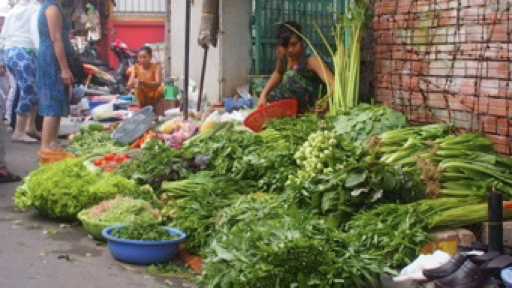
Noise is a constant factor with motorbikes, buses, trucks and an increasing number of private cars having carte blanche to blast their klaxon-like horns constantly, mingling with the incessant noise of daily life on the streets – people crouched on tiny stools over  rickety tin tables, sucking down noodle soup at all hours of the days or night while small “cafes” simply appropriated the space before a closed shop or office and set up their stools and tables there.  Along with eating on the street, there are all the concomitant activities that go with it – obviously, cooking over an open charcoal fire on the pavement is perfectly normal, as are washing the dishes in a tub of greasy lather while it is perfectly acceptable to sprawl on the pillion seat of a motorbike with your bare feet propped on the handlebars while a foot massage or pedicure is administered. 

Why stop there, of course?  The street is a perfect place for a barber to attach a chipped mirror to the railing and set up a barber’s chair, and while you are at it, you might as well bathe the naked children on the main street as well.  Need a toilet, well there is a perfectly good tree that you can hug and pee away to your heart’s delight.   Feel like a nap? Just stretch out on any semi level piece of ground and snooze away.

  Shopping was another new experience.  Supermarkets were few and far between and the ones that do cater to western tastes – i.e. selling such delicacies as Kiwi shoe polish, Cornflakes, baked beans in tomato sauce, long-life UHT milk imported from new Zealand and Australia, pasta and P.G. Tips tea bags – are few and far between as well as being outrageously expensive. 

Instead, Vietnamese life centers around the market – usually a maze of narrow alleyways where fruit, veg, fish, meat and live poultry are haggled over down to the last dong.  Don’t feel the need to have an actual stall? 

Fine, just spread a torn sheet of plastic on the muddy ground and pile your veg there.  Want a nice pig’s tongue or a bucket of toads, or a basin of slippery eels? No problem, just scoop them up into the ubiquitous plastic shopping bag and slaughter away in the convenience of your own home.  

Nothing pressing to do today?  Well then, sprawl in a plastic garden chair and drink syrupy black coffee with ice, or, for a real taste buster, load up the glass – cups are rarely used – with sweetened, condensed milk, top up with a thick syrupy coffee and then dilute the dregs with the complimentary glass of iced jasmine tea, flicking your cigarette butts (Craven A – pronounced CARavan A) at pedestrians’ feet as they stumble past on the cracked and uneven pavements between the parked and zooming motorbikes, while fending off the legion of cripples and maimed selling lottery tickets, sunglasses, feather dusters, zippo lighters and manicure kits from a sandwich board contraption they sling over their deformed shoulders.

Ah, yes, different to HK, as I say. 

However, it WAS an experience and I coped quite well, I think. I enrolled in a Vietnamese language school and signed up for an elementary class with other would-be aspirants, but I was the only student and had the undivided attention of a pretty, charming, superbly fluent and patient 24 year old teacher.  

I signed up for 35 hours at the monstrous price of 4,000, 000 dong (yep, 4 million!) and have already completed 12 hours, most of which has been spent grappling with the tonal aspect of the language as well as learning to write using the correct tonal signals along with the assorted diacritics that the Vietnamese alphabet of 29 letters uses.  

A “D” not surprisingly, is not, of course, pronounced “Duh” but instead sounds a bit like a “Yuh” while the (new to me) letters such as Ă, Â, Ê, Ô, Đ, Ư and Ơ still retain that aura of mystique.  Add the tones then on top of those letters and it becomes even more baffling as in Ầ or Ẩ or Ẫ while a simple and important word like “wine” becomes unrecognisable in RƯƠỤ – notice the all important dot under the final U!

However, having whinged about all that, to my rather modest surprise, I appeared to pick up some of the language fairly quickly.  My class was from 10:00 – 11:30 (but then again it might just be from 10:30 – 12:00 noon) three mornings a week so after the lesson I used to wander around and get lost in this sprawling city and finally, in a sweating, red-faced, sodden mess, I would attempt to squeeze my bum into a plastic chair clearly made for kindergarten kids and slurp coffee – (Cà phê) – while mumbling such phrases as I believe I had mastered only to later discover that I had just told the waitress that “her mother is a beautiful grave”!.  

Then the wearisome search for a bus home would begin.  Saigon is a maze of one way  streets and while this is blithely ignored by motorbikes and small utility trucks powered by oily, smoke-belching, ancient motorbikes engines, buses here do tend to follow the standard traffic direction.  So, getting off the bus and carefully noting the stop – all bus stops are conveniently identified with XÊ BỨYT stencilled in faded letters on the road itself – is all to no avail as the street apparently is a one-way street and the return bus would not just simply chug along on a parallel street but perhaps take a more tortuous route several blocks away.  My several attempts at asking directions in my newly fluent Vietnamese had one gentleman hawk a gob of spit at my feet while a rather prim lady blushed and pulled her paisley-patterned surgical-type mask firmly over her face and stalked off without a word.

Apparently, it is not just the beach that can make a lady’s skin dark.  It is, rather, the mundane situation of being anywhere outdoors between dawn and dusk.  Here in Saigon, of course is the added problem of “the dust” which necessitates every single female between the ages of 11teen and 90 wearing a plain or haute-couture designed face mask, much like the style favoured by bank-robbing cowboys.  

 Those particularly concerned with the “whiteness” of their features would additionally opt for the more comprehensive cover of a gorget or wimple. Along with the face mask, covering everything from below the eyes, a floppy hat is also de rigeur.  Add to that, elbow length evening style gloves, similar to those worn by Audrey Hepburn in Breakfast at Tiffany’s and, finally, as a finishing touch, wear fish-belly grey knee length stockings with a convenient cleft between the big and first toe, all the more suitable for slipping your foot into the ineveitable thongs / flip-flops that many ladies here seem to favour.

However, to make up for everything, we had a rather nice apartment in the Bình Thạnh District (notice the dot under the “a” again!).  It is bright, clean, airy and spacious – much larger than our former apartments In HK.  We have two large bedrooms, two loos and two balconies with a reasonable view of the city and a glimpse of the snaking Saigon river.  By motorbike taxi, less than 20 minutes into the city centre, perhaps 30 minutes by public bus, so all in all, not too bad.

I mentioned the figure of 4 million Dong – the Vietnamese currency – recently for my Vietnamese lessons and while I was vaguely familiar with large amounts – I remember once my peculiar joy at being both a millionaire and simultaneously broke while living in Italy in the late 70’s – but it is the excess of the numbers here  that put the heart sideways in me– I just couldn’t get used to dealing in millions for relatively simple purchases.  The first time I ever came to Vietnam, back in 1996, I needed a plastic shopping bag to carry the cruddy paper bank notes around.  Now, a semblance of sense exists and the notes are all the new, shiny, plastic bank notes, originating, I think from Australia.  The largest note is a 500,000 dong note, followed by a 200,000 and then a 100,000,  and then down the scale at 50,000, 20,000, 10,000, and the rather lowly paper notes of 5,000 2,000, 1,000 and finally the rather pitiful 500 dong note (approx. $0.02 Australian or Euro cents !) How easy it was to confuse a zero here or there and (usually) end up being massively overcharged.

Islands in the Sun

Moher
Cliff of Moher, West Ireland

I love islands and island life, possibly because I was born on the far flung western isle (Ireland) or maybe because my childhood was suffused with island adventure tales – Enid Blyton’s Famous Five’s escapades on Kirrin Island (and the slightly more mature Adventure series – The River of Adventure, the Mountain of Adventure and, inevitably, the Island of Adventure with Philip, Jack and his parrot Kiki, Dinah and little Lucy-Ann) – and followed up with R.L. Stephenson’s Treasure Island and R.M. Ballantyne’s The Coral Island (which was the first book to ever make me cry when Bloody Bill, the pirate, died!).


Then again, perhaps it was the magic of flying on a two engine Fokker Friendship prop plane from Dublin airport to The Isle of Man with my parents for another childhood holiday. One time we flew from Collinstown, later to become Dublin International, and once, more exciting, left at midnight from one of the city’s quays on a ship that seemed to loom immense in the glare of lights. Magical gardens and bridges where a fairy toll is ‘demanded’, cats with no tails and a unique ‘Q-Celtic’ Manx language – sadly now extinct, the last native speaker having died in the mid seventies – Manx was related to Scottish Gaelic and Irish as opposed to the ‘P-Celtic languages of Welsh, Cornish and Breton. I still remember the  buzz and roar of the annual TT motorbike races around the island and the excitement it generated.

On the other hand, it may have been the summer picnics to Dalkey Island2 (the closest

Coliemore
Coliemore Harbour

island to where I lived in Dublin as a child) which seemed to require such advance planning on the part of my parents. The No. 8 bus from the heart of the city would go past our house on the corner of the Monkstown Road and on through Dun Laoghaire, Sandy Cove and eventually the terminus at Dalkey and from there the walk, lumbered down with tartan rugs, picnic baskets, flasks of hot tea, buckets and spades, to the harbour at Coliemore from where my father would bargain with brawny men to row us across to the uninhabited island of Dalkey Island* crowned with a Napoleonic era Martello tower. Uninhabited except for a few goats, a Martello tower, a freshwater spring and a ruined church. Family picnics, diving off the small, whitewashed rocks where the rowing boat left us off and picking up fresh mackerel for dinner on the homeward trip.


Whatever it was, it seems that those most magical times have extended into my adult life and have all been centred on islands. Simple man, simple dreams3, I suppose. By horoscope, I fall under Cancer – a water sign – and in the Chinese zodiac I am a (water) snake and despite having enjoyed myself in mountainous regions worldwide – The Himalayays in Nepal, the Andes in Peru, the Caucasus Mountains in Georgia, the Pyrenees on the Spanish-French border, I feel my strength and vitality are at their peak when I am close to water, especially salt water!

With so many thousands of islands in Indonesia I have explored so few, Bali ages ago and more recently, the Gilli Islands off Lombok – an easy four hour direct flight from Perth here in West Australia and then a 90 minutes taxi ride to the port at Bangsal from where the public boats set out for the islands. Bali is a subtle blend of festive Hinduism and local traditions, Denpasar and Kuta being over commercialised  but it is still easy to escape to central Ubud and the black sand beaches along the north shore at Singha Raja. Everybody seemed talented – whether it was in dance or performance, wood and stone carving, music or hospitality and fluent in so many ways. I had to buy extra bags in Bali to accomodate all the carvings and knick knacks I acquired the first few times there.  I recently came across a few thousand rupiah from that time and when I produced them in Lombok last week, people laughed in incredulity at my crumpled bills. They have been out of date for almost forty years! IMG_3295I headed off initially to Trawangan, the party island, with plenty of bars and loud music and the furthest out from Lombok but after two nights of drinking cheap cocktails – two for the price of one – made with local spirits – I had a vicious headache and decided to try the delights of Menos, the middle or the ‘Robinson Crusoe’ island, the smallest and the quietest the three. Beautiful, semi unspoilt islands – no cars or motorbikes only bicycles and little pony and trap carts and a sunrise on one side and a sunset on the other side of the island. Three days on Menos and, with my time running out, I spent the last three nights on Air, the island closest to Lombok itself. IMG_3310All three islands were unique in their own way and were small enough to stroll around in less than two hours and all offered scuba training and day and night dives and probably excellent value if that is the kind of thing you like. I’m a bit different – I just wanted clear, deep water and that’s where the islands fell down for me as, for a hundred metres or so around all three islands, the water was shallow and while appearing to be sandy, was, in fact, made up of dead and broken white coral shards which made getting into and out of the water difficult and painful. Coral cuts tend to fester easily and reef shoes – which, of course I didn’t have – would be an absolute necessity. As it was, the water was so shallow that trying to swim overarm out to deeper water my finger tips brushed the broken coral with each stroke. Not ideal unless you want to lounge by the swimming pools most of the resorts provided.

A relatively new ‘discovery’ for me, Lombok is the large island next to Bali and, in theory,IMG_3317 should be just as beautiful. Certainly a fantastic ride from the airport skirting the capital and rushing past small villages and up over a jungle clad mountain with monkeys on the roadside, attracted by heaps of durian on sale, glimpses of the coast as we head down to the port. I am sure there are gorgeous beaches there too but I was set on new island horizons, the three small islands off the north west of Lombok.

Samosir, on the other hand, was almost an island, in the middle of Lake Toba, near Medan in Sumatra, practically the far end of the Indonesian archipelago from Lombok. My son fell, fully clothed, off the dock once we arrived and I had to jump in after him. That’s all I can really remember except for some really ratty accomodation.

So, on to all my favourite islands and how to rank them – by cost? (Rottnest island off Perth in WA is hideously overpriced); by beauty? (most S. E. Asian islands); by ease / difficulty of access? (although that has changed with airports springing up everywhere); by people? (all of them!). A listing in no particular order and with distinct memories of times past and present.

Lamai Koh Samui
Lamai Beach, Koh Samui

Ahh, Asia, every other island paled into significance once I came across Koh Samui, Koh Phangan, Koh Tao and Koh Samet.  Those tropical paradises, first visited in 1981, originally by slow, flat-bottomed overnight ferry from Dongson to Koh Samui before a pickup truck ride to Chaweng or Lamai or Bo Phut beaches still represent earthly paradise to me. Back in the early 80’s, I’d pay something like a nightly 30 Baht for a beach-side hut on stilts and have banana pancakes for breakfast, Tom Yam soup for lunch and barbecued fish 

Lamai
Lamai Beach, Koh Samui

for dinner, all washed down with icy Singha beer in cold frosted glasses and Mehkong whisky and soda water. Beautiful sandy beaches, relaxing beach massages and a gentle shelving beach so that you could run and dive straight into crystal clear waters. Now you can fly from most places into Ko Samui airport – one of the most appealing airports I have ever been in. Prices of course have gone up since my first visit and many beach side resorts also offer that abomination – a swimming pool! Koh Phangan was, I think, the ‘party’ island north of Koh Samui – the originator of the full moon parties? Koh Tao consisted of three tiny rocky islands connected by sand banks at low tide. I swam around the largest island once. There used to be just a handful of beach huts and a restaurant; now I believe it is packed but it must still be beautiful. All I remember of poor old Koh Samet are mosquitoes and ants!


I lived in Malaysia for three years and evocative names in Penang like Batu Fennenghi and Jalan Chulia where I bought my first ever SLR camera still stir me but it was off the east coast of northern Trengganu that the real tropical paradises of Perhentian and Redang lay. Deserted, at the time and  used only by local fishermen for its fresh water supply – hence the name ‘Perhenti’ / Stop, in Malay. I used to hire a local fishing boat from Kuala Besut, where I lived for three years and would make almost weekly trips (on a friday) to the island and come back to the kuala, sun-burnt, salt bleached and dehydrated to revive myself with large bottle of cold Anchor beer, served from metal tea pots into heavy ceramic cups in the only Chinese cafe in the kampong. I camped on the island for nearly  a week once while trying to study for my Graduate Record Examination into an American university, thinking I would have no distractions! Even further out than the Perhentian islands lay Redang. it was once used as a detention centre for Boat people in the aftermath of the Vietnam war. I much preferred the Perhentians where I swam with sting rays, turtles and small (leg-long) sharks in waters no deeper than three or four metres. Gorgeous!

A fast ‘coffin boat’ from Brunei Darussalam would bring me to Labuan, a duty free island off the coast of Malaysian Sabah in Borneo – an absolute haven away from alcohol-free, strictly Islamic, Brunei.  I used to treat myself and stay in the golf course hotel. Alternatively, I’d go over with some friends in their boat, depart Brunei legally, arrive in Labuan, stock up with up to 50 cases of beer (ballast, we used to call it) and return to Brunei illegally after dark when the customs had closed, off load the beer on a deserted beach where other friends were waiting and then report to Brunei customs the following morning, claiming the Evinrude engines had been giving us trouble and we had only just arrived! Another world, another time!

And then, of course, there is Hong Kong and with this view from my rooftop, what more could anyone ask?HK1

Lamma island, just off the bottom of HK’s 

MINOLTA DIGITAL CAMERA
Fish farms off Sok Kwu Wan, Lamma, HK

southern bottom, was such a laid-back spot off frenetic Hong Kong. ‘Draw-string pants, mismatched socks and guitar music’ I once heard someone describe the lifestyle there compared to HK’s bankers. One ferry from HK Central would arrive at Sok Kwu Wan on the north east side of the island with its fish-farms and quayside restaurants. I used to walk from there to the other side of the island with its ATM, bars and more seafood restaurants and a different ferry from Yung Shue Wan back to HK.

HK4
HK mini Buses


Lantau Island had the big Buddha (the biggest, seated, outdoor, bronze Buddha in the world,) as well as a great South African barbecue beachside restaurant with jugs of Margaritas. Cheung Chow, One of Hong Kong’s favourite suicide spots for some bizarre reason. Punters would rent a small chalet, close the doors and windows and light a charcoal barbecue and suffocate themselves.


Phu Quoc, off the most south westerly tip of Vietnam, looks closer to Cambodia and was fairly unspoilt and quiet when I was there about 20 years ago. So much so that the ‘resort’ I was staying in offered to sell itself to me after a night’s drinking with the owner! I choose what I would like to eat the following day from an ‘oral menu’ and he would make a trip to the local market just for me! The island boasted of its famed peppercorns and fish sauce which, locals zealously informed me, could not be brought on board an airplane lest the bottle break and its pungency imperil all on board!

Singapore was definitely my first ever S. E. Asian island! Gaping, like some yokel from the sticks, I went shopping along Orchard Road and bought my first – and only – portable typewriter – an Olivetti – there back in 1981.  Do those things still exist? The incredible humidity in the air – like walking into the bathroom after somehow had a long, very hot shower with the door and windows closed and the coolness of the Long Bar, in the Raffles Hotel, surrendering to Singapore slings, was a blessed relief after the turmoil of shopping!

I did an MA in the State University at Stony Brook, half-way out on the north shore of Long Island, a long spit of land reaching out into the Atlantic from New York City and did my drinking in places like Setauket and Port Jefferson and my swimming in the creek on the northside and in the Atlantic on the south side.

I worked one summer on the island of Sylt, the jewel of the ‘German Riviera’! I was ‘ein nacht portier’ at Hotel Ursula in the main town of Westerland. Long, windswept sandy beaches where elderly people played volley ball in the nude and where I was eventually fired when it was discovered that I didn’t really speak any German but it took nearly three weeks before that was discovered!

The Île de Noirmoutier is not really an island as it is connected to the French mainland by a causeway flooded daily by the incoming – and fast – tide. Famous for its new potatoes, I remember it for lazy afternoons drinking white wine with a touch of Cassis with old friends.

Slow, laid back, very patchy wi-fi, Cuba offered differently aged Habana rumsIMG_0631(apparently Bacardi sided with the Batista government forces against Castro and so signed their death warrant on the island) in generous mojito cocktails. Music in the bars at night – and everywhere – extravagantly old American cars lovingly tended (or rusted out heaps beyond repair), fat women squeezed into tight lycra and old men and women smoking cigars the size of a baby’s arm.

From Puno in Peru I went out to the amazing floating islands made of bundled reeds on Lake Titicaca, part of the border between Peru and Bolivia.

IMG_0089
Floating Reed Island, Titicaca


Trampoline-like under foot, the reeds were used for their shelters as well as their boats.

IMG_0088
Reed boat, Titicaca


Half an hour by fast ferry off Fremantle in West Australia,  Rottnest island is clearly visible from the mainland and like the Gilli Islands, there is no motorised transport – just bicycles and beautiful beaches, fresh octopus and, the island specific, quokkas (a type of small, short tailed wallaby). While beautiful and charming, the island is, in my opinion, mega expensive for what it offers..

Hainan
Hainan Island

Hainan island is China’s most southerly port and submarine base and I stayed in the same hotel where the Miss World beauty contest was once held in the southern city of Sanya. Parts of the beaches were cordoned off by the military, as I discovered when I ignored shouted warnings strolling along a sandy beach. Only the clunk-clunk of a pump-action shot-gun being cocked brought me to my senses.


Macau casinos held no 

Macau3
One of the fancy casinos


attraction for me but Portuguese food and wine certainly did in the area around the old harbour as well as crumbly old ‘Fawlty Towers’ type hotels. I’d return to HK laden with chorizo, olive oil, tinned anchovies and bottles of a slightly sparkling white wine.


Almost directly opposite the Chinese mainland city of Xiamen is Penghu County, a drab island claimed by Taiwan and reached by a three hour ferry trip from Xiamen itself. One of the most heavily shelled / bombed places after 1949 when the Nationalists retreated. The main culinary delight seemed to be  oyster omelettes!

Next up, after the Thai Islands mentioned above must be Puerta Galera in The Philippines. A half day bus trip out of Metro Manila down to Batangas and then a ferry over to Puerto Galera on the island of Mindoro. Fantastic! I stayed at the end of a rocky promontory with a floating bar a 100 metres away. Cold San Miguel beer cheaper than a coffee or a coke, mellow Tanduay rum, tiny, bitter little calamansi limes, green skin, bright orange inside with slippery pips, friendly people and crystal clear, deep water – perfect.

In late December, the sun rose around twelve noon in Reykjavik, Iceland and set again at about four pm. Ideal in some ways – use your imagination – the hotel in the small town of Hverageròi where I ended up for some reason, was overheated and I pushed the window open to let some air in and the window froze open overnight, as did the lens of my camera later that day. Amazing to come across hot houses growing bananas and tropic plants benefitting from underground thermal power.

So, a retrospecive look at islands sparked by my recent trips to the Gilli Islands, Indonesia.

1 Islands in the Sun – Harry Belafonte

https://www.last.fm/music/Harry+Belafonte/_/Island+In+The+Sun

2 Dalkey Island Photos – Niki McGrath

EFFECTS

3 Simple man, simple dreams – Linda Ronstadt‘s Asylum album released in September, 1977.

https://www.youtube.com/watch?v=QLk90r2sJMc

Yerevan and Environs

During the Yalta conference towards the end of the Second World War when the three Allied leaders, all with a penchant for booze, (Winston Churchill favoured champagne and brandy, Franklin D Roosevelt enjoyed martinis while Jozef Stalin, a native of Gori in Georgia, indulged in vodka and – to the detriment of the Georgian wine industry – super-sweet red wine), met to carve up post-war Europe, Armenian brandy was served which, apparently, won over Winnie’s heart.  Good enough reason for me to relinquish the delights of Georgian wines for Armenian brandies.

The overnight train from Tbilisi, the capital of Georgia, groaned in past grimy, dis-used lots, abandoned factories and unfinished, ugly concrete slab buildings – an air of  neglect, lovelessness, and dilapidation, dismal and decrepit. Not the most welcoming entrance into Yerevan, the capital city of Armenia, sandwiched between Georgia, Turkey, and Azerbaijan.

IMG_1878It was early morning and still cool so I decided to walk from the, admittedly, statuesque central station to the hostel I had booked at random before leaving Tbilisi but the walk didn’t change my initial opinion of the city despite the plenitude of park benches and drinking water fountains. Overall the impression was one of grey, concrete drabness. The hostel was small, cramped but cheery with two Filipina girls laughing and cooking breakfast in the tiny kitchen but only a small, top bunk was available and I decided to move on.

Untended vines, the thickness of my thigh, sprouted from broken pavements, climbing above fashionable shops on the ground floor, masking the ugly, squalid looking apartments two, three, four and five stories above while a dusty church  topped a small bare hill opposite aIMG_1881 Carrefour supermarket. I was beginning to regret having made the sweaty overnight trip here until I turned a corner and  ended up in the English Park, a shady, IMG_1921fountain filled park with a cafe and bar in its centre beside the big screen showing the latest matches from the 2018 World Cup.  Just around the corner from my new hostel was an elegant and upmarket food hall IMG_1882leading to a broad, pedestrianized avenue with a stream of fountains running down the central area, culminating in Republic Square. Massive, monolithic buildings of naturally coloured tufa, a rock made of compacted volcanic ash, in various shades, IMG_1885ranging from light pink pastels with a hint of orange formed a semi-circle around the Central Bank, and the National Art Gallery and Museum, almost completing one arc around the huge central fountain – musically choreographed and floodlit by night, as I was to discover later.
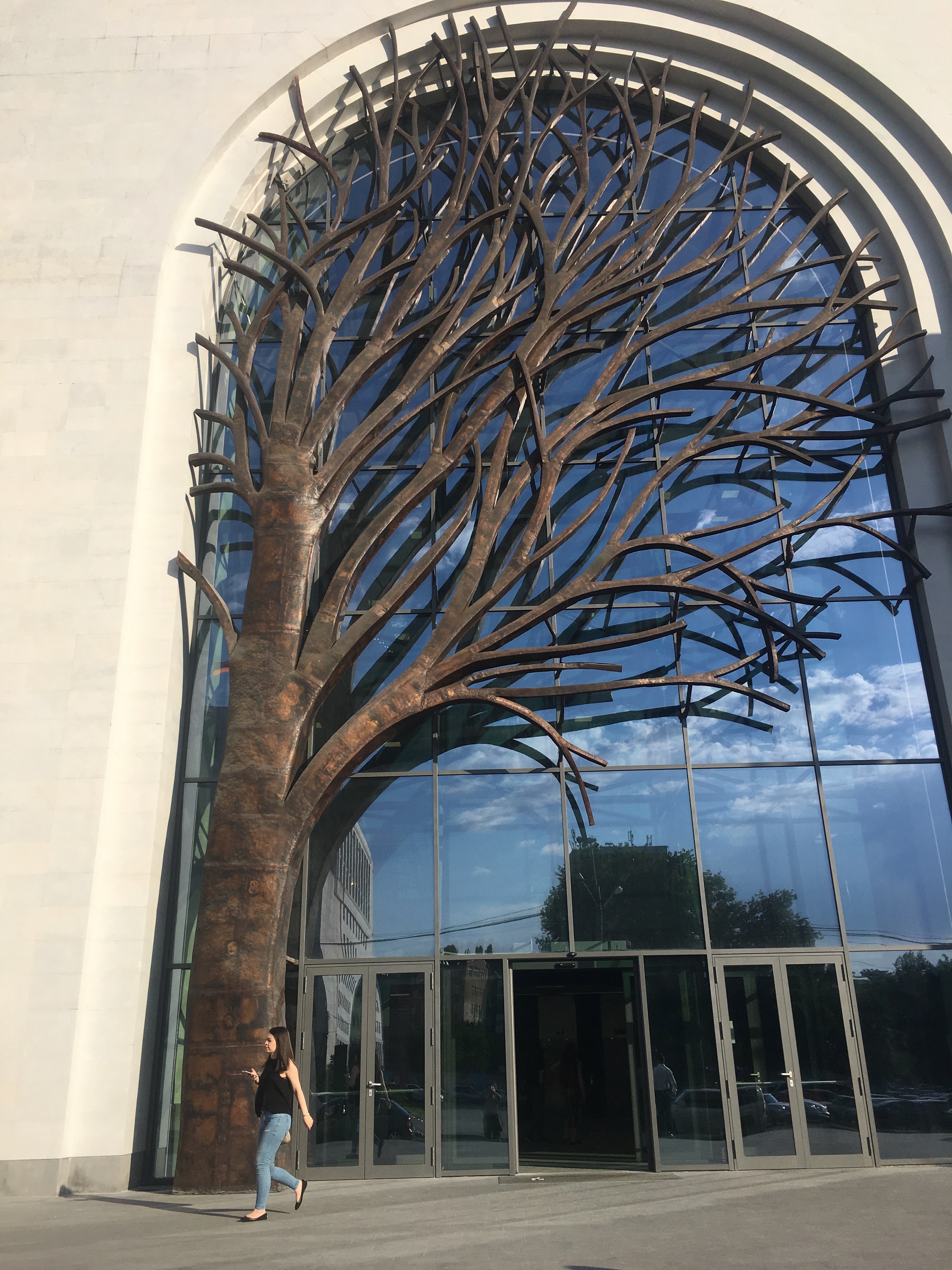
Fountains, parks, churches – Armenia was the first “European country” to become Christian in something like 330 A.D. – almost a century before St. Patrick arrived in pagan Ireland in 432A.D – and grapevines seemed to crowd the city,  which I could look down on after climbing the endless steps known locally as ‘the Cascades’ to the multi-level IMG_1898IMG_1904Cafesjian arts centre, named after the Armenian-American who funded the completion of the former Soviet era construction.

Cold beers – I loved the Name ‘Zadecky Goose’ – and lamb kebabs in the English park, watching the world cup matches at the convenient time of 4PM IMG_1915followed by classical concerts at the National Concert Hall with brandy chasers afterwards began to pall and it was time for a change of scenery.

IMG_1890I have spent twenty-odd years living in Asia and during that time visited most of the ruined and fabled lost cities and temples – Pagan in Burma, Angkor Wat in Cambodia, Ayutthaya in Thailand and My Son in central Vietnam, so I decided to do something similar here in Armenia.

Garni is the only pre-Christian structure remaining in this devotedly Christian nation. Built by Tirdates I around 77A.D., with reparation payments of 50 million sesterces along with Roman craftsmen provided by Roman Emperor Nero, the classical Graeco-Roman style building may have been a tomb, thus explaining why it escaped destruction during Armenia’s militant Christian past. Possibly IMG_1980

a temple dedicated to Mihr, the sun god in the Zoroastrian mythology, the massive colonnaded building, perched on the edge of sheer cliffs, would have been a perfect spot from which to hurl sacrifices! Huge steps led up the front IMG_1996entrance, forcing me to scramble up, practically on my hands and knees, proper style for entering a pagan temple, I thought.

A twisting road lined with cherry and other fruit trees led to a spectacular monastic settlement at Geghard a few kilometres away. Established in the early 4th century by Gregory the Illuminator, on a former pagan sacred site, inside a cave with a freshwater spring, and surrounded by towering cliffs and tumultuous drops on every side, IMG_2006 the incredible monastery huddled in the rock face where ascetic monks must have eked out a precarious existence in caves in the cliffs reached only by ladders or ropes, ‘adding prayer to shivering prayer’* and exposed to the elements. IMG_2039Apparently, the old monastery had, along with the monks’ quarters, churches, shrines, a seminary, an academy of music and, of course, a manuscriptorium where, presumably Gregory hung out. And all this was all just as the Armenian alphabet was being invented! To add gloss to the whole place, relics included the original spear used by the centurion to pierce IMG_2024Christ on the Cross, brought here by St. Jude – known, inexplicably here as Thaddeus The spear pictured here was just the case for the relic now kept elsewhere in Armenia, – as well as a chunk of wood said to be from Noah’s Ark!
Lake Sevan, about 70 k outside Yerevan and at 2,000 metres, promised cooler weather from the city’s stifling, hot summer where daily temperatures seemed to always be north of 38°C and the idea of bathing my feet in a local lake rather than Armenia’s beer, wine and brandy appealed to me. IMG_1967 No-one could call Sevan a pretty town and on the advice of another passenger on the bus, I skirted the town completely and headed out towards the Sevanavank monastery, founded in 874 A.D., built on the southern shore of a small IMG_1942island, which, after the lake was drained during the Stalinist era, transformed into a peninsula at the north western shore of the lake.IMG_1966

The lakeside was more appealing with a smattering of fashionable hotels clustered around rusty shipping container-like ‘rooms’ offering cheaper rates and massage to gawking tourists, many of them from neighbouring Iran, judging by the head-scarved women wearing what looked like voluminous dressing gowns.

Determined to watch the World Cup games, which my hotel was not showing, I ended up with a taxi driver, willing and smiling to my demands for ‘fussball’ and beer, who obligingly drove me around from betting shop to betting shop inm Sevan town before throwing up his hands in despair and taking me to a micro brewery on the edge of town where the staff were either unwilling or unable to turn the channel to the impending Australian Vs. Peru game. The taxi-driver – grinning maniacally – seemed happy to wait on the opposite side of a two lane motor highway while I gulped darkish beer and gnawed on tough lamb / goat bones before sullenly returning to my lakeside hotel and back to Yerevan the following morning.

Another day to stock up on Very Superior (VS); Very Superior Old Pale (VSOP); and Extra Old (XO). brandy and then the clunky train back to Tbilisi.IMG_2632

* ‘adding prayer to shivering prayer’ is a line from the poem September 1913 by William Butler Yeats, Ireland’s first Bobel Prize winner for Literature.

Trains and Boats and Planes

With the exception of balloons, submarines and helicopters, I have tried most major forms of transport – yes, even camels, elephants and horses – but I have to admit that trains are my favourite mode of travel – especially long distance ones, with a sleeper and a restaurant car, hurtling me through time and space.

There have been disappointments of course. One time, on a short trip from Dublin to Cork, I treated myself to a first class ticket, but warm cans of Guinness from a ‘bar-cart’ – not even a bar-car! – detracted from the overall experience.

I was looking forward to different train trips in the Caucasus but unfortunately there were no trains along the southern shore of The Black Sea in northern Turkey which I covered in hops and leaps in very comfortable, intercity coaches but I was really looking forward to the overnight train from Batumi, just over the border from Turkey, in Georgia to the capital, Tbilisi.IMG_1860

Because of prior difficulties regarding statehood, nationality, form of government and current strains of economics and global trade, the entire region seemed to be unhappy with its immediate neighbours. ‘Turkey has no friends,’ lamented one young professional who had taken her masters at a Dublin university and that story was echoed in one way or another in each of the countries I visited.IMG_1861

Tbilisi would be my hub and from there I could get an overnight train to Yerevan in Armenia and to Baku in Azerbaijan. The only problem was that since none of the countries permitted inter-travel, I would have to retrace my steps to Tbilisi each time before heading off again. While I could enter Armenia from Georgia I couldn’t continue on to Azerbaijan. I’d have to return to Tbilisi the same way and then take another train to Baku on the shore of the Caspian Sea.

Similarly, I could take a train from Tbilisi to Baku but I couldn’t go from Baku to Yerevan in Armenia. What that all meant was a lot of overnight train trips from Tbilisi throughout the Caucasus.

Impressed with the modern Stadler train which whisked me effortlessly from the brand new looking station in Batumi to Tbilisi, I expected, foolishly perhaps, something similar on a longer, overnight, cross border experience.IMG_1862

Despite starting in Georgia, the train was Armenian and didn’t look remotely like the sleek brute that had delivered me to Tbilisi a few days previous. This particular train looked like trains did in Hitchcock movies so, pre-warned there was neither bar nor restaurant car on the fifteen hour trip between the capital cities, I stocked up on red wine and brandy accordingly. Thank God I had because the only amenities provided turned out to be a box of sugary jellies, a bottle each of still and fizzy water along with a fresh pillowcase and sheets.

I handed over my first class ticket to the burly blonde guarding the steps outside my carriage who glared uncomprehendingly at me when I greeted her and asked her name. ‘Lana’ she growled before ushering me up the steps impatiently as if the train were just about to depart.

IMG_1865Strolling up and the down the narrow corridor outside my compartment – there was another twenty minutes before the train was due to leave – the only differences I could see between the carriages was mine had the top two bunks removed, leaving only the bottom two.

The window in the compartment was sealed shut and masked with voluminous drapes of bleached out nylon. Only every third window in the carriage corridor outside opened partially. Not a major issue if the air conditioning worked, but when I found Lana, brewing coffee in her private ‘office’, and made IMG_1864panting sounds, mopping rivulets of sweat running down my face and neck and pleaded for the air con to be turned on, the brutal blonde overseer of the first class compartment seemed not to notice the 37 degree heat and only reluctantly turned the a/c on low, only to turn it off every time the train crawled into another small, sun-baked station.

When I tried to open the half window in the corridor outside my compartment to get a breath of air, she bustled bossily down and shouted at me, along with emphatic hand gestures, to close the window.

“Well, turn the bloody a/c on again” I retorted peevishly, the sweat stinging my eyes and my shirt sticking like a wet rag to my streaming skin.

My initially chilled beer  was almost tepid when, glaring at the sugary jellies and the bottles of water I opened it.

Usually, the regular clack-clack of the train would lull me to sleep but this time, seeming to compound the heat, the train groaned along, accompanied by what sounded like extended and sporadic heavy machine gun fire from the iron wheels.  I had already finished the wine and was about to dose myself with the brandy when immigration marched down the train, collecting passports and then disappearing with them for a worrying length of time before returning them just as the train ground to a noisy and shuddering halt at the border with Armenia. IMG_2083 Surprisingly – and pleasingly – smartly dressed Armenian officials came down the corridor with laptop computer scanners and handed back my passport within a minute of collecting it.
Dawn broke as I panted by a window I had furtively opened – no sign of the bossy Lana – looking at a high white cloud before eventually realising it was the snow-capped peak of Mount Ararat towering over the plains. IMG_1876Arrival time rolled around and the train still trundled noisily over flat, dusty plains with no sign of an imminent city. IMG_2081Questions to Lana about the expected arrival time were dismissed with a brusque hand gesture and a shrug and it was a good four hours late before the train finally shuddered to a halt in Yerevan itself.
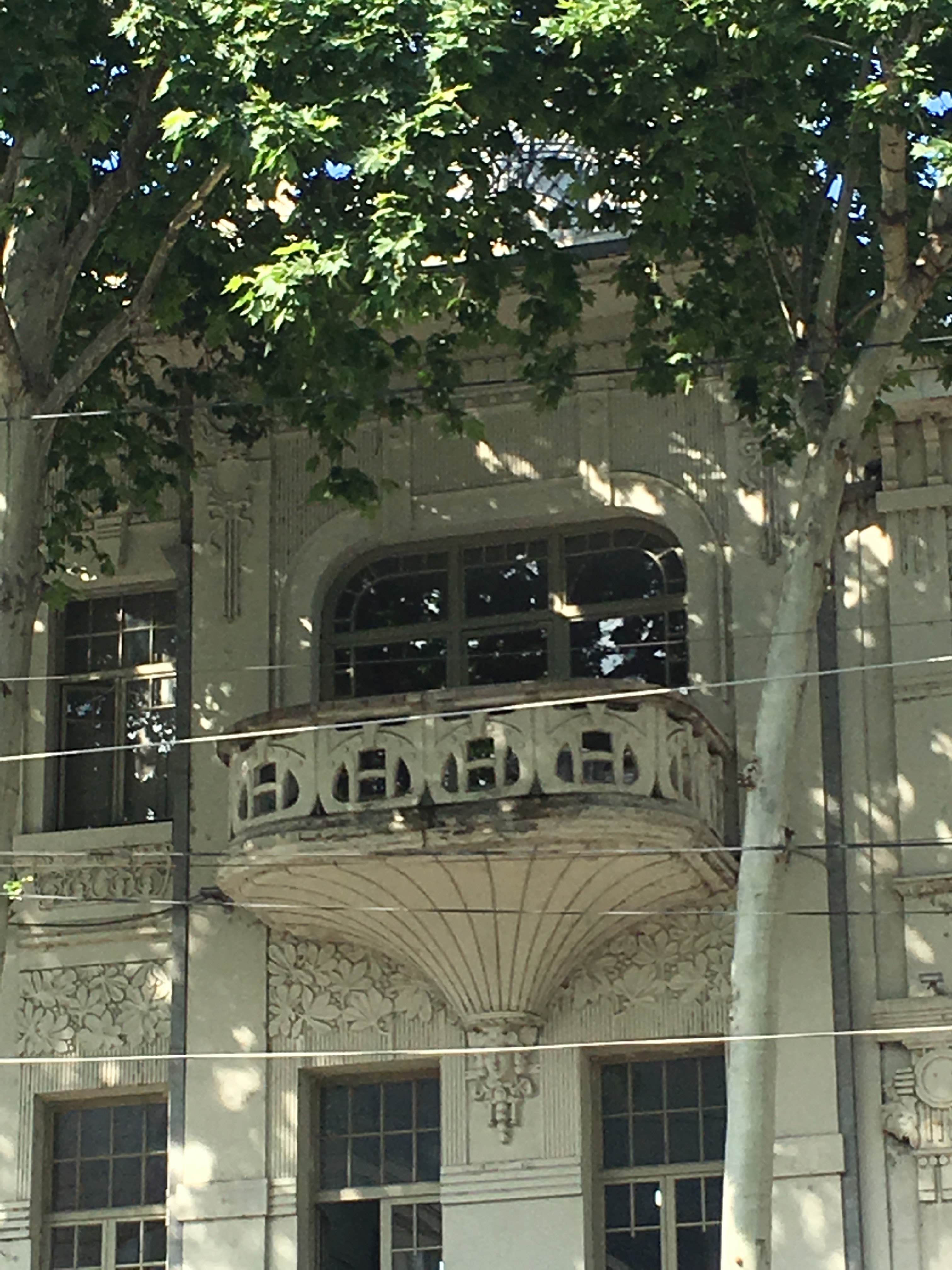
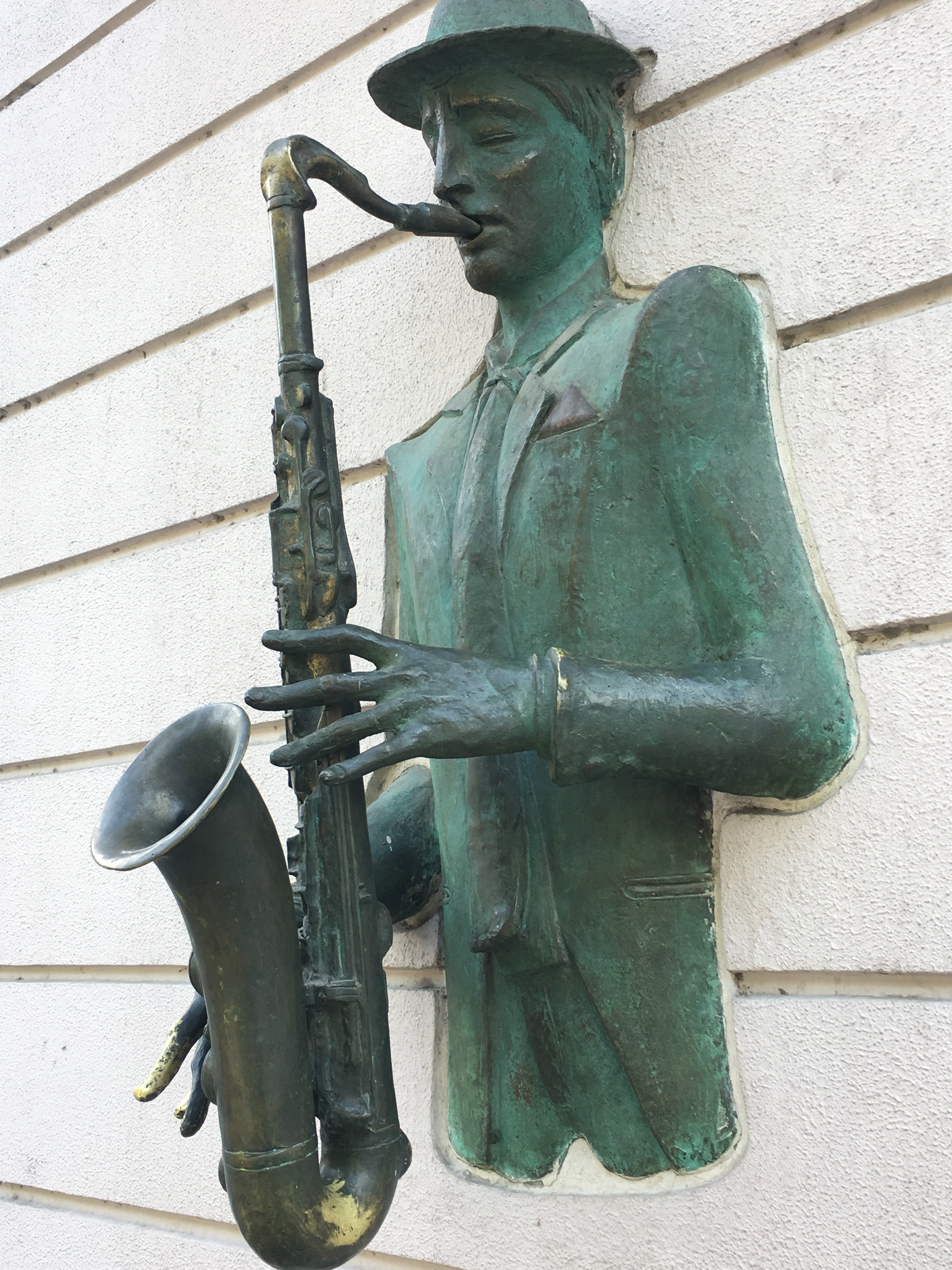
I was here, that was the main thing and Armenia is famed for (among other things) its brandy – the only brandy Winston Churchill would drink, apparently – so what could go wrong? And there was the return trip to look forward to and to compare with the overnighter to Baku later on.


Georgia Reconsidered

A big red M outside Tbilisi’s main station marked the entrance to the city metro – probably the longest, deepest and fastest escalator I have ever been on and, like the bus fare from the border to Batumi which cost something like 30 ct, the trip on the metro were priced similarly or even cheaper.

The Georgians I met – generally local punters in a bar or café or wait staff in the same places – were all terribly proud of being Georgian and were especially keen to distance themselves from anything Russian, having finally extracted themselves from the sphere of influence wielded by Imperial Russia, Soviet Russia and The Russian Federation. Armed only with red roses, protesters demonstrated for twenty-three days outside the Georgian parliament in November 2003 in order to bring about peaceful change and a new slant towards westernisation.

A waiter or waitress’ recommendation from the local menu invariably followed the same line, ‘this very, very good, this very good, this very good, this … Russian, this very, very good’.

This ‘turning away’ from their former rulers led to increased tensions with Russia, culminating in the brief 2008 war where the Federation forcibly backed two separatist revolts against the Georgian state. One night in a small bar half way up a hilly side street near the Opera, a fluent speaker of English confided in me that he hated the Russians. They killed his brother during the war in South Ossetia.IMG_1759

IMG_1760 2Popping up from the metro two stops away from the main station – again an incredible ascent – onto Shota Rushtavelli Ave I was amazed to see how fashionably modern Tbilisi was. I don’t know what I was expecting – perhaps something slightly less developed than a Western capital, perhaps something slightly shop worn – but what I got was an amazing melange of old and new.
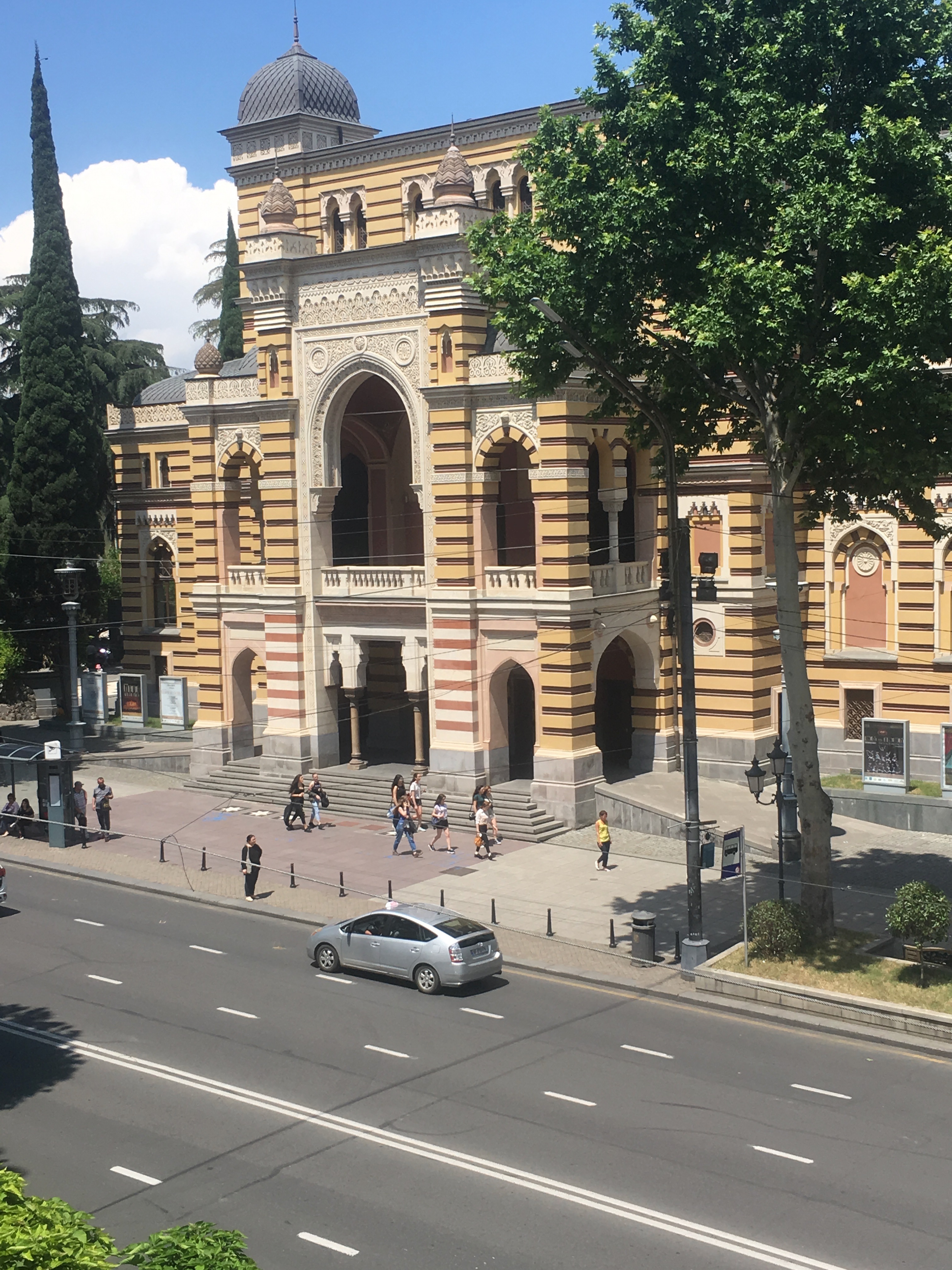
Opposite the Opera house where I was staying, it was only a IMG_1732short walk past the parliament buildings and down to Liberty Sq. and from there to the old town where crumbling buildings and shaky balconies edged fashionable pedestrian areas and parks.
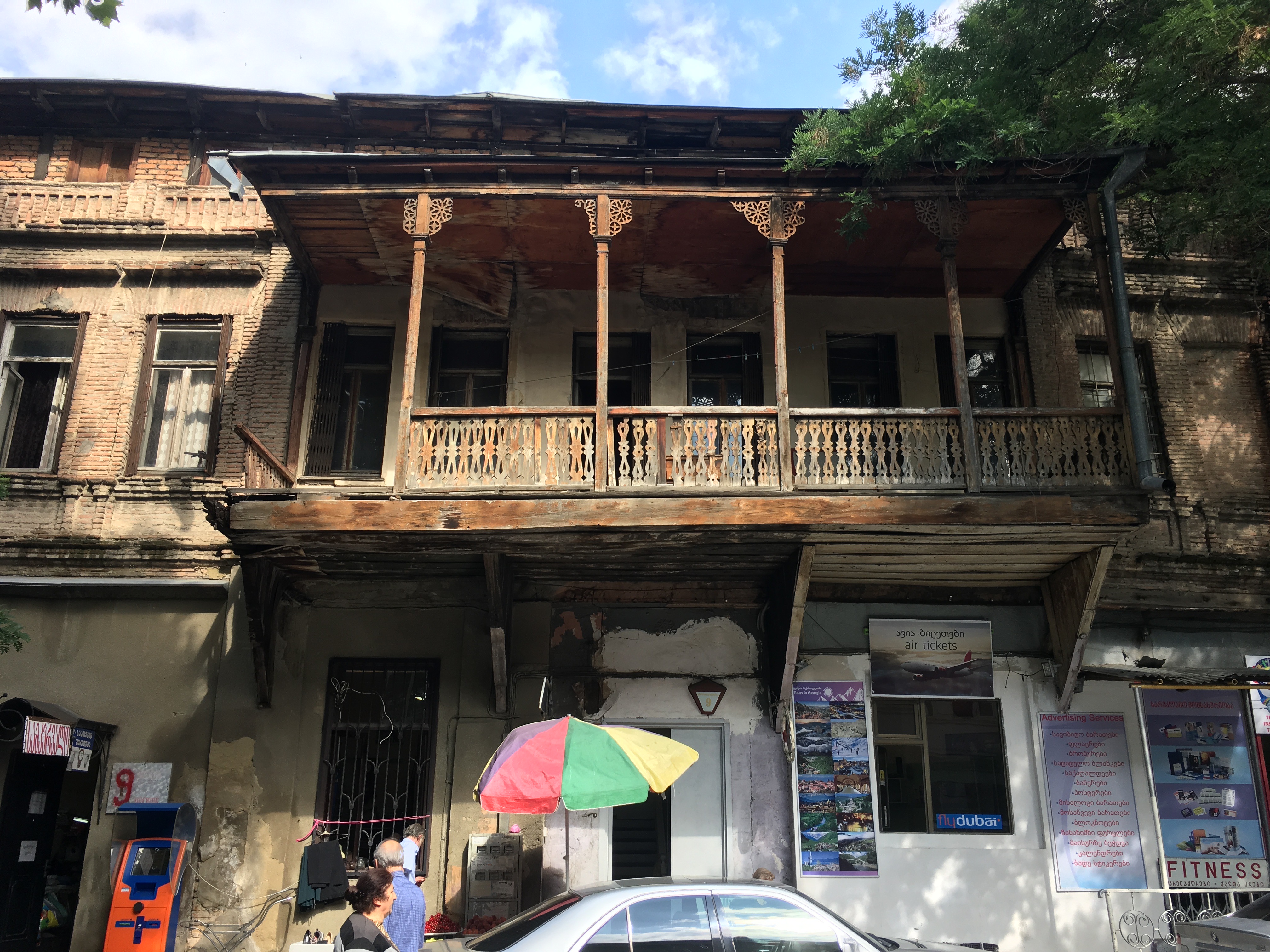
IMG_1752 2Flea markets selling Russian junk crowded the bridge before a maze of small streets leading back up to Liberty Square in which the centre plinth was so high that I couldn’t actually make out what stood on top. IMG_1632

And then, as if this wasn’t enough, there was a cable car connection to the old Persian fortress overlooking the city and the hot spring baths with fashionable wine-bars and restaurants spread out below in inviting pedestrian areas and squares.IMG_1642

Despite having lived in Milan for almost three years, to my shame I never once went to La Scala, one of the most famous opera houses in the world. This time, staying opposite the Tbilisi Opera and Ballet State Theatre House on broad Shota Rustavelli Avenue, all I had to do was take the underpass and the Opera house was right there.

IMG_1769 2I saw the premiere of one of Verdi’s little known (certainly to me anyway) operas – Simon Boccanegra – an opera with a prologue and three acts with one intermission, the brochure informed me. A Google search of the plot baffled me but the splendour, the lighting, the colour, the drama and the music and the voices had me entranced – although the only word I actually heard was ‘Maria’ – and I became an opera lover overnight!
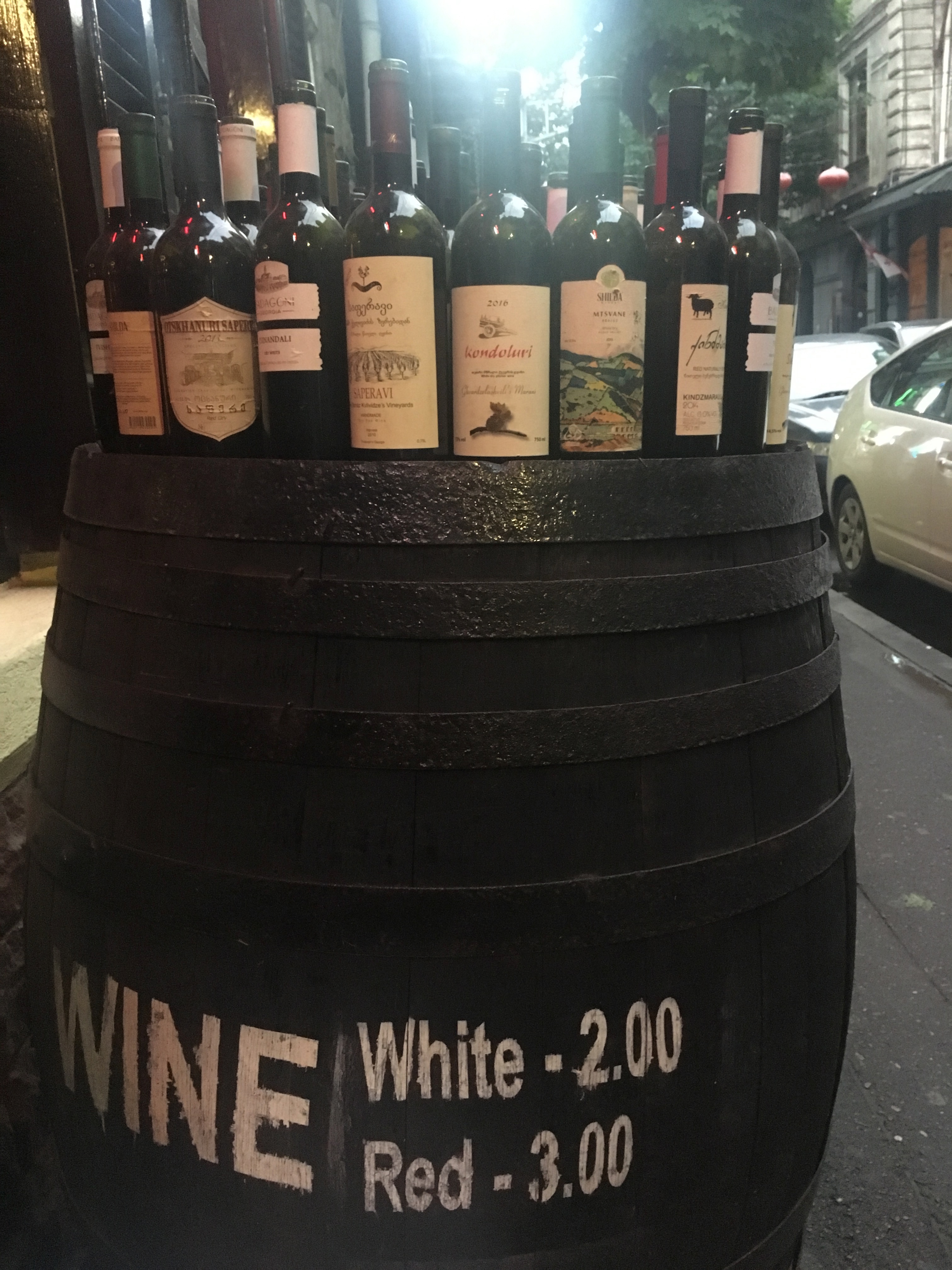
IMG_1619But time to leave the capital and explore the Kaheti wine region, the major wine growing area in the southeast. After all, in this part of the world, Neolithic farmers were making, drinking, enjoying and worshipping vitis vinifera 8,000 years ago so I assumed they knew how to make a decent drop.

And then there was the idea of  hiking in the Sveneti – the mountains region up in the northeast, rubbing shoulders with the breakaway state of Abhazia.IMG_1825

More of that later.


2 Georgian Lari = about $1.15 Australian cents

3 Georgian Lari = about $1.70 Australian cents