

I haven’t had a quiche for literally decades – one of my friend’s girlfriends used to make delicious ones – so on a whim I bought a smoked salmon quiche at a trendy and fashionable market recently. God, it was worse than awful in that it put my wife – who had never had a quiche before – right off the whole idea of the dish, when I suggested making one for the weekend.
I decided to do it from scratch, making my own pastry and only adding cheese and a few shallots to the traditional Quiche Lorraine which is made only with bacon, eggs and cream/crème fraiche.
This was no longer going to be a quiche lorraine in the purist sense because of the cheese and two shallots I found in the cupboard that I wanted to use up. I am neither French nor in Lorraine and as far as I am concerned, national dishes are allowed to develop once they escape from their country of origin.
For those who have no idea of what I am talking about, a quiche is an open-faced pastry pie with eggs, cream and lardons or bacon cubes. Of course there are endless variations with onion and garlic adding a more savoury flavour while added mature cheddar or a gruyère can be called, to keep the French flavour, a quiche au fromage, if you like. Add spinach and it becomes a quiche florentine, chuck in a few tomatoes and it becomes quiche provençale, throw in a handful of mushrooms and it is a quiche aux champignons.
Shocked by the amount of cream used in this recipe – the ultimate in cooking extravaganza? – I must admit it is not something I often use or buy. On the rare occasions when I do, for a luxurious Irish Coffee or some special occasion, I would feel vaguely guilty. But I remember, as a child, we always used to have cream, along with butter and eggs and potatoes and buckets of milk and it was all considered healthy. However, you can, if you like, use milk instead but you will be missing out, I assure you, on the rich succulence that only cream can provide.
 So, to work! I threw the flour, the cubed butter and the egg yolk into my aged food processor and dribbled in four spoonfuls of cold water as the processor grunted and heaved its way through the dough. I bundled out not quite coarse ‘breadcrumbs’ onto a floury board and gave it a bit of a knead before forming it into a rough ball which I wrapped in cling film and put in the fridge to ‘set’ for thirty minutes or so.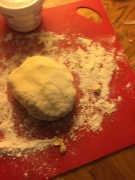
Using a wooden rolling pin, (I immediately thought of Andy Capp’s wife, Florrie, her hair in rollers, behind their front door, tapping a rolling pin 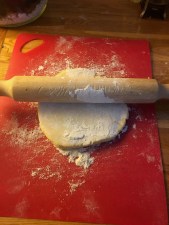 meaningfully into her hand as she waited for her sot of a husband to come home) I rolled the pastry out as thinly as I could before lifting the sheet up carefully and draping it over a round baking tin.
I trimmed the edges of overhanging pastry and squashed a sheet of baking paper down on top of the pastry, filling the entire tin. I didn’t have any baking stones so I used a handful of rice and 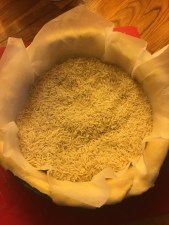 spread that evenly over the baking paper before putting the lot into a 180 degree C oven for about 10 minutes. After that, I removed the paper and rice – didn’t spill any, either! – and put the pastry tin back in the oven for another ten minutes.
 While that was baking, I chopped up two small shallots and tossed them into a pan with a spoonful of oil – I had no more butter, having used it all for the pastry. After the shallots softened a bit, I tossed in the cubed bacon and stirred it around for a while before leaving it for ten minutes or so.
Just in time I remembered to take the pastry tin out of the oven – a lovely golden hue and a slightly darker crust – and left it to cool slightly.
While the bacon and shallots were braising, I broke four eggs into a jug, added the leftover white from the first egg and then spooned in a substantial glop of the crème fraiche, although I actually used some type of cooking cream, and then several generous glugs of fresh cream and a good pinch of freshly ground nutmeg before giving it all a good whisk. By that time, the bacon bits and shallots were ready so I tipped them out onto kitchen paper to drain a bit and grated up two large handfuls of gruyère. Scattering the bacon mixture and the grated cheese into the empty piecrust, I poured my eggy-creamy mixture on top of the lot, filling the piecrust 3/4 full.
 I pulled out the oven rack and gently lowered the nearly filled pie tin down before topping it up with the rest of the creamy egg sauce. That way, I didn’t slop any on the floor while banging the lot into the oven at 180 degrees C.
I took a look at it after about 20 minutes and it looked gorgeous but still runny so I gave it another ten minutes. Even then, it was still soggy in the middle so I put it back for a further 15 minutes, took it out and, third time, it seemed perfection … until I tried to get it out of the baking tin.  Note to self: next time use one of those baking tins where you can push up from beneath the bottom.
Using a spatula and a wooden spoon, I managed to heave it out, almost unbroken, onto a plate and then … what’s the word for ‘heaven’ in French?
Hmmm, what am I going to do with the leftover fresh cream? Maybe … a coffee?
Ingredients (for the pastry)
175g / 6oz plain flour
100g / 4oz cold butter, cubed
1 egg yolk
4 spoons of cold water
Ingredients (for the filling)
150g bacon bits (or lardons if you can get them from a deli)
2 small red shallots, chopped finely,
50g / 2oz Gruyère
200ml / 7 fl oz cream
200 ml crème fraiche or cooking cream
4 full eggs plus the white left over from the yolk used in the pastry
Pinch of ground nutmeg.
 Almost without my noticing it, the chilli plant in the outdoor bed was suddenly flooded with brilliant red, small Birdseye chillies. I had no real idea of how hot they might be as they got watered whenever the others – sage, basil, rosemary, marjoram and parsley – got a soaking. Too much water reduces the chilli heat, while too little kills the other, thirstier, plants. The
 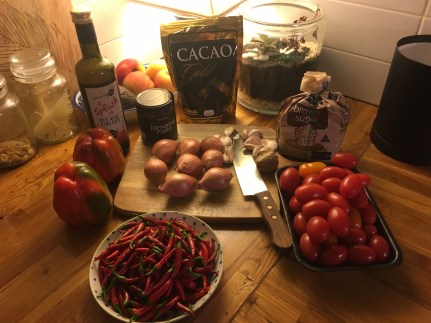 Rooting around in the cupboards and fridge, I came up with garlic, shallots, and ginger, fish sauce, vinegar, cherry tomatoes, and even a few capsicums and a smallish knob of ginger. There was also a half empty jar of roasted peppers and the only thing I had to buy was a jar of Tamarind paste.
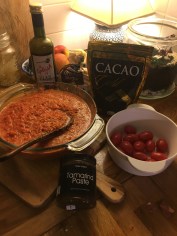


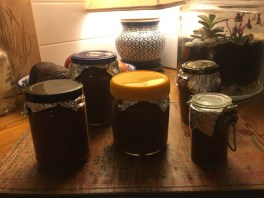 The next morning I lightly toasted some sourdough bread and then slathered on my new jam and the first bite … the sensation is instantaneous – my mouth floods with flavour, no part is untouched. A sourness – the tamarind, the vinegar? – along with the sweetness and the mellowness of the capsicum and cherry toms overlay the pleasing heat of an enjoyable burn, much like a aged Scotch, rolling around the mouth and between the teeth and over the roof, before extending its pleasurable warmth down the throat while the whole sensations lengthens and extends, the lips glowing in appreciation.
 I decided to cook the veg separately. But, as an alternative to frying the eggplant, which would soak up a huge amount of oil, I decided to toss the diced eggplant in a little oil in a plastic bag and then spread it in a single layer under a very hot grill to brown, before tipping the lot into a large bowl.
 I heated a generous splash of oil in a heavy-duty casserole dish over a low heat and lightly fried the chopped garlic along with a generous sprig of rosemary. I scooped out 2/3 of the garlic and discarded the rosemary before adding the zucchini and sautéing until tender, then added it to another bowl.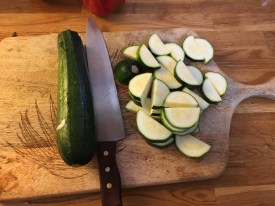
 combined all the cooked vegetables into a large pot and added the seeded and chopped tomatoes along with a tin of toms which I whizzed in the blender before simmering the lot gently for about 1½ hours. Remove from the heat, taste for seasoning and stir in the chopped basil. I also used dried thyme and marjoram as I had forgotten to pick up some fresh stuff.
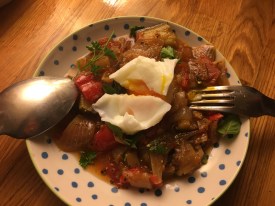 Serve with a soft-boiled poached egg, so the yolk can anoint the delicious vegetables.
 Someone, I don’t remember who, once told me that duck can have an unpleasant back flavour if not cleaned and prepared properly and the best way to prevent this is to rub the bird all over, inside and out, with grated ginger before giving it a good wash, so that is what I did, leaving it smothered in grated ginger root over night because I didn’t have time to deal with it then.
 I drained the duck pieces on kitchen paper and then poured off most of the oil into an old tin can and then peeled and julienned a decent size lump of ginger and stir-fried that in the remaining hot oil until fragrant.
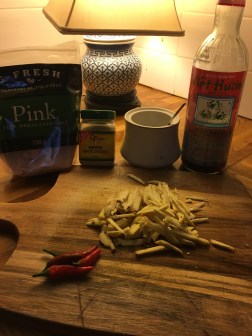 of boiling water with the fish sauce and sugar along with the ground white pepper. I chucked in a few small red chilies from a plant in the garden, not knowing how hot they might be so I only used about 4 small whole ones, seeds and all.
 I took the lid off and continued to simmer for another 30 minutes or so until the sauce reduces.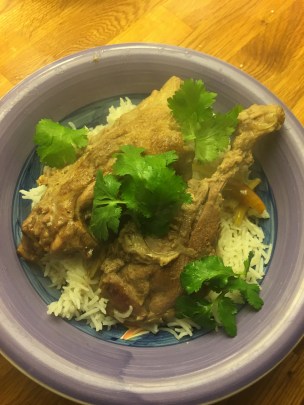
 Lobio is, at its most basic, just a thick stew of mashed beans with some or all or the following ingredients – fresh coriander, walnuts, garlic, onions,pomegranate molasses, fresh parsley or celery leaves, mint, chilli flakes, roasted whole coriander seeds, but it can be upgraded with bacon, beef, cheese etc. Here’s my take on the basic – feel free to add extras as you wish, but a word of caution, without any of the extras, it is still a deeply satisfying dish


 Drain but keep back some of the liquid and use the back of a wooden spoon, or a potato masher, to mash the beans on the side of the pot. Remember to remove the bay leaves.
 Fry the chopped onion until golden and add to bean mix. Heat and thoroughly stir in reserved cooking liquid from the beans for desired consistency. Garnish with a few leftover parsley or corainder leaves, or whatever you have!

 Stir and mix everything thoroughly and then add the red lentils. (I also used a few yellow split peas leftover from something else, probably less than a quarter of a mug’s worth), before adding about 6 mugs of boiling water or vegetable broth – I used a vegetable stock cube.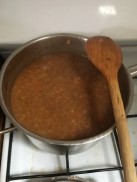

 I bought a cheap bottle of French brandy – bottled in France, VSOP and so on but still cheap as chips compared to the heavy hitters like Martell, or Remy Martin or Hennessey, but never mind, I’m just going to chuck it in with the livers.
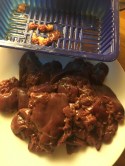 although when dealing with a handful of chicken livers, there’s not a lot to be said there. Not like a calf or a pig liver, which is a bit more of a substantial handful.
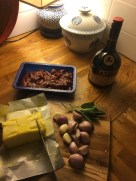 Anyway, next, chop the shallots and garlic finely. I used three large shallots which, when peeled, became about 8 or 9 cloves as well as three large cloves of garlic. In the end, I threw them all, along with half of the sage leaves into a food processor and whizzed them for less than thirty seconds.
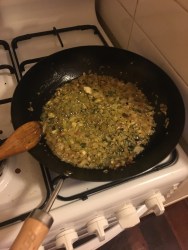 Shake the pan and give it a stir if you want and flip the livers over after two minutes or so. I added two full measures of the brandy then and let the liver
  simmer for a minute or two. I fished out a large one and cut it in two to check the interior pinkness.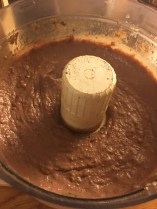

 The sieve became quite heavy and when I turned it over, all of the finely sieved paté was stuck to the underside of the sieve. I scraped it off with a palette knife and dumped into two ramekins I had ready. It looked gorgeous – a rich chocolaty colour and a smooth, silky finish.

 usually on offer in the same low-grade style cafe – sometimes the only thing available in villages along the route of my walk – so I congratulated myself when, after a fairly gruelling walk of 30k plus, I arrived in Postojna in south-western Slovenia and looked forward to a good meal.


 They should still be slightly pink inside.

 Wash the octopus by rubbing vigourously with a handful of coarse salt. Rinse well and remove central beak by pushing through from the underside.

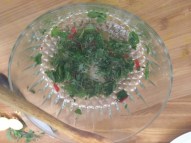 ground black pepper in a large bowl and mix. Add the octopus, chopped red chilli and the roughly torn mint and thyme leaves. Stir to coat the octopus with the dressing and set aside for 1 hour (preferably over night in the fridge) to absorb the flavours. If kept in the fridge, take out 1 hour before serving.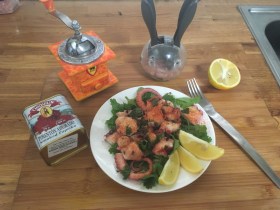
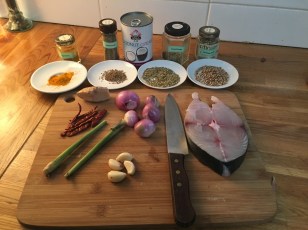
 In most S.E. Asian cooking, the spices are pounded and ground daily so that the sudden thumping of pestles and mortars traditionally done, squatting on the floor, echoes throughout the afternoon in the village.
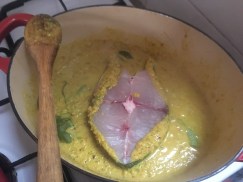 ed, it requires serious over-cooking before it falls apart.
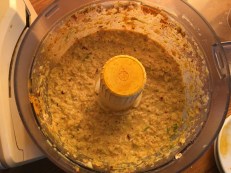 , crush on a cutting board with the back of a large spoon.

 Red Branch Chronicles
You must be logged in to post a comment.