I know, I know, maybe the idea of organ meats doesn’t appeal to everyone but I can assure you that this simple recipe, which can be whipped up in less than 30 minutes, is a complete stunner.
Completely different to calf or lamb liver – delicious in their own way with creamy mashed potatoes, bacon and onions – (which I could get my kids to eat by telling them it was exotoc goanna tongue!) this chicken liver curry is in a class of its own.
I was shown this recipe on 28 February 1991 when I was living in S. E. Asia but amazingly it was not an Asian who introduced me to the rich, velvety texture of this luscious dish but a good friend from Poland! Thanks K. Anyway, here is the recipe I learned more that a quarter of a century – gulp! – ago.
500g chicken livers 2 Tbs oil 1 large onion, chopped
3 tsp ground coriander 1 tsp garam masala 1 tsp sea salt
1/2 tsp ground black pepper
Wash and drain the livers. Cut each in half and discard any yucky bits.
Heat the oil and fry the chopped onions, garlic and ginger until the onion is soft and golden.
Add the ground turmeric, chilli, coriander and cumin and fry, stirring for about 2 minutes.
Add the garam masala, tomato and salt and cook, covered until the tomatoes are pulpy. Mash them with the back of a fork if necessary.
Add the chicken livers, stir well, sprinkle with the black pepper and cook, covered again, for about 15 minutes. Serve with steamed rice or warmed flat bread or deep fried tofu chunks or even baked potatoes. Gorgeous!
Oops – just realisedI have no photos to show even though I cooked this dish tonight, the last day of January. Honestly, it took me less than half an hour and it hadn’t occurred to me to put this on the blog until I had almost finished eating it (with the firm, deep fried tofu chunks I mentioned above!) Sorry – photos next time
I mentioned in a previous post somewhere that I had been looking forward to trying a Peruvian national dish, cuy al horno – roast guinea pig – but overall, I’d have to say I prefer the dish more commonly eaten down on the coast – ceviche. Chunks of white fish in a spicy lime marinade – tiger’s milk – served with an variety of corn kernels and chopped veg. Absolutely gorgeous and so perfect for a hot summer’s day.
Here’s my take on it. For this particular serving, this is exactly what I used: 320g of firm white grouper fillet, two tomatoes, 1/2 a red, 1/2 green capsicum, one small Lebanese cucumber and 1/4 of a red onion, three limes and one lemon with 1/4 teaspoon of coarse sea salt crystals and one chopped red chili, corn chips and popcorn
The basic ingredients, which remained the same as far down as Santiago in Chile, are:
Any firm, white fish with ½ cup of lime juice for each 500g or pound of fish.
Red onion, chopped and as much seeded capsicum (any colour), toms, red onion and cucumber as you like, lime juice, salt and a red chili, coriander or mint or both, corn chips or popcorn and sliced avocados.
Check the fillet for skin, bones and the dark red bloodline, if any. Depending on thickness, cut the fish into large, even chunks or slice into thin pieces and put into a glass or ceramic dish along with enough lime juice, (approx. 1/2 cup per 500g fish), sea salt and finely chopped chilies to completely cover. Set aside and chill.
I put the chopped veg in a separate dish, sprinkled with olive oil and a dash of freshly ground pepper. I didn’t want to put the veg and fish in the same dish so as the veg can keep their colour and not blanch in the lime marinade.
When the fish becomes translucent, whiter in color and opaque, drain off the marinade and mix the fish gently with the chopped veg.
I gave the fish about 90 minutes and then straining it and reserving the marinade. A thick chunk of fish was cooked through to the consistency of medium rare meat. If you like it more well done, give it up to four hours in the lime marinade.
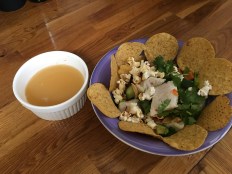
I spooned some of the veg mixture into a bowl, ladled a scoop of the drained fish on top, and sprinkled with chopped coriander and popcorn, with corn chips around the dish. I forgot the avocado!
I suppose some might be put off by the amount of limejuice – too acidic, I can hear people say. However, limes and lemons while acidic of course, somehow become alkaline when consumed and besides use only as much of the strained marinade – tiger milk – as you feel comfortable with.
Welcome to Tastes – a fairly eclectic and very personalised collections of culinary bits and pieces. I will include recipes – Irish cuisine initially but I will probably widen the scope and include dishes, snacks and main meals that I have enjoyed world-wide. Other times, it might be snippets of information about culinary oddities, explanations, queries and so on.
First off the rank, as I say, is traditional, Irish Mince pies that were always served to visitors and family in my childhood Dublin. I found an old, ratty cookery book belonging to my mother stuffed into the back of the kitchen cupboard here in Perth. I have no idea how old the book is, the cover and half a dozen pages are missing but it was a promotional booklet issued by Unilever, some type of multi national that, along with a myriad of other products also made margarine and every recipe in the booklet, under headings like Rock Cakes, Sandwich Cakes and Sponges, Icings and Fillings, Pastry, Fish, Meat & Poultry, Batters and Hot Puddings, includes a healthy dose of margarine.
In an age when cholesterol levels were an unknown factor and the emphasis was on taste, coupled, I suppose, with economy, margarine was the king among ingredients!
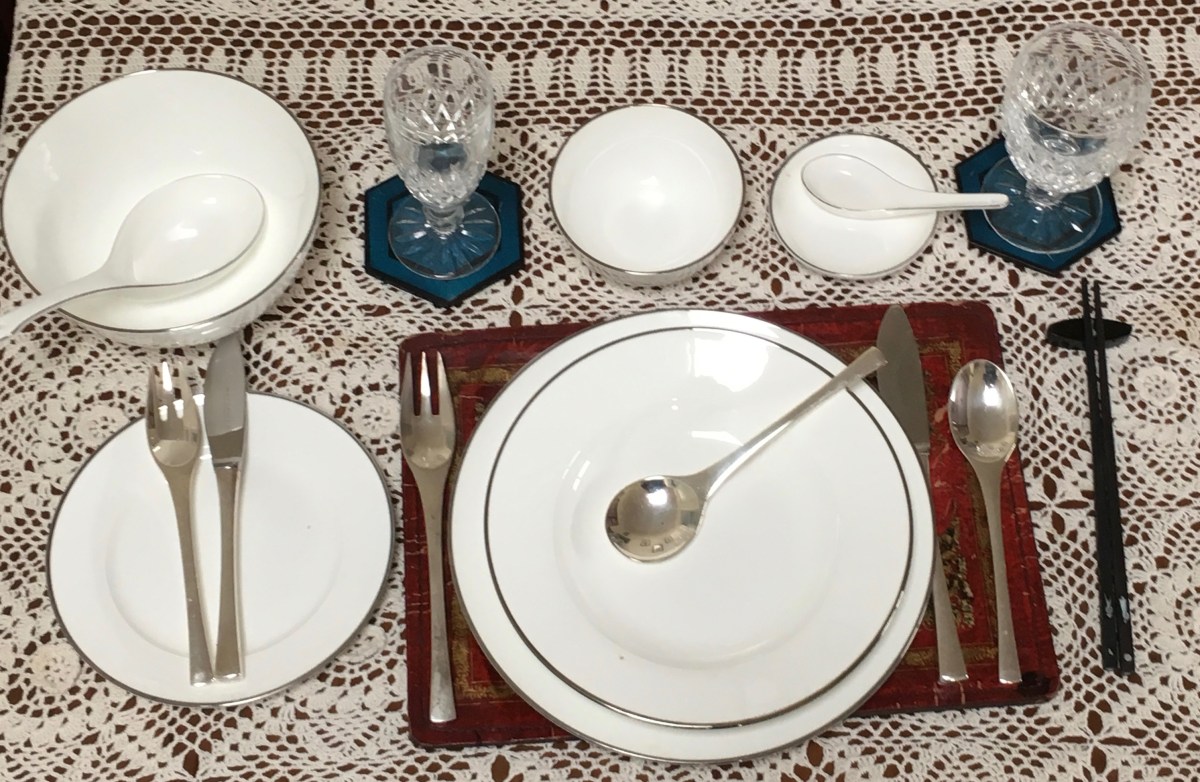
Oh, one last thing, I have a rather pretentious photo of a place setting which I will use as the featured image for Tastes.
I hope you find something you like, or at least can laugh at – i.e. my attempt at very Short crust pastry mince pies.
Christmas is fast approaching and I was mentally grazing in the aisles of the supermarket recently, marvelling at the variety and sizes of the mince pies on offer. As a child, I used to be fascinated by pies using a mincemeat mixture but which had no actual meat in them, filled instead with a mixture of dried fruits and spices called “mincemeat”. Apparently, the ingredients are traceable to the 12 hundreds, when returning European crusaders brought back exotic recipes containing meats, fruits and spices.
The Puritan authorities frowned on the savoury Christmas pie as it was associated with supposed Catholic “idolatry” with the spices such as cinnamon, cloves and nutmeg calling to mind the offerings of the Eastern Magi while the list of 13 ingredients was supposedly representative of Christ and his 12 Apostles. The Quakers were also opposed to those “who distinguish their Feasts by an heretical Sort of Pudding, known by their Names, and inveigh against Christmas Pye, as an Invention of the Scarlet Whore of Babylon, an Hodge-Podge of Superstition, Popery, the Devil and all his Works.” Nevertheless, the tradition of eating Christmas pie in December continued through to the Victorian era with people preparing the fruit and spice filling long before it was required, storing it in jars.
I recently came across something that has been in the back of the kitchen cupboard for ages – an old and tatty and coverless cookery book owned by my mother. Actually, it is more of a promotional booklet for a margarine that was introduced into Ireland in the 1920’s by Unilever. Apparently, Irish women were reluctant to abandon butter and looked askance at margarine – I remember my father not allowing it on the breakfast table, instead preferring to slather an inch of butter on his toast in the mornings. Anyway, it was not until the advent of the Second World War and the subsequent rationing of butter that the brand began to gain some acceptance. After rationing ended on 2 September 1946 the brand, supported by promotional cookery books like the one my mother had, now missing its first six pages, and later TV ads, began to gain wider acceptance.
I remember my mother used to make four dozen mince pies every Christmas, in addition to the rich, dark fruit cake and the even richer and darker plum pudding, all presumably using this particular brand of margarine. Here and there in the margins, scribbled in my mother’s hand, are additional annotations and, in one place, she wrote or butter beside a margarine based recipe. All I can say is … my mother’s baking – her meringues, stuffed with fresh cream and smeared with dark chocolate, her date and walnut slice but especially her mince pies … I could go on but they were all mouth watering. Anyway, here is the original recipe:
Mince Pies
Ingredients – Extra-Short Pastry:
8 oz. plain or self-raising flour (8 heaped tablespoons); A pinch of salt.
5 oz. Stork Table Margarine; 1 rounded dessertspoon of caster sugar, dissolved in 1 tablespoon of water
Filling:
1/2 – 3/4 lb. mincemeat (for homemade recipe, see below); Milk and caster sugar to glaze
Oven – Pre-heated to moderately hot (Gas no 5, 380F), shelf on second runner from top
Method
1 Have ready 8 – 12 ungreased patty tins.
2 Make the extra-short pastry: Sieve the flour and salt into a mixing bowl. Rub in the Stork until the mixture looks like fine breadcrumbs. Mix in the water (with sugar dissolved in it) to form a firm dough.
Soggy “Breadcrumbs”
3 Roll out two-thirds of the dough on a lightly floured board.
4 Cut into rounds with a fluted or plain cutter a little larger than the tins.
Needs a bit of rolling
5 Roll out the remaining dough with the pastry trimmings
6 Cut into rounds with a cutter large enough for the tops.
7 Line the tins with the larger rounds and place 1-heaped teaspoon of mincemeat in each.
Using a glass as a pastry cutter
8 Brush round the edges of the smaller rounds with water. Place on top of the filled pastry rounds and press the edges down gently to seal
9 Make 2 – 3 slits across each pie. Brush the tops with milk and sprinkle with caster sugar.
Getting messier!
10 Bake in the pre-heated oven for 20 – 25 minutes. Serve hot or cold.
The final product – zero points for looks but maximum yums for taste – rich, melt-in-the-mouth-delicious
And there’s my photographich attempt at it. Laugh away, if you want. I didn’t have any pastry cutters so I used two small drinking glasses and I converted all the oz. to grams, that sort of thing and of course I used butter. I hadn’t prepared my mincemeat mixture either so I bought a jar of ready-mixed fruit mince from the local supermarket for reason explained at the end of this post, but absolutely delicious – no prizes for looks however.
Original mincemeat recipe.
1/2 lb. currents; 4 oz. soft brown sugar (4 rounded tablespoons)
1/4 lb. raisins; 1/4 level teaspoon of mixed spice
1/4 lb. sultanas; 1/2 level teaspoon of ground ginger
1/2 lb. apples; 1/2 level teaspoon of nutmeg
1 lemon; 1/2 level teaspoon of ground cinnamon
4 oz. Stork Table margarine; 4 tablespoon od brandy (optional)
1/4 lb. mixed cut peel
Method
1 Have ready a large mixing bowl and two 1-lb. and one 1/2 lb. jam jars.
2 Wash and thoroughly dry the currents, raisins and sultanas. Stone and chop the raisins.
3 Peel, core and chop the apples finely.
4 Wash, dry and finely grate the rind from the lemon. Cut in half and squeeze out the juice.
5 Melt the Stork in a saucepan.
6 Place all the ingredients in the mixing bowl. Mix thoroughly; Cover and leave for 24 hours, for the fruit to swell.
7 Fill the jam jars. Seal and cover as for jam. Leave to mature for at least before using.



 The basic ingredients, which remained the same as far down as Santiago in Chile, are:
 I suppose some might be put off by the amount of limejuice – too acidic, I can hear people say. However, limes and lemons while acidic of course, somehow become alkaline when consumed and besides use only as much of the strained marinade – tiger milk – as you feel comfortable with.


 Red Branch Chronicles
You must be logged in to post a comment.