Lunar New Year of the Dog and Dog Days

Friday 16 February marks the 2018 Lunar New Year of the Dog, heralding spring. However, where I am right now the end of summer is approaching with autumn just down the road. I suppose that the Year of the Dog is related to the Dog Star, Sirius – so named as it appears to follow at the heels of the hunter, Orion. Dog days are also reputed to be the hottest period of the year. IMG_5215
I used to think the 12 Zodiac animals of the Lunar New Year matched with the Western horoscope of the dozen star-signs and I knew what I was in both systems – a snake and a crab respectively. A few years ago, when I lived in Vietnam, I realised that each animal had an aspect attached to it. I felt absurdly smug when I realised I was a water snake, having an affinity with that element, as opposed to, for example, fire, wood, metal or an air snake. And just as the 12 animals of the Zodiac follow each other in set order, so too does each aspect as they cycle through one or other of the five elements: Metal, Wood, Water, Fire, and Earth
MINOLTA DIGITAL CAMERA

It is often referred to as Chinese New Year, which must rankle with non-Chinese people who also observe the Lunar New Year, much like, perhaps, people in South American countries resent citizens of the USA claiming themselves to be American.

Despite having lived in Hong Kong for a full cycle of the Zodiac, I only encountered the frustration and delays as a massive migration of people took place and never really experienced the almost frantic excitement in the build up to the start of the festival that I encountered when I lived in Vietnam.

Tết Nguyên Đán to give it its full name in Vietnamese, like the Christian Easter, is a movable feast, usually falling around the end of January and before the middle of February.

However, with Tet being such an important holiday, it is essential to approach it with suitable reverence and intense preparation. Much like a western Christmas when shops start to gear up for the festive season as soon as Hallowe’en is over, so too do Tet preparations begin in earnest not only in shops and businesses but also in every home in the country. Shops fill up with gaudy decorations, usually some variation of the phrase Chuc Mung Nam Moi, ideally wrought in fine gold on a red velvet background – red and yellow being the principle lucky colours for an auspicious start to the New Year – but of course all variations on that theme, provided the colours are maintained, is acceptable.

The Kitchen God – and every household has one – must be propiated with gifts and offering because it is he, and he alone, who will report back to the Celestial Jade Emperor on the family’s efforts over the previous year and it is the Jade Emperor who will decide the future prosperity of each household.

Once the home has been thoroughly cleaned, paying special attention to the kitchen, then it must be suitable decorated. Red and yellow flowers will predominate although orange marigolds may be included. Yellow forsythia branches must adorn the home while peach and cheery blossom trees are especially popular. Kumquat trees laden with small fruit are also popular, symbolizing fecundity and abundance, something everyone aspires to in the New Year.

The largest, voluntary, world-wide migration of people take place prior to the Lunar New year as millions of Chinese and other Asian people return to their home birthplaces, similar, dare I suggest, to the mass gatherings for the Haj which followers of Islam feel it is incumbent on them to perform at least once in their lifetime.

Part of the excitement in the build-up to Tet, of course is preparing to receive long-absent family members and to scrupulously clean the home before Tet, as once the holiday begins, no cleaning may be done lest one inadvertently sweeps or throw away the good luck one is due on account of the preparations you and your family have made.

Imagine, if you can, having your birthday, Christmas, Easter, Wedding, Anniversary, Valentine’s Day, Buddha’s Birthday, St. Patrick’s day and all other major belief systems’ days of veneration all rolled into one glorious holidays where everything can be devoted to a glorious extravaganza of eating, drinking and gambling. Add to that, of course, the annual rollover of age in that at the beginning of Tet, every single person becomes a year older, so in fact, it is your birthday so what is there not to celebrate?

It’s bit different where I live now – although I am going to a Lunar New Year buffet. Unlike China and Vietnam whereat least 10 work free days is de rigeur, here in Australia it is just another day at the office although the Asian communities here of course plan their celebrations and lion dances, but for the ordinary Aussie, it is no big deal.

So, tomorrow, Friday 16 February is the first day of Tet and is considered the most important as the first visitor to the family home will set the luck for the coming year and is reserved for the nuclear family focused on the paternal side of the family. Children dressed in their new finery, bow to their parents and offer traditional greeting – Sống lâu trăm tuổi (Long life of 100 years) and formally receive a red packet – a small red envelope, decorated with traditional wishes, containing assorted bank notes while friends wish each other Tiền vô như nước (May money flow in like water).

The second day of Tet is then reserved for the maternal side of the family and for respected friends and acquaintances.

Anyway, this is first year of the Earth Dog since the last Earth Dog back in1958. Communicative, serious, and responsible in work, it seems, according to the characteristics assigned to that Zodiac. Hmm … as opposed to an Intelligent, hardworking, and sincere Fire Dog or the conservative, desirable, cautious, and always ready to help Metal Dog or the sincere, reliable, considerate, understanding, and patient Wood Dog or finally the brave and self-centered, even seemingly selfish, well-versed in dealing with financial issues Water Dog! Wow! Hard to choose among them all. Why can’t they all be combined in one?

The Year of Earth Dog also means that we will not see another one until 2078!

Inspired, enthused and curious about the frequency of dog in current English, I present the following words that are badly written or expressed – Doggerel!

If you are bored see if you can match up the dictionary definition with the numbered and italicised phrases in the following. Answers some time later, if anyone is interested. Happy New Lunar Year of the Dog!

 Doggerel

He felt his commanding officer had discarded him as someone worthless 1 and it really ranked. Who did they think they were to treat him like this, giving him menial tasks to do, as if he were a junior in some boring office .2.

He ground out the butt of his cigarette 3. under his heel and replaced his fatigues and military I.D.4. with a soutane and a clerical collar 5 before slipping his knife into a side pocket.

Despite the full heat of the last days of summer 6, he broke into a gentle trot7. This was a chance to redeem himself. Up until recently, his time in the unit had been less than happy, problems and unfair treatment 8. seemed to follow him wherever he went 9.

Worn out 10, he felt his luck had deteriorated 11 and this was just another period of inactivity or decline 12. He took out the small shabby notebook, the corners worn and battered with use 13. and looked at the directions and notes he had been given, knowing full well he had no chance 14. of making her change her mind 15.

A sharp bend 16in the road ahead revealed the villa on the hillside and he knew he would have to emphasize how delighted he was 17 when he met the selfish 18. occupant there if he was to overcome her suspicions.

The old lady was wearing ridiculously smart and ostentatious clothes 19 but it was obvious that her health had deteriorated 20. Her skin was lined and wrinkled, soft and doughy but her eyes remained sharp, as did her long nails. She lay back, weak and exhausted as if from influenza or gastroenteritis 21.

He’d be disgraced and more than probably dropped from favour 22. if he didn’t complete this mission. This was the last and least pleasing part 23. of something he had to do but it was necessary if he was to regain favour.

Distracting her with some debased form of Latin he vaguely remembered from his school days, he slipped the knife from his pocket in a fluid, easy motion and …

A. Dog days ^ K. dog-in-the-manger
B, in the doghouse L. dog leg
C. dogsbody M. dog’s life
D. dog end ^ N. dressed up like the dog’s dinner
E. dog eared O. gone to the dogs
F. dog tired P. like a dog with two tails
G. dog trot Q. a dog’s chance
H. dog tags R. throw to the dogs
I. dog collar S. teach an old dog new tricks
J. dog’s disease T. Dog Latin

^ Two distinct meanings!

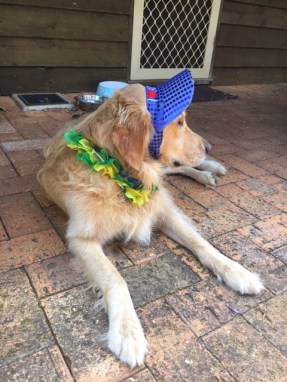
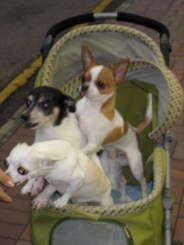
OH! Almost forgot – It’s a dog’s life can refer to a life of ease and luxury as in these pampered muttsIMG_2204
IMG_2211

IMG_2210

Words

I think that I have a good to excellent vocabulary; I read a lot, I write a bit, I had a good education and I tend not to need a dictionary – I don’t believe that I actually have a paper dictionary here in the house. When, on the rare occasions, I do come across an unfamiliar word – one that I might be hard pressed to give an accurate dictionary-style definition – it doesn’t matter because I can understand the general meaning from the context. For the vast majority of books and articles that I read, I would say I have a total understanding of every word used in my own native language.

So, imagine my chagrin when I recently reread a novel I had read some 25 years ago (hint: referred to recently on this blog) and was dismayed to come across a plethora of words, some of which, luckily, stirred a vague memory in my word-hoard. Nevertheless IMG_1324many of them forced me to stop, and go to my online Oxford Dictionary of English and check to see if my understanding tallied with the author’s use and, embarrassingly, to actually look up new words that appeared almost on every page – it was like reading in a foreign language.

I remember – I think – reading somewhere that Anthony Burgess (The Malaysian Trilogy; A Clockwork Orange; Earthly Powers, etc.) imageskept a dictionary on the shelf in his toilet and tore out a page each day after having committed it to memory!
I am not going to go that far, of course and, besides, I don’t have a paper dictionary, remember?

Wasn’t it Humpty Dumpty who said (rather crossly, as far as I can remember) that words mean what you want them to mean, so here is a sample of words that I came across – hats off to anyone who can understand these, lifted, as they are, from context – but all from the same novel published in 1989 – shortlisted for the Booker Prize too!

abulia

glair

kern

^ jorum *

^ villious

^ ataraxy

echolalia

spruik

kickshaw

flitch *

cully

bumper *

epicene

finical

losel

mephitic

In all honesty, I can’t remember what half of them mean now – and I only finished reading the novel yesterday, too.   Luckily my online OED keeps track of recently looked up words so there you have it.  Nevertheless, it’s humbling to think that the English language is so vast and complex that there will always be new words to come across and not just the recently added ones as in “Milkshake Duck” which was recently acclaimed as the Word of the Year here in Australia.  Go figure it out yourself.

* Words I have a memory my father used to use but I still had to check to ensure the author’s use tallied with my understanding of my father’s usage all those years ago.

^ Words which the inbuilt dictionary on my iMac does not recognise.

The Sea

I first read John Banville’s extraordinary tale, The Book of Evidence, based on a real-life murderer staying as a guest at the Irish Attorney General’s residence while on the run,

OLYMPUS DIGITAL CAMERA

back in the late eighties. Banville’s insightful recount of the “grotesque, unbelievable, bizarre and unprecedented*” set of circumstances which arose in Dublin in the early eighties was fascinating.

Funny how things change, along with latitudes, and Banville, like other authors I read back then, became forgotten, discarded and in competition with an increasing variety of TV shows, movies and the advent of video recorders and that was before VCD or DVD and Blue Ray!

Anyway, jump forward to now.

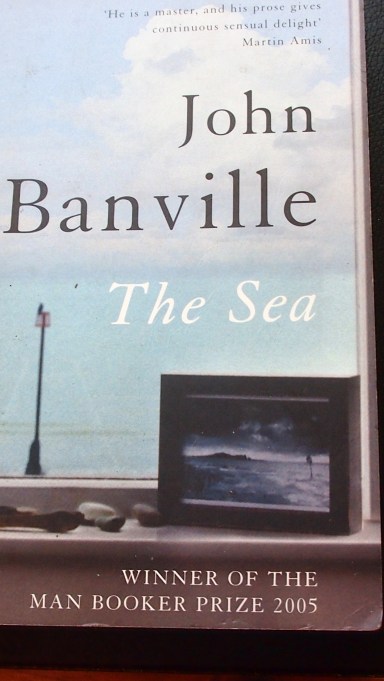
The Sea by John Banville caught my eye recently. Seen through the haunted eyes of the narrator, Max, an art historian, who returns to the seaside village where so many disturbing events one childhood summer took place.

Bereft of his recently deceased wife, Anna, Max seeks to come to terms both with his bereavement and the events that have haunted him since that summer so many years ago.

The early mention of the strange tide at the seaside village and Max’s odd assertion that he would not swim again combined with the novel’s bleached out seascape cover hooked me. My childhood summers too were spent down at the seaside so the title resonated with me too!

OLYMPUS DIGITAL CAMERA

Anyway, Max switches, ably assisted by booze, from recent episodic memories of the surgeon’s almost unseemly haste in washing his hands of the death of his wife, Anna (“At that, as if released Mr. Todd gave his knees a quick smack with two flat palms and jumped to his feet and fairly bustled us to the door”) to other, less well understood images from a traumatic childhood summer when the insouciant and feckless Grace family arrived for the summer holidays at the small seaside village.

The first thing I saw of them was their motor car parked on the gravel inside the gate. It was a low-slung, scarred and battered model with beige leather seats and a big spoked polished wood steering wheel … on the shelf under the sportily raked back window … was a touring map of France, much used. …the girl’s voice coming down from on high, the running footsteps and the man here below with the blue eyes giving me that wink, jaunty, intimate and faintly satanic.”

Mingled with scenes from his current stay at the Cedars – the cottage where he has retreated since his wife’s death.

“There goes the Colonel, creeping back to his room That was a long session in the lav. Strangury, nice word. Mine is the one bedroom in the house which is, as Miss Vavasour puts it with a demure little moue, en suite.”

Staying now at the same guesthouse which the wealthy Graces had rented that summer, Max drifts in and out of the past and present, interspersing his memories of the twins, the withdrawn Milo and the petulant Chloe, their lush mother, Connie Grace, jovial Carlo her husband and the outsider Rose, with the newly discovered trivia of his life at Miss Vavasour’s guesthouse where he is the only other guest along with the Colonel.

“Miss Vavasour is downstairs playing the piano. She maintains a delicate touch on the keys, trying not to be heard. She worries that she will disturb me, engaged as I am up here in my immense and unimaginably important labours.”

Unfamiliar with their world, Max attributed godlike stature to the Grace family but it was with the voluptuous Mrs. Grace that attracted the young Max.

“Was that a complicit smile? With a heaving sigh, she turned and lay down supine on the bank with her head leaning back on the grass and flexed one leg so that suddenly I was allowed to see under her skirt along the inner side of her thigh all the way up to the hollow of her lap and the plump mound there sheathed in tensed white cotton.”

Slowly, the three threads of Max’s memories coalesce and mysteries, cunningly concealed throughout the novel, are revealed and minor characters assume major proportions while the erstwhile understandings are now shown to have been misunderstandings.

Gracefully the strands, of seemingly unconnected events from the triad of introspective settings that Max relives, are woven into a stunning denouement whereby all is made clear from what had been only partially hinted at and mistakenly understood before.

Fantastic, a great read.


*          Attributed to Dr. Conor Cruise O’Brien with reference to Charlie Haughey’s government during that period.

NoseDive

(Not a graceful curve or elliptical)

I don’t know why, but ever since I returned from Europe in August 2017, I seem to have hit a dry patch with regard to my writing and this blog thingy. I have been able to write neither bucolic accounts of my European Peace Walk, nor do research for my Red Branch Chronicles.

That’s not to say that I’ve been lazy – far from it. I seem to have been busy all day and everyday, just doing things that need doing and that won’t get done by themselves. There is always something “new” that has to be done in everyday, general living which has completely blotted out my creative world or perhaps, then again, I have voluntarily chosen to neglect it.

Despite the scribbled contents of a grubby, wine-stained notebook that I dragged along on the EPW and my eclectic, albeit desultory, readings in the Celtic area and era, over the last few months, nothing has sparked my interests. In truth, it may well be the other way around. I have this vague reluctance to commit myself to write about Celtic Iron Age, cropped-img_0322_edited1.jpg

Travel,  OLYMPUS DIGITAL CAMERA

Food,  img_0046

Books cropped-bookcase.jpg

and those sorts of things on my blog so I have done absolutely nothing. Saying that nothing resonated with what I felt able to write allowed me to stagnate. I’ve barely sat down in front of the computer, let alone attempted to write something about my forays into Christmas cooking so, as Ian Dury intones, I have most certainly not been “a pencil squeezer”!

However, today was different. My kitchen clock, permanently stopped at 8:42, since before I went to Europe and the September calendar on the back of the door, were all physical manifestations, I was told, of my sloth, stagnation and inactivity. Half-heartedly defending myself from those (acknowledged) charges, I pointed out the clock is always right twice a day and who needs a paper calendar anyway, when we are all tooled up with smart wearable gadgets? Nevertheless, I put up a new calendar on the back of the kitchen door and threw the recalcitrant clock into the bin (no more K-Mart clocks for me, thank you very much), resolving to buy a proper clock as soon as possible.

Seems such an easy feng shui fix, doesn’t it – buy a new clock and put up a 2018 calendar? I’m sure there is more to it than that but let’s see. I suppose the proof will be in the pudding. How much will I have written by the end of this month (January), season (Summer) or year (2018)? Well, there’s a nice attempt at temporising if ever I saw one! I started out writing about a nosedive but I may be able to convert that downward plunge into a Bigglesian loop de loop. https://en.wikipedia.org/wiki/Biggles


The Argument

When I first started this blog – God, more than a year ago, some time in 2015 I think – the original idea was to promote my book, Raiding Cooley which I published as an E-book back then.  I confidently expected to start on my next masterpiece almost immediately.  Raiding Cooley CoverSee how wrong I can be!  Anyway, this blog thingy morphed into different paths, some, or all, of which I hope to continue pursuing. However, the consequent result was that I never got around to doing any new creative writing – i.e. another blockbuster!  Ideas did float around in my head, sequels and prequels and so on but it was always too easy to find a reason to do something else.  I suppose a story depends upon a character and the plot natuarlly evolves from what the character does and what happens to the character. So, here is my initial draft of God knows what – an initial character.  Comments, suggestions, ideas, complaints … anything?  Anyone?

An Introductory Paragraph

406 A.D. Roman rule is collapsing in Britannia as the legions are recalled to continental Europe. Barbarian tribes assail the Empire from all sides. Maewyn, scion of proud Brythonic stock long accustomed to Roman rule, refuses to assume his father’s role as Decurion, the “exactor” of taxes from the local Brythonic people.The scene takes place in a Roman style villa in the far western Brythonic province of Britannia.

The Argument

‘You know what your father needs’ Conchessa paused until her son looked up at her. ‘You do, don’t you?’ she insisted, adjusting her toga.

‘I told you before. I am not going to collect the taxes. I don’t care about being Decurion, do you not hear me? I refuse to do Rome’s dirty work.’

Contemptuous of both his parents’ Roman status and their newly adopted Christian piety, Maewyn glared at his mother opposite the atrium fountain.

‘Your father will explain everything later to you,’ Conchessa continued quietly.

‘There is nothing to explain.’ Maewyn snapped. ‘Do I have to tell him how things are here, in this far-western province of a crumbling Empire?’

”Don’t talk like that to your father. If Calpurnius becomes a deacon in the State religion, his property and responsibilities are passed on, in their entirety to you, his son.’

*

Maewyn pulled the copper goblet towards him, cradling it in his pale hands and smelling it, before looking up at his father.

‘Don’t you understand?’ Calpurnius demanded. ”The legate is insisting taxes must be collected as usual. Do you think I want to give up all of this?’

He gestured at the tilled fields stretching from the walls around the villa down the hillside, bounded by the blue line of the sea below them.

‘The legate! All the Belgae and Germania auxiliaries in Seguntium are being recalled, even now.’ Scornfully, Maewyn pushed the goblet away. ‘Roman power is collapsing along our coast, and everywhere else.”

‘Listen to your father.’ Conchessa pleaded. ‘Is there anything that you ever wanted that has not been provided for? Ask yourself, where does our wealth come from?’

‘I don’t care where it comes from. You want it, not me. And besides,’ Maewyn spat scornfully, ‘Barbarian raids are increasing. Soon there will be no-one to tax and nobody to give it to, despite your new religion.’

‘Don’t talk to me like that, you ungrateful whelp” Calpurnius shouted, his face purpling with rage. ‘We are Roman citizens and we have a responsibility to our position as Decurion and to Emperor Honorius.’

‘I thought we were proud Ordovices, the last tribe in Britannia Prima to have withstood the might of the Romans?’ he demanded of his father. Standing up abruptly, his stomach roiling in fear at his defiance, he pushed his stool back so that it crashed on the mosaic floor.

Walking through Celtic Heartlands

I have been guilty of ethnocentricity in my collection of posts about Celtic Iron Age Technology in that I related them solely to the culture and lifestyle associated with Ireland from roughly 300 BCE to the arrival of Christianity some 730 years later. Of course, no one in Ireland during that time would have considered themselves Celts – or Irish – for that matter, but Celtic is what they were.

IMG_0790

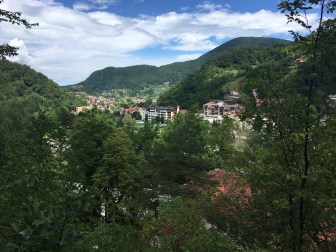
This year, travelling through France, Switzerland, Austria, Slovakia, Croatia and Slovenia I realised that I was in the very heartlands of the people known by the Romans as Galli or Galatae and as Keltoi by the Greeks, but what they called themselves is conjecture.  Prehistoric Bronze Age peoples, loosely linked by a common heritage, style, languages, customs and art, from the central and east central plains of Europe coalesced around 750 BCE, with the discovery and use of iron to become the most powerful people in Europe from about 450 BCE – 250 BCE.


Initially a nomadic, pastoral people who favoured the cow and the horse above all other, they adopted agriculture and settled down around La Tène in modern day Switzerland and around the Lake Neuchatel in modern Austria.IMG_0781

Archaeologists labelled certain cultures within the Late Bronze Age over view. The culture known as Urnfield, where the dead were cremated in pots, is considered ‘proto’ Celts followed by the Hallstatt – after a huge site in Austria – in 1200 BCE.

From 450 BCE, Celtic culture was marked by La Tène – after a lakeside site in Switzerland. There, a large quantity of material goods was found. With their discovery of iron, both in agricultural – better ploughshares – and in war – spears and swords – the Celts flooded new areas, urged on by increasing population and the need for more farmland.IMG_0732

Spread out from their base in North East Europe, inevitably they came into contact, and met resistance, from the expanding Roman Empire. Pushed back north and west into Gaul, modern-day France, the Celts were hemmed in by Scandinavian tribes moving south themselves as Slavic tribes pushed in from the east.

Under pressure on all sides, the Celts retreated to Britain and Ireland before even those in Britain were pushed to the extremes of Scotland, Wales and Cornwall by the arrival of the Saxons and other Germanic and Scandinavian tribes with the last remnants of true Celtic culture ensconced in Ireland until the arrival of Christianity circa 400 A.D.

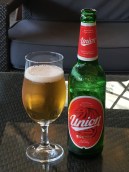
So goes the myth anyway, I suppose, but at the same time, I felt comfortable and at ease walking through these heartlands. Perhaps it was the beer!

IMG_0857IMG_0792IMG_0584IMG_0606

Piquant Liver

One of the things I looked forward to most during my European Peace Walk through Austria, Hungary, Slovenia, Croatia and Italy was exploring local cuisine, delighting at the newly discovered variety and novelty. The obverse of course is also, unfortunately, true. Ill-prepared, bland tourist fodder or the ubiquitous pizza or kebab,IMG_0866 usually on offer in the same low-grade style cafe – sometimes the only thing available in villages along the route of my walk – so I congratulated myself when, after a fairly gruelling walk of 30k plus, I arrived in Postojna in south-western Slovenia and looked forward to a good meal.

A lusty male choir in the chilly town square made sitting on the outdoor terrace of Hotel Kras unattractive and there were no seats in the bustling, brightly lit restaurant inside, but the waitress recommended another restaurant a few hundred metres away but, when I arrived, it was another pizza restaurant and it was closed.

Hunger began to make the prospect of a kebab seem feasible especially as a light rain started. A policeman mentioned a restaurant in the “red house” on the far side of the square but that too seemed to be closed as there were no lights on. Despairing, I walked around to the car park at the back and there was a lighted staircase leading to a basement restaurant, bright, warm and cheery inside.

There was an English menu and the chef’s specialty was braised liver in red wine. No hesitation here, a bottle of red wine – the waiter’s recommendation – and a starter of stuffed wild mushrooms in a nutty sauce and a delicious, rich dish of tender liver slivers, still pink inside.

I have distinct – and delicious – childhood memories of liver with creamed spuds and baked beans but since then I seem to have skipped over offal themed meals, although there was that fantastic liver, bacon and onion dish in the Serasa Yacht Club but that was in another lifetime and a different century! Anyway, inspired by my Slovenian meal, here is my take on liver, for what it is worth.

Ingredients

200 g lamb liver                            1 onion, cut in ringsIMG_0984

3/4 tsp whole black pepper

1/2 tsp mustard powder

1/2 tsp flour

10g butter

1 tsp oil

good splash of medium dry sherry

splash of Worcestershire sauce

1 Tblsp lemon juice

salt

Method

1.Crush the peppercorns and mix with the flour and mustard powder.IMG_0990

2. Heat oil and fry the onion rings for about 10 minutes until brown at the edges. Remove from heat.IMG_0991

Some recommend steeping the liver in milk before flash frying.  I tried both steeping and non-steeping with no appreciable difference.

3. Quickly fry the liver, sliced finger thick. When spots of blood begins to appear, flip them over. IMG_0993They should still be slightly pink inside.
4. Add to the onion.

5. Stir the flour, pepper, and mustard into pan. Soak up all the juices and then add sherry, followed by the Worcestershire and the lemon juice. Thin with more sherry, if necessary.

6. Season with salt and pepper. Pour over liver and onion. Serve with creamed spuds.

Sadly, plating a dish was never my forté but trust me, it tastes better than my photos look!IMG_1002


Lamentation

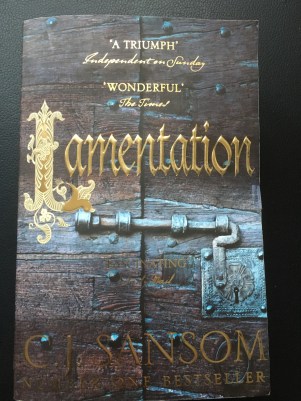
I have just finished Lamentation, the sixth novel by C. J. Sansom in the Shardlake* series, a massive 700 page historical mystery and detective story centred on the last year of the reign of the Tudor monarch, Henry VIII from the summer of 1546 until his death in January 1547.

The humanitarian and caring Matthew Shardlake, lawyer at Lincoln’s Inn, is once again, unwilling, involved in the murders and religious mayhem that ran rife during Henry’s reign.

The novel begins with the ghastly account of the burning at the stake of Anne Askew, and three other unfortunates in Smithfield, accused of heresy, a charge which Shardlake himself will face later on in the novel, recalling the last time the hunchback lawyer was dragged to the Tower of London for a tortuous questioning.

IMG_0997Without giving too much away, as Henry VIII vacillates between reform and traditionalist religion during the last months of his life, his court is divided between the Catholic and Protestant councillors vying to control Henry’s successor, the eight-year old Prince Edward. Henry’s last wife, the reformist Catherine Parr, formerly Catherine Latimer and the unrequited love interest of the solitary and melancholic sergeant -at-law, enlists his aid as she desperately fends off attacks from within the court and from mysterious and powerful influences in the world outside Whitehall.

As with the previous five Shardlake novels, the multiple plots concern a legal case unconnected with the hunchback lawyer’s involvement with the Tudor courts, something he had previously sworn to avoid. The inevitable conflicts, brought about by intimidation and violence, confirm the determination and bravery of Shardlake, showcasing his conscience and the inevitable consequences in a world of religious and political turmoil.

As always, London itself plays an atmospheric role as Shardlake trudges the dusty and pungent streets and alleyways of the medieval city in his quest to aid the endangered queen and to solve the litigations case between two quarrelling siblings with which he has become embroiled. The authentic background, the rich characterisation, and the wonderful weaving together of plot and historical reality combined with the final, real-politic twist make Lamentation the apotheosis of this sextet of fantastic novels.

Excitingly, C.J. Sansom hints, in the very last pages of the novel, that Shardlake may continue to see further service, but this time, in the service of the future Queen, Elizabeth I. Like many others, no doubt, I hold my breath in anticipation and look forward to a continuing Shardlake saga.

  • See my earlier blog about the first five Shardlake novels in the series

Floating

I watched a Christopher Nolan* movie recently on the long flight home – holy-moly, who understands or follows any of his plots on first viewing as they weave in and out, forward and back in undefined flash-forwards and backs? – and one of the main characters ejected from a doomed space station in a streamlined, white pod that zoomed through the atmosphere before plunging into the ocean.

IMG_0956I didn’t actually plunge but tentatively tried “a float’ in a space-aged pod to recover from my walk in Europe. Sleek and gently oval in shape, the pod is loaded with 500Kg of Epsom salts and the water gently heated to body temperature, allowing you to float and relax while the magnesium salts permeate the skin and relax tired muscles.

Remarkable therapeutic benefits, relieving stress, pain, fatigue, arthritis and fibromyalgia, are just some of the benefits claimed for the float and I was keen to try. Who wouldn’t? Described by some as otherworldly, a pure, blissful experience accompanied by deep feelings of lightens and grace.

Anyway, I turned up for this new adventure and there it was – the pod from the Nolan movie that had crashed into the ocean, only this one was sleeker and more inviting, a smooth, eggshell shape, yawning temptingly before me, soft internal pastel lights changing automatically.

I stepped into knee deep, warm water, pulled the (escape) hatch down, and lay back on the subtly shifting water as it adjusted so perfectly that I was barely aware of floating.

With the hatch down, it was stygian black – I couldn’t actually say ‘inside’, because I had no sense of the space around me, where right or left were, and which way was up or down – and alone, I floated or drifted in complete silence and darkness not knowing if my eyes were open or closed. There was no current, no movement until I thrashed around trying to centre myself, as if that were important.

I suddenly realised that everything I was experiencing then came from within me. There was no distraction, no outside stimuli to lead my wandering mind, nothing to look at, and nothing to hear or see. Deprived of most of the usual senses, I hung there passively, doing nothing.

Things are so black that I could imagine seeing vivid, other worldly scenes but all I saw was nothing. It reminded me of a comic scene where one character says, appreciatively, ‘ah, the sound of silence’ and the other character responds, ‘what? I don’t hear anything.’

IMG_0961

I giggled then and listened to the sound of my heart and the blood pulsing in my body and then it was all over and I stepped out into the “chill-out” room with a cup of herbal tea. Did I feel lighter, more vibrant, was I boosted, were my dopamine and endorphin levels brimming over?

Not knowing what my endorphin or dopamine levels were before, it was difficult to say if they were raised after the float but I certainly felt pleased with myself for no apparent reason, and there might even have been a bounce to my step and my hair definitely felt fluffy!


* Christopher Nolan directed Inception, Momento, Batman Begins, Interstellar, The Dark Knight, The Prestige, Dunkirk, among others

Jelly Wrestling

I have just come back from eight weeks, mostly in Eastern in Europe, some of which I spent walking about 600K from Sopron in Hungary to Trieste in Italy.

I brought my iPhone with me and the idea was that I would blog stuff to my website as I wandered along. I think I did it once. So much for that idea! I suppose other things – drinking super cheap beer and dealing with blisters and blackened toe nails – got in the way.

I had a wonderful and memorable time and I kept thinking how boring my home in Australia is when compared with the sights and scenes throughout Eastern Europe.

I returned home last week and I went down to my local – boring – pub for a quick pint before dinner. In recent years, the place has been tarted up so that on one side is the “family-oriented bistro” and on the other side is the so-called “sports bar” joined to the TAB or betting shop where a few elderly men hang out, watching the races or footy on the large screen TV’s.

This night the car park was unusually full and I thought there might be a “skimpy” serving the drinks as they usually drum up custom. As I walked up the back steps to the sports bar, I overheard some guy on the phone excitedly explaining why he couldn’t leave just yet because of the “jelly wrestling”! What?

Inside, the place was packed with tradies, still in their work boots and hi-vis clothes of yellow and orange, talking animatedly and drinking up a storm – it was Friday night after all.

In the middle of the floor was an inflatable child’s paddling pool filled with blue, gelatinous, soft, squishy beads. In the pool itself were two bikini-clad girls grappling with each other, slipping and sliding around in the blue goo.

Whenever one girl managed to “throw” the other, the victor would mount the victim and cursorily simulate sex with a few thrusts of her glistening hips, to the uproar and applause of the watching men.

Well, I never saw that in the country towns and villages in Slovenia or Croatia for sure, I thought to myself. I just wish Australian beer was as good and as cheap as it was there!