On the Right Track (part 2)

Continuing on from – Off the Rails in HK.

As it turned out, it was surprisingly easy. Not many train choices from Shenzhen apparently, as all trains seemed to be heading to Guangzhou and the first ticket window I approached was staffed by a smiling girl who, once she had seen my passport (a new government regulation for all foreigners buying train tickets in China), spat out a computer generated ticket with my passport number printed on the bottom. The train was leaving in less than 10 minutes and I just followed the crowd through the barrier and onto a sleek, bullet shaped train waiting at platform 6.

I had barely sat down when there was an almost inaudible purr of what sounded like an electric motor and then without any discernible jerk, the train slipped its moorings – I know, I know, mixed metaphor here – and slid smoothly out of the station. Almost immediately – and much to my chagrin – we were overtaken by the KCR – Kowloon to Canton (old name for Guangzhou) train from Hong Hom but a minute later we hit our stride and the digital display showing the speed flickered up from 35 kph to 60 and then 83 and – passing the old KCR train on a parallel rail – on to 107 and then 133 and upwards and onwards to 157 kph and so steady and silent that it was hard to credit that we were moving at that speed.

Up to Guangzhou East in about one hour and 10 minutes and a wait of a mere two hours before the K2109 train to Naming arrived. Guangzhou East Station was huge and it required some exploring from getting off one train and finding where to go next. As it turned out, train numbers were displayed and it was relatively easy to follow the displayed train number to the cavernous waiting room for a variety of trains, mine included.

After the standard bowl of instant noodles, (prawn flavour) the barriers were raised and what looked like 1,000 people stormed the train.  The corridor outside the carriages was carpeted and a smartly uniformed attendant greeted us and led us to our Carriage 11 which held four roomy berths, a bunch of artificial but colourful flowers in a ship’s decanter-style vase on the crisp white table cloth covering the small table by the window. The two lower berths were already made up with clean linen, pillows and a duvet and all I had to do was sit there and toast my success with a nip from the bottle of Stolicnaya peach flavoured vodka which I had thoughtfully bought in the duty free when I had crossed the border the previous day.

Conveniently, I thought, the buffet car was right next to carriage 11 but, shortly after the train pulled out of Guangzhou, when I wandered down, it was fully occupied by uniformed staff busily eating what looked like small bowls of rice, kidney beans, veg and soup. Ignored until their meal was done and the tables cleared, a uniformed youth approached me and, in impeccable English, asked if he could be of service to me. Moments later, a 500ml bottle of (warm) beer of – for me – an unrecognizable brand – and a paper cup were produced and we were on our way. What more could I want?

More sleep, as it turned out, because the train  arrived atNanning at 0500 hours and my next train wasn’t until 1820 hours. The first serious miscalculation of the trip occurred here when I discovered that once I had bought my onward train tickets – soft sleeper, bottom berth again for the Nanning to Hanoi leg – I had no more Chinese money. Buckets of HK dollars of course and even a few US stashed away secretly but of yuan / reminbi, money exchangers, ATMs, that sort of thing, the immediate vicinity of the Nanning train station seemed to be severely lacking.

Having spent the outrageous sum of 20 yuan to put my bag in the left luggage, I was down to a single, crumpled one yuan note (approximate value 1 Yuan = $1.26 HK, 0.12 Euro cents, or 16 US cents). China is fairly cheap of course, generally speaking, but how to pass the next 13 hours or so appeared to me to be a bit of a poser.

Stumping around, as usual on the wrong side of the tracks, I became increasingly hungry, tired and snappy and then .. finally an ATM. Stuck the card in only to receive the unwarranted message that I had already received my daily withdrawal allowance! At least the machine didn’t eat my card as had once happened in Phnom Penh. Never mind, wander around with increasingly dragging steps until I found another more accommodating machine which spat out the readies. Off for breakfast and then the temptation to check in to a hotel for a half day rate as opposed to tramping around Nanning seeing the sights was briefly debated and I checked into a hotel within hailing distance of the train station.

Up well in time, after the refreshing zzzz, for a few cold beers and a tasty meal of unidentifiable meat bits, noodles, rice, sautéd (again unidentifiable) veg and a small plate of pickled bits and pieces and then off to pick up the bag and find my train.

Rather easier said than done, the station heaving and pulsating with what seemed like thousands and not a word of English in sight, either on the electronic noticeboards or on my ticket other than Nanning and Hanoi. Rather like at any international airport, I was herded into massive queues leading to x-ray machines where my bag was scanned but nobody looked at the results and then I had to mount a step and was quickly scanned with an electronic wand by a bored Chinese functionary in a drab uniform. It beeped rather ominously for me but I was contemptuously waved through another metal detector which again beeped but I was quickly shoved forward by the impatient throng behind me.

Funneled into an escalator to another cavernous waiting area, I again attempted to produce my ticket to uniformed men and women who point blank refused to even look at it before disinterestedly waving me away. However, the train was due to leave at 6:30 pm and on the dot of 6:20, bells rang and barriers lifted and I was carried forward on a rising surge of people, stumbling over the wheeley bags everybody seemed to be trailing behind then, I was pushed and jostled forward to the platform and a solitary waiting train.

On File

Kuwait was the first time I had ever been fingerprinted. I knew then that one phase of my life had come to an end and that I was being forced into a new one – one I wasn’t quite sure that I wanted to embark upon at that time.

The thing that disturbed me most was the inevitability of the whole proceedings. I had just arrived in Kuwait to work as an Instructor at a oil refinery at Mena Abdullah and during my first morning, Sami, a brisk, bustling butterball of a little man led me to the Police headquarters for “formalities”.

Once inside the building I was led down an untidy corridor to a bare, cell like room where systematic fingerprint identification was made. Foolishly, I felt as if I should have been given a choice or my permission asked. Instead, a bored and disinterested police sergeant wearing a too tight tunic, buttons gaping to reveal dirty white underwear, grasped my arm by the wrist, inked my fingers thoroughly on a pad by pressing my hand down on it and then rolling my hand back and forth to gain maximum coverage, before pressing my finger tips down firmly on a pre-printed form.

To add offence to the whole issue was the perfunctionariness of the whole procedure and the absence of anything with which to wipe the offending black stain from my finger tips. Previous printees has both solved the problem, and shown their contempt, by wiping their hands on the bare, whitewashed, limestone walls of the room. I did the same, and finished off the job as best I could with some waste paper lifted gingerly from the rubbish bin.

Kuwait was definitely alien and shrouded in mystery for me. Everything was, from the ankle length robes and chequered headgear the men wore, to the voluminous black swaddling cloths the women were wrapped in, to the fierce dry heat, to the absence of greenery and to the ban on alcohol.

I was picked up from the airport at night by another Irish man called Tony and his close friend, a tall, well built Kuwaiti wearing an ankle length grey robe called a distacha. The ride from the airport through Kuwait city and then on beyond into the darkness on the Salmiah road to the village of Fahaheel was conducted in silence and coolness. Tony and Hamad dropped me off at an isolated, squat, three story block of flats and casually announced that mine was number 7 before they roared off into the night. Dusty roads snarled through unfinished building sites and heaps of rubble, lined with burnt out wrecks of cars marked a few rutted paths. From where I stood, on what looked like a disused building site, I could see across down a treeless street into town.

The next day I started work. Not knowing much about anything, I was lucky to have an understanding and sympathetic director and eager, mustached young engineers and mechanics, keen on improving their skills in order to gain a place at the Oklahoma Institute of Petroleum Studies in the States.

Leaving Fahaheel, a fifteen minute stroll past the new shopping centre, filled with narrow shops selling brand name watches, Japanese stereos and women’s designer clothes, totally at odds with the billowing black veils all Kuwaiti women wore, brought me to the new two storey fish market proudly perched in one corner of the curving bay.

Fish were haggled for noisily on the ground floor as Pakistani labourers dragged crates directly off the dhows straight into the tiled whiteness of the market. Men with large moustaches sat clustered together at small rickety tables on the balcony of the cafe overlooking the water, playing noisy games of dominoes. A mixed assortment of vegetables was scattered haphazardly on bits of cardboard and sacking, watched over by amorphous black clad shapes. Slovenly youths, wearing dirty ankle length distachas, slouched around, clearing soft drink cans, empty cigarette packets, the remains of meals and coffee residue from the tables by throwing them over the parapet directly into the waters of the Gulf below. Paul, my boss, had arranged to meet me there that evening and was smoking a tall brass water pipe and sipping a tiny cup of strong dark coffee flavoured with cardamom when I arrived.

Almost immediately, the reason for my invitation became apparent when he suggested going back to his mate, Sam’s apartment, to talk business.

“Steve, can you give a hand to carry these downstairs to the ute”

“These” were 5 gallon plastic bins with their lid taped on to some. Paul lifted one lid to examine the scum on the surface and a sour, rotten stench filled the small kitchen.

“This is sour mash,” Paul explained, “we’re taking it to someone else’s house for them to distil it into Flash.”

Over a homemade beer carefully poured first into a plastic jug, Paul explained that Flash was the raw alcohol from which anything else could be produced. “You want whisky?” Sam clarified, “Then you chuck in a handful of oak chips and the alcohol will absorb the colour and the flavour of the oak. If you want Cointreau, chuck an orange in and leave it for 6 months”

“You’ve got to be careful, though, with Flash, see.” Paul went on. “It has to be distilled properly. If it isn’t … Boom, you’re dead, in more ways than one. Never buy it from any of the Pakis down in the big camps. The way they do it, see, is to just stuff the sour mash in the freezer, pour off the liquid that doesn’t freeze and then repeat the process several times. They end up drinking raw wood alcohol and it’s no wonder they’re all as mad as they are. I remember last year, back in Saudi, some of the Paki’s died after drinking Snake eyes there.”

“Anyway” Sam interrupted, “we’re taking this over to this Yank in Ahmadi town. He works in the Lab at the refinery and after this stuff is run through the still, he’ll test it in the lab for purity. So, are you on to give us a hand?  Donkey like, I dragged and lugged heavy plastic bins down three flights of barren, roughly finished concrete steps to Sam’s ute. I wasn’t able to lift the bins up onto the back of the ute but Sam and Paul did this effortlessly, as if with long practice.

“You jump up there, Steve and keep an eye on the lids,” Paul said and obediently I hopped onto the back of the JMC ute. Paul got into the passenger seat inside while Sam drove.  The sudden jolt of starting off and the bouncing journey across a wilderness of rubble and junk before we hit a tarred road running in a straight line into the starry blackness of the night sloshed a considerable amount of sour mash over my clothes. The only way I could keep lids on so many bins was to lie on top of them and spread-eagle myself but that didn’t stop the contents from sloshing up and soaking my thin clothes.

“Ok up there,” Pail called through the open window and at that moment the night was split with the sound of police sirens. Sam immediately swerved off the tarred road and lurched through a wilderness of broken rocks and scrubby bushes cutting the engine and switching off the headlights. Seconds later a convoy of police cars screamed into view and just as rapidly disappeared into the other direction.

Sam waited a few moments longer before starting up and leisurely following the direction the convoy had taken.  I guessed we must have been coming into big money because the environment changed so suddenly. Instead of Fahaheel’s look and aspect of an abandoned building site of epic proportions, Ahmadi was American style, low slung ranch / bungalows on manicured squares of green grass. Sprinklers hissed in the background and low slung sports cars were parked everywhere. Sam turned left off the main strip and pulled into the attached garage of one of the ranches.

Before I knew what to do, Paul had pulled down roller shutters, closing off the garage and we were manhandling the bins into a sleek chrome and tile kitchen. I expected to see a Frankenstein style laboratory with a copper spiral and flashing lights but after a proffered cup of coffee which we all declined it was back in the ute and home to Fahaheel.

Over another homemade beer, Sam sold me all the equipment I could possible need to start home brewing myself and a few weeks later, just as I was enjoying my first 5 gallons of brew I was presented with a large laboratory gallon flask of clear liquid.
“Here, you go, but be careful now. This has already been cut once with water so it’s about 50% proof. You might want to cut it again and then cut it with tonic or coke or whatever you want to drink with it. Welcome to the world of Flash”


An Irish Childhood

I grew up during the mid fifties, sixties and seventies in an Irish family of six people on the outskirts of Dublin where the weekly menu followed a regularity which didn’t dull. Meals – breakfast, lunch and tea – were simple, quick, filling and always eaten!

Breakfast was invariable – bread, butter and Chivers orange marmalade, Kelloggs Cornflakes and lashings of tea, strong enough so that the spoon could stand up in it, as my father used to say. No tea bags for him – the sweepings off the factory floor, he used to refer to them disparagingly – but rich, dark Lyon’s breakfast tea. Sunday broke the monotony because that was when my father would cook breakfast for my mother, my brother and two sisters. That in itself was another invariable ritual. Good Galtee back rashers, Hafner’s homemade pork sausages, two eggs fried in the sizzling bacon fat, sliced black and white puddings and half a fried tomato, each plate kept hot in the oven while the final touch was prepared – a thick “doorstep” a slice of high loaf, fried in the remaining fat in the pan and liberally sprinkled with Lea and Perrin’s Worceshestshire Sauce. Not too healthy a breakfast, perhaps but it was only once a week.

Lunch was the big meal of my day. I’d come home from school by 12:50 to always find my mother in her tiny, cramped scullery (she always referred to it as the “kitchenette”) cooking our midday meal which I would wolf down before rushing out the back door to catch the 1:40 bus back to school.

Monday lunch was another fry, supplemented with baked beans but without the fried bread. Looking back now, I suppose it was just to use up whatever my father hadn’t cooked for Sunday breakfast. Tuesday was par-boiled sausages rolled up in mashed potato with butter and milk, lightly dusted with flour and then baked in a hot oven and served with fresh green peas from the garden, seasons permitting. Wednesday was steak and kidney pie, with a sopping crust of baked pastry supported in the middle of the casserole dish with a curious little Pyrex glass dome, which I have never seen since.

Thursday was lightly boiled eggs, chopped up and stirred into creamy mashed potatoes, garnished with parsley and served with a thick slab of calves liver, fried onions with baked beans on the side.  Friday was always the same because that was when Granny came for lunch and tea. Friday also meant fish and chips, but certainly not take-away ones. I’d peel the spuds on a Thursday night and leave them soaking in a large pot of cold water and then sometime on Friday morning, my mother would labouriously chip them by hand and cook them in hot lard, while at the same time the fish fillets would be dunked in home-made batter and then deep fried in the same chip lard, the whole lot served with the ubiquitous green peas from the garden.

Saturday was the only day my father was home for lunch and he’d insist on a real stew because, he claimed, he couldn’t get anything like that from the canteen in the maternity hospital where he worked. A real stew was one with a thick, dark gravy that could be sopped up with thick hunks of buttered home-made soda-bread.  Sunday was different in that, because we had had a late breakfast before tramping off as a family to 11:30 mass in the local town, we had no lunch. Back home at about 1:00 PM, my mother would sit at the kitchen table, a Silk Cut cigarette in the corner of her mouth, smoke wisping up into her eyes as she read the Sunday paper, a cup of instant coffee at her elbow. We’d all join her at the kitchen table and share a packet of Cadbury’s Half-covered chocolate goldgrain biscuits. I remember there were thirteen in a pack and five of us so we were all guaranteed getting at least two biscuits each. My mother might forgo her third biscuit which always presented the awkward situation of having three biscuits left over to share among four children, of whom I was the youngest.

The “cut” was usually the solution, as it was for the impartial divvying up of most tasks in our household. A book would be produced and each person would take turns, holding the book spine away from them and opening a page at random. The first letter on the top left hand corner block of print, headings and titles not included, was the key. The three “cutters” getting a letter nearest to A would then get the extra biscuit while, obviously, the unfortunate getting the letter furthest from A would not. This system, introduced by my father, was used for deciding who would wash the dishes, peel the nightly potatoes for the following day and for all the other mundane tasks that made up my Irish childhood.

Our evening meal, or tea, was just that. Identical to breakfast, only this time we had red jam, home-made loganberry, or gooseberry jam from the garden, more homemade soda bread, or as a change, crusty “Vienna Roll” from the shop up the road. Rarely did we have shop cakes, my mother turning out hot, buttered scones, jazzed up sometimes with the addition of raisins or some candied fruit and on Fridays, because granny was there, we always had homemade apple pie with a few cloves sprinkled through the chunky slices of green cooking apples, the shortcut pastry glazed with coarse brown sugar. Granny would always bring a Bewley’s Barn Brack with her, a rich, dark fruity cake on which the currants on top had always been burnt, giving a bitter, acrid undertaste to the brack’s sweetness.

Occasionally, perhaps for some adult celebratory reason, which I never though to ask about, my father would come home with a cake box, again from Bewleys’ Oriental Cafe in Westmoreland Street in Dublin, with individual Mary cakes. The mere thought of these delicious, gooey, chocolaty cakes on a hard biscuity base, capped with a shell of green marzipan with a drizzled chocolate M on the top is enough to bring back urgent memories of having to wolf down at least two slices of boring bread and butter and jam (in comparison to the anticipated sweetness) and gulp down hot, sweet tea before being allowed to have one’s reward.

Later, my father’s horizons expanded and he developed a taste for liver pate which he would bring home in a transparent tube as thick as my forearm, and which he would spread a inch thick layer of on top of his quarter inch of butter. Similarly, jellied eels were introduced, oily herring rollmops, stinky blue cheese that my mother insisted that he keep in the tool shed out in the garden. Summer time might produce smoked mackerel or punnets of strawberries, always accompanied by thick cream, but in the main, tea was just that – bread and butter, jam and hot tea with milk and sugar.

Sunday tea of course was different. We always had it around 5:30 or so in the evening and it was the most sumptuous meal of the week. Roast chicken, stuffed with chopped apples, walnuts, raisins, and bread crumbs, roast potatoes, giblet gravy, firm Brussel sprouts and sliced carrots, or perhaps Roast shoulder of pork, my mother’s favourite, homemade apple sauce, roast potatoes again, long green french beans with blanched, slivered almonds, carrots cooked in honey, butter and brown sugar. There was always a dessert to follow – stewed rhubarb with custard, sweet gooseberry fool with cream, semolina with a spoonful of loganberry jam swirled through it or sweet rice pudding with nuts and raisins stirred thought it.

Looking back, I never missed – nor even knew enough to notice their absence -such things as pasta or rice or the commonplaces that now abound worldwide. I was 18 and in Italy before I tasted my first ever pizza in the Trastevere in Rome and 22 in New York before I had a cheeseburger. I never knew of the delights of capsicum – indeed had never seen one until that eventful summer of 1971 when I first went to Europe – nor the bite of chilli or the freshness of ginger, the essentialness of garlic, the texture of beans and pulses, the succulence of seafood, the satisfaction of rice and noodles, the richness of aubergines, the meatiness of field mushrooms, the complexities of sauces and spices and fresh herbs…. Oh I could go on forever in a glorification of all the foods I have tasted and savoured and look forward to so much.

Looking back now, I wonder if my father’s eclectic and sporadic palate led me in search of new tastes or if necessity – that great mother – set me on the culinary path I have enjoyed so much all my life. Whatever it was, the career I chose brought me into contact with people and cultures, their food and tastes that was more than a quantum leap from the simple fare that I had grown up with and been accustomed to.


Off the Rails in HK

Part 1

The plan was simple – I would fly out of Saigon back to Hong Kong, clear some unfinished business there, catch up with some friends and then go into China. From there I would catch a succession of trains back into Northern Vietnam and then take the Reunification Express back down to Saigon. Two weeks, max, I thought and that was that.

Looking for a cheap flight from Saigon to Hong Kong involved the rather tortuous route of leaving Saigon on Tuesday 23 April at 9:00 AM for a flight to Singapore and a stopover there just long enough for lunch before the Singapore to Hong Kong leg, arriving there at 6:00 PM, a 9 hour trip for a standard 2 and a half hour direct flight. No such thing as a cheap flight, or perhaps no such thing as a cheap, direct flight.

But never mind, the whole point of flying to Hong Kong was to take a succession of trains all the way back through southern China and down into Northern Vietnam, stopping in Hanoi and all points south until I arrived back where I had started from.

Of course, such things as booking in advance and confirming trains and sleepers (not to mention hotels) didn’t actually occur to me. Booking in advance requires a bit of dedicated effort, organization and forward planning and while I enjoy the forward planning part as in where, how and when will I go, I never seem to get around to the grittier part of finding a hotel in advance in a place I’ve never been to before. Anyway, I have always been a great believer in serendipity and so far things have always worked out rather nicely. With a place the size of China – or for that matter, most places in the world, other than the eve of an world event like the Olympics or the World Cup – I have always been confident that I could find a place to stay without too much bother.

Furthermore, China has one of the largest and most extensive rail networks in the world, not to mention some of the fastest and most modern trains on some routes and I didn’t seriously envisage any problems in getting a sleeper given that I was being fairly flexible with dates. Arriving in Hong Kong on Tuesday night, I thought it might be nice to leave any time the following week.

So that when I fronted up in the China Travel Service (CTS) – a semi-government travel agent service for all of China – near Southern Playground in Wanchai, manned by smiling functionaries in attractive purple uniforms – looking for a soft sleeper, lower berth, please, from Shenzhen, just over the Hong Kong border to Guangzhou and from there on to Nanning, and then on to Hanoi, I was rather taken aback when I was told all trains were fully booked.

No problem getting a train to Guangzhou – I could either take the Hong Kong run MTR direct train from Hong Hom in Hong Kong itself, or cross over the border at Lo Wu and catch the high speed train – apparently they are so frequent that no booking is necessary – from Shenzhen to Guangzhou, but that was it, as far as CTS was concerned. Every train from Guangzhou to all points north, south and west, was booked.

“Impossible” I blurted, almost tempted to slip a few dollars across the counter to lubricate the transaction before I remembered that I was in Hong Kong and while such things may be commonplace in Vietnam or in China, they would be frowned upon, to put it mildly, in Hong Kong.

“Next Wednesday is May 01 and a national holiday in China, sir and many people take the opportunity to take several days off work. We call it a “Golden Week” for nearly all travel services are long booked up. The next available train from Guangzhou to Nanning will be on Monday 06 May. Would you like me to book that?”

Much as I like Hong Kong, after all, I had lived there for 12 years – so why had I forgotten about “Golden Week”? you’d wonder. I really didn’t want to spent a week there cooling my heels while waiting for a train, but I didn’t appear to have much choice.

Time for a beer and to revise my travel “plans”. I certainly didn’t want to fly and neither did I like long distance buses nor did I want to hang around in (expensive) Hong Kong, so what did that leave me?

The next day I decided to leave anyway and to hell with them all. Not on a real train, I suppose, just on the Hong Kong MTR up to the border at Lo Wu. Through immigration and onto the Chinese equivalent, the MRT and an hour’s ride down to Shekou, outside of Shenshen, the same ilk as the Fremantle of Perthor the Dun Laoghaire of Dublin.

At least, I am in China, I consoled myself and the hotels are cheaper and just as good and I know some excellent restaurants. Wandering out that night to one of my favourite bars I saw a small travel agent and on the off chance, went in to enquire. No problem, no explanations, but yes, I could get a train from Guangzhou to Nanning the next day, provided I could show my passport to the travel agency. Back to the hotel, grab the passport and rush back to the hole in the wall travel agency before it closes on Sunday night at 7:00PM and it is already 6:45.

Even more surprising – and pleasing – the price was significantly cheaper than the Hong Kong price quoted by the purple pups back in the Hong Kong CTS, even allowing for the difference in the exchange rate between Hong Kong dollars and Chinese Reminbi Yuan.

The next day, after a super spicy Xiangiang noodle breakfast, back on the MRT to Shenzhen and into the cavernous station outside Lo Wu Shopping Centre City. Teeming with would-be passengers, and über cool touts, offering copy watches, handbags and sexy DVD’s, all manner of bags, suitcases, bales and assorted bundles piled up, young girls swaying past on incredibly high heels, youths lolling on small baggage trolleys, old, wizened men crouching on their haunches, cigarettes cupped in gnarly hands, I began to wonder just how I was going to fight my way through the throng.


Peregrinations – Intro

At a dead loss writing creatively for the sequel of Raiding Cooley. Weather and acts of nature have stopped me from working in the garden so I have buckets of time, you’d think, to write my new best seller. However, although I have lot of projects – both for the garden and for writing – I am doing neither and here, instead, is a step to the side. Allow me to introduce  Perergrinations, a new page to Red Branch Chronicles  to join Celtic Trivia, Curves and Book Stuff.

Travel descriptions, recounts, stories, ramblings – no specific chronology but broken up into different geographic categories like Asia, Middle East, Europe, North and South America, Australia .

I’ll stick in photos and pics whenever I come across something suitable. Ok, Look out for the first post.


Hibernations

I feel I have slowed down and gone into a form of hibernation, as it were. That’s not quite true though. I have loads of plans – for the garden anyway – but not so much in the writing area and while I have started on a few garden projects recently, I’ve put off finishing anything – it’s too cold, or wet or stormy and such excuses.

Mind you, it has been the coldest start to Spring in something like forty-five years, apparently. Windy too – a tree in the back garden was uprooted, taking out a whole stretch of fence with it. My chooks are now truly free-range!

Anyway, this hibernation might be a metaphor for my (lack of) writing. Just as I have a score of undone things to do in the garden, I also shirk from the idea of writing a sequel to Raiding Cooley or even a different type of novel, and have also started to neglect my website and blog. As for Social Media – FaceBook, Twitter, Linkedin, Instagram, – I have completely reneged on all my intentions of getting to grips with it!

So, I need a new Curve! Summer is approaching here and – in lieu of physical travel which I am planning for next year – I am adding a new category to go with Celtic Trivia, Curves and Book Stuff. So, welcome to Travel Section with stories, comments and recounts of peregrinations worldwide.


Wine and Amphorae

“Adds its own seasoning to food, cutting the richness of fat, making meat seem more tender and washing down pulses and unleavened bread without distending the belly” Hugh Johnson – The Story of Wine.

Southern Italy picked up the wine growing tradition from Greece where wine was often diluted with water or even seawater! In Homer, Odysseus got the one-eyed Cyclops pissed on strong Maronean red wine. Poor ol’ Cyclops was only used to weak Sicilian wine made from unpruned wild grapes. Scythian wine was so hard that Ovid claimed an axe was needed to cut it! Greek wine wisdom warned that one bowl was good for health, two for pleasure and love, three for sleep, four for violence, five for uproar, six for drunken revel, seven for black eyes, eight for peace officers involvement, nine for biliousness and the tenth for madness and the hurling of furniture.

Throughout the first century BCE the best quality wine was the white and sweet Opinium vintage. The most famous grapes were grown between Rome and Sorrento at the vineyard of Falernum where the wine came in three varieties – dry, sweet and light. A strong wine, Falernian’s colour varied from amber to brown when matured in the amphorae. Following on in terms of quality was Caecuban, followed by the wines of Alba, just south of Rome, while Trebellian came from Naples.

An amphora was a slender clay vase with two handles and a long neck. The base was either pointed or formed into a knob, but never flat. Sizes varied. Greek amphorae averaged about 40 litres, Roman amphorae = 26 litres or so. Potters made the amphorae in several sections, and then the wet sections were moulded together and the base pared down to a point or a knob, making it easier to lift and tip with the point acting as a third handle. Stamp of origin pressed into the wet clay of their handles. The mouth of the jar was sealed with cork or wax and resin. Ships could carry 2000 – 3000 amphorae at a time, the pointed ends buried in a bed of sand and the handles tied together to keep them steady on the trip from Pompeii up to Rome

Bordeaux was a perfect port for wine distribution to Britain and Ireland. A ‘negotiator Britannicuus” was identified on the wharf in the 1st century BC. Both Britain and Ireland had long had an active maritime trade based on the tin wealth of Cornwall, and the gold and copper found in Ireland, Bronze Age requirements for the growth in metallurgy.

Wine routes to Britain, varied widely. A long sea journey around Spain, overland to Bordeaux and then by sea, via the rivers – the Loire, the Seine and the Rhine and finally via the Moselle which was much more expensive than the sea route around Spain. Britons possibly bought the surplus from the Roman garrisons or, more likely, the amphorae were emptied of their southern contents and refilled with inferior, local German wines.

The Celts, as a race, seemed inordinately fond of drinking and, according to Diodorus Siculus, writing in the first century BCE, “they sate themselves with the unmixed wines imported by the merchants; their desire makes them drink greedily and when they become drunk, they fall into a stupour or into a maniacal disposition.” Poseidonius, writing sometime between 135 and 51 BCE claimed, “the drink of the wealthy classes is wine imported from Italy or from the region around Massalia…”

The city, modern day Marseilles, thrived by acting as a link between inland Gaul, hungry for Roman goods and wine (which Massalia was steadily exporting by 500 BCE) and Rome’s insatiable need for new products and slaves.

The great bronze vase of Vix, found in the tomb of a Burgundian princess at Vix who died in about 600 BC could hold 1200 litres or approximately 45 amphorae with the going price of an amphora equal to one (female) slave!

Of course, not all wine was drunk, often it was often used as an antiseptic for wounds although Druids disapproved of wine!


.


Scythia

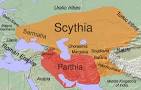
Having mentioned in a previous post that the followers of Nemed were the third group of colonisers – according to The Book of Invasions, the semi-mythical origins of Ireland,  – who came from Scythia, followed, at a later date by the last of the so-called colonisers, the Milesians, once again from Scythia, I thought I had better establish who or what Scythia was.  Here goes:

Scythia was the name given by the ancient Greeks after about 800 BC to the homeland of the nomascythiadic tribes in the southeast part of Europe, eastward from the Carpathian Mountains to the Don River and in Central Asia, from the Danube River, an important route between Western Europe and the Black Sea, to the mountains of Turkistan.

They were a nomadic people who raised horses, cattle, and sheep. According to ancient Greek historians, Scythians travelled in tent-covered wagons and fought with short bows and arrows from horseback and spoke a form of Persian.

The most detailed western description is by Herodotus, The Father of Lies, or, more kindly, The Father of History, according to the blurb on my Penguin Classic, though it is uncertain if he ever went to Scythia.

Their empire stretched north of the Black Sea to parts of present-day Ukraine, Russia, and Moldova from the 7th century BC to the 4th century BC.

This region was seized by the Sarmatians in the 4th century BC and became known as Sarmatia. By the 3rd century the Danube formed the northern boundary of the Roman Empire in southeast Europe.


Epochs & The Book of Invasions

I have been going on about archeological and geological times frames, periods and epochs recently and I want to try and put this into some kind of framework with regard to Ireland and the first people to inhabit the island.

The tables below show the most recent information I can find with reference to the periods mentioned.

Paleolithic

pre 8800 BCE

Mesolithic

8800 – 4900 BCE

Neolithic

4900 – 2100 BCE

Nomadic hunting and gathering groups Transition between the Paleolithic and the Neolithic, the “Middle Stone Age”. Start and end dates vary by geographical region. begining with the Holocene warm period and ending with the start of the Neolithic era. Ireland initially colonised during this period, most probably from Scotland, the Isle of Man and Wales through existing land bridges.


c. 3800 – Farming widely adopted in Ireland over just a few centuries. Herding, polished stone axes, megalithic tombs and pottery almost identical to those found in Britain, suggesting a common origin or on-going contacts between the islands. Late Neolithic Grooved style pottery replaced by new Beaker tyle ceramics c. 2500 BCE


Bronze Age

2100 -500 BCE

Iron Age

1100 – 1 BCE

Roman Age

56 BCE – 420 CE

Britain Ireland

Ireland

The arrival of the irish language?

 
2100- 750 2100- 1500

The megaliths and the use of copper and tin, ushered in the early Irish Bronze Age

Early Iron Age

700- 400

Developed Iron Age

400 – 1 BCE


Initial contact with Roman World

Late Iron Age

AD 1 – 400

 
  1500 – 1200        
  1200 – 500    

Before I go any further I want to assert the fact that there is absolutely no evidence whatsoever that the earliest inhabitants of Ireland – during the Meseolithic and / or Neolithic Era – spoke Irish, Gaelic, or any form of a Celtic language until thousands of years after the first arrivals, no matter what the Lebor Gabála Érenn, The Book of the Taking of Ireland or, as it is more commonly known, The Book of Invasions, claims. This is a collection of poems and prose narratives that presents itself as a chronological “history” of Ireland and the Irish, the earliest of which was compiled by anonymous scribes during the 11th century and is regarded as part of the Mythological Cycle of Old irish documents followed by the Ulster Cycle, from which I drew the the inspiration for my novel, Raiding Cooley. Updated in the 12th century with Christian overtones, the aim of which was to provide Ireland and its kings with a genealogical lineage dating back to the earliest biblical times.

The difficulty here is trying to match the Mythological origins of Ireland with the hard archeological, genetic and linguistic evidence currently available.

The Lebor Gabála tells of Ireland being invaded six times by six groups of people:

The people of Cessair, the descendants of Noah, (direct evidence that biblical stories were incorporated into a sanitised version of the mythology), who first came to Ireland clung to the coast but later abandoned the country. Next were the people of Partholón, but he and his people died of a plague. Nemedians, supposedly from Scythia, were next but they left, having been continually harrassed by fierce sea robbers, the Formorians, from their base on Tory Island.

The Fir Bolg, (or Bag Men), descendants of the Nemedians returned, supposedly from Greece but more likely from Gaul and are credited with the erection of the great stone forts such as Dún Aengus on the Aran Islands as well as the division of the island into the five fifths – Ulaidh, Laighin, Connachta, Dá Mumhain and the central territory of Midhe. The fifth group were the Tuatha Dé Danann who were credited with magical powers and later came to represent Ireland’s pagan gods. Under their king, Nuada of the Silver Hand, they defeated the Fir Bolg and later destroyed the power of the Formorians who still infested the island.   To them, the great passage tombs at Newgrange are ascribed as well as the Stone of Destiny upon which the High Kings of Ireland were later crowned on the Hill of Tara.

The final group, the Milesians, represent the Irish people (the Gaels) and arrived sometime between 1700 – 1000 BCE after extensive travelling from (again) Scythia, Greece, Egypt (?) and Spain.

Archeologically, it seems certain then that different groups of people, some from the north of Atlantic Europe and some from the South, reached Ireland at different times since the start of the Meseolithic period.

So, who were these first people, and where did they come from? I will come back to this in  later blogs.

Partholon

Anthropocene – Waves and Epochs

Alvin Toffler, the fururist who died recently, posited the ideas that the world had lived through three “waves”, each one pushing the next wave further on. The first wave was that of the spread of Agriculture which replaced the hunter-gatherer societies of the Mesolithic periods. That, in its turn, was replaced by the mid seventeenth century Industrial Wave based on the mass production, distribution and consumption of goods as we became bedazzled with mass media, recreation, entertainment, and weapons of mass destruction. Combined with standardization, centralization, concentration, and synchronization, this second wave resulted in bureaucracy which was swamped by the Third Wave – the title of Toffler’s 1980 book which described the post-industrial society, beginning in the late 1950s.

For me, the amazing thing is the time spans involved with the first wave enduring for several thousands of years while the second wave only lasted a few centuries. How long will the third wave last? A few decades and then what? Will the fourth wave consist of …?

I’m not sure how these waves fit in with geological time but the notion that the world has entered a new geological age is currently being reviewed by scientists worldwide and the term Anthropocene is being proposed as the latest subdivision of geological time.

The search is now on for a “golden spike”, a marker that can designate the start of the Anthropocene Epoch, meaning the current phase of Earth history known as the Holocene has terminated. The best spike should reflect events on Earth around the 1950s – the start of Toffler’s Third Wave – and would probably be plutonium fallout from bomb tests in the 1950s, found in marine or lake sediments or ice layers This is seen as the beginning of what is often referred to as the “great acceleration”, when human impacts on our planet suddenly intensified and became global in extent.

Anybody care to suggest what the Fourth Wave might be?