

I love astronomical words like ‘gibbous’ referring to one of the moon’s phases, even though I don’t fully understand what it means in the same way that I haven’t really come to grips with solstices (longest & shortest days?) and equinoxes (equal nights and days?) but I do know that one of them – the summer solstice – is just around the corner.
Falling usually on December 21 or, in this case, on Saturday, 22 December 2018, the summer solstice is the longest day of sunlight we can expect for the next year.
Solstices are specific times on opposite sides (north and south) of the equator, which is the imaginary belt running snugly around the Earth’s belly and thus occur twice a year.
The winter solstice in the Northern Hemisphere (Europe etc.) is around December 21, the darkest day of the year, while around June 21, is the summer solstice.
It is the exact opposite here, of course, in the Southern Hemisphere (Down Under). During the December solstice, which is summer here, the Sun is directly over the Tropic of Capricorn (another imaginary band around the Earth’s knees, as it were) and has reached its southern-most position on the globe, when the North Pole is tilted furthest away from the Sun.
The Solstice is actually at a specific moment – when the Sun is exactly over the Tropic of Capricorn, (latitude 23° 30′ South), and occurs at 06:23 in Perth, West Australia, this year.
The summer and winter solstices were crucial points of reference for ancient civilizations, including the Celts. Only the druids who had angled their sacred sites so that they either faced, or stood, in a geometrical relationship to the rising sun of the solstice, could reveal the paths of heavenly bodies, showing the workings of the universe and the designs of the gods as the solstice is one of the two times of the year when the sun rises and sets in almost exactly the same place, several days in a row
The term solstice comes from the Latin word solstitium, meaning ‘the Sun stands still’, because on this day, the Sun reaches its southern-most position as seen from the Earth. The Sun seems to stand still at the Tropic of Capricorn and then reverses its direction. Some cultures referred to this period as the day the Sun turns around.
Ancient people are thought to have seen the sun rising and setting ever further to the north or south and to have assumed that, without a good deal of prayer, procession and bloody sacrifice, it would either get stuck in the same place – with disastrous consequences for agriculture – or, worse, continue in the same direction until it disappeared for ever. Absolute nonsense of course, given that these self same Neolithic peoples built enormous, astronomically aligned stone temples so that their priests, and spiritual leaders could guide their peoples through the obligatory festivals and celebrations of the astronomical events of the year.
Both Greece and Rome revered the sun with Hercules seen as a sun god. His twelve labours were equated with the twelve constellations of the zodiac through which the sun passes in the course of a year while Sol Invictus, the Unconquered Sun, was the official sun god of the later Empire of Rome.
Emperor Aurelian reintroduced the sun god and cult in 274 A.D. The Emperor Constantine the Great, with the Edict of Toleration, proclaimed at Milan, made Christianity legal throughout the Roman Empire in 313 A.D., but continued to have his coins inscribed with the words, “Sol Invicto Comiti”, which means Committed to the Invincible Sun. Accordingly, Constantine’s adoption of Christianity in the Roman Empire was more likely a matter of political strategy than religious conviction.
St. Patrick (the patron saint of Ireland) blended pre-Christian, pagan beliefs onto his brand of Roman Christianity introduced to Ireland c. 432A.D. by taking druidic beliefs in the sun god, Lugh and fashioning them into orthodox Christianity. The addition of a circle (the wheel – like the pocket-sized votive wheels still found in Celtic sanctuaries – was a symbol of the sun. The eight spokes are thought to represent the cardinal points and the rising and setting of the sun at the summer and winter solstices) onto the Christian cross became the commonly recognised Celtic Cross, bringing together elements of paganism and Christianity.
So too were dates chosen to offset pagan celebrations of Saturnalia and Natalis Invicti. In ancient Rome, the winter solstice festival Saturnalia began on December 17 and lasted for seven days. The festival was held to honour Saturn, the father of the gods and was characterized by the suspension of discipline and reversal of the usual order. The date of Christmas itself celebrating the birth of the “true light of the world” was aligned with the December solstice because from that point onwards the days began to have more daylight in the Northern Hemisphere. Mind you, what that has to do with anything is anyone’s guess.
Happy Solstice (winter or summer, wherever you are) and a very happy Christmas to all.
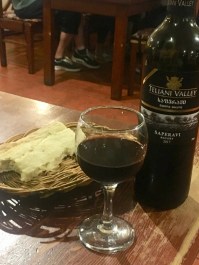 The Washington Post, National Geographic, The Daily Mail, the BBC, CNN, The New York Times and the ABC all ran fairly recent stories bruiting the news of radio-carbon dating of pot shards and bio-molecular and DNA archaeology of grape pips from the Stone Age accurately dating wine making to that period in Georgia.
 Just as no one can claim the invention of the wheel or the discoverer of fire, similarly, no one can claim to have invented wine. Nevertheless, legends lay easy claim to the latter. Noah, after he landed the ark on Mt. Ararat (on the borders of modern day Turkey and Armenia) disembarked the animals and planted a vineyard after which he got horribly drunk and made a disgrace of himself. All of which begs the question of where he originally came from because he must have brought the vine shoots or saplings with him in the ark! Then there is the much older Sumerian Epic of Gilgamesh which also details a deluge after which the eponymous hero sets out on a quest to discover wine and the immortality it can bestow. Another Persian legend describes how Jamshyd – a semi-mythical king – kept grapes to be eaten in jars. One of his handmaids, out of temper with the king and his court, attempted to top herself by drinking the juice from the foaming grapes in one jar, believing it to be poison. Instead she discovered the delights of alcoholic inebriation which she then passed on to the king who, according to the XVII Rubaiyát of Omar Khayyam (The Fitzgerald Translation 1859)



 Popping up from the metro two stops away from the main station – again an incredible ascent – onto Shota Rushtavelli Ave I was amazed to see how fashionably modern Tbilisi was. I don’t know what I was expecting – perhaps something slightly less developed than a Western capital, perhaps something slightly shop worn – but what I got was an amazing melange of old and new.
 short walk past the parliament buildings and down to Liberty Sq. and from there to the old town where crumbling buildings and shaky balconies edged fashionable pedestrian areas and parks.
 Flea markets selling Russian junk crowded the bridge before a maze of small streets leading back up to Liberty Square in which the centre plinth was so high that I couldn’t actually make out what stood on top.

 I saw the premiere of one of Verdi’s little known (certainly to me anyway) operas – Simon Boccanegra – an opera with a prologue and three acts with one intermission, the brochure informed me. A Google search of the plot baffled me but the splendour, the lighting, the colour, the drama and the music and the voices had me entranced – although the only word I actually heard was ‘Maria’ – and I became an opera lover overnight!
 But time to leave the capital and explore the Kaheti wine region, the major wine growing area in the southeast. After all, in this part of the world, Neolithic farmers were making, drinking, enjoying and worshipping vitis vinifera 8,000 years ago so I assumed they knew how to make a decent drop.
 Red Branch Chronicles
You must be logged in to post a comment.