

Have you ever noticed how easy it is to find non-existent links and connections with a mythical past just as it is easy to believe something because you want to believe it? This seems most evident to me when I am travelling.
In most places in Western Europe and elsewhere, links between a Celtic heritage and other cultures can be easily found. After all, Celtic tribes pretty much covered most of Europe and Asia Minor before the rise of the Romans.
Consequently, I could always find some connection to my Irish / Celtic past both real and imagined, no matter how tenuous. wherever I found myself, in a museum, a bar or faced with some artistic design.
However, recently in Georgia, I came across a common understanding in a shared belief that seemed to have no logical basis whatsoever.
Everyone I spoke with insisted that their Kartvelian language, spoken primarily in Georgia, and part of a language family indigenous to the Caucasus, is related to the Basque language spoken by a minority in the western Pyrenees, straddling the border between France and Spain on the coast of the Bay of Biscay.
People I chatted with in bars or with some inquisitive soul on a street or a park, one and all repeated the same thing.
Rome used to call their part of the world East Iberia as opposed to West Iberia, modern day Portugal and Spain and the Georgian language they speak today is also known as Iberian.
One excellent craft beer in a small bar in Batumi led to another and there were three or four young men, all speaking better English than my flimsy grasp of a smattering of European languages, all insisting on the similarities between their language and Basque.
When they discovered that I used to be a language teacher, they embarked on a list of grammatical and lexical similarities between the two languages, based on common names for landscape features such as river mouths and hilltops.
They had me there of course, because I didn’t know anything about Georgian or the Basque language except that ‘pinchos’ were the same as tapas! What I did know was that Basque is one of the living languages which did not descend from a proto-Indo-European group of families and that the Basque linguistic family tree is called an isolate, meaning it has no relation to any other known language.
Similarly on a wine ‘search and consume’ mission in Sighnaghi – one of the premium wine growing areas in Georgia, – an elderly women working in a veg plot in front of a ramshackle house beckoned me over and began to explain – in fluent but accented English – the history of the town walls around which I had been strolling.
 Proud of her fluency, she confided in me that she had been a lecturer in languages at the University in Tbilisi.
Aha, thinks I, I’ll check what the boys in the bar had told me and no sooner had I mentioned the possibility of a Basque Georgian link, than she pounced.
Absolutely and not only that, she insisted, when she found out where I was from, the Irish had their origin in the area of the Basque refuge during the last Ice Age, at least 18,500 years ago and so must also be related to Georgians because Georgians and the Basque language of Euskera have a common origin! Just look at the etymology of words, she insisted. Then, as further proof, she cited Biblical evidence, reminding me (!) that Noah’s Ark had landed nearby and Tubal, the grandson of Noah and the fifth son of Japheth, commonly believed to be the father of Europeans, left the southern slopes of Mt. Caucasus to settle between the Pyrenees and the river Ebro, and that the Basque people are his direct descendants.
Barking mad, I thought and after handing over a few Georgian lari as a requested ‘donation’ for the town wall, I rushed off for the solace of a glass of wine.
I had no doubt that there was an ancient kingdom of Iberia – next door to the kingdom of Colchis (see my post on Medea) and I suppose there could be some typological similarities between the two languages but to suggest that Basque and Georgian were related seemed an impossibility.
The Basques are a pre-Indo-European remnant population of Europe that trace their ancestry to Mesolithic hunter-gatherer groups at the end of the last ice age about 11,000 years ago, OR they date back to later Neolithic groups who introduced agriculture, later mixing with local hunters before becoming genetically and linguistically isolated from the progress of the Indo-European languages in the rest of Europe.
More than likely there would have been a multiplicity of language families in pre-Ice Age Europe, from one of which Basque, or Euskera, originated. Whatever their origins, it is the only Pre-Indo-European language that is extant in Western Europe.
The only thing that’s clear is that it existed in that area before the arrival of the Romans with their Latin that would eventually develop into the French and Spanish Romance languages.
While not a language isolate like Basque, there are only four Kartvelian languages, Georgian, Mingrelian, Laz, and Svan, all spoken within Georgia, and all unrelated to any other language in the world.
Georgian, along with other Kartvelian languages, appeared in what was known as the Kingdom of Iberia sometime around 1000 BC. The Roman grammarian Marcus Cornelius Fronto in the 2nd century mentioned the emperor Marcus Aurelius trying to understand their “incomprehensible tongue”, unlikely if there were a connection between Georgian and a language spoken in the Roman Pyrenees territory.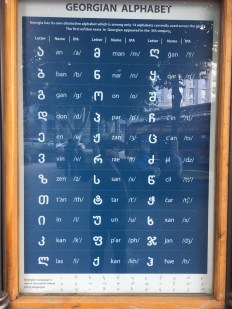
Georgian evolved into a written language with an original and distinctive alphabet, when the royal class converted to Christianity in the mid-4th century adopting the status of Aramaic, the literary language of the new national religion and the oldest surviving literary text dates from the 5th century AD.
However, the hypothesis of a relationship, linking the Caucasian languages with other non-Indo-European of ancient times, is generally considered to lack conclusive evidence.
Musing over a very pleasing bottle of wine on the terrace of my hotel, I could sympathise with the Georgians and their determination to connect with Basque. After all, I had wandered through the museums in Tbilisi and Yerevan finding ‘proof’ of a Celtic past in shards of broken pottery and vague spiral like designs because that is what I wanted to find. And there I laid it to rest until I noticed label on the bottle of wine I was drinking.
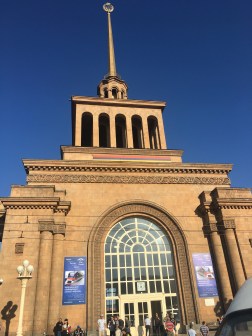 It was early morning and still cool so I decided to walk from the, admittedly, statuesque central station to the hostel I had booked at random before leaving Tbilisi but the walk didn’t change my initial opinion of the city despite the plenitude of park benches and drinking water fountains. Overall the impression was one of grey, concrete drabness. The hostel was small, cramped but cheery with two Filipina girls laughing and cooking breakfast in the tiny kitchen but only a small, top bunk was available and I decided to move on.
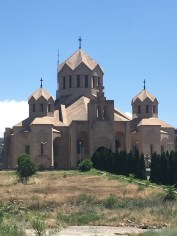 Carrefour supermarket. I was beginning to regret having made the sweaty overnight trip here until I turned a corner and ended up in the English Park, a shady,
 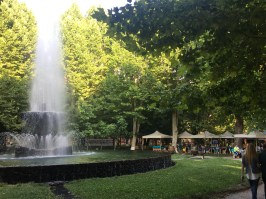 fountain filled park with a cafe and bar in its centre beside the big screen showing the latest matches from the 2018 World Cup. Just around the corner from my new hostel was an elegant and upmarket food hall
  leading to a broad, pedestrianized avenue with a stream of fountains running down the central area, culminating in Republic Square. Massive, monolithic buildings of naturally coloured tufa, a rock made of compacted volcanic ash, in various shades,
 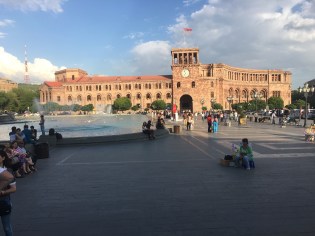 ranging from light pink pastels with a hint of orange formed a semi-circle around the Central Bank, and the National Art Gallery and Museum, almost completing one arc around the huge central fountain – musically choreographed and floodlit by night, as I was to discover later.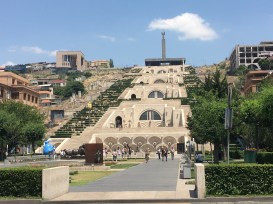
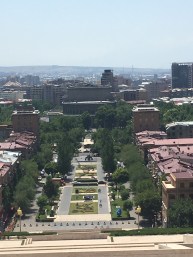 Cafesjian arts centre, named after the Armenian-American who funded the completion of the former Soviet era construction.
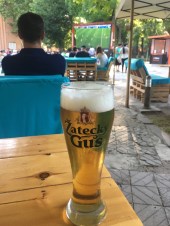 followed by classical concerts at the National Concert Hall with brandy chasers afterwards began to pall and it was time for a change of scenery.
 I have spent twenty-odd years living in Asia and during that time visited most of the ruined and fabled lost cities and temples – Pagan in Burma, Angkor Wat in Cambodia, Ayutthaya in Thailand and My Son in central Vietnam, so I decided to do something similar here in Armenia.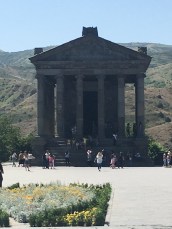
 entrance, forcing me to scramble up, practically on my hands and knees, proper style for entering a pagan temple, I thought.
 the incredible monastery huddled in the rock face where ascetic monks must have eked out a precarious existence in caves in the cliffs reached only by ladders or ropes, ‘adding prayer to shivering prayer’* and exposed to the elements.
  Apparently, the old monastery had, along with the monks’ quarters, churches, shrines, a seminary, an academy of music and, of course, a manuscriptorium where, presumably Gregory hung out. And all this was all just as the Armenian alphabet was being invented! To add gloss to the whole place, relics included the original spear used by the centurion to pierce
  Christ on the Cross, brought here by St. Jude – known, inexplicably here as Thaddeus The spear pictured here was just the case for the relic now kept elsewhere in Armenia, – as well as a chunk of wood said to be from Noah’s Ark!
 No-one could call Sevan a pretty town and on the advice of another passenger on the bus, I skirted the town completely and headed out towards the Sevanavank monastery, founded in 874 A.D., built on the southern shore of a small
 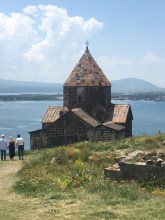 island, which, after the lake was drained during the Stalinist era, transformed into a peninsula at the north western shore of the lake.


 Popping up from the metro two stops away from the main station – again an incredible ascent – onto Shota Rushtavelli Ave I was amazed to see how fashionably modern Tbilisi was. I don’t know what I was expecting – perhaps something slightly less developed than a Western capital, perhaps something slightly shop worn – but what I got was an amazing melange of old and new.
 short walk past the parliament buildings and down to Liberty Sq. and from there to the old town where crumbling buildings and shaky balconies edged fashionable pedestrian areas and parks.
 Flea markets selling Russian junk crowded the bridge before a maze of small streets leading back up to Liberty Square in which the centre plinth was so high that I couldn’t actually make out what stood on top.

 I saw the premiere of one of Verdi’s little known (certainly to me anyway) operas – Simon Boccanegra – an opera with a prologue and three acts with one intermission, the brochure informed me. A Google search of the plot baffled me but the splendour, the lighting, the colour, the drama and the music and the voices had me entranced – although the only word I actually heard was ‘Maria’ – and I became an opera lover overnight!
 But time to leave the capital and explore the Kaheti wine region, the major wine growing area in the southeast. After all, in this part of the world, Neolithic farmers were making, drinking, enjoying and worshipping vitis vinifera 8,000 years ago so I assumed they knew how to make a decent drop.
 Red Branch Chronicles
You must be logged in to post a comment.