Argentine
Panting for breath in the high altitude of La Paz in Bolivia, which seemed to verge on the chaotic with strikes, blockades, enormous protests and heavily armed troops and police everywhere, I made a break for it and descended a few thousand metres to Salta in northern Argentine which was pleasant and warm, even when I arrived at night after a fairly lengthy bus, train, and three more buses, the last of which was stopped by a military style roadblock just outside Jujuy. Everybody was ordered off the bus and while the locals were all searched and questioned, I was totally ignored, thank God.
 Salta, the first major city over the border from Bolivia, looks and feels pleasant and actually warm at night compared to semi freezing temperatures in the mountains further north so I had a refreshing ale (40 pesos) before I even bothered to look for a hotel!
A few days to rest up and enjoy the amenities – my hotel bathroom actually had a bidet and excellent free Internet connections. Despite Google Maps claiming the existence of an Irish pub, there was no sign of it – the location 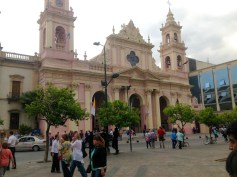 now an expensive jewellery shop which had been there for at least ten years. Never mind, plenty of other bars to enjoy a beer and a few empanadas around the Ninth of July plaza before gaping at the mummified bodies of three Inca children sacrificed centuries ago.
Four hours further south then and 190k through the most amazing canyons and rock formations to the small town called Cafayate, the second premier wine area of Argentine, after Mendoza.An incredible road winding through the most bizarre colourful mountains and canyons  similar to what I imagine the Painted Desert in Nevada would be like. Cafayate is probably the smallest town I’ve been in so far. Brilliant little wineries scattered around, almost at sea level, well, just over 1500 metres, warm and sunny. I got off the bus, found a hotel, had a litre bottle of excellent cold beer and a deep bowl of soup with beans, meat, and God knows what else here thrown in. I will probably stay here two or three days and explore local wineries – specialising,
  apparently in an Argentinean white which is Argentine’s only native variety of grape, Torrontes, and I’ve Just booked myself in for a fantastic tastings of five of the same white grape specific to this region!
Dinner every night is a huge steak and a bottle of Malbec now. In heaven, food and wine wise. I am quite content to let Peru keep its speciality dish of guinea pig, as far as I’m concerned.
Cafayate is a fantastic little town, best place so far on the whole trip. Baking hot in the day, cool at night, loaded with fantastic bodegas of which I am taking full advantage.  Every night seems to be a festival here – usually religious with processions adoring the rosary and the Virgin Mary, all of which was accompanied by noisy bands, people dancing in the streets and a never ending flow of wine. Great fun.
Much as I am enjoying Cafayate – another very pleasant lunch with two classes of wine, a Malbec flavoured ice cream and a bottle of Torrontes to enjoy in the afternoon in the garden of my hotel – I am aware that this is kind of a dead end. To continue on to Córdoba or Mendoza, I would have to go back to Salta – which I don’t want to do – or take another bus from here to Tucuman, which I have never heard of and (unreasonably) don’t like the sound of – and from there on to either Mendoza or Córdoba.
An 8 to 10 hour very comfortable bus trip (think business class on an airline) south to Tucaman – where Argentinian independence was declared from Spain but a bit disappointing. I arrived at sunset but every hotel seemed to be full. Eventually found a dump, well over priced but no choice so I checked in late and left the next morning at 5:30 for Córdoba, Argentine’s second largest city. Meant to be a hotbed of bars and nightlife – got in around 3:30 in the arvo and COULD not find a place to stay – must have tried at least 12 hotels and hostels and by 7:30 still hadn’t found a place to stay – beginning to get desperate, cold, drizzly, beginning to get dark when I eventually found a very rough place – Hostel Pomelo – a right dump. Probably among the worst places I have stayed in over the last 40 years. Absolutely desperate, but what choice did I have – there or a night sleeping upright in a cold bus terminal. Even then when I arrived, the host said he was full and t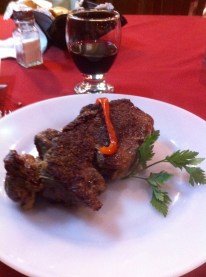 ried to give my money back, which his ratty partner has just accepted. At this point it was about 8:00 pm and cold as buggery so I played dumb and just sat down on a ragged sofa and began to doze off. Eventually I was herded into a dorm with 6 rickety bunks and torn, stained mattresses – fresh sheets, the host proudly claimed. However, no choice so I dumped my bag, took the important stuff and headed out to the best restaurant I could find and had a magnificent steak, gorgeous malbec and then, in lieu of a brandy, ½ a bottle of champagne. Back to the hostel and across the street into one of the roughest bars that would outshine the toughest outback bars in Oz by a long shot where I sampled the local favourite, Fernet and coke and became involved in a semi scuffle over the price of a single cigarette while unfriendly girls snorted Coke in the grubby, (unisex, I think) toilet. Back to the hostel where everyone seemed to be smoking dope, and into the bunk bed and slept like a log.
Next day, Sunday, the city seemed deserted and I really had to change money. – none of my cards worked in the atm and street touts didn’t want to change euros, only US dollars. Beginning to get pissed off, especially as Ireland was playing France in rugby and I was unable to find a bar open in the afternoon. So off to the bus station once again, a grey and fairly miserable day, and bought a ticket on an overnight bus (180 degree reclining seats) and eventually found a bar and watched Ireland thrash France before leaving that evening from Córdoba.
Mendoza, the premium wine district of Argentine, should knock Cafayate into the shade with its wineries and wines. Arrived in a freezing cold dawn and drew up a short list of five hotels before taking a taxi to the first one – “completo” – and that was the story with all of them that I trekked around, getting increasingly pissed off. Some hotels said come back at 11 0’clock, others said come back at 12:30!
Eventually I found a rather smart (for me, that is) Hotel International on the corner of Calle Peru that let me in by 8 o clock for 800 pesos a night. Gorgeous soft, fluffy pillows, crisp sheets and duvets, boiling hot water – what a contrast to Hostel Pomelo!
Argentine could be expensive as there are less than ten peso to the US dollar. However, at one of the crossroads on the pedestrian areas of Calle Sacrimento which cuts through the huge Plaza Independencia, past the pink water fountain, near a few newspaper kiosks, seedy looking punters hang around whispering “cambio” as you stroll past. On this so-called “mercado azul” you can easily change one dollar for about 16 pesos which makes thing seem more reasonable.
Nevertheless, I moved to Hotel Zamora on Calle Peru, a nice outdoor tiled courtyard but the room was small and dark and the shower crappy. Next-door in the Melbourne Coffee Company, I was offered a job as a barista so that the incumbent could focus on wine tasting. No time for that nonsense, of course as I planned to move to Hotel Petit, a bigger, brighter room, just past Plaza Chile.
 Loads of cafes line the beautiful tree-shaded streets with deep, cobblestone-lined irrigation ditches on either side. Presumably it gets hot in the summer and the trees provide a welcome shade. I don’t have gps and I never bother with maps, depending on my unerring sense of direction to guide me to the wrong side of the tracks as usual but with the huge Plaza Independencia – the art gallery is underground and the usual gaggle of street entertainers, dressed in motley and on stilts do the most amazing dances and contortions – and the other four main plazas on each corner, all with huge statutes of local heroes, even I found it easy to get around on foot.
Cold but not freezing with occasional splashes of sunshine filtering down through the trees onto a street cafe where I drink a large bottle of Andes beer and scribble in my notebook or just gape at my surrounding before returning to the hotel in the early evening. Just as well because no one in Mendoza would dream of going out to eat or to the bars until well after 10:30 pm. So, a snooze in the late afternoon and then fresh as a new coat of paint, I blunder out for a steak dinner later that night.
In Mendoza, the wine capital of Argentine, heavy-duty, meaty wine flows freely, cheaper than a bottle of beer. Excellent wine for less than 100 pesos so I indulged myself freely and enjoyed the last of the sunshine, wandering aimlessly around the city and the parks stopping here and there for coffee and ice cream!
 The main attractions seem to be snow boarding, expensive wine tours, white water rafting and that sort of thing, so I focus on what I do best!
The steaks here are magnificent, better than the steak in Lardos in Hong Kong where I used to live, or the steaks in El Gaucho, an Argentinian restaurant, in Saigon. Here, in Mendoza, the best steaks have been in El Florencita on the corner of Peru and Sacriemento – an enormous slab of bloody beef, cooked over charcoal.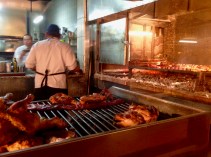
Despite gorgeous sunshine yesterday in Mendoza, which seemed to exacerbate the effect of a lovely bottle of Trapiche Malbec I was enjoying with my lunch of half a cow on a plate, there were hail stones as I was making my way to the bus station to buy a ticket to Santiago in Chile, a mere 149k as the crow flies. However, the road over the mountains winds back and forwards for more than 350k and the road is so steep in parts that the bus has to slow down to 10 or 15 kph. So the journey, in good weather, might take more than 8 hours.
Amazing, but not as amazing as when I arrived at the bus station and discovered all the buses were “completo” for the following day and it was only after I had tried half a dozen different bus companies that it was finally explained to me that all bus trips between the two countries have been suspended since last Sunday due to the mountain passes being blocked by bad weather – one company said because of “nieve”. Incredible! No one knows when the route over the Andes will reopen.
I still have plenty of time before I fly out of Santiago but I don’t know if my liver will last that long under the unremitting onslaughts of free flowing Malbec! Thank god for the “mercado azul” which makes a big difference to a budget traveller like  myself. I’m looking forward to the coach trip over the Andes into Chile, the seats as good as airline business class and the views should be spectacular.
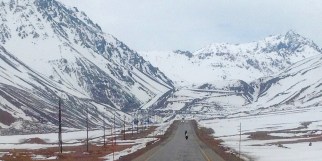
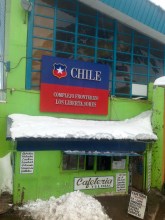
After a delay of several days I finally managed to get a bus over “La Routa de las Liberatores.” and had one cigarette, a small bottle of beer, 380g steak, 500ml bottle of plonk, an espresso, a brandy and a large ice cream in preparation for this second assault on the Andes, to Santiago, from where I eventually fly back to Perth.


 creaking, makeshift corridors of bare plywood and on into a no-man’s land where a very impressive Georgian border post, sparkling white in the sunshine, waited. No visa is needed for Georgia but my passport was scrutinised lengthily by a serious faced official before being smudgily stamped.
 haired waitress dressed like a flight attendant with a jaunty blue hat, served me my first and excellent Georgian beer. I don’t know the name of the beer because it was written in the Georgian alphabet, which, to my eye looked unintelligible, full of squiggles, radii and what looks like badly written numbers.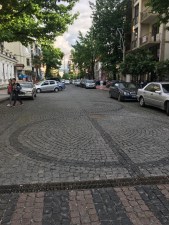
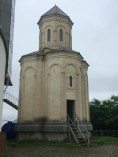 the musical fountain near the Ukrainian restaurant that had a dress code (I was not allowed to eat up on the balcony) and the somewhat gaudy buildings,
  the impossibly tall column of Medea (of Jason and the Argonauts fame),
 the excellent craft beer – although I meant to drink Georgian wine
 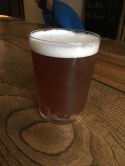 specifically! But what really bowled me over was the certainty on the part of everyone I spoke to that the Georgian language was directly related to the Basque language and that in the past Georgia had been called Iberia and that just proves it! Fantastic. Yes, I know this bottle does not say Iberia but then aagain I find it hard to believe Georgian and Basque languages are related.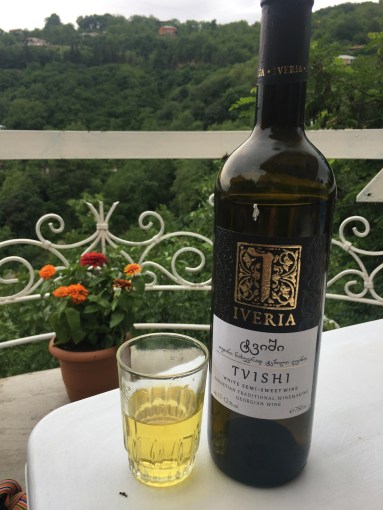
 further
  down had an old steamer crossing the Bosporus to the rather appealingly named bus station of Harem.
 than a conductor was pushing a trolley down the aisle offering tea, coffee, soft drinks and a choice of three snacks! Six hours later we rolled into Bartin only it wasn’t Bartin exactly as I was bustled off the coach and onto a waiting mini-bus that raced off in the opposite direction to another part of Bartin where another mini bus finally took me to Amasra.
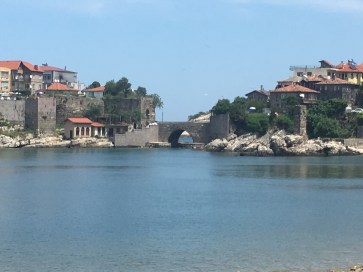 According to Homer, warriors from Bartin fought on the side of Troy against the Greeks. Certainly Amasra, known as Sesamos when it was founded by the Miletians in the 6th century BCE, would be worth fighting for its elegance, beauty and location on a peninsula made up of two inlets joined by an ancient Roman bridge.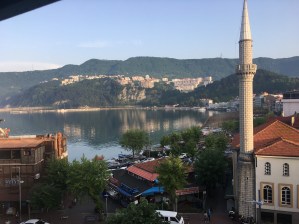
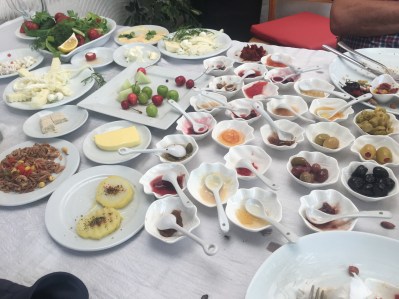




 I started off with a Pisco Sour – no sign of the egg white here – and then a bottle of Chilean Sauvignon Blanco Leon de Tarapaca, to accompany this huge plate of albacore covered in a salsa Santa Margarita, which appears to be small prawns and rings of squid in a white sauce, bread and a spicy dip of toms and onions and god knows what else.
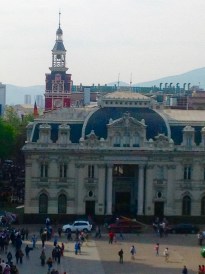 quiet drink in the only place open in Plaza de Armas. I ordered a pint of beer for a change and was absorbed reading in a cafe with maybe four or five other tables scattered around. I rather rudely ignored some mad punter who came up to my table and started jabbering away at me. I didn’t even look up until suddenly he grabbed my pint and started swilling it down. (Dan Hicks and His Hot Licks – “you’re drinking my beer and I’m gonna punch your teeth out”). I rather surprised myself by erupting, like an angry belch, up on the hind legs and grabbing him by the shirtfront, one arm raised to punch his lights out while roaring, in English of course, “I’ll f@#king kill you, you c**t”. Startled by my violent reaction, he twisted away while other punters at the outdoor cafe applauded and the waitress bustled over apologising and whisking my (nearly finished) pint off for a fresh one. No harm done, I suppose and a free pint, so I can’t complain. A promenade around the square later on, a surprising number of punters wrapped up in rugs, sleeping on the long park benches, despite police patrolling fairly regularly.
 One hour forty five minutes by bus from Santiago and arrived in Valparaiso shortly after12 noon. The first guest house was looking for 36,000 pesos a night so I moved a bit down market, private room with bathroom across the hall for 15,000. I’ll stay two nights and then look for something else – maybe at Viña del Mar, just down the road. Lovely to be beside the ocean again, although I am looking down at it as my hostel is up quite a steep hill but with no altitude, no problem.
 Drinking a 750 ml bottle of Altamirs Amber ale, lovely but a bit pricey at $15 Australian. Waiting for a “tun de mediterraneo” for lunch. “Que rico” (as they say here.) The place looks great, hundreds of hills and houses clustered around, all the colours of the rainbow. Pleasantly warm at the moment, t-shirt weather.
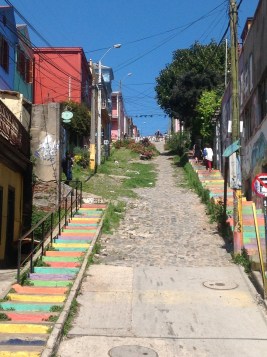 Valparaiso must be one of the most perpendicular cities I have ever been in. Hugging the coast, it clings to sheer hills that are accessed by elevators! Everywhere is a blaze of colour from the murals – think Banksy – on walls and hoarding and even the steps leading to my pensione. A stroll along the beach at Vina del Mar where the pelicans clusters at
 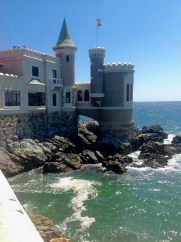 before returning to a tiny bar to watch the rugby between South Africa and New Zealand. Managed to swill down three pints in the company of a few South Africans.
 The journey on the bus from Cusco to Puno on Lake Titicaca on the border between Peru and Bolivia, crossing over 4000 metres, left me gasping with the effort of breathing at this altitude. However, Lake Titicaca, the largest lake in South America on the border of Peru and Bolivia and the “highest navigable lake” in the world at about 3,812 metres, gave me the illusion of sea level and my ragged breathing was enough for me to take a day-trip to the fantastic, floating islands on the lake.
  Small manmade islands have been constructed by the
 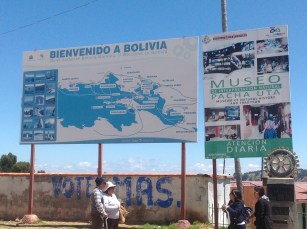 etch of the imagination could the bus from Puno cater to the “super executivo” class and it was a jerky ride to the border post. No problems there, off the bus and into Peru Immigration to get an exit stamp, walk 100 metres and enter Bolivia and get an entry stamp.
 through barren, desert country until the outskirts of the capital city approached.
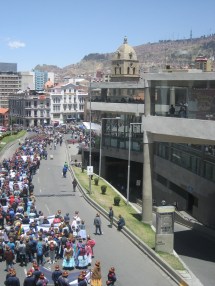 Massive demonstrations began in the city the next day with thousands of protesting miners parading through the streets. Every corner was covered with heavily armed police,
  toting pump action shotguns, teargas and heavy duty riot gear while the protesters poured into the city, firing off bangers from what looked like bamboo tubes, blocking off all exits.
  Toyland soldiers stood guard outside principal buildings, in rather sharp contrast to the heavily armed police on every street in the centre of the city.
 Monstrously broad-hipped women in voluminous coloured skirts, heavy shawls which doubled as blankets and makeshift backpacks, their heads topped with incongrous bowler hats while all the men seemed smaller and dressed in standard jeans and t-shirts with baseball caps. Amazing!
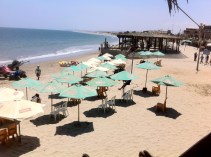 birds swooped in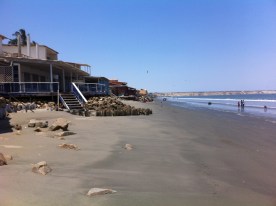
 The approach to the capital was along sand-blasted looking cliffs while a sullen slate-grey Pacific rolled relentlessly against the shore where an immense grey city, perpetually wrapped in a silver sea mist or fog, sprawled.
 It is always such a fantastic thing to go somewhere and then indulge with the national dishes and one of Peru’s national dishes is roasted guinea pig – I bet it tastes like chicken! Of course the other national essentials are ceviche and pisco sours – rum, lime, sugar and egg white whipped up in a blender.
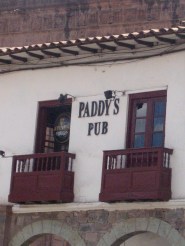 n the mountains in Peru, the old Inca capital, at about 3600 metres above sea level means difficulty breathing – but not for the Incas who built the city more than 500 years ago. The Spanish came then and raped the city, stole the gold and used the blocks of
  stone from the Inca temples to build their own churches and buildings. An amazing, solid city high in the mountains – a Siam Reap or an Ayutthaya alive with their original inhabitants, along with the tourists. Churches and squares everywhere instead of temples and pagodas – atmospheric and bewildering, warm during the day and then freezing at night. T
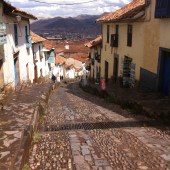 he steep climb between my hostel and Paddy’s Bar, the highest 100% Irish owned bar in S. America at 11156 feet, was an exhausting and panting effort! Machu Pichu become unattractive to me at an even higher altitude and I headed to the lower altitude city of Arequipa, surrounded by snow capped mountains and guarded by three active volcanoes – the last eruption only a dozen years or so ago.
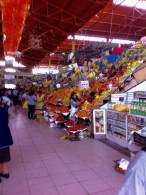 of cocoa leaves, for the altitude she had insisted and I decided to go to Cusco’s local wet market where I was sure to find more. For a few cents a withered crone stuffed a bag the size of a pillow case with the bitter leaves and then threw in a few sticks of some grey resin, stevia it turned out, to offset the bitterness of the leaves when chewed. There was the most incredible variety and abundance in the market, fresh squeezed juices, fruits and vegetables, most of them totally unknown to me, piled high in gleaming mounds. Potatoes ranged in siz
 e from peanuts to cabbage size and in colour from black to purple and yellow while the market itself was spotless, bright and airy. Corn was everywhere and in every size too from tiny kernels to knobs as big as my little finger joint.
 Smiling girls in elaborate costumes decorated with silver coins and outlandish headdresses cuddled baby alpacas in their laps and posed against the massive stone blocks of an imposing church for tourist photographs but I was more interested in food.
 Fatigued from both the altitude and the culture overload about cities I had never before heard of, and their extraordinary churches, convents
  and castles – all built at the behest of a handful of Spanish (less than 180 men) who invaded in 1530 or so and conquered the ruling Inca tribes and their vast empire stretching almost the length of the continent, I moved on to Puno, the stopover point for Lake Titicaca, the highest and one of the largest lakes in the world, making Lake Argyle in the Kimberley in West Australia look like a puddle.
 Their high prowed reed boats provide both a security and a living on the immense lake. A bit like the old Celtic habit, I suppose, of building fortified, enclosed homes on brushwood platforms over water or bogs – the Crannóg.
 Red Branch Chronicles
You must be logged in to post a comment.