Cuba and beyond – Part 3

Peru

Arrived in Peru on a very comfortable overnight bus from Cuenca that took me down to Tumbes, Ecuador’s border post with Peru. Before I go any further, I have to clarify here what I mean by a bus. I have travelled on Greyhounds across the US back in the 70’s and on long distance buses through Western Australia since then but I have never come across such luxurious bus travel as I have done so far in South America. First off, most of the buses – excuse me, coaches – are modern, sleek, two storey jobs with plush, airline style seats. Unlike most airline seats however, all of the seats here recline from a minimum of comfortably back to completely back, i.e., 180 degrees or “Executivo” class, each seat fully contained and separate with its personal TV screen while the on-board loo would not be out of place on Airforce One. I digress.

Minor delays to exit Ecuador and enter Peru – a bit like going from Saigon to Cambodia, – and then back on the bus until a beach resort called Mancora before dawn. I could have gotten a room right away but the night porter obligingly suggested that I wait until 6:00 AM as, that way, I wouldn’t have to pay for the previous night! I waited outside the gated resort at a small kiosk drinking beer and waiting for daybreak with the local desperadoes and long term ex-pat exiles, Patrick and Giorgio. The latter, a wrinkled veteran, hinted the upscale resort was pretending to be a backpacker place before offering me tours to watch whales or deep-sea fishing, treks to hot springs and mud baths.
I’ve always enjoyed beach holidays – in fact up until my late teens or early twenties, they were the only type of holiday I had ever had – and this was the Pacific, rolling in along an endless flat coastline as far as the eye could see in either direction, while Stuka winged img_0698birds swooped in img_0711
a stormy sky but the season here was coming to an end and there was never any pepper in the restaurants, the coffee was crap and long Pacific waves rolled in constant curls and I ended up being the only person staying on an isolated beach strip.

On down the west coast from Piura, a small northern town on a “Super-executivo” to Lima. It was like flying business class.  My seat was called a suite and reclined all the way back to a flat bed.  Two meals and drinks were served by a pretty little hostess, just like on a plane, and the loo was twice the size found there as well. img_3294The approach to the capital was along sand-blasted looking cliffs while a sullen slate-grey Pacific rolled relentlessly against the shore where an immense grey city, perpetually wrapped in a silver sea mist or fog, sprawled.

img_0726It is always such a fantastic thing to go somewhere and then indulge with the national dishes and one of Peru’s national dishes is roasted guinea pig – I bet it tastes like chicken! Of course the other national essentials are ceviche and pisco sours – rum, lime, sugar and egg white whipped up in a blender.
Down on the Malecon I felt dwarfed by the magnitude of the leaden expanse of the Pacific stretching endlessly away, awed by an ocean too vast for me to get a handle on.

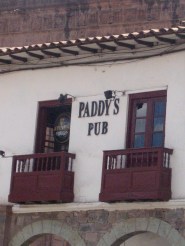
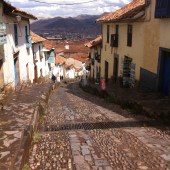
Another super executivo inland then, along with a few cocoa leaves to chew, to Cusco, an old Inca Indian capital, somewhere around 3400 metres. High iimg_3319n the mountains in Peru, the old Inca capital, at about 3600 metres above sea level means difficulty breathing – but not for the Incas who built the city more than 500 years ago. The Spanish came then and raped the city, stole the gold and used the blocks of img_0759stone from the Inca temples to build their own churches and buildings. An amazing, solid city high in the mountains – a Siam Reap or an Ayutthaya alive with their original inhabitants, along with the tourists. Churches and squares everywhere instead of temples and pagodas – atmospheric and bewildering, warm during the day and then freezing at night. Timg_0752he steep climb between my hostel and Paddy’s Bar, the highest 100% Irish owned bar in S. America at 11156 feet, was an exhausting and panting effort! Machu Pichu become unattractive to me at an even higher altitude and I headed to the lower altitude city of Arequipa, surrounded by snow capped mountains and guarded by three active volcanoes – the last eruption only a dozen years or so ago.
To compensate for missing out one of the wonders of the world, I had my first roast guinea pig for dinner. I thought it would just be like chicken but it was more like rabbit or quail. Not a lot of eating on a guinea pig I have to say and I was glad I hadn’t ordered the fillet but instead had the whole beast, head, tail, claws, the works.

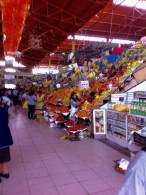
Before I had left Lima, a friendly bar-tender had given me a handfulimg_0788 of cocoa leaves, for the altitude she had insisted and I decided to go to Cusco’s local wet market where I was sure to find more. For a few cents a withered crone stuffed a bag the size of a pillow case with the bitter leaves and then threw in a few sticks of some grey resin, stevia it turned out, to offset the bitterness of the leaves when chewed. There was the most incredible variety and abundance in the market, fresh squeezed juices, fruits and vegetables, most of them totally unknown to me, piled high in gleaming mounds. Potatoes ranged in sizimg_3311e from peanuts to cabbage size and in colour from black to purple and yellow while the market itself was spotless, bright and airy. Corn was everywhere and in every size too from tiny kernels to knobs as big as my little finger joint.

Squat Inca women, all wrapped in heavy, embroidered shawls, colourful duster-like arrangements on their heads, sat in the main square, their legs straight in front of them, doing traditional weaving or selling local handicrafts.img_3328 Smiling girls in elaborate costumes decorated with silver coins and outlandish headdresses cuddled baby alpacas in their laps and posed against the massive stone blocks of an imposing church for tourist photographs but I was more interested in food.

Picanterias – local, family run small enterprise restaurants – serve traditional stews of beans and corn, stewed endlessly and served with meat barbecued on a cast iron parilla and I wanted llama. Although everyone seemed to know about picanterias, nobody seemed able to direct me to one so in desperation I took a taxi and told him to take me to his recommendation of a picanteria. After a moment or two of goggling at me uncomprehendingly, he slammed the car into gear and we roared out of the town centre up a gravelled road to a large, whitewashed building climbing the steep hillside. No llama, they assured me but ‘same-same but better” alpaca cooked on the parilla. The slab of meat was too much for me and I was glad of the extended stroll back into the city centre when the picanteria unceremoniously shut down in the early afternoon. Maybe a picanteria where the guinea pigs run around in the kitchen instead, feeding off scraps, would be more my size!

img_0770Fatigued from both the altitude and the culture overload about cities I had never before heard of, and their extraordinary churches, convents img_0783and castles – all built at the behest of a handful of Spanish (less than 180 men) who invaded in 1530 or so and conquered the ruling Inca tribes and their vast empire stretching almost the length of the continent, I moved on to Puno, the stopover point for Lake Titicaca, the highest and one of the largest lakes in the world, making Lake Argyle in the Kimberley in West Australia look like a puddle.

I remember reading about the extraordinarily strong convictions of Thor Heyerdahl and his Kon-Tiki expedition and thinking how exciting to venture on such a trip on a balsa-wood raft. But for the small communities on the border between Peru and Bolivia who lived on massive floating reed islands showed just how buoyant their floating homes were. img_0087Their high prowed reed boats provide both a security and a living on the immense lake. A bit like the old Celtic habit, I suppose, of building fortified, enclosed homes on brushwood platforms over water or bogs – the Crannóg.

Those reed boats now seem mainly for the tourists but at the same time I was rather relieved when my bus drove onto a sturdy wooden raft powered by a tiny outboard motor before attempting the border crossing into Bolivia. I warily climbed, with the other punters, into a tiny speedboat to make the same crossing in a fraction of the time it took our bus! The road would endlessly and sinuously up and up, it seemed into the snow-capped mountains and the high altitude began to affect my breathing again long before we seemed to make a circuitous descent into La Paz.

So far I’ve covered the length of the continent from Quito in Ecuador down to the tail end of Peru and thank God for loads of things like hot, sunny days and cold nights and heavy warm duvets on the beds, I mused, as I sipped a small bottle of good rum I had thoughtfully provided myself with against the cold.


Who are the Irish and Where did their Language come from? Part Three

Ireland was a different story – relatively untouched by Rome, society there did not change dramatically until the advent of Christianity 500 years later. Groups of Celtic speaking people continued to arrive and leave, bringing with them La Tène styles and influences.  Iron Age Celts thus survived in Ireland long after it had been wiped out elsewhere.

Linguists refer to the languages spoken in Britain and Ireland as Insular Celtic which can be further subdivided into Brittonic or P-Celtic and Goidelic or Q-Celtic, as in the table below.

Insular Celtic

Brittonic or P-Celtic

Goidelic or Q-Celtic,

Ancient British

Welsh Cornish Breton Irish Scots

Manx

Whether the ancient Celts can be identified with the Gauls that Caesar defeated, the Insular Celtic languages are closely related to one another and to the other Celtic languages of Europe, now sadly extinct. Although the earliest record of what is now known as Irish dates from the 5th century A.D. in the form of a simple inscription, there is no doubt that Irish is a branch of Celtic which is a branch of Indo-European and Irish cannot have arrived in Ireland before the spread of the Indo European languages.

Despite the similarities and inter-relationships between the Celtic languages, it is not possible to pinpoint the exact origin of Irish. Linguistically speaking, the more similar two languages are to each other, the less time they have spent apart and the languages of Ireland, Britain and Gaul are remarkably similar and related to Proto Celtic.

Obviously, languages like French, Spanish and Italian bear striking similarities, so much so that they can be viewed as cousins, with their parent language being Latin, as spoken during the Roman Empire.

Similarly, Irish can be seen as cousin to Welsh, Cornish and Breton on one hand and to Scots Gaelic and Manx on the other and the original parent language would have been Common Celtic.

A subset of the Proto- Indo European Family of Languages

Celtic Italic Germanic Slavonic Greek
Irish, Welsh, Cornish, Breton, Scots Gaelic & Manx Latin, French, Spanish, Italian etc. English, German, Scandinavian languages Russian

The shared vocabulary of all Indo European languages, including Celtic, indicates there could have been no separation of the Celtic group into divergent dialects before the development of farming soon after the end of the Stone Age as the ancestors of Indo European flood in from Eastern Europe and Western Asia in four main Language groups – Graeco-Latin along the Mediterranean, the Germanic around the Baltic, the Slavonic in the east and the Celtic in the centre and west. It is impossible to see “Irish” arriving during the Neolithic period as that would postulate a physical split between the earliest speakers of Irish, British and Gaulish back to 4000 BCE.

Equally, it is next to impossible to imagine a Celtic language entering Ireland much before 1000 BCE.   Although Ireland was in contact with Britain and Europe for nearly a thousands years prior to this, as seen through the distribution of ceramics, polished stone axes and megalithic tombs, and that link continued throughout the Bronze Age, with the exchange of weapons and ornaments, but again there is no direct evidence for Irish having been introduced as a “trade” language or as a “lingua franca”. Neither Irish nor any other Celtic language have the aspect of a pidgin or trade language nor are they simplified in any way while their respective grammars and vocabularies retain the full range of their Proto-Indo European ancestor.

By 300 BCE, archaeological evidence indicates the spread of La Tène culture and the arrival of small groups or bands but no sign of a major settlement of a foreign population. Nevertheless, the evidence of tribal names suggests that Celtic speakers, both Goidelic and Brittonic with the former gradually subsuming the latter, occupied large areas.

So, if the accounts in the Book of Invasions are discounted as to the origins of the Irish and their language and Irish was not a trade language introduced during the Bronze Age, what is left?

Although multiple opportunities for a language shift in Ireland have been postulated, the one most likely to have been the direct ancestor of Irish aligns itself with the rise of the hill forts from 1000 BCE as the sites assumed significant religious and ceremonial features. The spread of regional centres in areas of Ireland – Crúachan in the west, Eamhain Macha in the north, Dún Ailinne in the east, Cashel in the south and Tara in the middle – might also herald the arrival of a new language.

So, although Irish was not native to Ireland, there would have been Celtic predecessors brought in multiple times by small groups from similar areas of the Atlantic seaboard and Britain who introduced their language, not through warfare but more likely, through having a more productive economy or just by simply outnumbering the sparse native population and whose identity became subsumed under a continuing influx of Celtic people. Bi-lingualism is the first stage when two languages meet and the native Irelanders would have adopted Proto Irish if it had been in their interests to do so.

Languages represent social phenomena with no language being intrinsically superior or inferior to another. Instead, language is used to fulfil essential social contacts in areas such as religion, law, sport, trade, literature and so on. Linguists refer to these social contexts as “language domains”. The new or target language is often linked with specific domains and, in the case of a “proto Irish” arriving in Ireland, the new language must have either filled in an existing domain or else created a need for a new one so that the native inhabitants would have thought it worth their while to embrace the new language.

So, the most probably reason for the adaptation of a “proto-Irish” by native Irelanders was that the new language offered the people access to something they did not have before – perhaps it was a tighter form of social organisation,

based on stratification, feasting, gift giving or some type of social prestige – a warrior elite or a new religion. Traditionally, the spread of world religions often carried with it a new language, Islam and Arabic, for example or Christianity and Latin.

The spread of hill forts and the regional centres they controlled, along with the rise of iron weaponry, leading to a warrior elite such as the Red Branch (Craobh Ruadh), with society forming clearly delineated stratification lines between tribal chiefs, religious leaders or druids, the warrior elites and the trade and craft people all tended to attract the native Irelanders to a new social system and the language that came with it. The overall result might have caused the native “Irelanders” to identify with and behave like the early speakers of “proto Irish”.

So, on the basis of archaeological, linguistic and genetic evidence, it seems most likely that from 1000 BCE, “proto Irish” would have arrived with different Celtic groups, pushed to the fringes of Europe from the inhabited La Tène lands into Britain and then further west into Scotland, Wales and Ireland. Certainly by 100 AD, a Celtic language, the predecessor to the modern Irish language, was in place. Linguistically, Old Irish was a monolithic language, meaning that, if it had been in Ireland for millennia, it would have developed dialects, which it did not do until more recent times.

In conclusion, it seems that the language known today as Irish arrived in Ireland sometime between 1000 – 100 BCE with evidence for both Brittonic and Goidelic groups establishing central foci for existing communities and ultimately providing a means of dividing Ireland up into different social groups, tribes and clans. Nevertheless, it would be nonsense to think of the people then as an Irish nation, the first reference to which only occurred nearly 1800 years later!

Cuba and Beyond – Part Two

Banana Republic

The above pejorative term for a country run as business for private profit, shared between the State and favoured monopolies, was first coined by the American writer O. Henry in 1904.

Take a wild guess – which country is the biggest producers of bananas in the world and is also the highest capital city in the world? (provided you don’t count La Paz in Bolivia, which is only the seat of government and not it’s constitutional capital). Bingo! Quito, at 2850 metres (or 9350 feet) above sea level, is the national capital of Ecuador.

Arriving late at night in Quito, via Panama from Havana, the last thing I expected was to be pulled out of line by customs as I strolled through. Politely but very insistently, they went through my bag with a fine toothcomb, checking the lining and the straps fairly thoroughly and insisting on seeing how much money I was carrying. No hassle, just an hour delay or so but in repacking my bag, I forgot my jar of vitamins! Quito seems a different ball game with fast, free wifi at the airport and hair-dryers in the hotel bathroom!

img_3233At about 2800 metres above sea level it is lovely and cool, compared to Cuba. What that also means is that it is a little hard to breathe, with not enough oxygen, for me, anyway, so I had to walk very slowly but even then I was panting a bit. Radically different too from Havana – market stalls here in Quito have more stock than entire shops did in Havana.
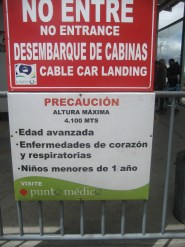
Surrounded by some active volcanoes, the air fresh and light I took a cable car up to 4100 metres and then tried to continue up hill on foot for another 45 minutes or so, each breath a rasp on the lungs hungrily sucking in the oxygen. img_3235img_3249Active volcanoes ringed this amazing city but I began to feel light-headed and aching so back down to the city level at about 2800 metres and into the Archbishop’s palace for a refreshing ale.

Staying in the historic centre which is beautiful and substantial – the old Spaniards knew how to build to last, or at least they made sure their slaves did so. Despite staying in the centre of the old historic part of Quito and asking policemen and newspaper sellers and other sundry hop-off-my-thumbs, I could not find a bar. All the bars and nightlife are tucked away in a different part of this vast city apparently and I need to take a taxi to “la zona rosa” for a refreshing beer. Luckily taxis are cheap, the flag fall starts at .50 U.S. cents and most rides cost less an 3 dollars!

Going into a bar just opening up for the evening trade, Dieter, the manager and part-owner of the bar was proud of his Spanish. From Jo’Burg, he told me with a strong South Africa accent, he had only been in Ecuador a short time when he had been mugged and had both his ankles broken. img_0648During his convalescence he had met Rosa his fiancé and it was with her father’s help that he was now part owner of a bar, he boasted. Insisting I try a local speciality, be busied himself preparing a Michelada – a salt encrusted beer mug filled with lager, lime juice, tomato juice, hot sauce and then decorated with an olive. Hmm.
Moving on to another bar, looking for a place to pass on my illegal tender, I found a busy corner place, dimly-lit both inside and out where the service appeared casual and lackadaisical among the young and carefree crowd. Ordering a jug of Margarita, knowing the twenty bucks would more than cover it, leaving a generous tip for the server, I sat back to enjoy the scene. Leaving the note protruding from the payment wallet tossed down on the table beside the empty jug, I slipped around the corner and into a taxi.

Leaving Quito tomorrow by bus and heading down to sea level to a fishing village called Canoa to get a beach bungalow and enjoy some beach life for a while. I am looking forward to the bus trip tomorrow down through the mountains. How the Spanish ever found their way up here in the first place is absolutely amazing. And then to build not just one but several mighty cities, and all under the control of less than 500 native Spaniards?

Dr. Denny, an American expat ran a seriously minimalist backpacker place just off the beach. Lurching slightly and gesturing with a beer bottle, he inducted me into Ecuadorian essentials. Wearing a stiletto on a chain around his neck, he showed me how he dealt with anyone trying to put any muscle on him, half pulling the stiletto out of its up-side down sheath on his chest. “It’s all they understand, man”, he assured me, explaining that everyone in Ecuador distrusts everyone else so that their taxis all have webcams and red panic buttons for both drivers and passengers. Sundays were dry, with no booze on sale, he warned me before solemnly leading me over to a shed in a corner of his property. Removing a heavy padlock he threw open the door to reveal a rough and ready bar with a shuttered window giving onto the side road.

I am still always surprised when a season is actually given precise start and end dates. Summer officially ends on the first Monday of September with a suddenly barren beach, img_0650everything shuttered and closed down and the sea no longer looking inviting.   Chasing the sun, further south to Puerto Lopez and on down the coast to a bigger beach resort – Montañita – but while there were still cafes and hotels open, what would have been loud and bustling now seemed tawdry and shonky.img_0662
Intrigued by the sound of “why I kill” I moved on again, inland and east to Guayaquil – but found it dull despite its reputation for being a dangerous city – thank God!

Early the next morning my bus laboured up into the mountains to Cuenca, 2600 metres above the beaches. In a high valley, surrounded by mountains, small rivers, with solid stone bridges, sectioned the town. img_0693Refreshingly cool and sunny during the day but chilly at night, Cuenca is famous for its reviving use of chocolate in both drinks and cooking, and, left breathless after wandering over a local zoo spread over half a mountain, I determined to try chicken in chocolate as I sipped hot chocolate with cafe liquor – didn’t know that chocolate was a big speciality. Things seemed much cheaper here in the mountains compared to the lowlands so I thought I might stay for a few days before contemplating the next onward stage.
One attempt, so far, at a partial mugging in Cuenca and I just laughed and pushed a bit out of the danger. A barmaid in one of the pubs I stopped off to have a quiet drink in, warned me not to go near a certain corner nearby because, she said, there is always trouble there. Not knowing the area anyway, I blithely paid no attention to her directions of how to avoid that particular spot. When I eventually left to look for a late dinner, I almost immediately came to a corner where a group of young toughs moved meaningfully to block me as I approached. Without slowing down or faltering in any way, I grinned and nodded maniacally at them as I brushed through them and kept going. No harm done to them or me.


Who are the Irish & Where did their Language come from? Part Two

Meanwhile, in Europe, Celts originated in central and east-central Europe during the Early Iron Age, about 850 BCE. Various groups or tribes assimilated during the Bronze Age and gradually developed a single culture around the discovery and use of Iron. Referred to as Hallstatt, from an area in Austria where major archaeological finds were discovered, this Celtic culture developed into a major trading centre with the Mediterranean and the Greek port of Massalia (modern day Marseilles).

By about 450 BCE, during the Late Iron Age in Europe, the Hallstatt culture was succeeded by a period known as La Tène after a site in modern day Switzerland. This was a major shift in culture and style focusing on decorative metalwork such as gold torcs and horse gear with iron being cheaper and more available than bronze. Despite later descriptions of the Celts being unruly and warlike, they were predominantly an agricultural and pastoral people and iron plough shares cleared the land more efficiently while iron swords, spears and shields gave them a tactical advantage as their need for farmland kept pace with their growing population and inevitably, groups reached Britain and Ireland.

Further south, Celtic tribes began their expansion over the Alps and into Italy (sacking Rome in 390 BCE) and down through the Balkans, eventually reaching Turkey where they were known as the Galatians (the object of many of St. Paul’s future letters!). The Romans called them Celtae or Galli and the Greeks referred to them as Galatae or Keltoi but it is not clear what they called themselves. The first written reference to them was in Greek c.500 BCE.

By c.600 BCE, during the early Irish Iron Age, the former trade links with Europe apparently collapsed, isolating Ireland from events in Europe. The former communal interdependence relied on Ireland being a source of copper, essential for Bronze Age metallurgy but with iron being relatively widespread in Europe, trade declined. After 600 BCE and before the start of La Tène in Ireland by about 300 BCE, nothing much is known yet it is during this time, from about 300 BCE – 400 AD that the Irish language most probably arrived in Ireland.

The shift from Bronze to Iron technology varied widely within Europe. The majority of metal finds in Ireland from this period were not, in fact iron, most being bronze which remained in widespread use throughout the Irish Iron Age. It was not until the 3rd century BCE, that La Tène items such as ornaments, weapons and tools appeared in Ireland and this Celtic influence may have been the greatest single cause of the creation of both the “Irish” people and their language. This was also the period when Ireland came into regular contact with the Roman world through Roman traders and “Irelanders” travelling to Britain and beyond.

Despite the archaeological evidence, once again there is no direct evidence of a substantial population movement from Europe to Ireland. In fact the opposite seems to have occurred, with the land becoming re-forested and agriculture declining, suggesting a sharp fall in population. Nevertheless, two streams of La Tène culture continued to enter Ireland, the first direct from Europe to the west of Ireland and the later input from Britain to the north.

From 300 – 200 BCE as Roman power extended in the south and east, the Celts were being pressed on the north by the Germanic tribes moving south. Rome continues to squeeze Celtic lands, and by 150 BCE their area of influence continued to decline until Caesar conquered Gaul a century later ending their hegemony and, more slowly but just as surely, the languages of the continental Celts. By 100 – 1BCE only Britain & Ireland retained a Celtic lifestyle.

Celtic Languages of Europe

Gaulish Galatian Lepontic Hispano Celtic Tartesian
P-Celtic P-Celtic P-Celtic Q-Celtic Q-Celtic

As a distinct entity, Celtic language and culture were wiped out in Europe. In Britain, Celtic tribes were driven north into Scotland and east into Wales by the numerous incursions, first by the Romans themselves and then later by the Angle and Saxon invasions.

Pub Talk – ‘Stralia

The sandy path from my hotel led past a massive squat water tank and then skirted the muddy mangrove-lined banks of Roebuck Bay before turning sharply left down towards Broome’s Chinatown area. I don’t know quite what I was expecting but it was certainly more than the broad street with a row of corrugated iron, beach style, huts on either side of a boardwalk. Despite the temporary look to the shops, they were by no means cheap, despite their tawdriness. Anasstaia’s Pearls – one of about ten shops selling Broome Pearls, Argyle Diamonds and Kalgoorlie Gold – stood opposite The Sun Picture Theatre – the world’s longest operating picture gardens (an open air cinema without a garden), where the shows change weekly – which shared the building with a Broome Realty business.

Despite the guide book’s assertion that a stroll past these tourist shops with kitsch names like “Kimberley Kreations” and “Shells Galore” would “evoke a startling sense of days gone by”, the squashed and scattered beer cans in the small park at the top end of Chinatown gave me a more realistic sense of the present. The Roebuck Bay Hotel had a slightly sagging wooden boardwalk outside and several completely sodden people inside. The bar was a huge cavern of a room with three pool tables at one end leading off to the adjoining TAB section. Several plastic topped tables were scattered around the room and four arcade games were lined bravely up against one wall.

A large notice behind the broad jarrah topped bar stated that footwear must be worn at all times and that no sarongs or singlets were permitted at any time. Thongs were allowed until 6:00 PM but men’s dress must be clean and tidy. A tall, bearded man slouched at one end of the bar wearing a collarless, horizontally striped T-shirt and vertically striped torn shorts that may once have been blue and white. I couldn’t see his feet, but it was a fair guess that he was wearing thongs. A narrow metal gutter, presumably for cigarette butts and rubbish ran along the foot of the bar but this had been tipped over and concealed his feet. Groups of overweight Aborigines lounged, shouting, at the tables and clustered noisily around the pool tables. A slatternly woman of indeterminate age with long, grey-streaked, untidy hair shrieked “C’mere you” at someone – was it me? as I edged into line at the bar. Australia’s best – Swan Gold and Emu Draft – were the only draft beers on offer so I ordered a middy before I noticed that all the men were drinking tinnies out of oversize Styrofoam stubby holders. The bearded man swung himself violently in my direction and thrust out a large hand at me “The name’s Greg, mate and this here’s Bill – the stupid bastard‘s just got himself divorced. Shit happens, eh?” As if to confirm this, Bill, ducked his head nervously and uncrossed his thonged feet.

“You’re a tourist, or what?” Greg asked, relighting the stub of a hand rolled cigarette.

I told them I was there for a conference and this was received in silence. Hastening to fill the gap, I asked Greg if he was involved in the pearling business without mentioning that he fitted my stereotypical idea of a cutthroat privateer but he was more interested in pointing out to Bill that divorce was not the end of the road.

“Jeez, mate, I jus’ come up from Perth 2 weeks ago cos I couldn’t pay me fines, y’know and then last week I gave the missus a ring in Brisbane and she tol’ me that she wanted a divorce. Jeez, I jus’ doan know”.

“What are you going to do now?” I asked him.

“Oh I reckon I’ll hang on here a bit and see what happens, I reckon I can pick up a bit of work here, y’know”.

A small, natty-looking, middle aged man finished his tinnie of Emu and got up from the table he was sharing with a blowsy Aboriginal woman, whispered something to her and walked towards the door. The Aboriginal woman moaned something I didn’t catch and then carefully checked his tinnie to see if there was anything left in it. Seeing me looking at her, she fumbled up the coins on the table and lurched towards me.

“Wha’s you name?” she demanded,

“Stephen” I said. She rolled one eye at me and said “Wha’?” “Stephen,” I repeated, “What’s yours?”

“Buy usmob a drink but”, she said, ignoring my question.

“Tell her to piss off”, Greg advised from the other side of me.

“What’s your name?” I repeated inanely. A tremendous effort wrinkled her weathered looking face and again one eye rolled at me “Name’s Margritta,” she slurred. “Whe’ you from? You bin come Darwin?”

“No”, I said, “I come from Ireland.”

“I knew youse was a paddy,” Greg said. “I was thinkin’ youse wasn’t a pom”.

Again a puzzled frown creased Magritta’s face and then enlightenment, “Ireland” she muttered. There was a moment’s reflective silence and then that odd roll of the eye at me again. “When Irish eyes are smilin…” she crooned at me, and then waited for a response. While I desperately sought one, she leaned precariously back on her stool and flung her arms wide in my direction and burst into “When Irish eyes are smilin…” again. This time I was ready. “That’s right,” I said, “That’s as much as I know, what comes next?”

Magritta sniggered knowingly and lurched a bit closer to me “C’mere you, buy usmob a drink.”

Before I could answer, there was a loud crash from the back of the barroom. The small, blonde barmaid behind the bar said “Danny” in a clear, calm voice and a square, young giant, with a crew-cut and a Roebuck Bay Hotel T-shirt stretched across his massive chest, came out from some back room and stood beside the barmaid, frowning impassively towards the back where an Aboriginal youth shamefacedly picked himself and his chair up off the floor to hoots of derisive laughter from his mates.

“C’mon, Stevo, I’ll give youse lot a game of pool” Greg suggested.

“You’ll just be in time for the end of happy hour if you order now” the barmaid piped up so I bought tinnies for myself, Greg, Bill and Magritta before following Greg and an unsteady Bill towards a vacant pool table.

“Jeez, mate, where did youse learn to hold a cue like that?” Greg burst out as I missed a simple shot. “Look, do it like this, see, bend your hand at the knuckles here and raise this finger up like this, see, an’ you’ve got a perfect bridge – no, like this, see, do this, can you bend your hand like this? Like you’re waving goodbye, yeah, like that, see, steady as a rock”.

“She’ll be right,” Bill chimed in as I contorted my hand into the required shape, feeling inept. “I guess I’ve always believed that proficiency in pool indicated a youth misspent” I joked. Greg paused, beer in one hand, cigarette and cue in the other hand and looked at me seriously “I’d say that’s fair enough” he agreed, “Whaddaya reckon on that one, Bill, eh”?

Magritta, lurching on her stool at the bar, leered, waved her tinnie at me and burst into “Irish eyes” again.

“Y’ver been divorced, Steve?” Greg demanded as he effortlessly potted three balls in a row.

“Yep, I said, “a few years ago”.

“Me too,” he replied. “See, Bill, what I was tellin’ you, shit happens. Best thing that ever happened to me, though.”

“Why’s that?” I wondered.

“Cos I married a Fiji princess then and I got myself a whole swag of land out in the Cook Islands. We’re gonna build us a swank resort out there soon for the tourists once I get my act together here in Broome. But I tell you, Bill, women, who needs ‘em, eh?”

Bill continued to look doubtful while another burst of singing erupted from Margritta as a group of fat, swaying women joined her.

“Mind you,” Greg pointed out, gesturing with his thumb over his shoulder, “She’s a bit of all right, int’she?” “She” was a blonde bikini-ed hussy draped over a leopard skin pillion of a Harley Davidson motorcycle poster, tacked to the wall behind us.

The noise, cigarette smoke and the crash of falling people and chairs were was building up to such a state that the square headed young man in the crew-cut, that the bar maid had called Danny, now took up a permanent stand down one end of the room, a fixed scowl on his young face.

Greg suggested going down to the picture gardens to see what was on and while Bill returned to his morose position at the bar, we sidestepped lurching groups of Aboriginals who stretched out long arms in half-hearted attempts to detain us. Greg weaved and ducked his way towards the door. “That’s Thursday for you, mate, it goes to their head, a bit, you know. When I looked puzzled at him, he added “Social Security, mate, why do you reckon they were all boozin’ up, but?”

Outside the Sun Picture Theatre, there was a decorous crowd of young people milling about, leaning on the roo bars of 4WD’s and eyeing the girls. Inside the theatre was a display of early film projectors and signed photos of famous people who had attended. Rows of linked deckchairs were lined up under ancient looking plane propeller-type fans dangling from a high wooden roof. Further down towards the screen similar deckchairs were laid out under the stars. A sign at the kiosk pointed out that no matter what the weather the show would go on.

Outside the theatre, Greg met a crowd of people he knew from ‘aut-ah town’ and despite noisy invitations, I decided not to return to the Roebuck Bay hotel with them.

Walking back the way I had come, I had to step over a group of sleeping people stretched every which way on the warm sand near the water tower, the squashed remains of a case of Emu draft beer scattered around them. One of them mumbled something at me as I walked past but I doubt it was “When Irish eyes are smiling”, so I kept going


First off the Rank

Welcome to Tastes – a fairly eclectic and very personalised collections of culinary bits and pieces.  I will include recipes – Irish cuisine initially but I will probably widen the scope and include dishes, snacks and main meals that I have enjoyed world-wide.  Other times, it might be snippets of information about culinary oddities, explanations, queries and so on.

First off the rank, as I say, is traditional, Irish Mince pies that were always served to visitors and family in my childhood Dublin.  I found an old, ratty cookery book belonging to my mother stuffed into the back of the kitchen cupboard here in Perth.  I have no idea how old the book is, the cover and half a dozen pages are missing but it was a promotional booklet issued by Unilever, some type of multi national that, along with a myriad of other products also made margarine and every recipe in the booklet, under headings like Rock Cakes, Sandwich Cakes and Sponges, Icings and Fillings, Pastry, Fish, Meat & Poultry, Batters and Hot Puddings, includes a healthy dose of margarine.

In an age when cholesterol levels were an unknown factor and the emphasis was on taste, coupled, I suppose, with economy, margarine was the king among ingredients!

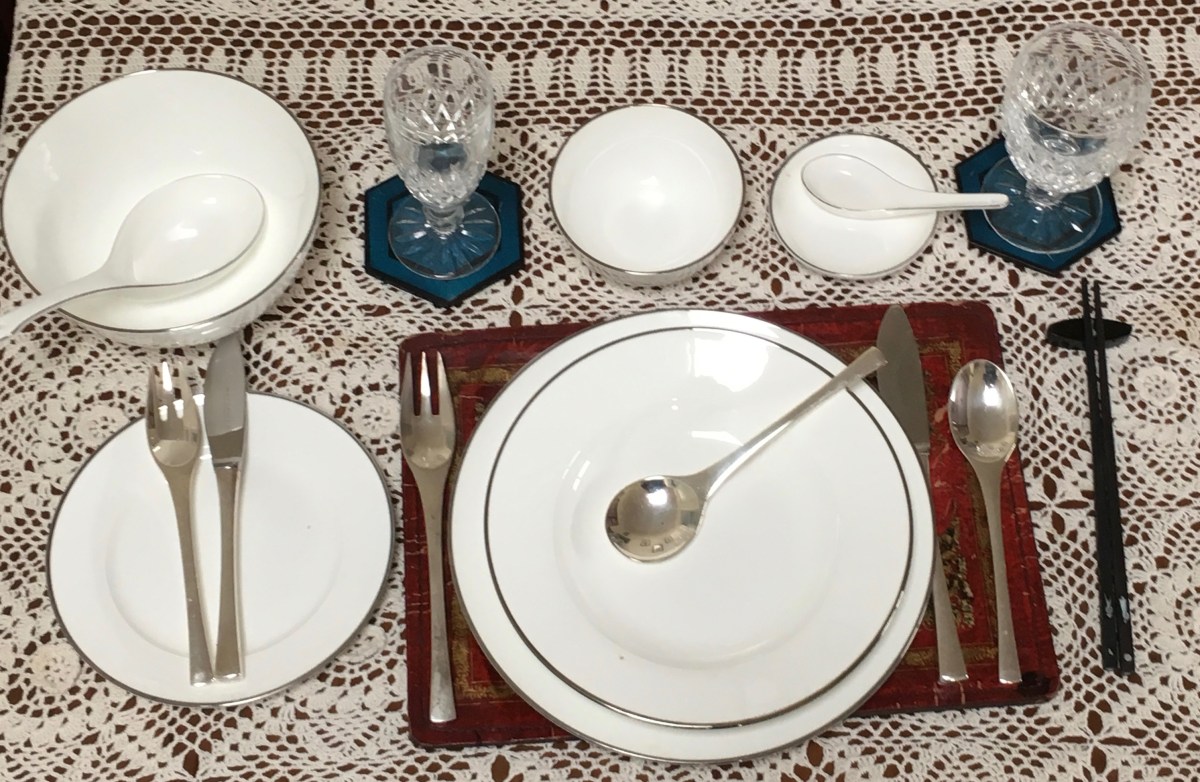
Oh, one last thing, I have a rather pretentious photo of a place setting which I will use as the featured image for Tastes.

I hope you find something you like, or at least can laugh at – i.e. my attempt at very Short crust pastry mince pies.

Mince Pies

Christmas is fast approaching and I was mentally grazing in the aisles of the supermarket recently, marvelling at the variety and sizes of the mince pies on offer. As a child, I used to be fascinated by pies using a mincemeat mixture but which had no actual meat in them, filled instead with a mixture of dried fruits and spices called “mincemeat”. Apparently, the ingredients are traceable to the 12 hundreds, when returning European crusaders brought back exotic recipes containing meats, fruits and spices.
The Puritan authorities frowned on the savoury Christmas pie as it was associated with supposed Catholic “idolatry” with the spices such as cinnamon, cloves and nutmeg calling to mind the offerings of the Eastern Magi while the list of 13 ingredients was supposedly representative of Christ and his 12 Apostles. The Quakers were also opposed to those “who distinguish their Feasts by an heretical Sort of Pudding, known by their Names, and inveigh against Christmas Pye, as an Invention of the Scarlet Whore of Babylon, an Hodge-Podge of Superstition, Popery, the Devil and all his Works.” Nevertheless, the tradition of eating Christmas pie in December continued through to the Victorian era with people preparing the fruit and spice filling long before it was required, storing it in jars.

I recently came across something that has been in the back of the kitchen cupboard for ages – an old and tatty and coverless cookery book owned by my mother. Actually, it is more of a promotional booklet for a margarine that was introduced into Ireland in the 1920’s by Unilever. Apparently, Irish women were reluctant to abandon butter and looked askance at margarine – I remember my father not allowing it on the breakfast table, instead preferring to slather an inch of butter on his toast in the mornings. Anyway, it was not until the advent of the Second World War and the subsequent rationing of butter that the brand began to gain some acceptance. After rationing ended on 2 September 1946 the brand, supported by promotional cookery books like the one my mother had, now missing its first six pages, and later TV ads, began to gain wider acceptance.

I remember my mother used to make four dozen mince pies every Christmas, in addition to the rich, dark fruit cake and the even richer and darker plum pudding, all presumably using this particular brand of margarine. Here and there in the margins, scribbled in my mother’s hand, are additional annotations and, in one place, she wrote or butter beside a margarine based recipe. All I can say is … my mother’s baking – her meringues, stuffed with fresh cream and smeared with dark chocolate, her date and walnut slice but especially her mince pies … I could go on but they were all mouth watering. Anyway, here is the original recipe:

Mince Pies

Ingredients – Extra-Short Pastry:

8 oz. plain or self-raising flour (8 heaped tablespoons); A pinch of salt.

5 oz. Stork Table Margarine; 1 rounded dessertspoon of caster sugar, dissolved in 1 tablespoon of water

Filling:

1/2 – 3/4 lb. mincemeat (for homemade recipe, see below); Milk and caster sugar to glaze

Oven – Pre-heated to moderately hot (Gas no 5, 380F), shelf on second runner from top

Method

1 Have ready 8 – 12 ungreased patty tins.img_0055

2 Make the extra-short pastry: Sieve the flour and salt into a mixing bowl. Rub in the Stork until the mixture looks like fine breadcrumbs. Mix in the water (with sugar dissolved in it) to form a firm dough.

img_0056
Soggy “Breadcrumbs”

3 Roll out two-thirds of the dough on a lightly floured board.

4 Cut into rounds with a fluted or plain cutter a little larger than the tins.

img_0058
Needs a bit of rolling

5 Roll out the remaining dough with the pastry trimmings


6 Cut into rounds with a cutter large enough for the tops.

7 Line the tins with the larger rounds and place 1-heaped teaspoon of mincemeat in each.

img_0060
Using a glass as a pastry cutter

8 Brush round the edges of the smaller rounds with water. Place on top of the filled pastry rounds and press the edges down gently to seal


9 Make 2 – 3 slits across each pie. Brush the tops with milk and sprinkle with caster sugar.

img_0065
Getting messier!


10 Bake in the pre-heated oven for 20 – 25 minutes. Serve hot or cold.

img_0067
The final product – zero points for looks but maximum yums for taste – rich, melt-in-the-mouth-delicious

And there’s my photographich attempt at it. Laugh away, if you want.  I didn’t have any pastry cutters so I used two small drinking glasses and I converted all the oz. to grams, that sort of thing and of course I used butter. I hadn’t prepared my mincemeat mixture either so I bought a jar of ready-mixed fruit mince from the local supermarket for reason explained at the end of this post, but absolutely delicious – no prizes for looks however.


Original mincemeat recipe.

1/2 lb. currents; 4 oz. soft brown sugar (4 rounded tablespoons)

1/4 lb. raisins; 1/4 level teaspoon of mixed spice

1/4 lb. sultanas; 1/2 level teaspoon of ground ginger

1/2 lb. apples; 1/2 level teaspoon of nutmeg

1 lemon; 1/2 level teaspoon of ground cinnamon

4 oz. Stork Table margarine; 4 tablespoon od brandy (optional)

1/4 lb. mixed cut peel

Method

1 Have ready a large mixing bowl and two 1-lb. and one 1/2 lb. jam jars.

2 Wash and thoroughly dry the currents, raisins and sultanas. Stone and chop the raisins.

3 Peel, core and chop the apples finely.

4 Wash, dry and finely grate the rind from the lemon. Cut in half and squeeze out the juice.

5 Melt the Stork in a saucepan.

6 Place all the ingredients in the mixing bowl. Mix thoroughly; Cover and leave for 24 hours, for the fruit to swell.

7 Fill the jam jars. Seal and cover as for jam. Leave to mature for at least  before using.


Who are the Irish & Where did their Language come from?

In a few recent posts – Epochs & the Book of Invasions and Anthropocene – Waves and Epochs – way back in September or October I have been wittering on about past times and after months of dithering, I have decided to put it all together and explain who the irish are and where they came from! No smallorder, I admit. Here goes:

Part One

According to the 11th Century Book of Invasions, the Lebor Gabála Érenn or The Book of the Taking of Ireland, (see earlier blog entry), the Milesians, the last of the six groups of “invaders,” brought the Irish language and constituted what are now known as the Irish people (the Gaels) and arrived sometime between 1700 – 1000 BCE after extensive travelling from Scythia, Greece, Egypt and Spain. These Gaels / Gauls were Celts and preserved their culture in Ireland, untouched by the heavy hand of Rome, where Celtic traditions live on, unhampered until the advent of Christianity 1500 years later.

That’s what I learned in school, anyway and it remains good copy for tourist brochures, I suppose. So the question remains, where, then, did the people and the language come from and when?

Pre-Aryan people initially occupied Ireland, probably from circa 8000 BCE arriving via the then existing land bridges, connecting Ireland with the Isle of Man, Scotland and mainland Britain. Judging by the number of polished stone axes found throughout the island dating from this Mesolithic period c. 8800 – 4900 BCE, there was more than likely a common language among these early inhabitants. Whatever that language was, it most certainly was not Irish or anything remotely connected with it. These hunters and gatherers, the first “Irelanders” left little behind them that archaeologists could use other than a handful of small stone tools – microliths – and the recently discovered remains of two people dated from 7200 – 6500 BCE. However, both Britain and Ireland were abandoned when the glaciers expanded and northwest Europe became too cold so that populations retreated to southern France and northern Spain before moving north again as the climate warmed.

The start of the Neolithic Period, roughly 4900 – 2000 BCE, ushered in the rise of farming communities with the arrival, at different times, of different groups of people, some from the north and some from the southern Atlantic seaboard.

These indigenous, pre-Celtic people built massive stone structures sometime between 4900 – 2000 BCE. Most notable among them are New Grange or Brú na Bóinne, just north of modern day Dublin, indicative of a noticeable change in the material and spiritual culture which had gone before.

The Bronze Age, c 2000 – 500 BCE, brought, along with metallurgy, a new style of ceramics – Beaker ware – which quickly superimposed itself on the earlier Grooved ware pottery but there is no direct evidence that “Beaker people” moved from north-west Europe into Britain and then on to Ireland despite the abundant evidence for a Beaker presence in Ireland. Ideas travel, not just people. What is clear is that the Beaker people established, or maintained, a network of trade both within Ireland and between Ireland, Britain and Atlantic Europe, which, of necessity, would have involved communication and immigration in all directions.

The early Bronze Age (2000 – 1500) was also the Age of the Megaliths and examples can be found along the Atlantic seaboard where trade flourished. Ireland was a vital part of a chain of contacts extending into Europe by reason of it being a source of gold and copper, the latter abundant in Ross Island in southwest Ireland.

Between 1500 – 1200 BCE – the Middle Bronze Age – Ireland underwent extensive land clearance, along with improvements in transport with the establishment of track ways across bogs and the rise of the hill forts. Prior to this time, Irish circular dwellings had their entrance on the north side, but after 1500 BCE entrances moved to the south and the east, another possible indication of a change in customs brought about by new immigrants, but again not sufficient to warrant the introduction of an Irish language.

However by 1000 BCE, there are signs of a society splitting into tribal societies with regional centres such as Eamhain Macha and Crúachan. These hill forts usually consisted of a ditch surrounding the summit of a raised area, the up thrown soil forming an inner wall, enclosing easily defended internal areas. Some of the larger hill forts would have up to three defensive rings around the protected centre. These massive structures, the products of community labour and effort over an extended period, must have been for defence or as trade and exchange centres or ceremonial sites used for communal feasting, but whatever their purpose, they served to focus communities in the vicinity. Nearly 5000 Fulachta Fiadh, stone troughs used for a variety of purposes, including cooking, brewing and so on, are in close proximity to these centres, again indicative of a communal purpose outside of the individual home. By 800 BCE, the largest architectural structures of the entire Bronze Age had been completed.

Because hill forts required massive co-operation, society became characterised by the rise of the elites, including that of the warrior in search of fame and glory, marked by advanced weaponry and ornamentation. By the Late Bronze Age, c. 600 BCE, Ireland was changing again with substantial reforestation and a decline in agriculture with settlements reduced down to small family groups.

(To be continued)

Further reading: J.P. Mallory – The Origins of the Irish

Simon James – The Celts

Helen Litton – The Celts

Kenneth H Jackson – The Irish Language and the languages of the world


Another Direction

“Christmas is coming and the geese are getting fat,

Please put a penny in the old man’s hat”

is a rhyme from this time of year that I remember from my childhood and as I start laying in stocks of booze and food for the festive period I thought I might well update my blog with a new section devoted to … you guessed it, Food.

I haven’t done much on Curves recently, too busy with other rubbish, I suppose (more about that later), but I think I will overhaul the site and give it a new look as well as.

So, Food … hmm, recipes, I suppose. Now I can limit myself to traditional Irish recipes, given that the site is Red Branch Chronicles and was originally set up to promote my novel set in iron-Age Ireland, Raiding Cooley or … I can cast the net a but further afield and do world-wide recipes from places I’ve lived in and travelled to. Hmm, tugs at hair absent-mindedly, I’ll have to have a think about that.

Anyway, while I think of it – Happy Christmas everyone!

I will attempt to justify my lack of new Curves by telling you that I have been struggling with a wealth of data recently in an attempt to untangle where and when Irish people and their language came from, looking at the old annals as well as modern linguistic, genetic and archeological research.  Drowning in data at the moment but will hopefully make sense of something before Christmas.

The other thing is that I have finally decided to start on a new novel.  Spent the last two days scribbling away in a notebook and got quite excited about the whole project.  Something completely different to what has gone before, but that is all I can say at this moment.

Memory of a Childhood Christmas in Ireland

Christmas has always remained in my memory, I suppose because it was such a magical and loving time. For weeks before Christmas, food preparation was in full swing. Mummy would set about making the gigantic Christmas cake and three dozen mince pies. Daddy would spend every spare moment in the Golf Club trying to win a turkey or a special Christmas hamper. Stockpiling of foods and drinks would begin. Large brown glass flagons of Bulmer’s Cidona would be stored on the floor in the pantry under the stairs, green bottles of 7-Up would be bought for the “chiselers” while mummy would always have to remind daddy to pick up a bottle of A Winter’s Tale Sherry for granny. My father would receive gifts of bottles of Jameson whiskey and Cork CDC gin and every year we would be given a box of strongly smelling coal tar soap from McCormack’s Coal Merchants near the old west pier. I never thought to ask why we received these gifts from people I had never seen; it was just the way it was.

The Christmas tree would be bought a few days after my older brother’s birthday on December 15. Usually, we would get it from Davis’ shop around the corner of Temple Hill but sometimes we bought it from the narrow little shop with the two high stone steps leading up to it down in Monkstown, near the roundabout. It was always my job to find the Christmas tree stand, a hollow iron tube with three supporting scroll-like legs. Then the bole of the tree would have to be whittled down, by my brother with the small hatchet, out in the back garden, to fit into the tube or, if the bole was too thin, it would be wedged into place with old magazines.

Christmas decorations would be taken down from the attic above the bathtub and my brother would be needed to climb up there. My father would test the two sets of Christmas lights, the wires still wrapped around a rolled up magazine from the previous year. Invariably some of the bulbs of the Disney decorated lights in their old-fashioned egg-cup-sized plastic shades would need replacing, as would a few of the elegantly shaped plain coloured lights.

Orders for the ham and the turkey and a peculiar, gritty, brown spiced beef would be placed with Farren’s down in Blackrock or sometimes further down the Main Street at Grehan’s the butcher, with its old worn wooden chopping blocks and the sawdust liberally sprinkled on the tiled floor. The Galtee rashers and Hafner’s sausages and black and white pudding, and the kidneys would, of course, be bought up in Rheinhart’s or Hicks in Dun Laoghaire. My mother never did all her shopping in any one shop or supermarket, but would distribute her trade among a dazzling variety of places in both Blackrock and Dun Laoghaire which always made going shopping with her an exhausting business. God help you, if she sent you out alone with two pound notes wrapped up in a shopping list and you bought everything in one of the new supermarkets coming on stream then at that time in Dublin!

Christmas Eve followed a routine. Twice the amount of potatoes – half for mash and the other half to be roasted with the turkey – had to be peeled and left standing overnight in a large pot of cold water out in the scullery. The fires had to be set, but not lit, in the drawing room and in the dining room. The mahogany table in the dining room had to be dusted with Johnson and Johnson wax polish before one of the “good” linen, lacy tablecloths was put on. Then the heavy, gilt-edged place mats would be placed around the table for the six of us while the heavy box of silverware cutlery had to be pulled out from under the sideboard and every piece polished along with the silver table candelabra and the silver sauceboats. Then, they all had to be washed in hot water and dried carefully to prevent watermarks forming. Usually my sisters would have to attend to all of that while my brother and I were in charge of the potatoes and last minute urgent messages up or down to the shops. Everything always had a sense of urgency about it which all added to the Christmas thrill.

Short quarrels would break out among my two sisters and brother -all older than me – waiting impatiently for their turn in the one bathroom, one or other of them impatiently opening the door of the kitchen cupboard and feeling the huge copper tank of the old hot-water immersion heater and complaining that the other was using all the hot water. I was always the last to get my bath as I wasn’t going anywhere on Christmas Eve.
Instead, mummy would give me one of daddy’s or my brother’s, rugby socks and I would pin it up on the wooden mantelpiece in the drawing room beside my sister’s stocking, the elder two siblings too old for that kind of thing. A small tray, with a home-made mince pie, a bottle of Guinness Stout and a small glass of whiskey on it, had to be prepared and left out for the imminent arrival of Santa later that evening

Then, sitting excitedly in the kitchen, watching Bonanza on TV while my mother made last minute, endless preparations and my father sat by himself at the card table playing intricate games of Patience and Solitaire while he waited for my mother to finish whatever she was doing so that they could play their nightly game of gin rummy.

I’d twitch aside the kitchen window curtain sometimes to spot Santa on his sleigh or, even more magical, to see the snow swirling down in the orange glow of the street lights along Monkstown Road.

Up early the next morning, vague memories of my brother sitting on the edge of the bed the previous night, smoking a forbidden cigarette before flicking the butt out the window into the rhododendrons below. My father would shake us awake in the cold darkness by 6:45a.m. but no complaining was allowed on Christmas morning. Waiting downstairs in the hall for my mother, who was invariably the last to come down the stairs, I would just have time to peek into the closed drawing room to ensure that Santa had actually come in the middle of the night, appreciated the thoughtful offerings and that my stocking was bulging.

Then the brisk walk, led by my father, down to the church in Blackrock for the 7:30 mass. Numbed by the cold and the eerie quietness of the hour, our breath hanging in the still air, the church was alive with whispers and murmurs, the altar ablaze with candles and flowers, the air thick with the smell of incense, the priests resplendent in their heavy, embroidered robes, solemnity on everyone’s face, Children, smaller than me, unable to restrain themselves, squirming in the hard wooden pews whispering “Is it over yet? is it nearly over yet?”. The long, tortuously slow, queue for communion, people edging in and out of their pews while we waited our turn and then finally the priest would intone “The Mass is over, Go in peace” to which the congregation would respectfully reply “Thanks be to God”!

It would take an age to shuffle out of the church, dipping the tips of our fingers into the freezing holy-water fount in the vestibule and then stepping out into the cold still dark air, greeting well-wishing neighbours and relatives before heading back home, up Temple Hill, the excitement mounting for the day ahead.

Hats and coats off and put upstairs in the bed rooms to leave room in the pantry for visitors coats and scarves, but still no time for present opening, and then mummy would disappear upstairs to do her hair while my father took charge of the scullery, a linen dish cloth tucked into the front of his trousers, his collarless shirt open at the neck. The large kettle would be put on for tea while I would finish setting the breakfast table in the kitchen. Halved chilled grapefruit, each segment carefully loosened with a serrated paring knife, sweetened with a dusting of castor sugar, a red cherry in the centre, would be placed in glass bowls and put at each place setting. Daddy would light the oven and start the massive fry of bacon and sausages, eggs, black and white pudding, mushrooms, kidney, sliced tomatoes, the lot kept warm in the hot oven, the day outside slowly brightening. Waiting for mummy, my father would impatiently jerk open the kitchen door and go out into the hall to shout up the stairs to his wife “Shall I take the mea?” This was a common spoonerism, along with “Shall I take the most” that we all understood but which only served to irritate my mother who never understood what he was saying but who never failed to respond. She’d open the bathroom door and demand to know what was he talking about.

Finally breakfast, and with a flourish, daddy would serve us all, mummy snapping “mats, mats, mats” for the plates, red hot to incautious fingers. Cups of hot tea, Yorkshire Relish liberally sprinkled on the fry, runny egg yolks mopped up with crisp fried bread. As soon as breakfast was over, everyone had a job to do. Someone had to do the washing up, someone else had to dry and put away everything, then the two fires in the drawing and dining rooms had to be lit, ice put in the plastic pineapple ice bucket on the trolley in the dining room along with the ginger ale (for the whiskey), tonic water and the Mi-Wadi orange squash (for the gin). Then glasses and tumblers needed to be laid out on the sideboard and the oven in the scullery turned on to preheat for the turkey. The ham had to be taken out of the water in which it had been steeping overnight and rinsed in cold, fresh water and then put on to cook gently, steaming up the windows in the scullery.

Daddy commandeered the bathroom to shave, affix his collar to his starched white shirt and Brylcreme his hair, while mummy closed herself up in her bedroom to, yet again, get ready. Last minute ironing of pleated skirts would be carried out by my eldest sister, while my brother and I would wrestle with starched new shirts. Someone would be pounding on the toilet door, mixing accusations of whoever was inside of reading to desperate pleading that they were “bursting” and all the time, the pressure and excitement continued to mount among the increasing bustle of our Christmas morning.

To release some of this pressure – and to keep me from under their feet – my sister and I were now allowed to open the Christmas stocking presents, but on no account to touch the brightly wrapped packages and parcels under the Christmas tree by the drawing room window. Cheap, wind-up toys, made in Hong Kong, and bought in Hector Grey’s, off Henry Street in Dublin, Dinky and Matchbox cars, plastic bracelets, hard sweets and Urney chocolate bars barely dented our fierce anticipation.

No presents could be opened until we were all assembled in the drawing room and the turkey had finally been put into the oven. A week or so before Christmas, Daddy had given me a few pounds to buy presents for my brother and sisters well as giving me a present – usually a heavy brass figurine – to give to mummy. Now, sitting on the couch in the drawing room, the heat from the fire, the twinkling of the Christmas tree lights, the chocolate already eaten on top of the huge breakfast, the imminence of present giving made me almost sick with excitement. Not only were there the presents from mummy and daddy, but also from my sisters and brother, granny, my Godmother, and from different aunts and uncles. In addition, there were also the communal presents of large tins of Quality Street sweets and flat tins of Butter Shortbread.

And then mummy would finally come down the stairs and daddy would insist on her having a small whiskey and ginger before anything else could be done. At last, reaching under the tree, he would lift up the first present and make a great show of squinting at the label on it before reading out loud the gift card sellotaped to it. The frantic tearing off the paper to reveal jig-saws, Mechano sets, Lego, storybooks, Christmas Annuals of The Beano and other popular comics, The Guinness Book of World Records, sets of cuff-links for my brother, Switzer’s vouchers for my sisters, torches with coloured plastic overlays, board games of Cluedo and Checkers, new shirts, fleece-lined pyjamas. The big moment, of course was when daddy gave his present to mummy. We all knew that the success of that particular gift would make or break our Christmas Day. There would be an involuntary silence while daddy would present a carefully wrapped package to her. Sometimes it would be a large flat package which, when opened, would reveal another smaller one inside that and so on until finally Mummy, with a great show of exasperation, would demand to know was she getting anything at all.

Looking back now, I can’t remember the hits and misses that must have occurred over the years. I do remember the elegant bracelet, each slender, oblong green stone encased in fine gold links and the looks of joy and happiness that passed among us all. And then, “Cripes, the turkey”, daddy would shout and rush off to the kitchen to baste the slowly roasting turkey with hot oil.

My sister gave daddy one of the first small, pocket electronic calculators I had ever seen and we amused ourselves by calling out involved sums to daddy which he would do in his head faster than our clumsy fingers could tap the numbers into the display. “Bloody thing!” he’d claim, proudly “Sure, can’t I do all of that stuff in my own noggin just as well?” Months later, I noticed that he always kept it in the breast pocket of his suit for ease of constant access!

By 12 noon, the first visitors arrived. We didn’t have a car, so we never went anywhere on Christmas Day. Instead, uncles and aunts, cousins and neighbours would drop in for Christmas drinks and to exchange presents, if they hadn’t already dropped them off in the days preceding Christmas. “How art thou?” mummy would archly greet the menfolk. Granny, in her high heeled, black, buttoned boots, diminutive in an armchair, clutching her glass of Winter’s Tale, a morose aunt in a coat with a fur-trimmed collar, sipping a small whiskey and ginger, a jocular uncle in a mustard coloured waistcoat, his hands tucked under the flap of his loud check jacket, warming his backside at the fire, a large gin and tonic on the mantelpiece beside him, a thickset uncle, reminding me a badger, a white streak in his thick head of hair, a twinkle in his eye belying the severity of his look, cuddly aunts, smelling of perfume and sherry, the sweet tang of pipe tobacco, the roars of cousins racing up and down the hallway and stairs, a tall uncle with a beaky nose coming out into the hallway to bellow “Shout quietly, or I’ll knock the block off the lot of you” before helping himself to another whiskey in the dining room.

Just as suddenly as they had all come, they were gone and the job of picking up the torn wrapping paper – mummy always wanted to save it while daddy would order me to throw “the bloody lot out, for cryin’ out loud”.

On the second basting of the turkey, daddy managed to splash his wrist with the hot oil and an enormous, painful blister immediately developed. I was amazed at his stoicism until I overheard my brother whisper to my sister that he was fluthered. The kitchen – the heart of the house – was unnaturally quiet and empty, the smell of the roasting turkey and the gently cooking ham and spiced beef flavouring the room. As suddenly as the bustle had begun, quiet descended with mummy and daddy going upstairs for a snooze, after giving strict instructions about putting on the potatoes and preparing the vegetables for a late dinner at 5:30 or so.

A second round of visitors would arrive then for my older brothers and sisters. The drawing room would fill with the smell of cigarette smoke, bottles of Smithwicks beer and Harp Lager would appear. I sat, half hidden, at the top of the stairs, peeping down at my sister kissing a tall, dark, saturnine boy in the hall under the mistletoe while I nibbled home made traditional mince pies.

The dining room table had to be checked, fresh mustard made in a tiny blue dish which sat inside its own silver pot. My brother would carefully open a bottle of red wine for my parents and make sure that there was enough white wine in the fridge. No shortages of anything could be tolerated on Christmas Day

Mummy and daddy would come downstairs, looking refreshed after their afternoon snooze and my father would carefully stoke up the fire in the drawing room so that there would be a good blaze there when we returned after dinner. Mummy would cautiously stir her home-made parsnip soup and adjust the season while daddy would have another small whiskey before dinner to take the edge off his appetitie (he used to claim) so that he could enjoy the dinner the more!

Then, when we were all ready and set, the lights would be dimmed, the candles lit and mummy and my sisters would start carrying in the food from the kitchen. Turkey on a huge oval platter decorated with sprigs of holly, crisp roast potatoes in a bowl of their own, creamy, fluffy mashed potatoes with a glaze of brown sugar in another, moist Brussel sprouts adding colour to the carrots cooked with honey and brown sugar, peas glistening with melted butter, the round Irish ham studded with cloves, spiced beef, pink and rare in the centre, crusty and brown around the edges, candlelight glinting off daddy’s precious Waterford crystal glasses, our plates loaded with everything we desired, and always plenty more to come. When we could eat no more and the dinner plates had been cleared away, the candles blown out, my brother and mummy disappeared back to the kitchen to reappear with the plum pudding on its special Christmas plate. My brother had carefully poured a small glass of brandy over the pudding and just as mummy carried it into the dining room, he would light it with a match so that the round hump of the pudding was wreathed in exquisite blue flames as the liquor burnt off. Of course we were all far too stuffed – had sufficient, mummy would attempt to get us to say – to even attempt a serving so the pudding, after being admired by all was carried back to the kitchen and stored for the following Easter! Instead, the fruit and sherry trifle would be carried in by my sister. A light sponge base, doused in sweet sherry and loaded with fruit suspended in jelly topped with fresh, whipped cream, we could always find room for a few spoonfuls. Daddy would make the coffee in the rarely used percolator and allow us all to have a tiny glass of liqueur – coffee-flavoured Tia Maria, honey infused firey Drambuie, or the sweet orangeness of Cointreau.

The tedious task of clearing the table and washing all the plates, bowls, dishes, cups, silverware and glasses was divided up amongst us all. Once again, everybody had a job to do, picking up and tidying because, as mummy used to say, ”You’d never know what dog, cat or divill might drop in on top of us.”

Back from the chill of the unheated kitchen and scullery and into the warmth of the drawing room where the flames were just beginning to lick through the coal slack daddy had heaped on the fire before dinner. A fresh tea-towel would be laid on the low coffee table and the Christmas game of poker would begin. Almost a rite of passage, it was not a game I was allowed to play as a child. Daddy took poker seriously and showed no mercy to mummy or anyone else as he bluffed, raised or bet. Woe betide anyone who mis-called their hand of cards. I remember, sitting on the arm of his armchair, when someone, in an attempt to theatrically raise the tension of a winning hand, called out their opener as two pair when fours were actually held. Daddy insisted on enforcing strict rules and a declared hand was entitled to that value only. Tears and apologies were brushed aside and no quarter was given in a cut and thrust game of family friendly poker. “Sure, if you can’t afford to lose the money, you shouldn’t be playing the game in the first place” was daddy’s hard maxim. Looking back now, I see it as an attempt to prepare us all for the harsh realities that we might well face outside the security of our own family. Hard lessons were learned by us all but, for us all, it was still a part of Christmas.

Exhausted by the excitement of the long day, sated with rich food, bloated with fizzy apple Cidona and Seven-Up, giddy from the strength of the liqueur, it was all I could do to keep my eyes open as the carriage clock on the drawing room mantelpiece ticked away the minutes remaining on Christmas day. Gathering up my books and games and toys, the Airfix models sets, the Mechano, Lego boxes, coloured-light torches, teddy bears, the new shirts still in their cardboard boxes, I often needed a strong extra arm to help me upstairs to bed. And then the pleasure of finding, last thing of all, that someone had remembered to put a hot-water bottle into my bed. Drifting off into warm sleep, my last thought would be that the next day would be just as good