Ireland was a different story – relatively untouched by Rome, society there did not change dramatically until the advent of Christianity 500 years later. Groups of Celtic speaking people continued to arrive and leave, bringing with them La Tène styles and influences. Iron Age Celts thus survived in Ireland long after it had been wiped out elsewhere.
Linguists refer to the languages spoken in Britain and Ireland as Insular Celtic which can be further subdivided into Brittonic or P-Celtic and Goidelic or Q-Celtic, as in the table below.
|
Insular Celtic
|
|
Brittonic or P-Celtic
|
Goidelic or Q-Celtic,
|
|
Ancient British
|
Welsh |
Cornish |
Breton |
Irish |
Scots |
Manx
|
|
|
|
|
|
|
|
Whether the ancient Celts can be identified with the Gauls that Caesar defeated, the Insular Celtic languages are closely related to one another and to the other Celtic languages of Europe, now sadly extinct. Although the earliest record of what is now known as Irish dates from the 5th century A.D. in the form of a simple inscription, there is no doubt that Irish is a branch of Celtic which is a branch of Indo-European and Irish cannot have arrived in Ireland before the spread of the Indo European languages.
Despite the similarities and inter-relationships between the Celtic languages, it is not possible to pinpoint the exact origin of Irish. Linguistically speaking, the more similar two languages are to each other, the less time they have spent apart and the languages of Ireland, Britain and Gaul are remarkably similar and related to Proto Celtic.
Obviously, languages like French, Spanish and Italian bear striking similarities, so much so that they can be viewed as cousins, with their parent language being Latin, as spoken during the Roman Empire.
Similarly, Irish can be seen as cousin to Welsh, Cornish and Breton on one hand and to Scots Gaelic and Manx on the other and the original parent language would have been Common Celtic.
|
A subset of the Proto- Indo European Family of Languages
|
| Celtic |
Italic |
Germanic |
Slavonic |
Greek |
| Irish, Welsh, Cornish, Breton, Scots Gaelic & Manx |
Latin, French, Spanish, Italian etc. |
English, German, Scandinavian languages |
Russian |
|
The shared vocabulary of all Indo European languages, including Celtic, indicates there could have been no separation of the Celtic group into divergent dialects before the development of farming soon after the end of the Stone Age as the ancestors of Indo European flood in from Eastern Europe and Western Asia in four main Language groups – Graeco-Latin along the Mediterranean, the Germanic around the Baltic, the Slavonic in the east and the Celtic in the centre and west. It is impossible to see “Irish” arriving during the Neolithic period as that would postulate a physical split between the earliest speakers of Irish, British and Gaulish back to 4000 BCE.
Equally, it is next to impossible to imagine a Celtic language entering Ireland much before 1000 BCE. Although Ireland was in contact with Britain and Europe for nearly a thousands years prior to this, as seen through the distribution of ceramics, polished stone axes and megalithic tombs, and that link continued throughout the Bronze Age, with the exchange of weapons and ornaments, but again there is no direct evidence for Irish having been introduced as a “trade” language or as a “lingua franca”. Neither Irish nor any other Celtic language have the aspect of a pidgin or trade language nor are they simplified in any way while their respective grammars and vocabularies retain the full range of their Proto-Indo European ancestor.
By 300 BCE, archaeological evidence indicates the spread of La Tène culture and the arrival of small groups or bands but no sign of a major settlement of a foreign population. Nevertheless, the evidence of tribal names suggests that Celtic speakers, both Goidelic and Brittonic with the former gradually subsuming the latter, occupied large areas.
So, if the accounts in the Book of Invasions are discounted as to the origins of the Irish and their language and Irish was not a trade language introduced during the Bronze Age, what is left?
Although multiple opportunities for a language shift in Ireland have been postulated, the one most likely to have been the direct ancestor of Irish aligns itself with the rise of the hill forts from 1000 BCE as the sites assumed significant religious and ceremonial features. The spread of regional centres in areas of Ireland – Crúachan in the west, Eamhain Macha in the north, Dún Ailinne in the east, Cashel in the south and Tara in the middle – might also herald the arrival of a new language.
So, although Irish was not native to Ireland, there would have been Celtic predecessors brought in multiple times by small groups from similar areas of the Atlantic seaboard and Britain who introduced their language, not through warfare but more likely, through having a more productive economy or just by simply outnumbering the sparse native population and whose identity became subsumed under a continuing influx of Celtic people. Bi-lingualism is the first stage when two languages meet and the native Irelanders would have adopted Proto Irish if it had been in their interests to do so.
Languages represent social phenomena with no language being intrinsically superior or inferior to another. Instead, language is used to fulfil essential social contacts in areas such as religion, law, sport, trade, literature and so on. Linguists refer to these social contexts as “language domains”. The new or target language is often linked with specific domains and, in the case of a “proto Irish” arriving in Ireland, the new language must have either filled in an existing domain or else created a need for a new one so that the native inhabitants would have thought it worth their while to embrace the new language.
So, the most probably reason for the adaptation of a “proto-Irish” by native Irelanders was that the new language offered the people access to something they did not have before – perhaps it was a tighter form of social organisation,
based on stratification, feasting, gift giving or some type of social prestige – a warrior elite or a new religion. Traditionally, the spread of world religions often carried with it a new language, Islam and Arabic, for example or Christianity and Latin.
The spread of hill forts and the regional centres they controlled, along with the rise of iron weaponry, leading to a warrior elite such as the Red Branch (Craobh Ruadh), with society forming clearly delineated stratification lines between tribal chiefs, religious leaders or druids, the warrior elites and the trade and craft people all tended to attract the native Irelanders to a new social system and the language that came with it. The overall result might have caused the native “Irelanders” to identify with and behave like the early speakers of “proto Irish”.
So, on the basis of archaeological, linguistic and genetic evidence, it seems most likely that from 1000 BCE, “proto Irish” would have arrived with different Celtic groups, pushed to the fringes of Europe from the inhabited La Tène lands into Britain and then further west into Scotland, Wales and Ireland. Certainly by 100 AD, a Celtic language, the predecessor to the modern Irish language, was in place. Linguistically, Old Irish was a monolithic language, meaning that, if it had been in Ireland for millennia, it would have developed dialects, which it did not do until more recent times.
In conclusion, it seems that the language known today as Irish arrived in Ireland sometime between 1000 – 100 BCE with evidence for both Brittonic and Goidelic groups establishing central foci for existing communities and ultimately providing a means of dividing Ireland up into different social groups, tribes and clans. Nevertheless, it would be nonsense to think of the people then as an Irish nation, the first reference to which only occurred nearly 1800 years later!




 I recently received the European Peace Walk (EPW) guidebook for 2017. I know I mentioned ages ago that I was going to do this Walk – a 500+K walking trail through six European countries – Hungary, Austria, Croatia, Slovenia, Slovakia and Italy – over three weeks. It seems a bit daunting, given the current state of my overall fitness. Some days involve 30K hike between sleepovers and the most I’ve done so far is about 16k or so. Anyway, I don’t begin until mid summer – July 04, – so I still have a few months to get up to speed.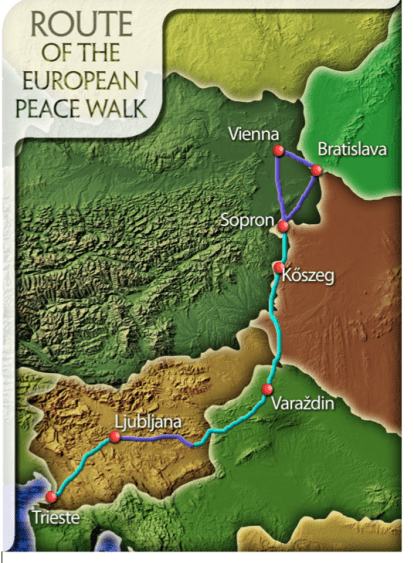

 The basic ingredients, which remained the same as far down as Santiago in Chile, are:
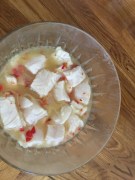
 I suppose some might be put off by the amount of limejuice – too acidic, I can hear people say. However, limes and lemons while acidic of course, somehow become alkaline when consumed and besides use only as much of the strained marinade – tiger milk – as you feel comfortable with.
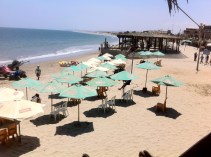 birds swooped in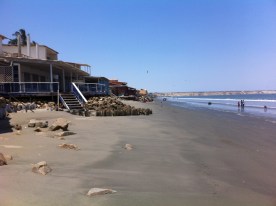
 The approach to the capital was along sand-blasted looking cliffs while a sullen slate-grey Pacific rolled relentlessly against the shore where an immense grey city, perpetually wrapped in a silver sea mist or fog, sprawled.
 It is always such a fantastic thing to go somewhere and then indulge with the national dishes and one of Peru’s national dishes is roasted guinea pig – I bet it tastes like chicken! Of course the other national essentials are ceviche and pisco sours – rum, lime, sugar and egg white whipped up in a blender.
 n the mountains in Peru, the old Inca capital, at about 3600 metres above sea level means difficulty breathing – but not for the Incas who built the city more than 500 years ago. The Spanish came then and raped the city, stole the gold and used the blocks of
  stone from the Inca temples to build their own churches and buildings. An amazing, solid city high in the mountains – a Siam Reap or an Ayutthaya alive with their original inhabitants, along with the tourists. Churches and squares everywhere instead of temples and pagodas – atmospheric and bewildering, warm during the day and then freezing at night. T
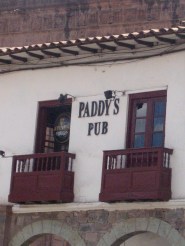
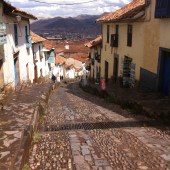 he steep climb between my hostel and Paddy’s Bar, the highest 100% Irish owned bar in S. America at 11156 feet, was an exhausting and panting effort! Machu Pichu become unattractive to me at an even higher altitude and I headed to the lower altitude city of Arequipa, surrounded by snow capped mountains and guarded by three active volcanoes – the last eruption only a dozen years or so ago.
 of cocoa leaves, for the altitude she had insisted and I decided to go to Cusco’s local wet market where I was sure to find more. For a few cents a withered crone stuffed a bag the size of a pillow case with the bitter leaves and then threw in a few sticks of some grey resin, stevia it turned out, to offset the bitterness of the leaves when chewed. There was the most incredible variety and abundance in the market, fresh squeezed juices, fruits and vegetables, most of them totally unknown to me, piled high in gleaming mounds. Potatoes ranged in siz
 e from peanuts to cabbage size and in colour from black to purple and yellow while the market itself was spotless, bright and airy. Corn was everywhere and in every size too from tiny kernels to knobs as big as my little finger joint.
 Smiling girls in elaborate costumes decorated with silver coins and outlandish headdresses cuddled baby alpacas in their laps and posed against the massive stone blocks of an imposing church for tourist photographs but I was more interested in food.
 Fatigued from both the altitude and the culture overload about cities I had never before heard of, and their extraordinary churches, convents
  and castles – all built at the behest of a handful of Spanish (less than 180 men) who invaded in 1530 or so and conquered the ruling Inca tribes and their vast empire stretching almost the length of the continent, I moved on to Puno, the stopover point for Lake Titicaca, the highest and one of the largest lakes in the world, making Lake Argyle in the Kimberley in West Australia look like a puddle.
 Their high prowed reed boats provide both a security and a living on the immense lake. A bit like the old Celtic habit, I suppose, of building fortified, enclosed homes on brushwood platforms over water or bogs – the Crannóg.
 Red Branch Chronicles
You must be logged in to post a comment.