(I know, I know this isn’t really Celtic Iron Age Trivia / Technology like the other posts in this category have been but …. well, it was just St. Patrick’s Day (March 17) this day last week so here goes – sorry if I dispell any myths!).
Go into any Irish pub anywhere outside of Ireland itself and no doubt there will be a mural or picture of the saint himself, mitred, robed, smiling beatifically or looking suitably sombre and not a pint of Guinness in sight.
The reality was rather different as it turns out.
Patrick, whose birth name was Maewyn Succat (b.390 CE), was the son of Conchessa and Calpurnius, a tax collector appointed by the Roman administration in western Britain. Patrick’s family were local stock who had long accepted Roman rule and custom and would be considered well to do in that they themselves were slave-owners.
Constantine the Great had earlier exempted Christian clergy from city council duties and, as increasingly frequent raids on the coastal districts made collecting taxes difficult, Maewyn’s grandfather, Potitus, had taken full advantage of the exemption by entering into a relaxed form of Christianity.
Calpurnius, however, was obliged to resort to harsh methods to collect the amounts demanded by Rome as, if less than demanded was collected, the “exactor,’ as Calpurnius was known, had to make up the deficit from his own pocket.
Stillicho, a Roman legate, was insisting on the full tax levy and Calpurnius was under a lot of pressure to buy and sell slaves to redress the difference
In 406 CE, Irish raiders attacked their Roman style villa and enslaved the 16 year old Maewyn to herd and tend sheep in the rugged countryside around Slemish, Northeastern Ireland. By 410 CE, all Roman forces had withdrawn from Brittania, leaving the country exposed to continuing raiding by Goidels or Irish raiders.
The youth spent 6 years in thrall to Irish pagans, where he discovered both his “anam cara” – the friend of his soul with his God and an empathy for his captors as much cut off from the true religion as he felt himself to be. Guided by a voice only he could hear, he escaped captivity and, convinced of his divinely inspired mission, studied under Bishop Germanus in Auxerre and again in Rome, determined to bring salvation to the people controlled by their pagan druids.
In 431 Pope Celestine I, concerned more at the growth of Pelagianism in Britain than the rife paganism in Hibernia, sent his bishop to suppress the Pelagianheresy but Palladius died with no success in Scotland in 432.
Maewyn, meanwhile, had received the tonsure at Lérins Abbey and taken the name Patroculus, and jumped at the chance to return to the island of his slavery and pagan druidism. Celestine sensed that Patroculus was made of sterner stuff than his former envoy and as a womaniser, a fighter, a hard man of his times, well used to both the power of the word as well as the sword, he would be an invaluable bulwark against the bishops in Britain who stuck to their heretical ways. Patroculus certainly never claimed to be a saint but by his death in 461 he had founded a base for Christianity in the far-flung western isle that has never wavered since.
Happy Saint Patrick’s Day for next year if you missed it!
According to Julius Caesar and other writers and chroniclers from the first century BCE, such as Strabo, a Greek geographer, and Diodorus Siculus, an historian from Sicily, the ancient Celtic druids were more than just a semi-mystical priesthood.
Caesar certainly saw them not only as an organised inter-tribal brotherhood who acted as living repositories of their tribal histories and legends, negotiating, legislating, judging and officiating over all individual and community oaths and sacrifices but also as a rival authority to the extension of Roman power among the so-called barbarian tribes of the north.
Others regarded druids as poets and bards, seers, teachers, historians, astronomers, medical practioners and – later through the distorted lens of early Christians – as devious wizards and magicians who kept their people in thrall with simple sleight-of-hand tricks.
Probably all of the above is true, in some sense, in that they were, without doubt, the learned men of their people who had the recognised and unquestioned power to ‘excommunicate” individuals from community events. All commentators agree that they had a vast store of knowledge which they acquired orally and passed on to their followers over a 20 year training period.
No doubt they were poets and bards as the easiest way to memorise huge tracts of knowledge relating to tribal law and ownership was to make use of standard poetic functions such as alliteration, rhyme, onomatopoeia, simile and metaphor as a way of preserving and keeping alive tribal history and legends.
However, as no written records*1 exist of what the druids knew or learned, it is mere conjecture to say what they actually did.
Nevertheless, it is feasible to consider how the classical ancients described them and to put that knowledge into a suitable context.
It is likely that the druids became the sole provider of laws and customs among the widely varied nomadic and pastoralist Celtic people inhabiting Europe from the Early Iron Age, c.800 BCE. Being outdoors as a way of life, the druids would have become very receptive to the divine powers inherent in nature and would willingly have entered into a communion with them, having gradually assimilated facets from other existing codes of law and belief into their own oral bodies of knowledge. As nomadic people settled and adopted agriculture, more elaborate rituals and sacrifices were needed and the druids eventually became the predominant social and political bond uniting all Celtic people that Caesar feared so much and vowed to destroy.
What is known is that druids could be both male and female, with the men shaving their head across the forehead, leaving the hair long at the back, and that they were exempt from taxes and military service. Extraordinary attention was paid to the human head, which was seen as the location of the human spirit or soul. Heads, taken as a trophy in battle, implying control of an enemy’s spirit, were later preserved in cedar oil. Shrines often contained these mummified skulls or artistic representations of them.
With the rise of the hill forts and their ascendant chieftains, druids gravitated to the throne where they acted as trusted advisors. Regarding their role as seers and astronomers, they believed in a future or imagined worlds such as Tír na nÓg, Uí Breasail and Magh Mell.
Such powers they may have exercised would have depended upon their knowledge of the seasons and seasonal change, and their priveledged status, as intermediaries in the communion between men and gods, giving them the authority to initiate the planting and harvesting of crops and rites of thanks for success.
Seasonal change may have involved a close study of nature with such signs as frogs spawning deeper than usual or the trees showing the backside of their leaves and so on, being an imminent sign of changing weather patterns.
Similarly, like shamans world-wide, they perhaps used local plants to alter their worldly perception and also that of their people through the use of hallucinogenic mushrooms and plants such as foxglove or belladonna or perhaps, on a more one-to-one situation, hypnotism.
Oak groves were sacred to the druids as were certain rivers, and natural features of their landscape such as hilltops and valleys. Certainly, sacrifice of plants and animals took place while classical writers shuddered in scandalised horror at the idea of human sacrifice, ignoring their own brutal histories of slavery, torture and sacrifice in the public arenas.
Caesar seemed to feel Druidism originated in Britain, most especially in the modern day region of Anglesley Island off Wales, known then to the Romans as the Isle of Mona and that druidism spread to most of Europe but not as far south as Spain or Italy but it is more likely the other way round. As Caesar advanced into Gaul, gradually pushing back the barbarian tribes, the old knowledge retreated along with the population until further encroachment from Germanic tribes in the north meant that remaining Celts retreated to the islands of the Atlantic or clung to the northernmost fringes of Europe. Pushed again and finally hemmed in by the legions in Britain, the druids reputedly met their end facing off against advancing Roman legions who stormed the Isle of Anglesey in 60 CE, wiping out the last stronghold of Celtic druidism. That he knew of, anyway!
Inevitably druids continued, unhindered in their ways, in the far flung western isle of Ireland, relatively untouched by Roman rule, for a further 500 years until the arrival of Christianity on the shores, (not taking into account of the hundreds of Christian enslaved from raids on both the European mainland but also from the west coast of Britain, a trade that was to continue for many more centuries).
The Hindu Link
Recent Celtic scholarship*2 has shown that the origins of druidism share a common Indo-European heritage with the Brahmins of Vedic India. Strong parallels exist between ancient Celtic and Hindu society, with their common Indo-European roots in law and customs going back to the Early Bronze Age or even the Neolithic period.
As far back as 1786, Sir William Jones discovered close links between ancient Sanskrit – the language of the Vedas – and Greek, Latin, Celtic and Germanic languages. Linguistically, Italic and Celtic (the fore-fathers of Latin and Old Irish) and Indo-Iranian (Persian, or Avestan, and Sanskrit) were part of the much greater family of Indo-European languages sharing many common features and lexical cognates.
By the third millennium BCE, The Indo-Aryan cattle-rearing nomads roaming the Eurasian steppes west of the Urals dispersed west to Europe and, circa 1500 BCE, arrived in the north west plains of India from the mountain passes of Afghanistan where their beliefs merged with pre-existing ones to form the basis of Hinduism. Similar to the Celts of Western Europe, their culture was characterised by domesticated cattle and horses, chariots, spoked wheels and elaborate metalworkings.
Certainly, early Celtic society was based on a shared or common language – (Proto-Celtic), an authoritative priesthood (Druids), a strict social hierarchy (Chieftains / Kings – Nobles / Warriors – Priests / Druids – Farmers / Craft-workers – Slaves) with acknowledged descent from a single, known ancestor and where cattle represented both wealth and prestige. The Indus valley civilization at a comparable time was remarkably similar as society was based on the pillars of language (Sanskrit), an authoritative priesthood (the Brahmins) and a social hierarchy of chieftains supported by the Brahmin priestly caste overseeing a warrior nobility with ordinary people below them and subjugated people or slaves at the bottom).
The Celtic grouping of families into four generations – the Irish “derbfine” is similar to the Indian notion of “sapinda.” Ancient Irish marriage laws paralleled ancient Indian ones, so too did the laws of inheritance through the female line. The use of fasting – a hunger strike – to “dishonour” a transgressor is common to this day in both societies – think Gandhi, Bobby Sands and the many others who have pledged their life for a principle! The ancient oral Irish legal foundation, the laws of Fénechus, transcribed from the 7th century CE by Christian scribes and constantly annotated and added to, and later known as the Brehon Laws, share many similarities with the Vedic culture and laws of the North West Indus valley in modern day India.
According to The Book of Invasions, (see earlier post on Epochs and the Books of Invasions) a collection of poems and prose narratives that presents itself as a chronological “history” of Ireland and the Irish, the earliest of which was compiled by anonymous scribes during the 11th century, Amergin was a Milesian seer or druid who fought against the Tuatha De Danann and is chiefly remembered even today for his song where he subsumes the world into his own being with a philosophic outlook that parallels the declaration of the Lord Shri Krishna in the Hindu Bhagavad-Gita. *3
The Song of Amergin
I am the wind that blows across the sea;
I am the wave of the ocean;
I am the murmur of the billows;
I am the ox of the seven combats;
I am the vulture on the rock;
I am a beam of the sun;
I am the fairest of flowers;
I am a wild boar in valour;
I am a salmon in the pool;
I am a lake on the plain;
I am the skill of the craftsman;
I am a word of science;
I am the spear point that gives battle;
I am the God who creates in the head of man the fire of thought.
Who is it that enlightens the assembly upon the mountain, if not I?
Who tells the ages of the moon, if not I?
Who shows the place where the sun goes to rest, if not I?
Who is the God that fashions enchantments – The enchantment of battle and the wind of change?
Compare with Chapter 10, The Divine Manifestations, of the holy book of the Bhagavad Geeta *3
I am the electric Force in the powers of nature
I am the mind
and I am the intelligence in all that lives,
I am the Whirlwind among the winds
of the waters, I am the Ocean
I am the Thunderbolt of weapons
of cows I am the Cow of Plenty
I am the Eagle among birds
I am the passion in those who procreate
I am the eternal present,
I am the lion among beasts
I am the beginning, the middle and the end in creation
I am time inexhaustible
I am all devouring death
I am the origin of all that shall happen
Whatever is glorious, excellent, beautiful and mighty,
be assured that it comes from but a fragment of my splendour.
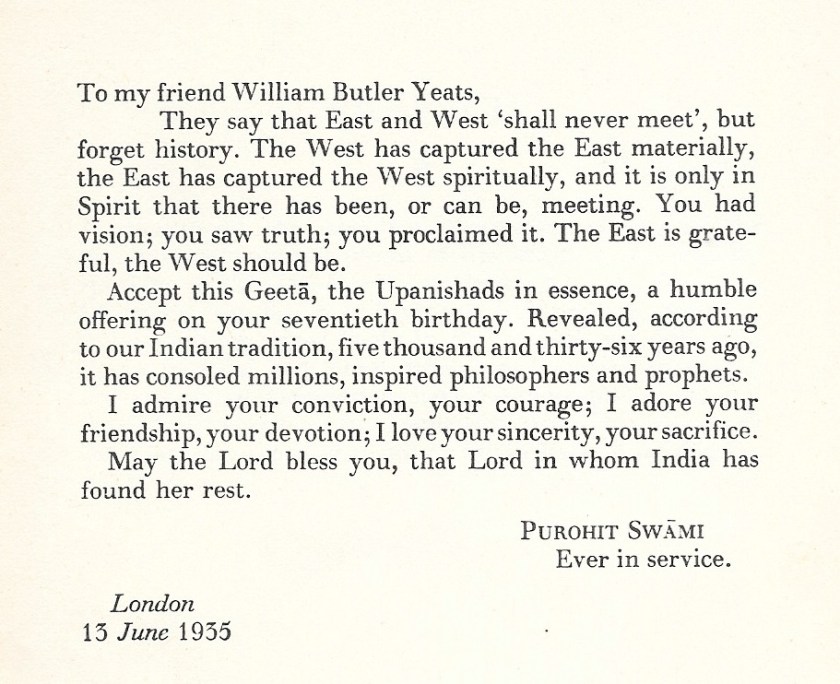
Whatever the case, it is beguiling to think of a single strand of humanity sowing the seeds of civilization from Bengal to Donegal as attested by this dedication from the 1935 edition of The Geeta to W.B. Yeats!
*1 The Coligny Calendar, dating from the first century CE has sixteen columns of months covering a period of five years and has been compared with Vedic cosmology. Major festival, according to Diodorus Siculus were held every five years and festival days were marked on the calendar.
Binchy, D. A. 1972. “Celtic Suretyship, a fossilized Indo-European Institution?” The Irish Jurist 7, 360–72.
Charles-Edwards, Th. 1980. “Nau Kynwedi Teithiauc.” In D. Jenkins and M.E. Owen (eds.), The Welsh Law of Women. Studies presented to Professor Daniel A. Binchy on his eightieth birthday, 3 June 1980. Cardiff: University of Wales Press, 23–39.
*3 The Geeta – the Gospel of the lord Shri Krishna
Put into English by Shri Purohit Swami 1935 Faber & Faber Ltd.
Panting for breath in the high altitude of La Paz in Bolivia, which seemed to verge on the chaotic with strikes, blockades, enormous protests and heavily armed troops and police everywhere, I made a break for it and descended a few thousand metres to Salta in northern Argentine which was pleasant and warm, even when I arrived at night after a fairly lengthy bus, train, and three more buses, the last of which was stopped by a military style roadblock just outside Jujuy. Everybody was ordered off the bus and while the locals were all searched and questioned, I was totally ignored, thank God.
Salta, the first major city over the border from Bolivia, looks and feels pleasant and actually warm at night compared to semi freezing temperatures in the mountains further north so I had a refreshing ale (40 pesos) before I even bothered to look for a hotel!
A few days to rest up and enjoy the amenities – my hotel bathroom actually had a bidet and excellent free Internet connections. Despite Google Maps claiming the existence of an Irish pub, there was no sign of it – the location now an expensive jewellery shop which had been there for at least ten years. Never mind, plenty of other bars to enjoy a beer and a few empanadas around the Ninth of July plaza before gaping at the mummified bodies of three Inca children sacrificed centuries ago.
Four hours further south then and 190k through the most amazing canyons and rock formations to the small town called Cafayate, the second premier wine area of Argentine, after Mendoza.An incredible road winding through the most bizarre colourful mountains and canyons similar to what I imagine the Painted Desert in Nevada would be like. Cafayate is probably the smallest town I’ve been in so far. Brilliant little wineries scattered around, almost at sea level, well, just over 1500 metres, warm and sunny. I got off the bus, found a hotel, had a litre bottle of excellent cold beer and a deep bowl of soup with beans, meat, and God knows what else here thrown in. I will probably stay here two or three days and explore local wineries – specialising, apparently in an Argentinean white which is Argentine’s only native variety of grape, Torrontes, and I’ve Just booked myself in for a fantastic tastings of five of the same white grape specific to this region!
Dinner every night is a huge steak and a bottle of Malbec now. In heaven, food and wine wise. I am quite content to let Peru keep its speciality dish of guinea pig, as far as I’m concerned.
Cafayate is a fantastic little town, best place so far on the whole trip. Baking hot in the day, cool at night, loaded with fantastic bodegas of which I am taking full advantage. Every night seems to be a festival here – usually religious with processions adoring the rosary and the Virgin Mary, all of which was accompanied by noisy bands, people dancing in the streets and a never ending flow of wine. Great fun.
Much as I am enjoying Cafayate – another very pleasant lunch with two classes of wine, a Malbec flavoured ice cream and a bottle of Torrontes to enjoy in the afternoon in the garden of my hotel – I am aware that this is kind of a dead end. To continue on to Córdoba or Mendoza, I would have to go back to Salta – which I don’t want to do – or take another bus from here to Tucuman, which I have never heard of and (unreasonably) don’t like the sound of – and from there on to either Mendoza or Córdoba.
An 8 to 10 hour very comfortable bus trip (think business class on an airline) south to Tucaman – where Argentinian independence was declared from Spain but a bit disappointing. I arrived at sunset but every hotel seemed to be full. Eventually found a dump, well over priced but no choice so I checked in late and left the next morning at 5:30 for Córdoba, Argentine’s second largest city. Meant to be a hotbed of bars and nightlife – got in around 3:30 in the arvo and COULD not find a place to stay – must have tried at least 12 hotels and hostels and by 7:30 still hadn’t found a place to stay – beginning to get desperate, cold, drizzly, beginning to get dark when I eventually found a very rough place – Hostel Pomelo – a right dump. Probably among the worst places I have stayed in over the last 40 years. Absolutely desperate, but what choice did I have – there or a night sleeping upright in a cold bus terminal. Even then when I arrived, the host said he was full and tried to give my money back, which his ratty partner has just accepted. At this point it was about 8:00 pm and cold as buggery so I played dumb and just sat down on a ragged sofa and began to doze off. Eventually I was herded into a dorm with 6 rickety bunks and torn, stained mattresses – fresh sheets, the host proudly claimed. However, no choice so I dumped my bag, took the important stuff and headed out to the best restaurant I could find and had a magnificent steak, gorgeous malbec and then, in lieu of a brandy, ½ a bottle of champagne. Back to the hostel and across the street into one of the roughest bars that would outshine the toughest outback bars in Oz by a long shot where I sampled the local favourite, Fernet and coke and became involved in a semi scuffle over the price of a single cigarette while unfriendly girls snorted Coke in the grubby, (unisex, I think) toilet. Back to the hostel where everyone seemed to be smoking dope, and into the bunk bed and slept like a log.
Next day, Sunday, the city seemed deserted and I really had to change money. – none of my cards worked in the atm and street touts didn’t want to change euros, only US dollars. Beginning to get pissed off, especially as Ireland was playing France in rugby and I was unable to find a bar open in the afternoon. So off to the bus station once again, a grey and fairly miserable day, and bought a ticket on an overnight bus (180 degree reclining seats) and eventually found a bar and watched Ireland thrash France before leaving that evening from Córdoba.
Mendoza, the premium wine district of Argentine, should knock Cafayate into the shade with its wineries and wines. Arrived in a freezing cold dawn and drew up a short list of five hotels before taking a taxi to the first one – “completo” – and that was the story with all of them that I trekked around, getting increasingly pissed off. Some hotels said come back at 11 0’clock, others said come back at 12:30!
Eventually I found a rather smart (for me, that is) Hotel International on the corner of Calle Peru that let me in by 8 o clock for 800 pesos a night. Gorgeous soft, fluffy pillows, crisp sheets and duvets, boiling hot water – what a contrast to Hostel Pomelo!
Argentine could be expensive as there are less than ten peso to the US dollar. However, at one of the crossroads on the pedestrian areas of Calle Sacrimento which cuts through the huge Plaza Independencia, past the pink water fountain, near a few newspaper kiosks, seedy looking punters hang around whispering “cambio” as you stroll past. On this so-called “mercado azul” you can easily change one dollar for about 16 pesos which makes thing seem more reasonable.
Nevertheless, I moved to Hotel Zamora on Calle Peru, a nice outdoor tiled courtyard but the room was small and dark and the shower crappy. Next-door in the Melbourne Coffee Company, I was offered a job as a barista so that the incumbent could focus on wine tasting. No time for that nonsense, of course as I planned to move to Hotel Petit, a bigger, brighter room, just past Plaza Chile.
Loads of cafes line the beautiful tree-shaded streets with deep, cobblestone-lined irrigation ditches on either side. Presumably it gets hot in the summer and the trees provide a welcome shade. I don’t have gps and I never bother with maps, depending on my unerring sense of direction to guide me to the wrong side of the tracks as usual but with the huge Plaza Independencia – the art gallery is underground and the usual gaggle of street entertainers, dressed in motley and on stilts do the most amazing dances and contortions – and the other four main plazas on each corner, all with huge statutes of local heroes, even I found it easy to get around on foot.
Cold but not freezing with occasional splashes of sunshine filtering down through the trees onto a street cafe where I drink a large bottle of Andes beer and scribble in my notebook or just gape at my surrounding before returning to the hotel in the early evening. Just as well because no one in Mendoza would dream of going out to eat or to the bars until well after 10:30 pm. So, a snooze in the late afternoon and then fresh as a new coat of paint, I blunder out for a steak dinner later that night.
In Mendoza, the wine capital of Argentine, heavy-duty, meaty wine flows freely, cheaper than a bottle of beer. Excellent wine for less than 100 pesos so I indulged myself freely and enjoyed the last of the sunshine, wandering aimlessly around the city and the parks stopping here and there for coffee and ice cream!
The main attractions seem to be snow boarding, expensive wine tours, white water rafting and that sort of thing, so I focus on what I do best!
The steaks here are magnificent, better than the steak in Lardos in Hong Kong where I used to live, or the steaks in El Gaucho, an Argentinian restaurant, in Saigon. Here, in Mendoza, the best steaks have been in El Florencita on the corner of Peru and Sacriemento – an enormous slab of bloody beef, cooked over charcoal.
Despite gorgeous sunshine yesterday in Mendoza, which seemed to exacerbate the effect of a lovely bottle of Trapiche Malbec I was enjoying with my lunch of half a cow on a plate, there were hail stones as I was making my way to the bus station to buy a ticket to Santiago in Chile, a mere 149k as the crow flies. However, the road over the mountains winds back and forwards for more than 350k and the road is so steep in parts that the bus has to slow down to 10 or 15 kph. So the journey, in good weather, might take more than 8 hours.
Amazing, but not as amazing as when I arrived at the bus station and discovered all the buses were “completo” for the following day and it was only after I had tried half a dozen different bus companies that it was finally explained to me that all bus trips between the two countries have been suspended since last Sunday due to the mountain passes being blocked by bad weather – one company said because of “nieve”. Incredible! No one knows when the route over the Andes will reopen.
I still have plenty of time before I fly out of Santiago but I don’t know if my liver will last that long under the unremitting onslaughts of free flowing Malbec! Thank god for the “mercado azul” which makes a big difference to a budget traveller like myself. I’m looking forward to the coach trip over the Andes into Chile, the seats as good as airline business class and the views should be spectacular.
After a delay of several days I finally managed to get a bus over “La Routa de las Liberatores.” and had one cigarette, a small bottle of beer, 380g steak, 500ml bottle of plonk, an espresso, a brandy and a large ice cream in preparation for this second assault on the Andes, to Santiago, from where I eventually fly back to Perth.
Some books claim to change your life but then when you pick one up, it seems banal, run-of the-mill but you glean that it is actually giving a real message. So it was with this book – The Circle by Dave Eggers.
I didn’t like it for a lot of reasons (but I did admire the logo) and I couldn’t empathise with the main character, tech worker Mae Holland -who seemed, from my point of view – exasperatingly stupid, naive, foolish or just plain insensitive – and she was (initially, anyway) on the side of the good guys. Joining a lavish and ever expanding Tech company which provided all the bells and whistles that an aspiring Google or Facebook employee could dream of – free pizza, concerts, parties, saunas, down-time, the latest proto- gadgets, all of which “newbies” like Mae are expected to not only partake of but also to recommend and support. The all-pervasive company began to take over every aspect of Mae’s life, with her lack-lustre willing acceptance.
The “baddies” were just the same but manipulative, faux-caring and determined to dominate. Their use of language irritated me, a meta-language insistence on agreement, even as their ideology is absorbed with a generous helping of sugar as in the Sound of Music song. Statements, directives and implicit orders always ended with something like “do you see the benefits of that?” or “Does that sound interesting / appealing / better?” The never relenting stream of “…, don’t you think?“, the condescending “… sound good?” or the more insistent “…, don’t you agree?” wear the reader down, as they are intended to do.
Set in near or contemporary time, the Circle is a global network linking billions of people sharing and associating with others similar to them, rather like people do on Facebook. Much like Orwell’s Animal Farm, where such aphorisms as “All animals are equal” and “four legs good, two legs bad” take the place of meaning, phrases in The Circle like “secrets are lies,” “sharing is caring,” and “privacy is theft” illustrate the philosophy of the tech company. One of the innovations of the company is a lightweight, wearable camera allowing everyone to see what the wearer sees, a bit similar, perhaps, to police body cams which monitor the actions of both the police and the suspect. Once the ice is broken by a minor politician wishing to be “transparent” to his constituents, the rush is on for everyone to allow the world to see what they are seeing at all times.
Bit by bit, witless Mae gets sucked deeper and deeper into the folds of the Circle where every aspect of her life, and that of her parents and her friends, is constantly streamed to the world. In a justification for its ever encroaching inroads on privacy, the Circle administration claims that it never extorts citizens to provide their private data – everything was willingly provided by the eager masses clamouring to hand over every aspect of their lives, from what they had for breakfast to photographs and videos of their private and domestic lives.
And then, recently, on the BBC, there was an article on the incredible advances of facial recognition technology which is increasingly used by both governments and corporations to screen and vet everyone within their gambit.
High-definition cameras – measuring such things as the distance between the eyes, the length and width of the nose, along with other “nodal points” on our faces – combine with machine learning algorithms, utilising ever-enlarging databases of videos and photos, available to individuals, organisations and businesses, and to intelligence and law enforcement agencies, sort through this vast store of data to improve security and surveillance and to identity verification for business transactions.
Technological Tools such as FaceSearch, analyse more than 350 aspects of the human face, enabling suspects to be matched to a cloud-based database of more than 15 million “mugshots” while Faception, a middle-eastern “facial profiling” company claims it can determine your personality traits, with an 80% accuracy rate indicating whether you are on a government watch list for terrorism, extortion, paedophilia, or merely an “average Joe”
The Georgetown Law Center for Privacy and Technology claims more than 117 million US adults have their images logged in a facial recognition network of some kind – a trend civil liberties groups describe as “a real and immediate threat” to privacy while New York plans to install facial recognition tech on its bridges and tunnels to scan and identify people driving in and out.
In theory, you could track down a complete stranger you snapped on the bus or train and what price is privacy then?
I remember an Irish movie from the late 90’s – The General – in which Brendan Gleeson
played the role of Martin Cahill, a prominent Irish criminal who gained a certain notoriety in the Dublin media, which referred to him by the sobriquet “The General”. During his relatively short lifetime – he was gunned down at the age of 45 – Cahill took particular care to hide his face from the media by spreading the fingers of one hand across his face. Perhaps that is what we should all do to preserve our increasingly elusive privacy.
The flip side of the coin, however is that while Big Brother and his little sister keep a constant watch on us all, the same applies to organisations and governments world-wide. Increasingly, individuals, armed with a camera concealed in a shirt button, or some other innocuous thing, can challenge the power of a brutal and despotic regime, by filming human rights abuses by soldiers, militia groups and corrupt officials. Just as cameras – think the multinova traffic speed cameras – can inhibit anti-social behaviour, the same goes for the governments as well as those governed. Let’s hope so, anyway.
Named after Simon Bolivar from Venezuela who, in 1804, declared that he would fight to the death to break the chains binding South America to Spain, leading to the Declaration of Independence for Venezuela in 1811 followed by most of the other Spanish colonies after the invasion of Spain by Napoleon. As far as I know, Bolivia is the only country in the world to be named after its liberator!
The journey on the bus from Cusco to Puno on Lake Titicaca on the border between Peru and Bolivia, crossing over 4000 metres, left me gasping with the effort of breathing at this altitude. However, Lake Titicaca, the largest lake in South America on the border of Peru and Bolivia and the “highest navigable lake” in the world at about 3,812 metres, gave me the illusion of sea level and my ragged breathing was enough for me to take a day-trip to the fantastic, floating islands on the lake. Small manmade islands have been constructed by the Uros (or Uru) people for generations from layer upon layer of cut totora, a thick buoyant reed that grows everywhere along the shores of the lake. Many of the golden coloured islands are more or less half the size of a football field, containing several thatched houses, with about 25 people living on the island I visited.
La Paz, in Bolivia, the highest capital city in the world, is at about 3,600 metres above sea level. The air felt very thin so a simple task like tying my shoelaces left me breathless and panting for oxygen.
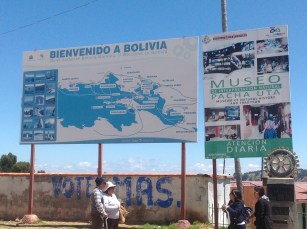
On the surface, Bolivia seems to be the most under developed of all the countries I have been in so far on this trip, with the exception of Cuba. For starters, the bus trip from Puno, on the border, to La Paz should only have been 7 or 8 hours. Instead it ended up being nearly 12. By no stretch of the imagination could the bus from Puno cater to the “superexecutivo” class and it was a jerky ride to the border post. No problems there, off the bus and into Peru Immigration to get an exit stamp, walk 100 metres and enter Bolivia and get an entry stamp.
Then, across the lake on a small, cramped and crowded motor boat while the bus laboured across the lake on a barge powered by a tiny outboard engine, back on the bus again and onto a nondescript border town inside Bolivia where a change to a inferior bus was delayed by hours and then finally off to La Paz, through barren, desert country until the outskirts of the capital city approached.
Protesting, indigenous people however, had blocked off the city, with rough barricades barring all the main roads to the centre. The bus was forced to stop and take on a native guide who then directed the bus up, down and round about through a maze of unpaved, rutted, dirt roads only suitable for a 4X drive and somehow the bus lurched and twisted and limped past the rough blockades of piled heaps of dirt and stone blocks until eventually beginning the descent into the valley where the heart of the city lay.
Pretty amazing but by this time I was having serious problems catching my breath and I just took a taxi to a hotel in the centre and crashed out on the bed.
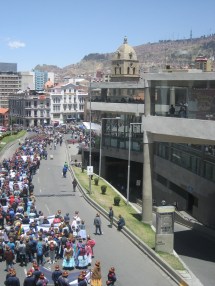
Massive demonstrations began in the city the next day with thousands of protesting miners parading through the streets. Every corner was covered with heavily armed police, toting pump action shotguns, teargas and heavy duty riot gear while the protesters poured into the city, firing off bangers from what looked like bamboo tubes, blocking off all exits. Toyland soldiers stood guard outside principal buildings, in rather sharp contrast to the heavily armed police on every street in the centre of the city.
Had enough of gasping for breath in the altitudes of Peru and La Paz and I decided to leave to anywhere south and at a lower altitude. I just needed to get down to sea level again where I could breathe properly and I decided to leave as soon as the city barricades were removed. I must admit I was not prepared for the high altitude, as anywhere from 3600 metres plus didn’t do a lot for me despite me chewing my way through wads of coca leaves with my breath rasping in the lungs. Consequently, many of the activities on offer – mountain climbing (!), trekking, white water rafting, zip lining, death route cycling downhill and so on – were all out of bounds for me so I pretty much confined myself to armchair drinking and sampling the local cuisine – roast guinea pig (not much to gnaw on, as I mentioned) and roast alpaca – delicious and almost a cross between lamb and beef but slightly gamier.Bolivia was also notable for appearing to have the greatest number of indigenous people. Monstrously broad-hipped women in voluminous coloured skirts, heavy shawls which doubled as blankets and makeshift backpacks, their heads topped with incongrous bowler hats while all the men seemed smaller and dressed in standard jeans and t-shirts with baseball caps. Amazing!
Sights are extraordinary but hard to do justice to with my camera as I took a bus meandering through the blockades 5 hours south to the small town of Oruro where I connected with one of South America’s rare trains running down to Villazon on the border with Argentine. I love train journeys – possibly my favourite mode of long distance transport and I was amazed that train travel is relatively rare in this part of the world. That was until I caught the noisiest, slowest and bumpiest train I have ever been on for about 15 hours down to Villazon on the border with Argentine. No sleepers, a minimalist buffet car and only 140-degree reclining seats here!
An easy border crossing, no paperwork or forms involved whatsoever, merely answering a desultory question or two and walk over into Argentine and another world. While Cuba was behind the times, Ecuador organised and capable, Peru suave and cosmopolitan, Bolivia half arsed, Argentine immediately struck me as being modern with its highway diamonds, flyovers, sky scrapers, functioning traffic lights, traffic cops with white gloves – and all this in only a small cross border town and then on to Salta, on the edge of the Andes and the breathing is almost back to normal.
I know, I know, maybe the idea of organ meats doesn’t appeal to everyone but I can assure you that this simple recipe, which can be whipped up in less than 30 minutes, is a complete stunner.
Completely different to calf or lamb liver – delicious in their own way with creamy mashed potatoes, bacon and onions – (which I could get my kids to eat by telling them it was exotoc goanna tongue!) this chicken liver curry is in a class of its own.
I was shown this recipe on 28 February 1991 when I was living in S. E. Asia but amazingly it was not an Asian who introduced me to the rich, velvety texture of this luscious dish but a good friend from Poland! Thanks K. Anyway, here is the recipe I learned more that a quarter of a century – gulp! – ago.
500g chicken livers 2 Tbs oil 1 large onion, chopped
3 tsp ground coriander 1 tsp garam masala 1 tsp sea salt
1/2 tsp ground black pepper
Wash and drain the livers. Cut each in half and discard any yucky bits.
Heat the oil and fry the chopped onions, garlic and ginger until the onion is soft and golden.
Add the ground turmeric, chilli, coriander and cumin and fry, stirring for about 2 minutes.
Add the garam masala, tomato and salt and cook, covered until the tomatoes are pulpy. Mash them with the back of a fork if necessary.
Add the chicken livers, stir well, sprinkle with the black pepper and cook, covered again, for about 15 minutes. Serve with steamed rice or warmed flat bread or deep fried tofu chunks or even baked potatoes. Gorgeous!
Oops – just realisedI have no photos to show even though I cooked this dish tonight, the last day of January. Honestly, it took me less than half an hour and it hadn’t occurred to me to put this on the blog until I had almost finished eating it (with the firm, deep fried tofu chunks I mentioned above!) Sorry – photos next time
I haven’t done an audio recording of Raiding Cooley for a while – and it would feel a bit too strange to do a video recording of me reading, so I think I’ll give that a miss for now.
Anyway, trying to decide what to read – whether to begin at the beginning or just pick a point at random, like I’ve done before.
OK, the very, very, very beginning.
The Prologue outlines the reasons why the Triple Goddess of War cursed the warriors of the Ulaidh Kingdom in Celtic Ireland, thereby setting the scene for the future consequences of the curse, and, incidentally, the beginning of the story proper, about 450 years later. Imperial Rome is still occupied with subduing the Celts in Gaul and Teutonics in northern Rhineland in 57 BCE but Caesar is already planning the first invasion of Britain. Ireland, while sharing extensive linguistic, cultural and extensive trade links with both Britain and Europe, remains a land of mystery, remote from Roman rule.
Along with the rise of the hill forts circa 1000 BCE, and the emphasis on items both as weapons and ornamentation, the stratification of society, into chieftains or kings surrounded by nobles and warriors supported by priests or druids interceding for farmers, craft-workers and slaves, was firmly established. This hierarchy inevitably involved the notion of the hero or champion and was marked by a leader able to distribute gifts and largesse while, at the same time, host feasts and celebrations where warriors would vie with each other for the favour of their liege. Such restrained power necessitated the rise of the heroic warrior, the hero, to stand alone and unbeaten. No doubt the flowering of literature of the twelfth century French Romance and Mallory’s later Arthurian romances must all have stemmed from the Iron Age concept.
Not everyone would – or could – be a hero. While all young boys played fierce physical games with wooden sticks – a proto Hurley? – before weapons could be handled, a hero was always set apart. Never having recognised parents and a mysterious background, Arthur is fostered at an early age just as Oedipus is brought up in ignorance of his parents and Lancelot of Arthurian legend is raised by the shadowy Lady of the Lake while Cú Chulainn’s birth is similarly shrouded in mystery.
Not obvious parentage means the hero has no name and must acquire one through his own actions – Sétanta kills the forge hound and becomes Cú Chulainn, while later Celtic heroes, Finn and the Welsh, Gwion, gain their later names of brilliance and light. The significance of having no family means a concomitant feeling of standing alone – the hero can expect no aid in his quest for glory but at the same time no limits are placed on his ambitions for his name to live on, forever, on the lips of men.
Never accepted in his own country, the Iron Age hero must leave his comfort zone, undergoing training at the hands of learned druids or experienced warriors. Tests of physical prowess, – ability to jump or vault over a stick their own height, run barefoot through a forest without breaking a twig underfoot, defend against 9 men throwing spears, remove a thorn from his foot while running – must be passed, but the hero must also be erudite and knowledgeable about poetry. Strangers approaching the territory of a chieftain had to undergo single combat or compose a poem on the spot.
Cú Chulainn trained under the tutelage of the warrior woman, Scáthach, who presented the fearsome gae bolga to the hero, along with a warning of its consequent use. Beowulf sought out sea monsters before going on to defeating Grendel and its mother, Arthur trained under the venerable Sir Ector de Maris, all to achieve the fame they sought. Beowulf leaves for the court of Denmark; Tristan of Arthurian legend travels to Ireland from his native Cornwall.
Nowhere in the manuscripts is it ever suggested that Cú Chulainn is not from the kingdom of the Ulaidh (modern day Ulster in Northern Ireland) nevertheless, when all the fighting age men of the area are stricken with an ancient curse, Cú Chulainn alone is exempt. Like all his fellow outsiders, having no ties to hamper his actions, the hero inevitably becomes a force for disruption, change and catastrophe.
Heroes must claim their weapons forcibly or obtain them from supernatural forces – Lancelot receives his sword from the Lady of the lake, Beowulf discovers a sword in the lair beneath the lake, and Cú Chulainn smashes King Conor’s armoury before the king himself presented the nascent hero with his very own weapons while the youthful Arthur plucks the sword from the stone.
A tipping point occurs in all the lives of the heroes when the focus on honour and glory supersedes the needs or bonds of their society. Achilles rejects his mother’s help and chooses to die before the walls of Troy. Cú Chulainn hears the druid’s prophecy of bloody and glory but still chooses to seek the latter. This tipping point influences the remaining portion of the heroes’ life. Every further irrevocable action with the umbrella-like spear, the gae bolga, that Cú Chulainn accepts from the hands of Scáthach maintains or furthers the glorification of his name. Chulainn, in his killing fury, is just as prepared to slaughter his enemies as his compatriots once his battle fury descends upon him.
Mortal enemies of the heroes often involve demonic or supernatural forces as human weapons have little effect upon them, Achilles is dipped in the pool of immortality, Arthur is protected by the power of Excalibur and Cú Chulainn is unassailable when he is in his battle fury. The inevitable downfall of the hero is, therefore, always linked with the breaking of a vow or the forsaking of an oath. Arthur is killed at the hands of his illegitimate son, Cú Chulainn dies alone after breaking the taboos that ruled his life, Beowulf meets his demise by neglecting his role of kingship and acting as if he were still the hero.
I recently received the European Peace Walk (EPW) guidebook for 2017. I know I mentioned ages ago that I was going to do this Walk – a 500+K walking trail through six European countries – Hungary, Austria, Croatia, Slovenia, Slovakia and Italy – over three weeks. It seems a bit daunting, given the current state of my overall fitness. Some days involve 30K hike between sleepovers and the most I’ve done so far is about 16k or so. Anyway, I don’t begin until mid summer – July 04, – so I still have a few months to get up to speed.
I’m really looking forward to this – it is going to be both an adventure and a bit of a learning curve – grappling with languages I don’t know – I only have a smattering of German and Italian, spoken, respectively, at the start and end of the journey, and no idea of the cultures, history, topography, everything.
Croatia, Slovenia and Slovakia didn’t exist as separate entities when I was in school and when the Balkans began its tragic breakup after the death of Marshall Tito, I was no longer living in Europe and the events passed me by, for the most part. Since its debut in 2014, commemorating the 100th anniversary of the First World War, the EPW now passes through Slavic, Teutonic & Romantic cultures, a route only made possible by the geo-political collapse of the region’s former Democratic, Communist and Socialist political allegiances. As recently as 1989, the EPW would not have been feasible, as Europe was still divided into the above contrasting ideologies and its borders and peoples were firmly closed. Now, it is possible to have breakfast in Hungary, lunch in Slovenia and sleep that night in Croatia! So an exciting learning curve there, getting to grips with the tangled histories of the region – I think Bismarck once referred to the Balkans as “the sick man of Europe” – and that, along with the dourness I associated with the former Iron Curtain countries may have contributed to my former lack of interest in the area. But now? Rolling countryside, originally populated by Celts before they (were?) moved on in their endless migrations and then there is the wine and food of the different regions. Can’t wait!
It’s kind of exciting to know that I will have to be totally alone, solely responsible for my own safety and enjoyment in exciting and new environments. I think the whole journey will be a mixture of ‘down-time” and reflection – perhaps not as spiritually reflective as on the Camino, – as well as a physical challenge (in between wines, beers and exciting food) as well as meeting and communicating with locals along the way as well as the 9 other walkers who begin on the same day I do. I suppose both the EPW and the Camino bring people together to share common experiences as well as to learn about each other’s differences and I think this might well embody the ‘Peace’ aspect of the EPW.
Anyway, I have already started planning and preparing,and that’s half the fun, isn’t it?. I bought a new 30 litre capacity backpack, a good pair of walking shoes – not boots – shirts and jackets and pants made of modern textiles which “wick” the sweat away from the skin while at the same time keeping me warm in cold weather and cool in hot. We’ll see. I want to travel really light, total weight, including my bag, should be no more than 10Kg. I’ll have to start carrying the bag when I walk soon. So, that is my current curve – start walking more in this Perth summer heat and build up to at least 20 – 25 k a day so that when July rolls around I will be in some type of fit condition to actually enjoy the walk and the surroundings. Wish me luck!
I mentioned in a previous post somewhere that I had been looking forward to trying a Peruvian national dish, cuy al horno – roast guinea pig – but overall, I’d have to say I prefer the dish more commonly eaten down on the coast – ceviche. Chunks of white fish in a spicy lime marinade – tiger’s milk – served with an variety of corn kernels and chopped veg. Absolutely gorgeous and so perfect for a hot summer’s day.
Here’s my take on it. For this particular serving, this is exactly what I used: 320g of firm white grouper fillet, two tomatoes, 1/2 a red, 1/2 green capsicum, one small Lebanese cucumber and 1/4 of a red onion, three limes and one lemon with 1/4 teaspoon of coarse sea salt crystals and one chopped red chili, corn chips and popcorn
The basic ingredients, which remained the same as far down as Santiago in Chile, are:
Any firm, white fish with ½ cup of lime juice for each 500g or pound of fish.
Red onion, chopped and as much seeded capsicum (any colour), toms, red onion and cucumber as you like, lime juice, salt and a red chili, coriander or mint or both, corn chips or popcorn and sliced avocados.
Check the fillet for skin, bones and the dark red bloodline, if any. Depending on thickness, cut the fish into large, even chunks or slice into thin pieces and put into a glass or ceramic dish along with enough lime juice, (approx. 1/2 cup per 500g fish), sea salt and finely chopped chilies to completely cover. Set aside and chill.
I put the chopped veg in a separate dish, sprinkled with olive oil and a dash of freshly ground pepper. I didn’t want to put the veg and fish in the same dish so as the veg can keep their colour and not blanch in the lime marinade.
When the fish becomes translucent, whiter in color and opaque, drain off the marinade and mix the fish gently with the chopped veg.
I gave the fish about 90 minutes and then straining it and reserving the marinade. A thick chunk of fish was cooked through to the consistency of medium rare meat. If you like it more well done, give it up to four hours in the lime marinade.
I spooned some of the veg mixture into a bowl, ladled a scoop of the drained fish on top, and sprinkled with chopped coriander and popcorn, with corn chips around the dish. I forgot the avocado!
I suppose some might be put off by the amount of limejuice – too acidic, I can hear people say. However, limes and lemons while acidic of course, somehow become alkaline when consumed and besides use only as much of the strained marinade – tiger milk – as you feel comfortable with.


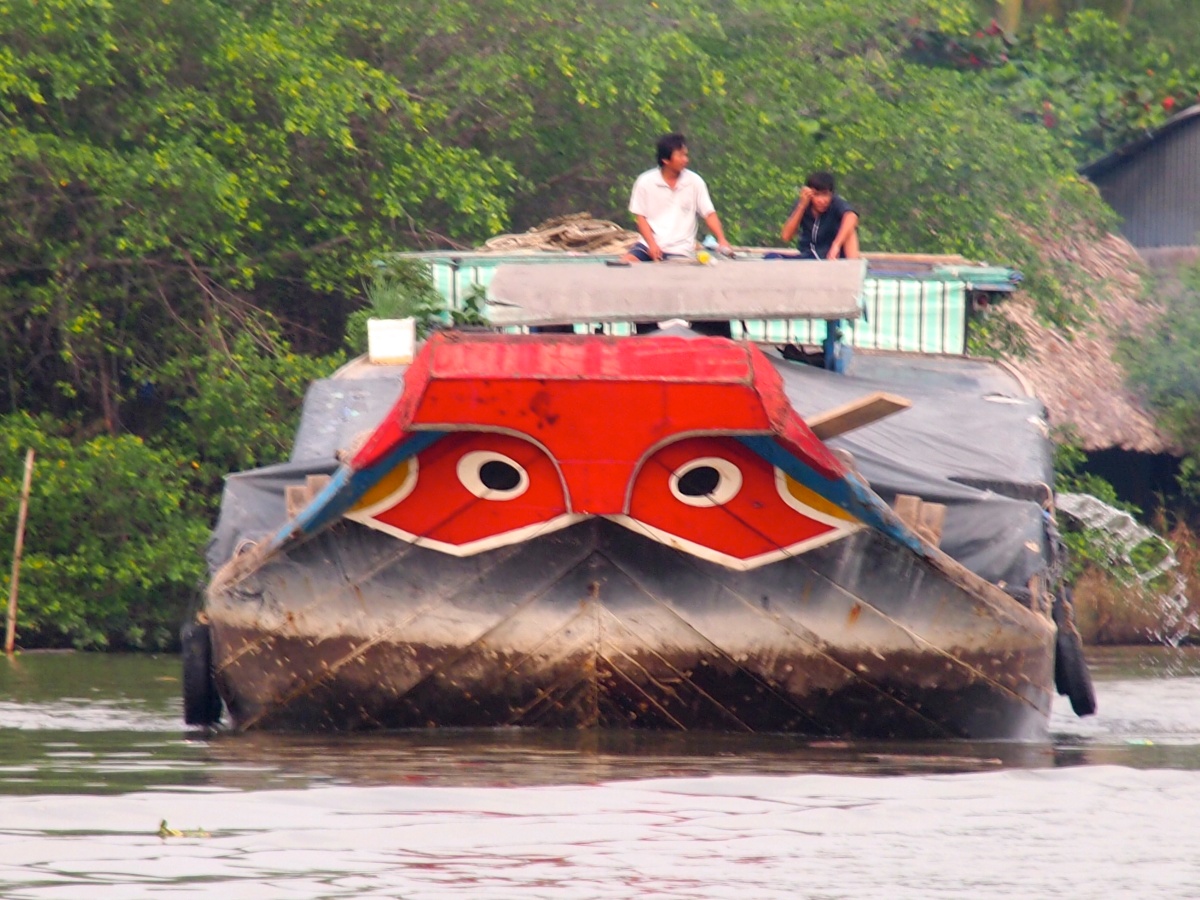
 Salta, the first major city over the border from Bolivia, looks and feels pleasant and actually warm at night compared to semi freezing temperatures in the mountains further north so I had a refreshing ale (40 pesos) before I even bothered to look for a hotel!
 now an expensive jewellery shop which had been there for at least ten years. Never mind, plenty of other bars to enjoy a beer and a few empanadas around the Ninth of July plaza before gaping at the mummified bodies of three Inca children sacrificed centuries ago.
 similar to what I imagine the Painted Desert in Nevada would be like. Cafayate is probably the smallest town I’ve been in so far. Brilliant little wineries scattered around, almost at sea level, well, just over 1500 metres, warm and sunny. I got off the bus, found a hotel, had a litre bottle of excellent cold beer and a deep bowl of soup with beans, meat, and God knows what else here thrown in. I will probably stay here two or three days and explore local wineries – specialising,
  apparently in an Argentinean white which is Argentine’s only native variety of grape, Torrontes, and I’ve Just booked myself in for a fantastic tastings of five of the same white grape specific to this region!
 Every night seems to be a festival here – usually religious with processions adoring the rosary and the Virgin Mary, all of which was accompanied by noisy bands, people dancing in the streets and a never ending flow of wine. Great fun.
 ried to give my money back, which his ratty partner has just accepted. At this point it was about 8:00 pm and cold as buggery so I played dumb and just sat down on a ragged sofa and began to doze off. Eventually I was herded into a dorm with 6 rickety bunks and torn, stained mattresses – fresh sheets, the host proudly claimed. However, no choice so I dumped my bag, took the important stuff and headed out to the best restaurant I could find and had a magnificent steak, gorgeous malbec and then, in lieu of a brandy, ½ a bottle of champagne. Back to the hostel and across the street into one of the roughest bars that would outshine the toughest outback bars in Oz by a long shot where I sampled the local favourite, Fernet and coke and became involved in a semi scuffle over the price of a single cigarette while unfriendly girls snorted Coke in the grubby, (unisex, I think) toilet. Back to the hostel where everyone seemed to be smoking dope, and into the bunk bed and slept like a log.
 Loads of cafes line the beautiful tree-shaded streets with deep, cobblestone-lined irrigation ditches on either side. Presumably it gets hot in the summer and the trees provide a welcome shade. I don’t have gps and I never bother with maps, depending on my unerring sense of direction to guide me to the wrong side of the tracks as usual but with the huge Plaza Independencia – the art gallery is underground and the usual gaggle of street entertainers, dressed in motley and on stilts do the most amazing dances and contortions – and the other four main plazas on each corner, all with huge statutes of local heroes, even I found it easy to get around on foot.
 The main attractions seem to be snow boarding, expensive wine tours, white water rafting and that sort of thing, so I focus on what I do best!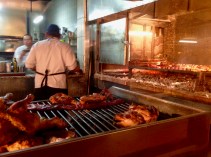
 myself. I’m looking forward to the coach trip over the Andes into Chile, the seats as good as airline business class and the views should be spectacular.
 didn’t like it for a lot of reasons (but I did admire the logo) and I couldn’t empathise with the main character, tech worker Mae Holland -who seemed, from my point of view – exasperatingly stupid, naive, foolish or just plain insensitive – and she was (initially, anyway) on the side of the good guys. Joining a lavish and ever expanding Tech company which provided all the bells and whistles that an aspiring Google or Facebook employee could dream of – free pizza, concerts, parties, saunas, down-time, the latest proto- gadgets, all of which “newbies” like Mae are expected to not only partake of but also to recommend and support. The all-pervasive company began to take over every aspect of Mae’s life, with her lack-lustre willing acceptance.
 The journey on the bus from Cusco to Puno on Lake Titicaca on the border between Peru and Bolivia, crossing over 4000 metres, left me gasping with the effort of breathing at this altitude. However, Lake Titicaca, the largest lake in South America on the border of Peru and Bolivia and the “highest navigable lake” in the world at about 3,812 metres, gave me the illusion of sea level and my ragged breathing was enough for me to take a day-trip to the fantastic, floating islands on the lake.
  Small manmade islands have been constructed by the
  etch of the imagination could the bus from Puno cater to the “super executivo” class and it was a jerky ride to the border post. No problems there, off the bus and into Peru Immigration to get an exit stamp, walk 100 metres and enter Bolivia and get an entry stamp.
 through barren, desert country until the outskirts of the capital city approached.
 Massive demonstrations began in the city the next day with thousands of protesting miners parading through the streets. Every corner was covered with heavily armed police,
  toting pump action shotguns, teargas and heavy duty riot gear while the protesters poured into the city, firing off bangers from what looked like bamboo tubes, blocking off all exits.
  Toyland soldiers stood guard outside principal buildings, in rather sharp contrast to the heavily armed police on every street in the centre of the city.
 Monstrously broad-hipped women in voluminous coloured skirts, heavy shawls which doubled as blankets and makeshift backpacks, their heads topped with incongrous bowler hats while all the men seemed smaller and dressed in standard jeans and t-shirts with baseball caps. Amazing!
 I recently received the European Peace Walk (EPW) guidebook for 2017. I know I mentioned ages ago that I was going to do this Walk – a 500+K walking trail through six European countries – Hungary, Austria, Croatia, Slovenia, Slovakia and Italy – over three weeks. It seems a bit daunting, given the current state of my overall fitness. Some days involve 30K hike between sleepovers and the most I’ve done so far is about 16k or so. Anyway, I don’t begin until mid summer – July 04, – so I still have a few months to get up to speed.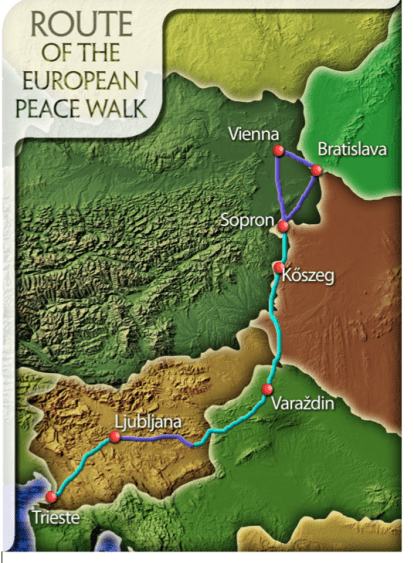

 The basic ingredients, which remained the same as far down as Santiago in Chile, are:
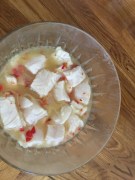
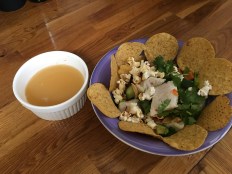 I suppose some might be put off by the amount of limejuice – too acidic, I can hear people say. However, limes and lemons while acidic of course, somehow become alkaline when consumed and besides use only as much of the strained marinade – tiger milk – as you feel comfortable with.
 Red Branch Chronicles
You must be logged in to post a comment.