

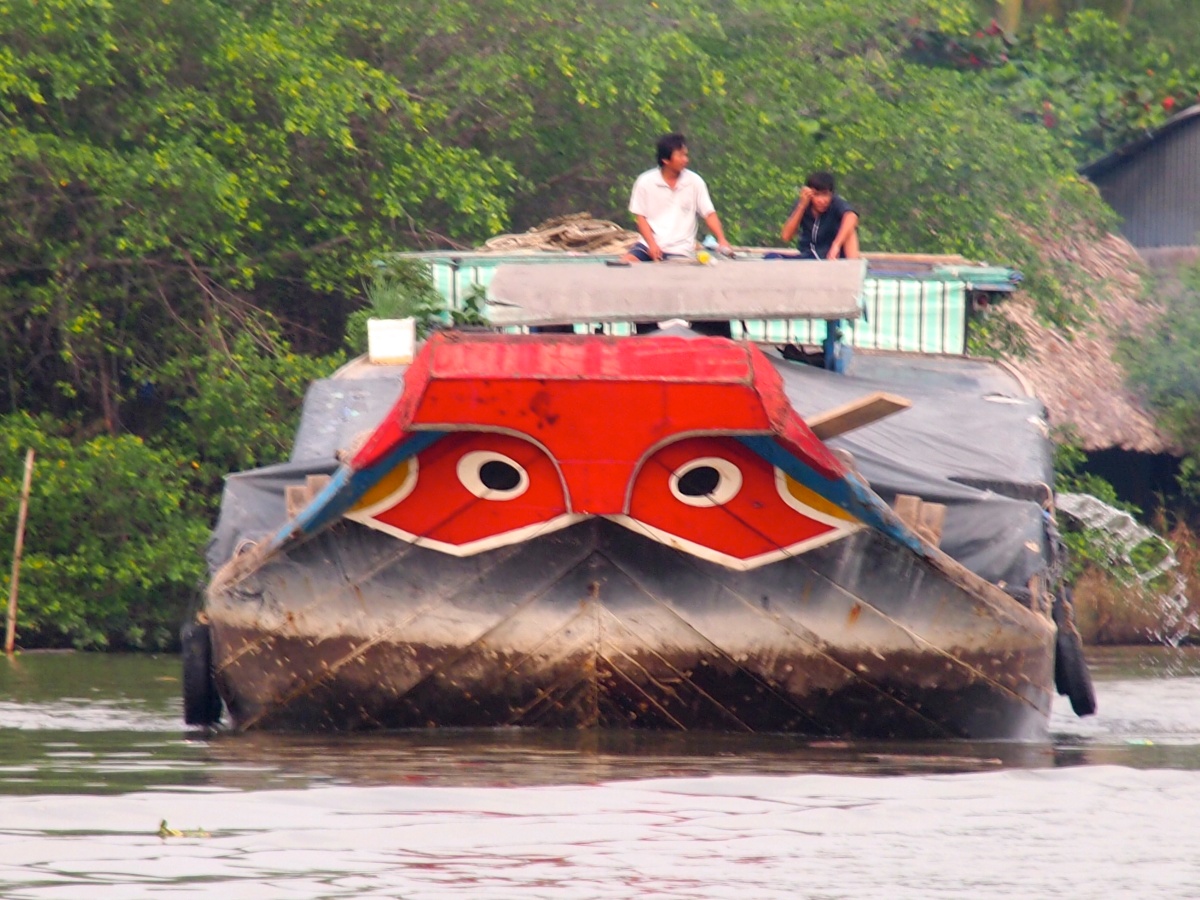
With the exception of balloons, submarines and helicopters, I have tried most major forms of transport – yes, even camels, elephants and horses – but I have to admit that trains are my favourite mode of travel – especially long distance ones, with a sleeper and a restaurant car, hurtling me through time and space.
There have been disappointments of course. One time, on a short trip from Dublin to Cork, I treated myself to a first class ticket, but warm cans of Guinness from a ‘bar-cart’ – not even a bar-car! – detracted from the overall experience.
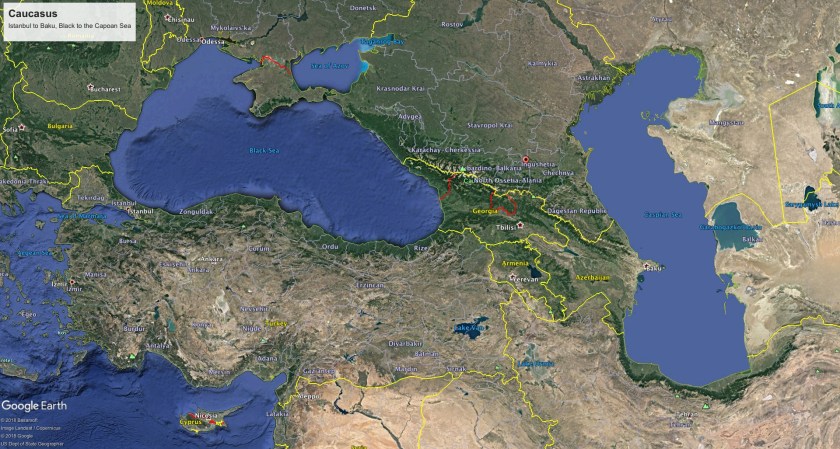
I was looking forward to different train trips in the Caucasus but unfortunately there were no trains along the southern shore of The Black Sea in northern Turkey which I covered in hops and leaps in very comfortable, intercity coaches but I was really looking forward to the overnight train from Batumi, just over the border from Turkey, in Georgia to the capital, Tbilisi.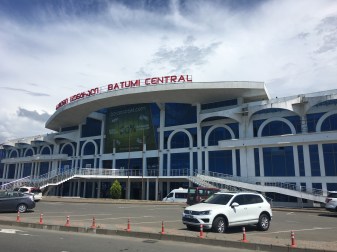
Because of prior difficulties regarding statehood, nationality, form of government and current strains of economics and global trade, the entire region seemed to be unhappy with its immediate neighbours. ‘Turkey has no friends,’ lamented one young professional who had taken her masters at a Dublin university and that story was echoed in one way or another in each of the countries I visited.
Tbilisi would be my hub and from there I could get an overnight train to Yerevan in Armenia and to Baku in Azerbaijan. The only problem was that since none of the countries permitted inter-travel, I would have to retrace my steps to Tbilisi each time before heading off again. While I could enter Armenia from Georgia I couldn’t continue on to Azerbaijan. I’d have to return to Tbilisi the same way and then take another train to Baku on the shore of the Caspian Sea.
Similarly, I could take a train from Tbilisi to Baku but I couldn’t go from Baku to Yerevan in Armenia. What that all meant was a lot of overnight train trips from Tbilisi throughout the Caucasus.
Impressed with the modern Stadler train which whisked me effortlessly from the brand new looking station in Batumi to Tbilisi, I expected, foolishly perhaps, something similar on a longer, overnight, cross border experience.
Despite starting in Georgia, the train was Armenian and didn’t look remotely like the sleek brute that had delivered me to Tbilisi a few days previous. This particular train looked like trains did in Hitchcock movies so, pre-warned there was neither bar nor restaurant car on the fifteen hour trip between the capital cities, I stocked up on red wine and brandy accordingly. Thank God I had because the only amenities provided turned out to be a box of sugary jellies, a bottle each of still and fizzy water along with a fresh pillowcase and sheets.
I handed over my first class ticket to the burly blonde guarding the steps outside my carriage who glared uncomprehendingly at me when I greeted her and asked her name. ‘Lana’ she growled before ushering me up the steps impatiently as if the train were just about to depart.
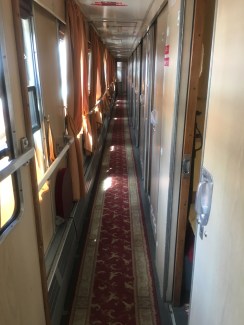 Strolling up and the down the narrow corridor outside my compartment – there was another twenty minutes before the train was due to leave – the only differences I could see between the carriages was mine had the top two bunks removed, leaving only the bottom two.
The window in the compartment was sealed shut and masked with voluminous drapes of bleached out nylon. Only every third window in the carriage corridor outside opened partially. Not a major issue if the air conditioning worked, but when I found Lana, brewing coffee in her private ‘office’, and made 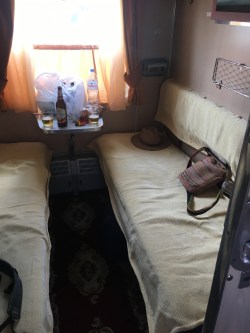 panting sounds, mopping rivulets of sweat running down my face and neck and pleaded for the air con to be turned on, the brutal blonde overseer of the first class compartment seemed not to notice the 37 degree heat and only reluctantly turned the a/c on low, only to turn it off every time the train crawled into another small, sun-baked station.
When I tried to open the half window in the corridor outside my compartment to get a breath of air, she bustled bossily down and shouted at me, along with emphatic hand gestures, to close the window.
“Well, turn the bloody a/c on again” I retorted peevishly, the sweat stinging my eyes and my shirt sticking like a wet rag to my streaming skin.
My initially chilled beer was almost tepid when, glaring at the sugary jellies and the bottles of water I opened it.
Usually, the regular clack-clack of the train would lull me to sleep but this time, seeming to compound the heat, the train groaned along, accompanied by what sounded like extended and sporadic heavy machine gun fire from the iron wheels. I had already finished the wine and was about to dose myself with the brandy when immigration marched down the train, collecting passports and then disappearing with them for a worrying length of time before returning them just as the train ground to a noisy and shuddering halt at the border with Armenia. 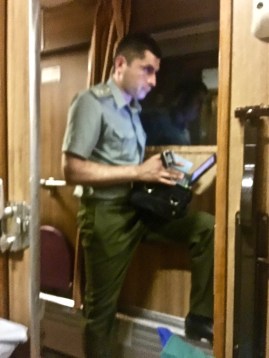 Surprisingly – and pleasingly – smartly dressed Armenian officials came down the corridor with laptop computer scanners and handed back my passport within a minute of collecting it.
Dawn broke as I panted by a window I had furtively opened – no sign of the bossy Lana – looking at a high white cloud before eventually realising it was the snow-capped peak of Mount Ararat towering over the plains.  Arrival time rolled around and the train still trundled noisily over flat, dusty plains with no sign of an imminent city.
  Questions to Lana about the expected arrival time were dismissed with a brusque hand gesture and a shrug and it was a good four hours late before the train finally shuddered to a halt in Yerevan itself.
I was here, that was the main thing and Armenia is famed for (among other things) its brandy – the only brandy Winston Churchill would drink, apparently – so what could go wrong? And there was the return trip to look forward to and to compare with the overnighter to Baku later on.


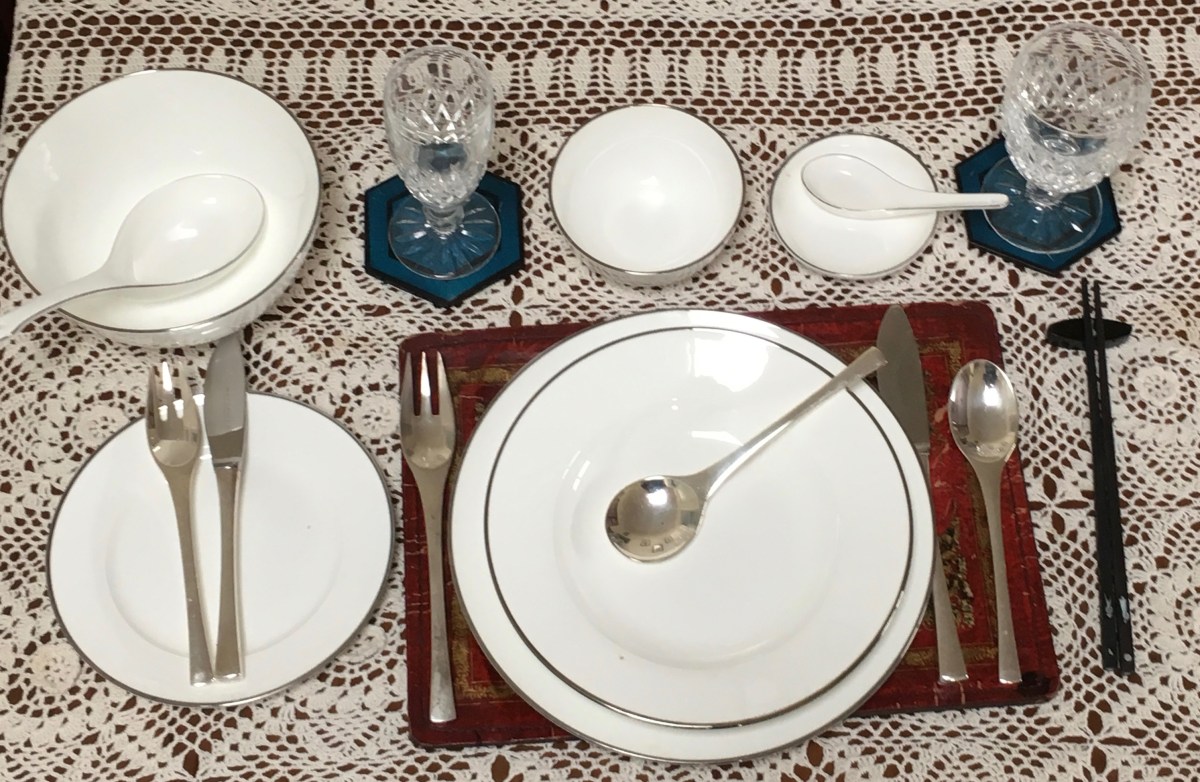
 Lobio is, at its most basic, just a thick stew of mashed beans with some or all or the following ingredients – fresh coriander, walnuts, garlic, onions,pomegranate molasses, fresh parsley or celery leaves, mint, chilli flakes, roasted whole coriander seeds, but it can be upgraded with bacon, beef, cheese etc. Here’s my take on the basic – feel free to add extras as you wish, but a word of caution, without any of the extras, it is still a deeply satisfying dish


 Drain but keep back some of the liquid and use the back of a wooden spoon, or a potato masher, to mash the beans on the side of the pot. Remember to remove the bay leaves.
 Fry the chopped onion until golden and add to bean mix. Heat and thoroughly stir in reserved cooking liquid from the beans for desired consistency. Garnish with a few leftover parsley or corainder leaves, or whatever you have!
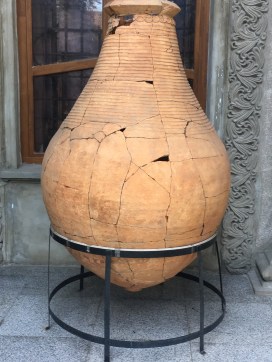
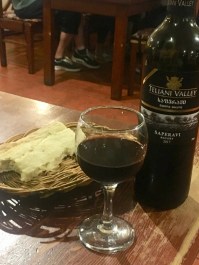 The Washington Post, National Geographic, The Daily Mail, the BBC, CNN, The New York Times and the ABC all ran fairly recent stories bruiting the news of radio-carbon dating of pot shards and bio-molecular and DNA archaeology of grape pips from the Stone Age accurately dating wine making to that period in Georgia.
 Just as no one can claim the invention of the wheel or the discoverer of fire, similarly, no one can claim to have invented wine. Nevertheless, legends lay easy claim to the latter. Noah, after he landed the ark on Mt. Ararat (on the borders of modern day Turkey and Armenia) disembarked the animals and planted a vineyard after which he got horribly drunk and made a disgrace of himself. All of which begs the question of where he originally came from because he must have brought the vine shoots or saplings with him in the ark! Then there is the much older Sumerian Epic of Gilgamesh which also details a deluge after which the eponymous hero sets out on a quest to discover wine and the immortality it can bestow. Another Persian legend describes how Jamshyd – a semi-mythical king – kept grapes to be eaten in jars. One of his handmaids, out of temper with the king and his court, attempted to top herself by drinking the juice from the foaming grapes in one jar, believing it to be poison. Instead she discovered the delights of alcoholic inebriation which she then passed on to the king who, according to the XVII Rubaiyát of Omar Khayyam (The Fitzgerald Translation 1859)


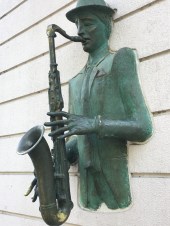 Popping up from the metro two stops away from the main station – again an incredible ascent – onto Shota Rushtavelli Ave I was amazed to see how fashionably modern Tbilisi was. I don’t know what I was expecting – perhaps something slightly less developed than a Western capital, perhaps something slightly shop worn – but what I got was an amazing melange of old and new.
 short walk past the parliament buildings and down to Liberty Sq. and from there to the old town where crumbling buildings and shaky balconies edged fashionable pedestrian areas and parks.
 Flea markets selling Russian junk crowded the bridge before a maze of small streets leading back up to Liberty Square in which the centre plinth was so high that I couldn’t actually make out what stood on top.

 I saw the premiere of one of Verdi’s little known (certainly to me anyway) operas – Simon Boccanegra – an opera with a prologue and three acts with one intermission, the brochure informed me. A Google search of the plot baffled me but the splendour, the lighting, the colour, the drama and the music and the voices had me entranced – although the only word I actually heard was ‘Maria’ – and I became an opera lover overnight!
 But time to leave the capital and explore the Kaheti wine region, the major wine growing area in the southeast. After all, in this part of the world, Neolithic farmers were making, drinking, enjoying and worshipping vitis vinifera 8,000 years ago so I assumed they knew how to make a decent drop.
 creaking, makeshift corridors of bare plywood and on into a no-man’s land where a very impressive Georgian border post, sparkling white in the sunshine, waited. No visa is needed for Georgia but my passport was scrutinised lengthily by a serious faced official before being smudgily stamped.
 haired waitress dressed like a flight attendant with a jaunty blue hat, served me my first and excellent Georgian beer. I don’t know the name of the beer because it was written in the Georgian alphabet, which, to my eye looked unintelligible, full of squiggles, radii and what looks like badly written numbers.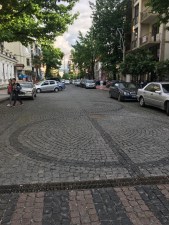
 the musical fountain near the Ukrainian restaurant that had a dress code (I was not allowed to eat up on the balcony) and the somewhat gaudy buildings,
  the impossibly tall column of Medea (of Jason and the Argonauts fame),
 the excellent craft beer – although I meant to drink Georgian wine
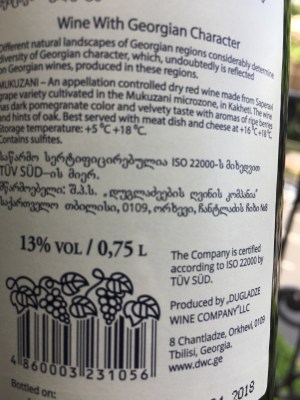
 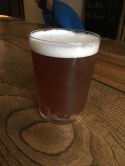 specifically! But what really bowled me over was the certainty on the part of everyone I spoke to that the Georgian language was directly related to the Basque language and that in the past Georgia had been called Iberia and that just proves it! Fantastic. Yes, I know this bottle does not say Iberia but then aagain I find it hard to believe Georgian and Basque languages are related.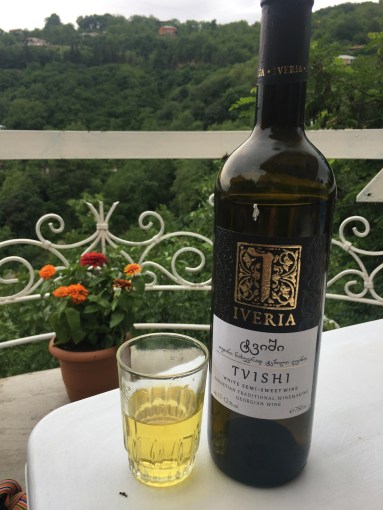
 further
  down had an old steamer crossing the Bosporus to the rather appealingly named bus station of Harem.
 than a conductor was pushing a trolley down the aisle offering tea, coffee, soft drinks and a choice of three snacks! Six hours later we rolled into Bartin only it wasn’t Bartin exactly as I was bustled off the coach and onto a waiting mini-bus that raced off in the opposite direction to another part of Bartin where another mini bus finally took me to Amasra.
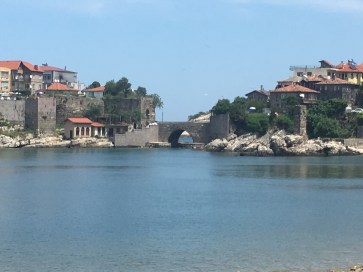 According to Homer, warriors from Bartin fought on the side of Troy against the Greeks. Certainly Amasra, known as Sesamos when it was founded by the Miletians in the 6th century BCE, would be worth fighting for its elegance, beauty and location on a peninsula made up of two inlets joined by an ancient Roman bridge.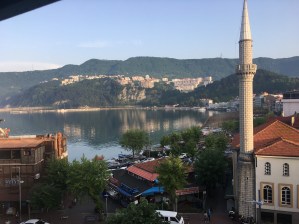



 Red Branch Chronicles
You must be logged in to post a comment.